

Social Media Recruitment Strategy: How to Build One That Works
Social media is now a central tool for recruitment, with 9 out of 10 companies using platforms like LinkedIn, Instagram, TikTok, and Facebook to find talent. Nearly 80% of job seekers rely on social media during their job search, making a professional social media recruitment strategy essential for modern firms
A strong social media recruitment strategy starts with understanding what social recruitment really means for modern hiring and why it has become a core channel for attracting both active and passive talent.
Why Your Business Needs a Social Media Recruitment Strategy
- A well-defined social media recruitment strategy allows you to reach passive candidates. 82% of organizations report use social media to connect with skilled professionals who aren’t actively job hunting.
- A cohesive social media recruitment strategy boosts employer branding**.** Platforms like Instagram and TikTok let you showcase your workplace culture, which 68% of millennials check before applying.
- Lower Costs and Increase Efficiency: Ulta Beauty increased social media hires by 53% year-over-year, while Texas Roadhouse achieved their lowest cost-per-hire with over 400,000 applicants in one year.
Essential Steps to Build a Social Media Recruitment Strategy
- Set Clear Goals: Use the SMART framework to define hiring objectives and track metrics like cost-per-hire and retention rates.
- Target the Right Platforms: Match candidate profiles to platforms like LinkedIn for professionals or TikTok for younger, creative talent.
- Showcase Your Brand: Share employee stories, behind-the-scenes content, and day-in-the-life videos to connect with potential hires.
- Engage with Content: Use short-form videos, interactive polls, and infographics to attract attention and spark interest.
- Leverage Employee Advocacy: Encourage employees to share job openings, boosting reach by up to 561%.
- Run Paid Campaigns: Use tools like HireLab.io for targeted ads and automated optimization to streamline recruitment efforts.
- Track and Improve: Monitor metrics like application rates and cost-per-hire to refine your strategy over time.
Social media recruitment isn’t just about posting job ads, it’s about engaging with candidates, building trust, and creating a seamless hiring experience. With the right approach, you can attract top talent while saving time and money.
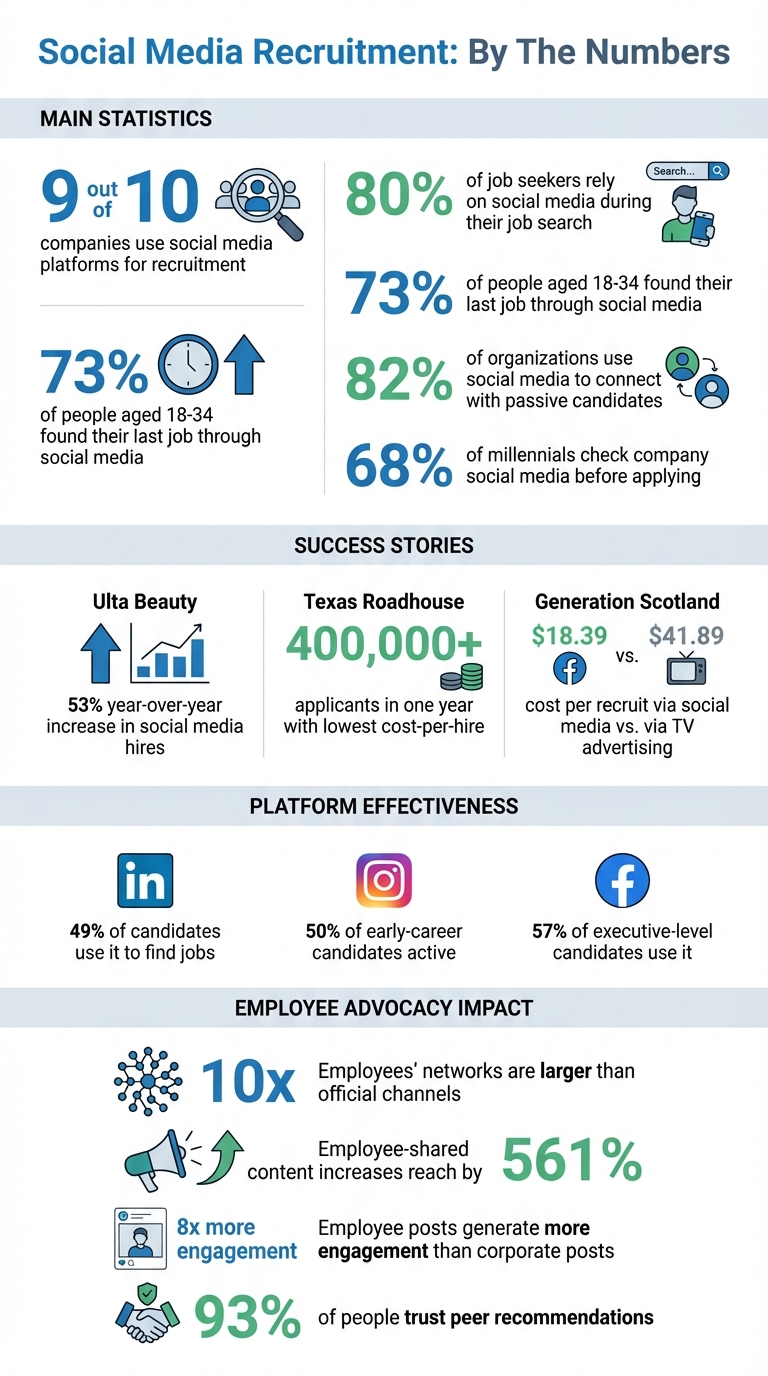
Social Media Recruitment Statistics and Key Benefits
Step 1: Setting Goals for Your Social Media Recruitment Strategy
Establish Clear Hiring Objectives
Establish clear hiring objectives as the foundation of your social media recruitment strategy. Use the SMART framework to ensure your goals are specific and measurable. Whether you want to reduce time-to-hire or improve diversity, every part of your social media recruitment strategy should align with these broader company priorities.
For hiring teams responsible for execution and compliance, following essential social media recruitment tips for HR professionals helps align campaign goals with hiring policies, candidate experience, and long-term workforce planning.
A great way to structure your goals is by using the SMART framework – make them Specific, Measurable, Achievable, Relevant, and Time-bound. For example, you could aim to reduce time-to-hire for software roles by 20% within six months or increase engagement with job posts by 30%. Track key metrics like cost-per-hire, the number of qualified applicants, time-to-hire, and retention rates to measure how well your strategy is working.
Before you dive into a new campaign, take a moment to review past social media posts. This audit will help you identify what kind of content resonates most with your audience and where there’s room for improvement. Make sure your social hiring goals align with broader company priorities, like diversity, equity, and inclusion (DEI) initiatives.
Matching Platforms to Your Social Media Recruitment Strategy
Understanding your ideal candidate is crucial. For instance, a senior accountant might spend time on LinkedIn, while a graphic designer prefers TikTok. A successful social media recruitment strategy matches these candidate personas to the specific platform’s strengths.
For instance, a 35-year-old senior accountant might spend more time on LinkedIn, while a 22-year-old graphic designer could be scrolling through Instagram or TikTok.
Choosing the best social media platforms for recruitment in 2026 requires more than following current trends. Recruiters must consider where their ideal candidates are shifting their attention and how platform algorithms are evolving.
It’s also helpful to talk to current employees in hard-to-fill roles. They can provide insights into the platforms where similar candidates are most active. For example, LinkedIn is great for connecting with experienced professionals, while Instagram and Facebook might be better for engaging younger, local talent.
Aligning Social Media Recruitment Strategy with Your Target Audience
Here’s a quick breakdown of how different platforms can help you target specific audiences:
| Platform | Primary Target Audience | Best Use Case |
|---|---|---|
| Professionals, Executives | Sourcing qualified talent and showcasing expertise | |
| Gen Z, Millennials, Creatives | Highlighting company culture and behind-the-scenes moments | |
| TikTok | Gen Z, Tech-savvy talent | Sharing authentic, day-in-the-life video content |
| Local talent, Niche communities | Engaging local candidates and facilitating high-volume hiring | |
| X (Twitter) | Industry professionals, Tech | Sharing real-time updates and industry news |
To see how effective targeted platform selection can be, take the example of the Generation Scotland health cohort at the University of Edinburgh. Between May 2022 and December 2023, they recruited 7,889 new participants using various channels. Social media (Meta) stood out as the most cost-effective tool, with a cost of $18.39 per recruit, compared to $41.89 per recruit through TV advertising. Social media efforts brought in 2,436 participants – 30.9% of their total recruits – proving how powerful the right platform strategy can be.
Once you’ve identified the best platforms for your audience, the next step is to build a strong employer brand that translates these insights into an engaging online presence.
The Most Effective Social Media Recruitment Campaign Strategy
Step 2: Strengthening Employer Branding Within Your Social Media Recruitment Strategy
Your employer brand is where your social media recruitment strategy comes to life. In fact, 92% of recruiters and 86% of candidates rely on platforms like LinkedIn, Instagram, and TikTok to evaluate potential employers.
Use "Day in the Life" stories to ensure your social media recruitment strategy feels human rather than corporate. It’s worth noting that 75% of active job seekers are drawn to companies with a strong employer branding presence. Without an engaging social media presence, you risk being overlooked by candidates casually scrolling through their feeds.
"Social media is where your employer brand comes to life." – US Chamber of Commerce
What candidates want to see is authenticity – real people and real stories, not just polished corporate messaging. A genuine and relatable social presence builds trust and helps you connect with potential hires long before they even consider applying.
Create Consistent Social Media Profiles
Start by setting up or refining your profiles on the platforms where your target audience spends their time. Use your official company logo and high-quality banners that reflect your brand identity. For larger organizations, consider creating dedicated career accounts (e.g., @CompanyCareers) to separate recruiting content from general marketing.
Your profile descriptions should include relevant keywords – industry, location, and roles you typically hire for – to make your page more discoverable. For example: "Tech startup in Austin hiring software engineers, designers, and product managers." Don’t forget to include a direct link to your careers page and claim custom URLs (like facebook.com/yourcompanycareers) when possible.
On Instagram, take advantage of Story Highlights to organize content into categories such as "Day in the Life", "Team Events", or "Employee Spotlights." This allows candidates to explore your company culture quickly and easily.
| Platform | What to Optimize | Why It Matters |
|---|---|---|
| Keywords in descriptions, "Life" tab photos | 49% of candidates use LinkedIn to find jobs | |
| Story Highlights, Reels showcasing culture | 50% of early-career candidates use Instagram | |
| TikTok | Authentic videos, trend participation | Gen Z increasingly uses TikTok as a search engine |
| Employee testimonials, community involvement | 57% of executive-level candidates use Facebook |
Well-optimized profiles set the stage for sharing authentic content that highlights your company culture.
Share Company Culture and Employee Stories
When it comes to content, quality beats quantity. Since 71% of candidates rely on employee referral programs, showcasing authentic voices from your team is essential.
One effective strategy is employee takeovers. Let team members take over your Instagram Stories for a day to share their work routines – morning coffee runs, team meetings, lunch breaks, or project milestones. This kind of unfiltered content resonates strongly with Gen Z and Millennials, who prefer genuine, relatable posts over highly produced videos.
Another idea is to share stories of career growth within your company. Highlighting employees who have been promoted or transitioned into new roles shows your commitment to professional development. Behind-the-scenes glimpses – like brainstorming sessions, team celebrations, or office tours – can also help candidates picture themselves as part of your team.
Take inspiration from Zappos. In May 2014, they moved away from traditional job boards and launched "Zappos Insiders", a platform where candidates could connect directly with employees to explore the company culture before applying. The lesson? Real employee voices foster trust.
Encourage your employees to share company content on their personal social media accounts. Posts from employees generate up to eight times more engagement than posts from official company pages. When your team becomes active brand ambassadors, they can help you reach passive candidates who might not be actively job hunting.
"Social recruiting is proving to be a very effective component of our overall recruiting strategy. It allows us to reach a demographic of candidates that we may not traditionally reach with other methods." – Katy Barclay, Senior Vice President of Human Resources, The Kroger Co.
Consistency is key. Posting regularly – several times a week – shows candidates that your company is active, engaged, and invested in its community.
Up next, we’ll explore how to create content that resonates with your target audience.
Step 3: Content Creation for a Winning Social Media Recruitment Strategy
After establishing a strong employer brand, the next step is crafting a solid content strategy to ensure your message consistently reaches the right audience. A well-organized content calendar can help you stay on track, avoid last-minute chaos, and deliver posts that genuinely resonate with potential candidates.
Start by defining 3–5 key content themes, or pillars, to shape your posts. For example, one pillar could focus on educational content like career advice and industry insights. Another might emphasize engagement with polls or Q&A sessions, while a third could highlight your brand through employee spotlights or company milestones. This approach keeps your content varied, focused, and prevents it from feeling overly promotional.
A solid content calendar ensures your social media recruitment strategy consistently reaches the right audience. To strike the right balance, apply the 70/20/10 rule: dedicate 70% of your content to educational topics, 20% to curated content, and 10% to promotional material. This mix keeps your audience interested without bombarding them with job postings. It’s worth noting that 86% of job seekers use social media during their job search.
Using scheduling tools can help maintain a steady posting rhythm. Batch-creating content is another time-saver and ensures a consistent presence. Don’t forget to repurpose content across platforms – turning a blog post into a LinkedIn infographic or a short Instagram Reel is a great way to maximize your efforts.
"A social media strategy is the driving force behind why you post what you post… Your content calendar is every mile you’ll travel along the way." – Rochi Zalani, Buffer
Plan Content That Connects with Candidates
Engaging content is key to capturing attention. Short-form videos, for example, are incredibly effective at reaching new audiences. Instagram Reels, for instance, achieve 36% more reach than other post types. Use these videos to give candidates a behind-the-scenes look at your workplace, feature employee takeovers, or share quick "day-in-the-life" clips that offer an authentic view of your company culture.
Interactive content like polls, quizzes, and live Q&A sessions can spark two-way conversations and boost engagement. For example, you could post a LinkedIn poll asking, "What’s your top priority when considering a new job?" or host an Instagram Live session to discuss your company’s culture and values.
Visual storytelling is another powerful tool. Infographics and carousel posts are great for breaking down complex topics, such as explaining your benefits package, showcasing your diversity initiatives, or guiding candidates through your application process. When creating job posts, include essential details like job title and location to make it easier for social search engines to find your content.
Tailor your content to fit each platform’s strengths. LinkedIn is ideal for professional insights and thought leadership, while Instagram thrives on eye-catching visuals and Reels. TikTok works well for short, authentic videos, and X (formerly Twitter) is perfect for real-time updates and quick interactions.
| Platform | Best Content Types | Optimal Frequency |
|---|---|---|
| Professional insights, articles, polls | 1 post daily | |
| High-quality visuals, Reels, Stories | 1–2 posts daily | |
| TikTok | Short-form video, trending audio | 1–3 videos daily |
| X (Twitter) | Real-time updates, news, threads | 3–5 tweets daily |
| Community posts, videos, events | 1 post daily |
For instance, a recruitment campaign that used platform-specific content successfully generated 1,684 applications and filled all roles with a diverse pool of candidates. This highlights how adapting your content to each platform can deliver tangible hiring results.
Once your content starts to engage candidates, amplify its reach with targeted hashtags and trending topics.
Use Hashtags and Trending Topics
Hashtags act like search filters, helping candidates who don’t already follow your page discover your content. Social platforms are increasingly functioning as search engines, with Twitter users alone performing around 2 billion search queries daily. By using relevant keywords and hashtags, you can ensure your posts appear when candidates search for opportunities.
Instead of generic tags like #hiring or #jobs, opt for niche, skill-specific hashtags that target your ideal candidates. For example, try #NYnursejobs, #PythonDeveloper, or #RemoteMarketingJobs. Combining these with location-based tags can narrow your audience even further.
"Social networks act as search engines… The goal is to exist – to have a presence and share relevant content – on that network when candidates search for you, your jobs, your industry, or your relevant keywords and hashtags." – CareerArc
Trending topics and formats also play a vital role. Algorithms often prioritize short-form videos like Reels and TikToks, which can help you reach beyond your current followers. If a trending audio clip or challenge aligns with your company’s voice, consider participating – as long as it feels natural and aligns with your brand.
Don’t forget to use geo-tags and keywords in your posts for better visibility. For video content, including closed captions is a smart move since 80% of viewers are more likely to finish a video with captions.
Lastly, keep an eye on emerging platforms like Threads. Even if you’re not actively posting yet, securing your company’s username and monitoring the platform can position you to take advantage when it becomes a viable recruitment channel.
Step 4: Using Employee Advocacy to Support Your Social Media Recruitment Strategy
Once you’ve laid the groundwork with your content strategy and employer branding, it’s time to take things up a notch with employee advocacy. This approach doesn’t just extend your reach – it also builds trust, making your social media recruitment efforts even more effective.
Here’s the deal: your employees have networks that are 10 times larger than your official channels. Plus, when employees share branded content, it increases reach by 561% and engagement by 800%. Why? Because 93% of people trust recommendations from their peers. That kind of trust translates into real results, as posts from employees carry far more credibility than those from corporate accounts.
For example, when a software engineer shares a job opening, it resonates more with their network than the same post coming from HR. This peer-to-peer trust is why employee advocacy works so well. Companies with strong advocacy programs are 58% more likely to attract talent and 20% more likely to retain it.
"Audiences trust recommendations from family, friends, and peers – i.e., people. For people, authenticity and relatability matters. The goal of employee advocacy is to position your employees as the people audiences listen to and follow." – PostBeyond
The secret to success? Make it easy for employees to participate and ensure the content they share feels authentic and aligns with the hiring goals you’ve already established.
Encourage Employee Sharing and Referrals
The first step is to eliminate any hesitation employees might have about sharing. A clear social media policy that outlines what’s encouraged and where the boundaries lie can go a long way. When employees know what’s okay to post, they’re much more likely to hit "share".
Next, simplify the process by creating a central hub for pre-approved content. This could be a Slack channel, a Microsoft Teams space, or even a dedicated tool where you upload job openings, company updates, and industry news. Include ready-to-use captions that employees can tweak to match their tone. The easier you make it, the more likely they are to participate.
Incentives can also drive participation. Leaderboards, rankings, and rewards like gift cards or donations in an employee’s name can spark friendly competition. For instance, Hootsuite’s "Amplify Recognition Program" rewarded employees with small business gift cards through monthly contests. They also formed an "Amplify Content Council" to curate 10 posts weekly. The results? A 94% adoption rate (up 9% year-over-year) and 4.1 million organic employer brand impressions in just one quarter – all from employee posts.
Position advocacy as a win-win. Emphasize how sharing content benefits employees by helping them build their personal brand, expand their network, and establish themselves as thought leaders. When employees see how it aligns with their career goals, they’ll be more motivated to join in.
Finally, integrate advocacy into your onboarding process. From day one, let new hires know that sharing is part of your company culture. Provide resources like on-demand video training and ready-to-use templates to make it simple. And don’t forget to highlight employees in your content – when people see themselves featured, they’re far more likely to share it with their networks.
While pre-approved posts are effective, live interactions can take things to the next level by fostering deeper trust and engagement.
Host Live Q&A Sessions or Webinars
Static posts are great, but live interactions can deliver an authenticity that’s hard to match. When candidates get real-time answers from actual employees, it strips away the polish and gives them a genuine glimpse into your workplace.
Consider hosting live Q&A sessions on platforms like LinkedIn, Instagram, or Facebook. These could feature employees talking about what it’s like to work at your company. For example, your engineering team might discuss your tech stack, or your customer success team could talk about career growth opportunities. These sessions provide potential candidates with an honest look at your company culture, helping them decide if it’s the right fit.
Webinars are another excellent option, especially for in-depth topics. You could host a panel on work-life balance or have department heads share what they look for in new hires. Record these sessions so you can repurpose them into short clips for social media, extending their reach beyond the live audience.
To boost participation, use native platform features like LinkedIn polls or Instagram Stories Q&As. The more interactive and informal these sessions feel, the more relatable they’ll be to candidates. Remember, 73% of job seekers aged 18 to 34 found their last job through social media. Many of them are looking for this kind of direct, unfiltered access to a company before they apply.
Step 5: Running Paid Ads as Part of a Social Media Recruitment Strategy with HireLab.io
While organic reach is important, a paid social media recruitment strategy offers the precision needed to scale quickly. To succeed, recruiters must craft effective recruitment ads, target the right audience, optimize performance, and manage costs. That’s where HireLab.io steps in.
With 84% of organizations now leveraging social media for recruitment and 79% of job seekers using these platforms during their search, paid campaigns have become a cornerstone of modern hiring strategies. However, spending on ads without the right tools can drain your budget. HireLab.io simplifies the process by combining ad creation, precise targeting, and automated optimization into one streamlined platform.
Create and Publish Targeted Ads
HireLab.io allows you to design and launch recruitment ads on platforms like Meta and LinkedIn without leaving its interface. The real power lies in its ability to target candidates with precision – filtering by job title, skills, location, industry, interests, and even online behaviors.
For instance, if you’re looking for a senior software engineer in Austin, you can target LinkedIn users with the title "Software Engineer", specific skills like Python or JavaScript, and a location within 25 miles of Austin. On Meta, you can refine the audience further by including interests like tech blogs, coding communities, or companies they follow. This ensures that your ads reach only the most relevant candidates, avoiding wasted clicks and unnecessary costs.
HireLab.io also supports retargeting campaigns using tools like the Facebook Pixel or LinkedIn Insight Tag. If a potential candidate visits your careers page but doesn’t apply, you can re-engage them with follow-up ads that remind them of the opportunity. This strategy is especially effective for passive candidates – those not actively searching for jobs – who often need multiple interactions before they take action. In fact, 82% of organizations cite recruiting passive candidates as one of their top reasons for using social media.
The platform’s creative ad studio simplifies the design process, enabling you to test different ad copy, visuals, and calls-to-action through A/B testing. This helps identify what resonates most with your audience. For campaigns focused on driving traffic, you can set objectives like "Traffic" and optimize for pay-per-click rather than impressions, ensuring predictable costs.
Once your ads are live, the next step is making sure they perform at their best, and that’s where automation comes into play.
Automate Campaign Optimization
After launching your ads, HireLab.io’s built-in optimizer takes over, monitoring performance and fine-tuning campaigns automatically. This means you don’t have to manually adjust bids or pause ads that aren’t delivering results – the system handles it all.
Key metrics like click-through rate (CTR), conversion rate (applications submitted), and cost per conversion are tracked in real time. If an ad’s CTR drops or the cost per application spikes, HireLab.io adjusts targeting or reallocates budget to better-performing ads. It also keeps an eye on frequency – how often the same person sees your ad – to avoid overexposure, which can annoy candidates and hurt your campaign’s effectiveness.
This automation is particularly helpful when managing multiple campaigns across platforms. Instead of juggling separate dashboards for Meta and LinkedIn, everything is centralized within HireLab.io. The platform even uses UTM links to track which platform delivers the best candidates, so you can focus your budget where it matters most.
"Job posts are now one of our highest drivers of traffic; they consistently perform better than ads promoting products and services." – Manager of Creative Services and Design, Security Provider
Step 6: Build Recruitment Funnels That Convert
Getting someone to click on your ad is just the beginning – the real challenge lies in turning that click into a completed application. With 77% of job seekers using mobile devices, your recruitment funnel has to be quick, seamless, and designed for mobile users. The more steps you add between the ad and the "Submit" button, the higher the chance of losing potential candidates.
HireLab.io takes the hassle out of this process by transforming ordinary job postings into streamlined recruitment funnels. The platform uses AI-powered landing pages and smart forms to minimize drop-offs and ensure you capture qualified applicants.
Create AI-Powered Landing Pages
When a candidate clicks on your ad, they shouldn’t end up on a generic careers page hidden deep within your website. Instead, they should land on a page built specifically to convert. That’s where HireLab.io comes in – it instantly turns job postings into mobile-friendly landing pages that load fast and present information clearly.
These landing pages are designed to keep candidates engaged. Instead of bombarding them with too much text or confusing navigation, the layout focuses on the essentials: key job details, insights into your company culture, and employee stories – all presented in a visually appealing way. With about 90% of mobile users active on social media, every detail – like image sizes and button placement – is optimized for mobile screens.
Not only do these pages load quickly and highlight important information, but they’re also search-friendly. By incorporating relevant keywords and hashtags, they help expand your reach beyond just paid ads. Once a candidate lands on the page, the next step is to make the application process as simple as possible.
Reduce Drop-Off with Smart Forms
Overly complicated forms with endless fields are a surefire way to lose candidates. Since mobile optimization is key to keeping applicants engaged, streamlined forms are critical. HireLab.io’s smart forms make this process effortless and mobile-friendly.
These forms are fully customizable, so you can ask only the questions necessary to pre-qualify candidates. Instead of requiring a resume and cover letter upfront, you can start with the basics – name, email, and phone number – and include targeted questions to filter applicants without overwhelming them. This approach respects the candidate’s time while still gathering the information you need.
The platform also tracks where candidates abandon the process. If drop-offs spike at a specific step, you can adjust that form field and test different versions to improve completion rates. Plus, for companies without an applicant tracking system, HireLab.io provides a free ATS that can handle up to 50 applicants, ensuring you don’t miss out on any potential hires.
Step 7: Tracking and Optimizing Your Social Media Recruitment Strategy ROI
Finally, track your results. A social media recruitment strategy isn’t "set it and forget it”, tt requires constant tracking and fine-tuning based on data. With 68% of marketers expressing concerns about proving ROI from their social media efforts, understanding what metrics to track – and how to act on them – is absolutely essential.
Monitor Key Metrics
Follower counts might look impressive, but they don’t tell the full story when it comes to hiring success. Instead, focus on metrics tied to your recruitment funnel stages: Awareness (reach and impressions), Engagement (likes, comments, shares, and saves), and Conversion (click-through rates, application numbers, and cost-per-hire). These data points give you a clearer picture of how your efforts are translating into actual recruitment outcomes.
Here’s an example: Texas Roadhouse tracked conversion metrics and successfully generated over 400,000 applicants while achieving their lowest cost-per-hire. Likewise, Ulta Beauty saw a 53% year-over-year increase in hires during a holiday rush by leveraging engagement and conversion data from social media.
To calculate ROI, use this formula:
((Value generated from recruitment – Costs of investment) / Costs) * 100. As Eileen Kwok, Social Media Specialist at Hootsuite, explains:
"You don’t know what your ROI is until you’ve laid out the goals you are tracking towards."
Beyond numbers, also track quality metrics like retention rates. For instance, Boston Market reported an 85% retention rate for employees hired through social media channels. This demonstrates that targeting the right candidates on social platforms can lead to long-term success.
Adjust Strategy Based on Data
Once you’ve identified key metrics, use them to refine your approach. Tools like HireLab.io’s analytics dashboard can help pinpoint where candidates are engaging and where they’re dropping off. For example, if you notice a high click-through rate but a low number of applications, the problem might lie in your landing page or form design, not your ad creative.
Testing is essential. A/B test ad copy, visuals, and calls-to-action (CTAs) to see what resonates best. For instance, swapping out generic CTAs like "Learn More" for action-driven ones such as "Apply Today" can significantly improve conversion rates. Alana Willis, Content Marketing Manager at Later, underscores the importance of this iterative process:
"The most successful social teams aren’t afraid to experiment and never stop improving. So, test your assumptions, track your results, and tweak your strategy like the social media scientist you are."
When a campaign isn’t performing well, dig into the data to uncover the issue. Is it the platform, the content, or the targeting? For example, low engagement might mean your content isn’t resonating with your audience, while strong reach but weak conversions could point to problems with your messaging or application process. HireLab.io’s real-time insights can help you adjust targeting and reallocate budgets to the platforms and ads delivering the best ROI.
Make it a habit to review your strategy monthly. Assess which content formats – whether it’s video, carousels, or static images – are driving the most engagement and applications. Use these insights to replicate what works and pivot when something isn’t hitting the mark. A commitment to continuous improvement ensures better recruitment results and keeps your hiring strategy aligned with your goals.
Conclusion
Crafting a winning social media recruitment strategy takes more than simply posting job ads. It’s about setting clear goals, creating content that speaks to your audience, and using measurable tactics to refine your approach. From showcasing your employer brand to running targeted campaigns and tracking performance, each step works together to build a system that delivers results.
Consistency is key. With nearly 80% of job seekers turning to social media during their search and 9 out of 10 brands vying for their attention, regular posting helps your brand stand out. As the American Marketing Association puts it:
"Consistency builds trust and makes your content more recognizable in busy feeds".
Given that 71% of hiring managers report challenges in filling open positions, relying on guesswork just isn’t an option. Instead, lean on data-driven insights – track metrics like click-through rates, application numbers, and cost-per-hire. Use tools like A/B testing to fine-tune your messaging. If something underperforms, dig into the data, identify the issue, and adjust. This process of constant refinement can turn an average campaign into a standout success.
And remember, you don’t have to start from scratch. Platforms like HireLab.io simplify the process, providing tools for everything from creating landing pages to running automated campaigns. Whether you’re just beginning or scaling your efforts, these tools can help you attract, engage, and convert top talent more effectively.
FAQs
How do I choose the best social media platforms for recruiting?
To begin, pinpoint who your ideal candidates are and figure out where they spend most of their time online. For instance, if you’re targeting seasoned professionals, LinkedIn is a solid choice. On the other hand, platforms like Instagram or TikTok are perfect for connecting with younger audiences. Dive into industry trends and demographic data to help shape your strategy. Once you have a plan, try posting content on a few different platforms to see which ones generate the most engagement and attract the right applicants. Stick to the channels where your audience is most active to get the best results.
How can you effectively engage passive candidates on social media?
To connect with passive candidates on social media, focus on building genuine relationships instead of just promoting job openings. Start by sharing industry-focused content like blog posts, videos, or employee stories that highlight your expertise and give a glimpse into your company’s culture. This helps establish your brand as a go-to resource and encourages candidates to engage with your content.
Incorporate interactive elements like live Q&A sessions, webinars, or challenges to foster real-time conversations. Combine this with employee advocacy by motivating your team to share job postings and workplace highlights within their own networks. This not only boosts credibility but also broadens your reach. Additionally, use targeted social ads to send tailored messages to professionals who match your ideal candidate profile.
To keep candidates engaged over time, create a talent community. Offer exclusive groups, behind-the-scenes glimpses, and early access to job opportunities. These approaches help passive candidates feel more connected and increase the likelihood they’ll consider your company when the right role comes along.
How do I measure the success of my social media recruitment strategy?
To gauge how well your social media recruitment strategy is working, begin by establishing SMART goals – these are goals that are specific, measurable, achievable, relevant, and time-bound. Once your goals are in place, keep an eye on key performance indicators like follower growth, engagement on your posts, click-through rates to job postings, and how many applicants convert into hires.
You should also track recruitment-focused metrics, including time-to-fill (how long it takes to fill a position) and cost-per-hire (the expense associated with each new hire). Reviewing these numbers regularly will help you spot trends, fine-tune your strategy, and make sure your efforts are aligned with your hiring goals.