
Recruitment on Social Media: Essential Tips for HR Professionals
Social media has reshaped recruitment, making it the go-to strategy for HR teams. Here’s why it works:
- 92% of companies use social platforms to hire, connecting with active and passive candidates alike.
- 86% of job seekers turn to social media during their search, with platforms like LinkedIn, Instagram, and TikTok becoming key.
- Companies like Texas Roadhouse and Ulta Beauty have seen massive success, with lower costs and higher applicant numbers.
Why does it matter? Social media helps build your employer brand, target specific audiences, and attract quality talent at a lower cost. From organic posts to paid ads and direct outreach, these platforms offer unmatched reach and precision. Plus, tools like HireLab.io simplify campaign management and analytics, saving time and improving results.
Want to hire smarter? Focus on:
- Engaging content: Share employee stories, behind-the-scenes videos, and job openings.
- Platform selection: LinkedIn for professionals, Instagram/TikTok for younger audiences, and Facebook for broad reach.
- Tracking performance: Measure cost-per-hire, application rates, and retention to refine your strategy.
Social media isn’t just about hiring – it’s about connecting with the right people, building relationships, and showcasing why your company is the best choice.
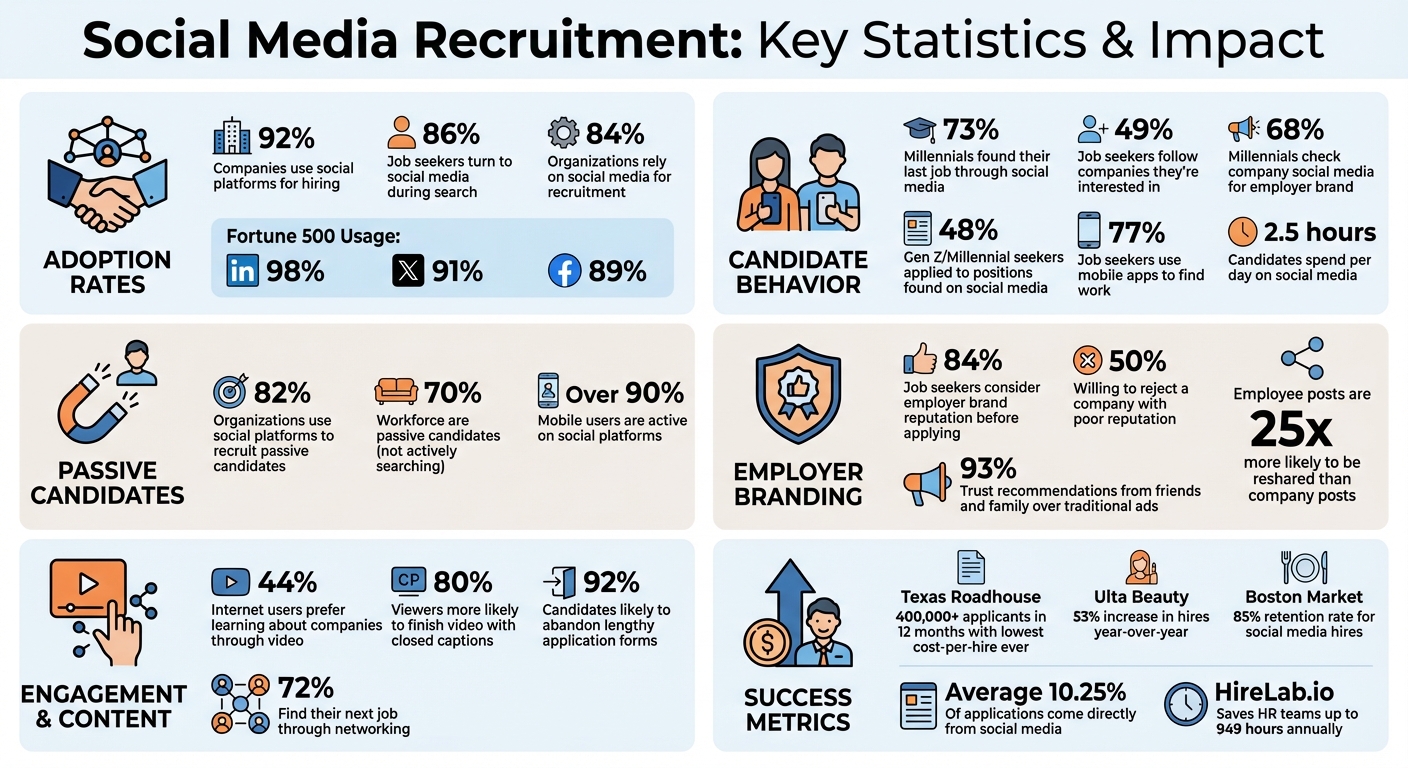
Social Media Recruitment Statistics and Impact
The Most Effective Social Media Recruitment Campaign Strategy
To maximize your results, ensure you set up a social recruitment landing page to capture and convert the traffic from your campaigns.
How Social Media Recruitment Works
Social media recruitment relies on three main strategies: organic methods, paid advertising, and direct outreach. Each offers distinct benefits, and the most effective HR teams use a mix of all three to broaden their reach and connect with diverse talent pools.
Organic Recruitment Methods
Organic recruitment takes advantage of the free tools available on social platforms to attract potential candidates. For example, LinkedIn Company Pages, Facebook’s Jobs tab, and job links on X (formerly Twitter) let you post openings directly on your page. A major perk of this approach is employee advocacy – when your team shares job postings or company updates with their personal networks, it significantly increases exposure compared to just posting on the company’s page.
But it’s not just about job postings. Showing off your workplace culture plays a huge role in attracting candidates. Sharing behind-the-scenes photos, employee highlights, or day-in-the-life videos gives job seekers a real sense of what it’s like to work at your company. This approach is especially appealing to younger job seekers who often turn to social media during their job hunts. As noted by the Manager of Creative Services and Design at a Security Provider:
“Job posts are now one of our highest drivers of traffic; they consistently perform better than ads promoting products and services”.
To boost your reach, you can also join industry-specific groups on LinkedIn and Facebook where niche talent gathers. Using hashtags like #NowHiring or #TechJobs helps your posts appear in searches. And don’t overlook video content – adding captions can make a big difference, as 80% of viewers are more likely to finish a video when subtitles are included.
While organic strategies build trust and authenticity, paid advertising can help you target candidates with pinpoint accuracy.
Paid Advertising Options
Paid social media ads allow you to zero in on specific types of candidates. For instance, Facebook Ads Manager lets you target users by their current employer using the “Demographics → Work → Employers” filter. LinkedIn recruitment funnels can be tailored by job title, education level, or location. If you’re looking to connect with Gen Z or Millennial candidates, Instagram and TikTok ads are highly effective – 48% of these job seekers have applied to positions they found on social media.
The importance of paid ads has grown since Meta removed Facebook’s dedicated “Jobs” section in February 2023. Paid campaigns are now essential for staying visible. To make your ads stand out, use bold visuals like eye-catching graphics, GIFs, or short videos, and highlight key benefits – think salary, health insurance, or vacation policies – directly in the ad. On LinkedIn, enabling the “Easy Apply” feature can make a big difference, as 92% of candidates are likely to abandon lengthy application forms.
Direct Candidate Outreach
The third piece of the puzzle is direct outreach, which involves contacting candidates through direct messages or engaging with them publicly in comments. This method creates personal connections that traditional job boards can’t match and is especially effective for reaching passive candidates – those not actively searching for jobs. In fact, 82% of employers use social media specifically to engage with passive candidates.
For the best results, personalize your messages by referencing a candidate’s skills or interests based on their profile. Engaging publicly, such as commenting on posts or joining industry conversations, can also help build your visibility and credibility. Additionally, LinkedIn’s “Open to Work” filter makes it easier to identify candidates actively looking for new opportunities – a smart move, considering 72% of people find their next job through networking.
How Social Media Changes Recruitment
Social media has revolutionized recruitment by connecting companies with passive candidates, showcasing genuine employer brands, and fostering deeper engagement with potential hires. Unlike traditional job ads that primarily target active job seekers, social platforms extend their reach to the 70% of passive candidates who aren’t actively searching but might be open to the right opportunity. This shift has allowed recruitment efforts to scale in ways previously unimaginable .
Consider this: 86% of job seekers now use social media during their job hunt, and 73% of millennials found their last job through a social platform. Recruitment has evolved from simply posting job openings to proactively engaging with talent – highlighting company culture, building relationships, and creating meaningful connections long before positions are even available. This not only broadens the talent pool but also reshapes how companies interact with potential candidates.
Reaching Passive Job Seekers
One of social media’s greatest strengths is its ability to connect with talent that traditional methods often miss. A staggering 82% of organizations now use social platforms to recruit passive candidates. These are professionals who aren’t actively browsing job boards but might be intrigued by an opportunity that appears in their LinkedIn, Instagram, or Facebook feed. Given that over 90% of mobile users are active on social platforms, your job postings can seamlessly integrate into their daily social media scroll.
The impact grows exponentially when you involve your employees. A single job post shared by your team can reach far wider audiences as their connections engage and reshare it. To maximize this, provide employees with shareable content that highlights your workplace as an attractive, dynamic environment. This makes it easy for them to act as ambassadors for your brand.
Building Your Employer Brand
Beyond expanding your reach, social media plays a key role in shaping how candidates perceive your company. It’s not just about finding the right talent – it’s about making them want to work for you. With 84% of job seekers considering an employer’s brand reputation before applying and 50% willing to reject a company with a poor reputation, your online presence becomes a critical factor in recruitment.
Social media offers a unique opportunity to showcase your workplace culture in an authentic way. Companies that excel at this often see tangible results. For example, AT&T uses the hashtag #LifeAtATT to share employee milestones and personal stories, creating a relatable and humanized image of their workplace. Similarly, Zappos highlighted their fun, people-focused culture during the pandemic by sharing a virtual 21st-birthday celebration through their “Inside Zappos” accounts.
Authenticity is crucial here. Sixty-eight percent of millennials specifically visit a company’s social media to evaluate its employer brand. They trust content shared by employees far more than polished corporate messaging. In fact, employee-generated posts are 25 times more likely to be reshared compared to the same content posted by the company itself. UPS leverages this by using hashtags like #UPSers and #ThankAUPSer to feature real employee stories, positioning themselves as a company where people can build long-term careers.
Increasing Candidate Engagement
Social media transforms recruitment into a two-way conversation. Nearly half of all job seekers – 49% – follow companies they’re interested in on social platforms. This creates ongoing opportunities for connection, keeping your organization top-of-mind through engaging content and interactions.
The type of content you share makes a huge difference. Videos, for instance, are particularly effective: 44% of internet users prefer learning about a company through video rather than text, and 80% of viewers are more likely to finish a video if it includes closed captions. Salesforce taps into this trend by sharing employee interviews and humorous videos about workplace culture on Instagram, effectively engaging Millennials and Gen Z audiences.
What’s more, candidates who interact with your brand on social media before applying often have a better understanding of your culture, values, and work environment. This pre-application engagement can lead to more informed decisions on both sides, increasing the likelihood of finding the right fit. Social media, in this way, isn’t just a tool for recruitment – it’s a platform for building lasting connections.
Social Media Recruitment Best Practices
Boost your social media recruitment efforts by refining your profiles, picking the right platforms, and sharing engaging content that resonates with potential candidates.
Setting Up Professional Employer Profiles
Your social media profiles are often the first impression candidates have of your company, so it’s essential to make them count. Start by creating dedicated Careers pages that focus solely on showcasing your company culture, employee perks, and job opportunities – separate from your consumer-facing accounts. Use clear handles like @[Company]Careers, official logos, and high-quality banners to maintain a professional and inviting look.
Pay special attention to the biography section. Instead of listing dry corporate facts, write something with a human touch that reflects your company’s vision and values. This matters because 68% of millennials actively check a company’s social media to evaluate its employer brand. Your profile should tell a story about what makes your workplace stand out.
Consistency is key. Post regularly and collaborate with your marketing team to ensure all visuals and messaging align with your brand . Additionally, encourage recruiters to optimize their personal profiles with professional photos and polished summaries, as candidates often research the recruiter behind a job post .
“The goal is to exist – to have a presence and share relevant content – on that network when candidates search for you, your jobs, your industry, or your relevant keywords.” – CareerArc
Selecting the Right Platforms
Not every platform suits every role or audience, so choose wisely. LinkedIn remains the top choice for professional networking, used by 98% of Fortune 500 companies, while 91% use Twitter and 89% use Facebook. However, the best platform for you depends on your target audience.
For B2B roles and experienced professionals, LinkedIn is ideal thanks to its job boards and networking tools . Facebook, with its massive user base, is great for reaching passive candidates who aren’t actively job hunting . Meanwhile, Instagram and TikTok shine when it comes to visually showcasing your employer brand, making them perfect for creative, marketing, and social media roles. Twitter works well for niche positions, especially when paired with industry-specific hashtags like #TechJobs or #GameDevJobs .
Demographics also play a huge role. Platforms like Instagram and Snapchat are better for younger audiences (18-24), while LinkedIn caters more to professionals aged 25-34. Since 77% of job seekers use mobile apps to find work, ensure your application process is mobile-friendly. Tools like LinkedIn’s “Easy Apply” can help reduce the high abandonment rate of lengthy online forms.
Once you’ve identified the right platforms, tailor your content to suit the audience and tone of each channel.
Developing Engaging Content
What you post is just as important as where you post it. A mix of job ads, employee testimonials, and behind-the-scenes glimpses can showcase your company culture in a way that feels authentic. Employee spotlights, testimonials, and “day-in-the-life” stories are particularly effective in giving potential candidates a genuine sense of what it’s like to work at your company .
Visual content is a must. Photos and videos of team events, office life, and daily interactions help candidates assess whether they’d be a good cultural fit . Videos, in particular, perform well – especially when they include closed captions, as 80% of viewers are more likely to finish watching them. Short-form videos on platforms like TikTok, Instagram Reels, and YouTube Shorts are especially effective for reaching younger audiences.
Customize your content for each platform. LinkedIn calls for a professional tone, while Instagram and TikTok thrive on a more creative, visual approach . Use hashtags to make your posts discoverable – both industry-specific ones (e.g., #TechJobs) and location-based ones (e.g., #NYnursejobs) . Always include clear calls-to-action, like links to job applications or signups for job alerts.
Consider creating a unique company hashtag and encouraging employees to use it when sharing their work experiences. This not only generates organic content but also amplifies your reach. Recognize and reward employees who act as brand ambassadors by sharing job openings with their personal networks.
“Always do your best to highlight and showcase your employees – people respond to people more than they do brands.” – Tony Prudente, Senior Specialist, Employer Branding, Recruitment Marketing & Social, Brother
How HireLab.io Improves Social Media Recruitment

Recruiting through social media can be a daunting task for HR teams, especially with the challenge of managing multiple platforms and ensuring conversions. HireLab.io simplifies this process by offering a single platform that combines AI-driven page creation, automated campaign management, and advanced analytics. This eliminates the hassle of juggling multiple tools or relying on external developers and designers. Here’s a closer look at how its features enhance each step of the social media recruitment journey.
Creating AI-Powered Landing Pages
One major hurdle in social media recruitment is turning high click-through rates into actual applications. Many candidates end up on dull, uninspiring career pages. HireLab.io tackles this issue by leveraging AI to craft job descriptions in seconds, transforming them into visually appealing, mobile-ready landing pages designed to maximize conversions. These pages feature no-code tools that create interactive recruitment funnels, engaging candidates from the start and pre-qualifying them before they even apply. Instead of directing potential hires to a generic careers page, you can guide them to a branded, purpose-built landing page. To make things even easier, the platform provides customizable, pre-designed templates that ensure a seamless, mobile-friendly experience across all devices.
Automating Campaign Management
After creating effective landing pages, HireLab.io takes campaign management to the next level, saving HR teams up to 949 hours annually. The platform integrates directly with LinkedIn and Meta (Facebook and Instagram), allowing you to manage recruitment campaigns across multiple social channels from one centralized dashboard. You can set targeting parameters, upload creative assets, and launch ads in just minutes. Its built-in ad optimizer uses performance data to fine-tune campaigns, helping you avoid common issues like ad fatigue – when candidates see the same ad too often, typically more than three times. For teams without an applicant tracking system (ATS), HireLab.io even includes a free ATS capable of managing up to 50 applicants.
Using Analytics to Track Results
Once landing pages and campaigns are in place, analytics provide the insights needed to fine-tune your recruitment strategy. Knowing which platforms deliver the best candidates – not just the most clicks – can help you make smarter budget decisions. HireLab.io uses tracking tools like the LinkedIn Insight Tag and Meta Pixel to monitor conversions and identify the platforms and ad variations that attract the highest-quality applicants. Beyond that, it tracks engagement metrics such as click-through rates, likes, shares, and comments to measure how well your content connects with your target audience. A/B testing lets you experiment with different ad elements – like copy, visuals, or targeting settings – to find the combination that lowers your cost-per-hire. By using unique tracking links for each platform, you can pinpoint exactly where your top candidates are coming from and allocate your budget more effectively. This level of precision is especially valuable, considering that over 84% of organizations now rely on social media for recruitment.
Measuring Social Media Recruitment Performance
Creating effective social media recruitment campaigns is only half the battle – measuring their success is just as important. But don’t get distracted by “vanity metrics” like likes and shares. While they may look impressive, they rarely tell you if your efforts are actually helping you fill positions effectively.
Instead, focus on metrics that directly impact hiring outcomes. For example, track your application conversion rate, which measures how many visitors to your job page actually apply. This gives you a clear picture of whether your high-converting job pages are turning interest into action. Another critical metric is the Recruiting Cost Ratio (RCR). This is calculated as:
(Total recruiting costs / Total salary of hires) × 100
This metric is especially helpful because it takes into account the higher costs of filling senior-level roles compared to entry-level ones. For instance, if you spend $50,000 on recruitment and hire candidates with a combined salary of $500,000, your RCR would be 10%.
Quality over speed is key. For example, Boston Market achieved an impressive 85% retention rate for candidates sourced through social media. As Nancy Borgia, Talent Acquisition Leader for Oatey, explains, social media recruiting can also have a long-term impact:
“If those stats are accurate, and your social recruiting program is working… the size of your talent pipeline should increase and time-to-hire should decrease over time”.
These metrics provide a solid foundation for assessing and fine-tuning your social media recruitment strategies.
Key Metrics to Track
Beyond conversion rates, it’s important to understand how candidates first discover you. Don’t just rely on “source-of-hire” data. Instead, ask candidates to evaluate all the factors that influenced their decision to apply. Social media often plays a subtle but crucial role in building awareness, even if candidates end up applying through your career site.
You should also track the percentage of applications that come directly from social media. In 2015, this figure averaged 10.25% across industries, with sectors like information and construction reaching as high as 12.25%.
While engagement metrics like impressions, clicks, and shares can help measure brand awareness, combine these with more actionable data. For example:
- Referral rates from employees sharing your posts
- Mobile conversion rates (77% of job seekers use mobile apps)
- Growth in your talent pipeline
Gary Zukowski, Senior VP of CareerArc, emphasizes the importance of quality over quantity:
“It’s not just a numbers game. Your recruiting efforts on social media should attract high quality, culturally aligned candidates who contribute more, stay longer and who are promotable”.
Once you’ve gathered these metrics, compare performance across platforms to ensure your recruitment budget is being used wisely.
Comparing Results Across Platforms
Not all social platforms perform equally, and their effectiveness often depends on your industry and the roles you’re hiring for. To make fair comparisons, use consistent metrics across all channels. For example, track the same KPIs – like cost-per-hire and conversion rates – on LinkedIn, Facebook, and Instagram.
Here’s what the numbers can reveal: Texas Roadhouse generated over 400,000 applicants through social media in just 12 months, achieving their lowest cost-per-hire ever. Similarly, Ulta Beauty increased hires by 53% year-over-year during their holiday rush by leveraging social platforms. The results will vary depending on your needs. LinkedIn, for instance, tends to work better for professional and technical roles, while Facebook is ideal for reaching hourly workers and entry-level candidates.
| Platform | Best For | Key Strength | Key Metric |
|---|---|---|---|
| Professional, technical, executive roles | Industry-specific targeting | Lead quality and conversion rate | |
| Entry-level, hourly, broad demographics | Massive reach and diverse audience | Cost per application | |
| Creative fields, Gen Z/Millennials | Visual storytelling and culture fit | Engagement rate and video views |
Finally, track retention by source to identify which platforms consistently yield employees who stay longer and perform better. This data will help you refine your recruitment strategies and focus on the platforms that deliver the best long-term results.
Conclusion
Social media has firmly established itself as the go-to channel for connecting with top talent. With 84% of companies using these platforms for recruitment and 86% of job seekers actively searching for opportunities on them, the question is no longer if social media should be part of your hiring strategy but how to use it effectively. To succeed, HR teams must fine-tune their messaging and adopt precise methods for tracking results.
The key to effective social media recruitment lies in building a strong employer brand, creating engaging content, and selecting the right platforms for your target audience. For example, LinkedIn is ideal for professional and corporate roles, Facebook works well for high-volume hiring, and Instagram or TikTok can help attract creative talent and younger job seekers. Additionally, employee advocacy plays a powerful role – 93% of people trust recommendations from friends and family over traditional ads, making it a strategy worth prioritizing.
Tracking measurable outcomes is critical. Metrics like cost-per-hire, application conversion rates, and retention rates by source can reveal which platforms deliver the best results over time. Tools like HireLab.io simplify this process by offering AI-powered landing pages, automated campaign management across LinkedIn and Meta, and centralized analytics – all in one place. This eliminates the need to juggle multiple platforms and streamlines the entire recruitment process.
With candidates spending nearly 2.5 hours per day on social media, the opportunity to build a steady pipeline of high-quality talent has never been greater. By combining strategic content with smart analytics, companies can transform recruitment into a cost-effective, impactful process – reducing both hiring time and expenses while consistently reaching the right candidates.
FAQs
How can HR professionals use social media to attract and engage passive job seekers?
HR professionals can engage passive job seekers by meeting them where they spend their time online. While LinkedIn is a go-to platform for professional networking, don’t overlook the potential of Facebook, Instagram, and niche industry groups. Start by sharing content that showcases your company’s personality – think employee stories, behind-the-scenes moments, and posts that reflect your workplace culture. This kind of content keeps your organization on their radar and makes it more appealing.
To take things up a notch, go beyond general posts and connect directly with potential candidates. Use tools like advanced search filters, relevant hashtags, and group memberships to pinpoint individuals who match your hiring needs. When reaching out, craft personalized messages that show genuine interest – mention something specific about their experience or recent activity. You can also expand your reach by encouraging employees to share job openings or company updates within their networks, turning them into ambassadors for your brand.
Treat your social media recruiting efforts like a marketing campaign. Use targeted ads to promote key posts, monitor engagement metrics like comments, shares, and applications, and refine your strategy based on what works best. By combining authentic storytelling, tailored outreach, and data-driven insights, you can turn passive job seekers into enthusiastic applicants.
What are the best practices for creating engaging social media content for recruitment?
To craft engaging social media content for recruitment, focus on creating genuine connections. Highlight real employee experiences, share behind-the-scenes snapshots, and celebrate achievements that reflect your workplace culture. Incorporate visuals that grab attention – think photos, short videos, or GIFs – and pair them with concise, action-driven captions like “Join us today!” or “Be part of our team.” Adapt your content to match the vibe of each platform, such as using Instagram carousels, hashtags on Twitter, or in-depth posts on LinkedIn.
Boost interaction by asking questions, encouraging comments, or inviting candidates to share their own stories. Make sure to respond quickly to keep the tone conversational and approachable. Stick to a regular posting schedule, use inclusive language, and track engagement metrics like likes, comments, and clicks to fine-tune your approach. These strategies can help transform casual viewers into enthusiastic applicants while strengthening your employer brand.
How does HireLab.io simplify social media recruitment for HR professionals?
HireLab.io simplifies social media recruitment by equipping HR teams with tools to attract, engage, and manage candidates across multiple platforms – all in one place. Instead of switching between different apps or accounts, recruiters can centralize their efforts, saving both time and energy.
Key features like automated job postings, candidate analytics, and streamlined communication allow HR professionals to concentrate on connecting with top talent. At the same time, these tools provide clear insights into the effectiveness of their social media recruitment strategies.