
Social Media Recruitment Campaigns: How to Create High-Impact Campaigns
Social media recruitment campaigns are transforming how companies find talent. By leveraging platforms like LinkedIn, Instagram, and TikTok, businesses can connect with both active and passive candidates. Here’s what you need to know:
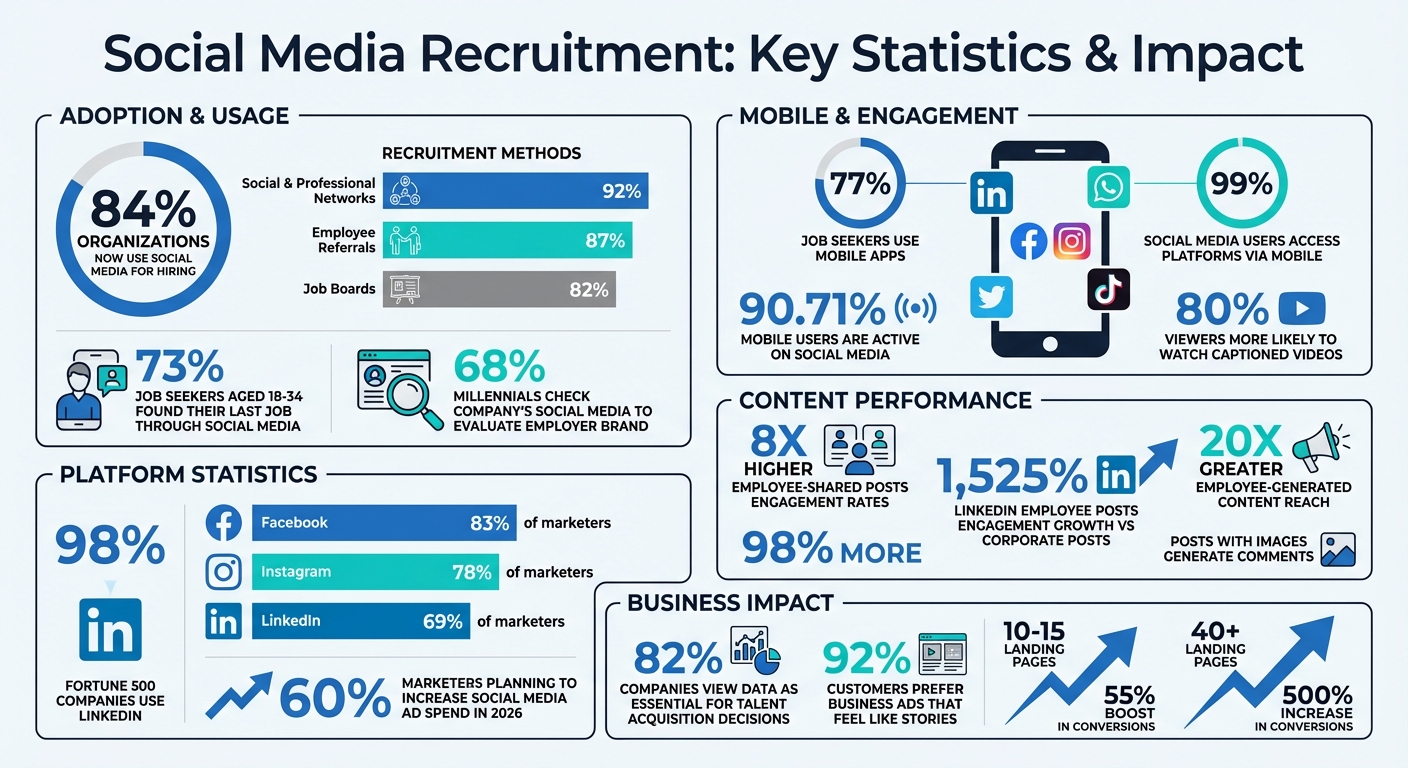
- 84% of organizations now use social media for hiring, while 73% of job seekers aged 18 to 34 found their last job on these platforms.
- Platforms enable companies to showcase their workplace, engage with candidates, and target specific audiences, leading to lower hiring costs and faster results.
- Effective campaigns rely on clear goals, tailored content, and consistent branding across platforms.
To succeed, focus on understanding your audience, creating mobile-friendly landing pages, and using tools like AI for automation and analytics. Track metrics like cost-per-hire and conversion rates to refine strategies. Social media as a recruitment tool allows companies to reduce hiring costs, strengthen employer branding, and build long-term talent pipelines.
Social Media Recruitment Statistics and Key Metrics for 2025
The Most Effective Social Media Recruitment Campaign Strategy
To implement this strategy effectively, you should first set up a social recruitment landing page that converts mobile traffic into applicants.
How to Plan a Social Media Recruitment Campaign
Planning a social media recruitment campaign starts with understanding who your ideal candidates are and where they spend their time online. This ensures your efforts are focused and effective.
Define Candidate Personas and Choose Your Platforms
Begin by creating a detailed candidate persona. This should include their professional background, career aspirations, and the social platforms they frequent. To refine this, ask your current employees where they spend their online time and what type of content resonates with them.
Data shows that platform choice matters. For instance, 98% of Fortune 500 companies use LinkedIn to maintain a professional presence. This makes LinkedIn a go-to for B2B roles and senior-level hiring. On the other hand, 73% of job seekers aged 18 to 34 found their last job through social media. If you’re targeting younger candidates, platforms like Instagram and TikTok are essential.
Before diving into new platforms, take stock of your existing social media presence. You may already have an audience on platforms like Facebook or Instagram that you can leverage. For example, Texas Roadhouse used its established social media presence to attract over 400,000 applicants in just 12 months, achieving its lowest cost-per-hire metric. Instead of trying to be everywhere, they focused on platforms where their target audience – restaurant workers – was already active.
Match the platform to the type of content you plan to share. LinkedIn is ideal for professional networking and in-depth content, while Instagram is great for visual storytelling and behind-the-scenes glimpses. TikTok and Instagram Reels dominate short-form video, which continues to shape social media trends. As of January 2025, Facebook leads with 83% of marketers using it, followed by Instagram at 78% and LinkedIn at 69%.
Once you’ve identified your audience and platforms, set clear goals, allocate your budget, and establish a timeline to guide your campaign.
Set Goals, Budget, and Timelines
Define specific, measurable goals for your campaign. Examples include aiming for 500 applications per month, reducing cost-per-hire by 30%, or increasing diversity hires by 20%. Work backward from these objectives to determine the level of activity needed on social media.
Social media recruitment isn’t about quick wins; it’s a long-term strategy that requires consistent effort over months. Your timeline should account for building relationships with potential candidates, not just immediate results.
Budget allocation should align with your priorities. Invest more in urgent or hard-to-fill roles, while using organic, low-cost strategies for positions that are always in demand. Keep an eye on metrics like Cost-Per-Application (CPA), Cost-Per-Hire, and Click-Through Rate (CTR) to measure your campaign’s effectiveness. For example, Ulta Beauty saw a 53% year-over-year increase in hires during a holiday rush thanks to a well-planned social media recruitment strategy.
Collaborate with your marketing team to share resources and insights. You might even tap into their existing social media budget. With 60% of marketers planning to increase their social media ad spend in 2026, there’s a growing opportunity to align recruitment efforts with broader marketing goals.
Jason Mitchell, CEO of Movement Strategy, offers practical advice:
“You don’t win on social media by crafting one masterpiece a quarter. Imperfection allows you to show up often, try new angles, see what sticks, and adjust.”
Build a Content Calendar
A content calendar is essential for staying organized and consistently posting across platforms. Schedule your posts for times when your target audience is most active to maximize engagement.
Balance your content using the 80-20 rule: 80% of your posts should inform, educate, or entertain, while only 20% should directly promote job openings or your employer brand. This approach helps guide candidates through the stages of awareness, consideration, and conversion.
To maintain a steady posting schedule without overwhelming your team, follow the “Three Rs”:
- Repurpose customer reviews into engaging social posts.
- Repost user-generated content from employees.
- Recycle top-performing evergreen content across platforms.
Posts shared by employees are especially effective, generating 8x higher engagement rates than brand-shared content. Additionally, employee-generated content has 20x greater reach than all organic brand posts combined.
Tailor your content to each platform’s audience by creating platform-specific mission statements. For instance, “LinkedIn is where we attract professional talent; Instagram is where we showcase our daily culture”. This strategy ensures your content isn’t generic and resonates with the unique audience on each platform. Considering that 68% of Millennials check a company’s social media to evaluate its employer brand, your content should authentically reflect the workplace culture candidates are looking for.
A well-structured content calendar lays the foundation for creating posts that not only engage but also convert potential candidates into applicants.
How to Create High-Impact Social Media Recruitment Campaigns
After planning your campaign, the next step is setting up the tools and processes to turn social media clicks into completed applications. This involves creating user-friendly landing pages, ensuring brand consistency, and automating ad delivery for better efficiency.
Design AI-Powered Landing Pages and Smart Forms
Your landing page is where potential candidates decide whether to apply or move on. Since 77% of job seekers use mobile apps and 90.71% of mobile users are active on social media, having a mobile-responsive page is critical. Any lag or awkward navigation can cause users to drop off instantly.
Make sure the design of your landing page matches the look and feel of your ads. For example, if your Instagram ad uses a blue color palette and a friendly tone, the landing page should seamlessly continue that experience. This consistency builds trust and keeps candidates engaged.
Keep your application forms simple. Focus on the essentials – name, email, phone number, and one or two role-specific questions. If your ads are getting clicks but few applications, your form might be the issue. Each extra field increases the likelihood that mobile users will abandon the process.
Use tracking tools like Facebook Pixel and LinkedIn Insight Tag to monitor visitors and retarget those who don’t complete the application. Limit retargeting to three impressions to avoid overwhelming candidates. This way, a single ad view can turn into multiple opportunities to engage the same person.
Adding rich media, like closed-captioned “Day in the Life” videos, can also boost engagement. 80% of viewers are more likely to watch captioned videos, especially younger candidates who often browse without sound.
Once your landing page is optimized for conversions, focus on maintaining consistent branding across job pages and application funnels.
Build Branded Job Pages and Application Funnels
Branded job pages strengthen your employer identity and guide candidates smoothly through the application process. Consistent branding isn’t just about looking good – it’s about building trust. Since 68% of millennials check a company’s social media to evaluate its employer brand, every interaction counts. Your job pages should align with the impression candidates get from your Instagram or LinkedIn presence.
Collaborate with your marketing team to use approved brand assets like logos, high-quality images, and style guidelines. This ensures your recruitment materials align with the brand image candidates are already familiar with. Clare Hogan, Marketing Coordinator at Hyde Engineering + Consulting, highlights this point:
“Beyond optimizing the delivery of our jobs on social media, CareerArc also helps us reinforce our brand. As a marketer, I like being able to create, save, and schedule social media content all within one platform.”
Platforms like HireLab.io offer pre-designed templates that maintain brand consistency while focusing on conversions. These templates are mobile-friendly and include smart forms that adjust based on candidate responses, making the application process smoother. Plus, their AI-powered page builder allows you to create professional job pages quickly, no coding required.
Use unique tracking links for each social platform – LinkedIn, Meta, TikTok – to see which channels deliver the best candidates, not just the most clicks. For instance, LinkedIn might have a higher cost per click but yield applicants who are more likely to move forward in the hiring process, making it a better investment than cheaper traffic sources.
Branded job pages also improve search visibility, helping candidates find your openings even when they’re not actively browsing social media. This extends the reach of your campaigns beyond their initial paid impressions.
Connect with Social Media Platforms for Automation
Once your landing pages and job funnels are ready, automate your outreach to maintain consistent messaging across platforms like LinkedIn and Meta. Manual posting doesn’t scale, but automation tools can help you tailor your content for each platform while keeping your messaging aligned. This approach is essential since 92% of companies now use social and professional networks to recruit talent, surpassing even employee referrals (87%) and traditional job boards (82%).
HireLab.io integrates with platforms like Meta and LinkedIn, allowing you to manage recruitment ads from a single dashboard. Its built-in ad optimizer adjusts campaigns based on performance data, so your budget focuses on the audiences most likely to apply. This means you can launch complete campaigns – including landing pages, smart forms, and ads – in a fraction of the time.
Run A/B tests to find the best-performing combinations of headlines, images, and target audiences. For example, you might discover that ads featuring employee testimonials outperform those showcasing office spaces, or that targeting by job title is more effective than targeting by interests.
Monitor ad frequency to avoid overwhelming candidates, and use tools like Facebook’s “Saved Audiences” to refine your targeting. Narrowing your audience to specific profiles – like “marketing managers with 5+ years of experience interested in B2B software” – can significantly improve your cost-per-application.
Finally, connect your social automation tools to your Applicant Tracking System (ATS). This integration tracks not just where applicants come from, but which platforms produce quality hires. HireLab.io even offers a free ATS for users without one, helping you capture applicant data and track which social channels lead to long-term successful hires. This insight helps you focus on strategies that deliver the best results, not just quick applications.
What Makes a Social Media Recruitment Campaign Successful
A strong social media recruitment campaign boils down to three key elements: how you tell your story, how you present your content, and how you showcase what makes your workplace stand out.
Use Storytelling and Consistent Branding
People connect with stories, not just job descriptions. In fact, 92% of customers prefer business ads that feel like stories, and this principle applies to recruitment too. Instead of listing qualifications, share real employee experiences – highlight their career paths, achievements, and the challenges they’ve overcome.
Take UPS, for example. Their “Our Jobs Change Lives” campaign on Facebook and Twitter spotlighted personal employee stories and videos, emphasizing workplace satisfaction and dependable pay. This effort earned them recognition as one of the “Top 50 recruiters on Twitter”. Similarly, Marriott’s “Begin. Belong. Become.” campaign used their Facebook career page to showcase employee stories, achieving 1.3 million likes by engaging in real-time interactions and celebrating employee milestones.
Maintaining a consistent brand voice across platforms is just as important as storytelling. Tony Prudente, Senior Specialist in Employer Branding at Brother, highlights this:
“Always do your best to highlight and showcase your employees – people respond to people more than they do brands.”
Your tone – whether professional, witty, or laid-back – should remain steady across LinkedIn, Meta, TikTok, and other platforms. Develop clear brand guidelines and stick to them. Use tools like editorial calendars to ensure regular posting, and encourage employees to share pre-approved content through their personal networks. This is crucial because 68% of millennials check a company’s social media to assess its employer brand, and over 40% of consumers unfollow brands that don’t reflect their values.
Once your branding is on point, make sure your content is optimized for mobile users.
Create Mobile-First and Interactive Content
With 99% of social media users accessing platforms via mobile and 77% of job seekers using mobile apps to explore opportunities, your content needs to be mobile-friendly and easy to engage with.
This goes beyond just responsive design. Create content that’s quick to consume, like short videos with closed captions – especially since 80% of viewers are more likely to finish a video with subtitles, as many browse with the sound off. Take advantage of platform-specific features like Instagram Stories, LinkedIn polls, and Facebook Live to keep candidates engaged.
Interactive content can also help build relationships before candidates even apply. Host live Q&A sessions for potential hires to ask about roles or company culture. Use polls to understand what job seekers value most in a workplace. These approaches create a sense of connection and make the application process feel more approachable.
But to truly attract the right talent, you need to let your company culture take center stage.
Showcase Company Culture and Values
While job descriptions tell candidates what you need, your culture content shows them why they should want to work for you. 73% of job seekers aged 18 to 34 found their last job through social media, often influenced by what they saw about a company’s culture rather than just salary or perks.
Zappos nailed this with their Instagram strategy, using the hashtag #InsideZappos and the handle @zinternships to target millennials. By sharing campus events and employee stories that reflected their “fun and vibrant” culture, they built a talent network rooted in relationships. Disney took a similar approach with their “Disney Career” YouTube channel, showcasing recruiter insights and behind-the-scenes hiring videos to engage over 11,000 subscribers.
Create a unique hashtag for your company, like #LifeAtYourCompany, to gather culture-driven posts. Share authentic moments – team outings, volunteer events, or casual office interactions. Let employees take control of your social accounts for a day to give an unfiltered glimpse into workplace life. This kind of transparency helps candidates decide if they align with your culture, leading to better applications and lower turnover.
Peter Levin, Creative Director at Finn Partners, underscores the importance of authenticity:
“Telling a brand’s story begins with finding its truth… consumers will seek out brands that feel authentic to both their values and what they want from a product or company.”
The key is to show, not just tell. Don’t just say, “We value innovation” – post a video of your team brainstorming ideas. Instead of claiming, “We prioritize work-life balance”, share a photo of employees leaving early to attend their kids’ soccer games. These genuine moments resonate far more than polished corporate statements ever could.
Examples of Best Social Media Recruitment Campaigns
These real-world campaigns highlight how effective strategies can deliver impressive results:
Targeted Meta Ads for High Application Volume
When Land O’Lakes, Inc. needed to quickly fill open positions, they turned to geo-targeted Facebook ads with their “Feed the Nation” campaign. In just 11 days, the campaign reached 19,000 potential candidates, drove 16,000 site visits, and resulted in 162 new leads and 25 completed applications. This demonstrates how location-based targeting on Meta can efficiently connect employers with local talent.
Ulta Beauty also leveraged social media for their holiday hiring push. Their strategy led to a 53% year-over-year increase in hires, proving that Meta’s vast reach is particularly effective when filling multiple positions across different locations.
LinkedIn Professional Content for Qualified Hires
LinkedIn’s precision targeting and professional tone make it a standout platform for recruitment, especially when using LinkedIn recruitment funnels to drive engagement. When UBS needed 300 bilingual professionals during the Credit Suisse migration (June to December 2024), they launched the “Recruiting at Speed” campaign. Featuring a senior leader ambassador on LinkedIn and multi-lingual Instagram content, the campaign generated 1,684 applications and successfully filled all 300 roles – with a 50% gender balance.
Additionally, LinkedIn posts from employees see 1,525% higher engagement growth compared to standard corporate posts. By spotlighting employees and leveraging LinkedIn’s targeting tools to focus on specific industries, job titles, or skills, companies can attract highly qualified candidates who are already primed for the right opportunity.
Video Campaigns on Instagram and TikTok
To connect with Gen Z, Kruidvat launched the “Apply with Your Bestie” campaign, which encouraged applications as a shared experience. Using TikTok and WhatsApp, they saw a 52% increase in total applications and an 83% rise in duo applications. A Rally Award Judge praised the campaign:
“The overall strategy was well thought out – from target audience, to objectives, to approach – it met the talent where they were. It felt very interactive and engaging”.
For platforms like Instagram and TikTok, short, authentic videos work best. Instead of listing team accomplishments, show behind-the-scenes celebrations or day-in-the-life snippets. Keep videos under 60 seconds, add captions for sound-off viewing, and use platform-specific tools like Instagram Reels or TikTok’s trending sounds to maximize reach. This unpolished, genuine style resonates with younger audiences who value transparency over high production.
These examples show how tailoring recruitment strategies to specific platforms can lead to measurable success.
How to Measure Recruitment Campaign Effectiveness
Once you’ve laid the groundwork with strategic planning, the next step is evaluating how well your recruitment campaign is performing. Data plays a crucial role in shaping talent acquisition strategies, so it’s essential to focus on metrics that directly influence hiring outcomes.
Track Key Metrics and Conversion Rates
Start by analyzing which sourcing channels are delivering the most qualified candidates. Platforms like LinkedIn, Meta, and TikTok can be compared by tracking both the number of applicants and the conversion rates from impressions to completed applications. If you notice low application completion rates, it might signal technical issues or a confusing user interface.
Cost-per-hire (CPH) is another important metric. Calculate this by dividing your total campaign investment – such as ad spend, recruiter hours, and software costs – by the number of hires. For digital campaigns, aim for click-through rates (CTR) between 2% and 5%, while recruitment emails typically achieve open rates around 21.33%. Tools like HireLab.io’s analytics dashboard can help centralize and simplify tracking, allowing you to identify trends and compare campaign performance.
Beyond numbers, look at the quality of hire by assessing first-year performance ratings and retention rates of candidates sourced through social media. A campaign that quickly fills roles but struggles with retention isn’t hitting the mark. Dig deeper into your recruitment funnel by measuring yield ratios at each stage – such as clicks to applications or applications to interviews – to pinpoint bottlenecks.
Once you’ve gathered this data, refine your strategy through testing and engagement monitoring to improve results.
Run A/B Tests and Monitor Engagement
A/B testing can reveal what resonates most with your audience. Between 2024 and 2025, Octopus Energy Services partnered with Amberjack to run targeted campaigns on Facebook and Instagram for roles like Electricians and Heating Engineers. By tailoring messages and visuals to specific roles and optimizing by location, the campaign achieved 3.35 million impressions and 1,660 initiated applications. Notable results included a 25% increase in applications for Heating Engineers, a 91% jump for Sales Specialists, and an overall application surge of 257% across all roles. Impressively, the campaign also saw a 22% female application rate, 2.4 times higher than the industry average.
Using UTM parameters can help track which versions of ad copy, images, landing pages, or call-to-action buttons drive the most traffic and applications. Companies with 10–15 dedicated landing pages see a 55% boost in conversions, while those with over 40 landing pages can experience up to a 500% increase.
Engagement metrics like likes, comments, shares, and reposts also provide valuable insights. Posts with images generate 98% more comments than those without. Experiment with creative elements, such as using real employee photos instead of stock images, as authentic visuals often perform better. Use weekly insights from platform algorithms to fine-tune audience targeting and improve conversion rates.
Optimize Campaigns with AI-Driven Insights
After tracking metrics and testing, advanced AI tools can take optimization to the next level. These tools can predict the best-performing headlines, adjust bidding strategies in real time, analyze user behavior patterns, evaluate campaign results, and even generate ad variations for continuous testing.
For example, in 2024, Ingredion’s two-person team launched the “Create the Future with People Who Care” campaign. By using data from Rally Inside and Gartner benchmarks, they refined Workday landing pages and LinkedIn targeting, resulting in a 32% increase in careers page traffic, a 650% jump in Indeed applications, and a staggering 1,525% boost in LinkedIn engagement.
Platforms like HireLab.io offer AI-driven insights to help identify where candidates drop off during the application process – critical, given that abandonment rates can reach as high as 95%. This allows you to address and remove obstacles promptly. Combining metrics like fill rates with new hire retention rates ensures that a fast hiring process doesn’t sacrifice quality.
As privacy regulations evolve, targeting strategies now rely more on first-party data and contextual methods. By 2025, 41% of PR professionals reported increasing their reliance on paid social media. Run tests long enough to gather meaningful data, then double down on what works and scrap what doesn’t. This approach ensures your campaigns stay effective and adaptable in an ever-changing landscape.
Conclusion
Running a successful social media recruitment campaign requires thoughtful planning, effective execution, and consistent measurement. Start by defining your ideal candidate personas and choosing the right platforms – like LinkedIn for professional roles, Meta for high-volume hiring, or TikTok to connect with younger talent. Set SMART goals, allocate your budget carefully, and stick to a consistent content calendar to keep your employer brand front and center.
The execution phase is where your strategy takes shape. Focus on creating mobile-friendly landing pages and smart forms that minimize drop-offs. Use employee-generated content to highlight your company culture authentically, and customize your messaging for each platform’s audience. To truly stand out, combine creative storytelling with technical precision. After execution, measurement becomes critical to separate effective strategies from mere guesswork.
Track key metrics like cost-per-hire, conversion rates, quality of hire, and retention. Use A/B testing to refine elements like headlines, visuals, and targeting, and double down on what works. Remember, 82% of companies view data as essential for making talent acquisition decisions, so analytics should be at the core of your recruitment efforts.
Technology can simplify and enhance this entire process. Platforms like HireLab.io offer AI-powered tools, including landing pages, smart forms, and automated campaign management. Instead of juggling multiple tools or manually tracking performance, you can build complete recruitment funnels in minutes, integrate directly with platforms like Meta and LinkedIn, and gain real-time insights for instant optimization. Its built-in analytics dashboard consolidates your data, helping you identify bottlenecks and improve application completion rates – all within one streamlined solution.
Think of your strategy as a dynamic framework: experiment with fresh ideas, learn from your data, and adapt to better connect with your target candidates. With strategic planning, engaging content, and actionable insights, you can attract top talent while keeping costs under control.
FAQs
How can companies attract younger job seekers through social media?
To connect with younger job seekers like Gen Z and early millennials, it’s essential to meet them where they already spend their time – on platforms like TikTok, Instagram, and Snapchat. These audiences respond well to content that feels genuine and relatable. Think short-form videos, authentic employee stories, or even behind-the-scenes glimpses, such as “day-in-the-life” clips. These formats are far more engaging than static posts and can help showcase your company culture in a way that feels real.
Interactive strategies, such as hashtag challenges or live Q&A sessions, can also spark engagement and create a sense of connection with potential candidates. These approaches not only grab attention but also encourage active participation, making your brand more memorable.
If you’re using paid ads, take advantage of precise targeting tools. Focus on criteria like interests, education level, or career stage to ensure your message reaches the right audience without blowing your budget. And don’t forget to adapt your content to fit each platform’s vibe – whether it’s music-driven Instagram Reels or storytelling on TikTok. Highlight values that resonate with younger talent, such as flexibility, diversity, and purpose-driven missions, to make your job opportunities stand out and attract the applicants you want.
How does storytelling enhance social media recruitment campaigns?
Storytelling breathes life into recruitment campaigns, turning them into compelling narratives that resonate with candidates on a personal level. By sharing genuine employee stories, emphasizing company values, and illustrating meaningful contributions, it helps candidates picture themselves thriving within your organization. This kind of storytelling not only builds trust but also creates a sense of connection – even before someone submits an application.
On social media, storytelling can take many shapes: short video testimonials, “day-in-the-life” clips, or carousel posts that outline challenges, solutions, and outcomes. These formats make your brand feel approachable and relatable, sparking engagement and inspiring shares. Combine this with clear calls-to-action and defined goals, and storytelling becomes a dynamic strategy for attracting top talent and driving impactful recruitment efforts.
How can AI tools improve social media recruitment campaigns?
AI tools can play a game-changing role in boosting the efficiency of social media recruitment campaigns. By automating repetitive tasks, fine-tuning targeting, and delivering actionable insights, these tools can simplify the entire process. For instance, AI can analyze social media profiles to identify candidates whose skills and experience align with specific job requirements. It can also optimize ad placements and tailor content to ensure it reaches the right audience at the ideal time.
On top of that, AI-powered analytics can track campaign performance, offering detailed data on metrics like engagement, reach, and the quality of candidates. This information helps recruiters fine-tune their strategies, focusing on what works best. By integrating AI into their recruitment efforts, companies can streamline the process and connect with top-tier talent more efficiently.