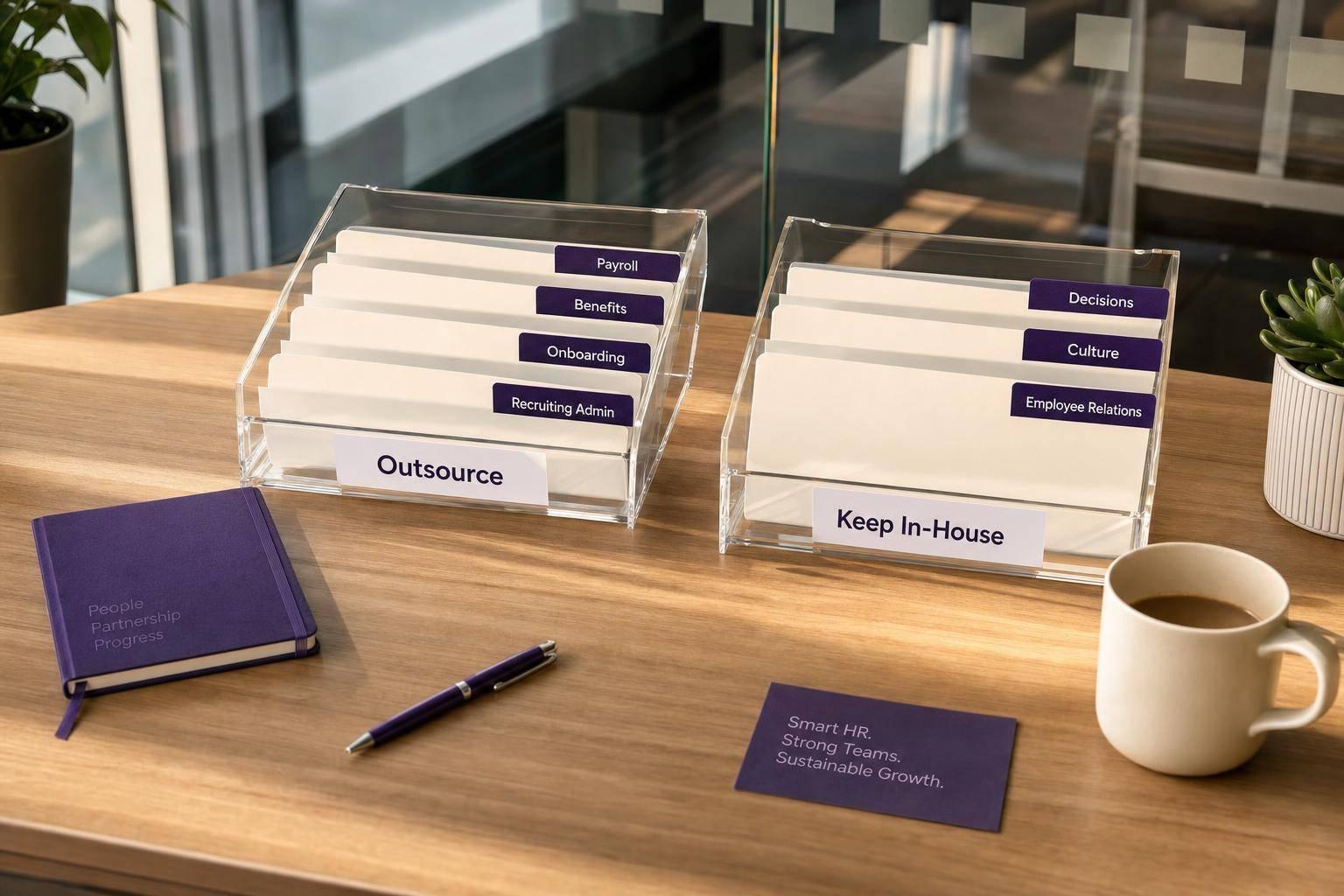

HR Outsourcing: What It Covers and When It Makes Sense
If your HR team is buried in payroll, hiring admin, and compliance work, HR outsourcing may be the right move. I’d keep decision-based work inside the company and hand off process-based work to a provider.
Here’s the short version:
- Outsource: payroll, benefits admin, onboarding paperwork, offboarding steps, screening support, scheduling, and compliance tracking
- Keep in-house: final hiring calls, manager coaching, employee issues, workforce planning, and company values work
- Use outsourcing when: hiring volume climbs, admin costs grow, or multi-state rules create too much error risk
A few numbers make the case clear:
- Hiring teams spend about 48 hours per role on recruiting tasks
- Each extra week in time to hire can add 10% to 15% to total cost per hire
- Automated scheduling can cut 3–5 days from the hiring cycle
- AI can handle more than 50% of onboarding tasks and make onboarding up to 3x faster
The simplest rule I’d use is this: outsource the process, keep the decision. If a task follows the same steps each time, an outside partner can usually take it on. If it needs judgment, close manager contact, or a strong feel for your company, keep it inside.
| Area | Better to outsource? | Better to keep in-house? |
|---|---|---|
| Payroll | Yes | No |
| Benefits admin | Yes | No |
| Compliance tracking | Yes | No |
| Screening and scheduling | Yes | No |
| Onboarding paperwork | Yes | No |
| Final hiring decision | No | Yes |
| Employee issues | No | Yes |
| Workforce planning | No | Yes |
Bottom line: I’d use HR outsourcing to cut admin load, lower error risk, and free up internal HR for people-focused work that needs human judgment.
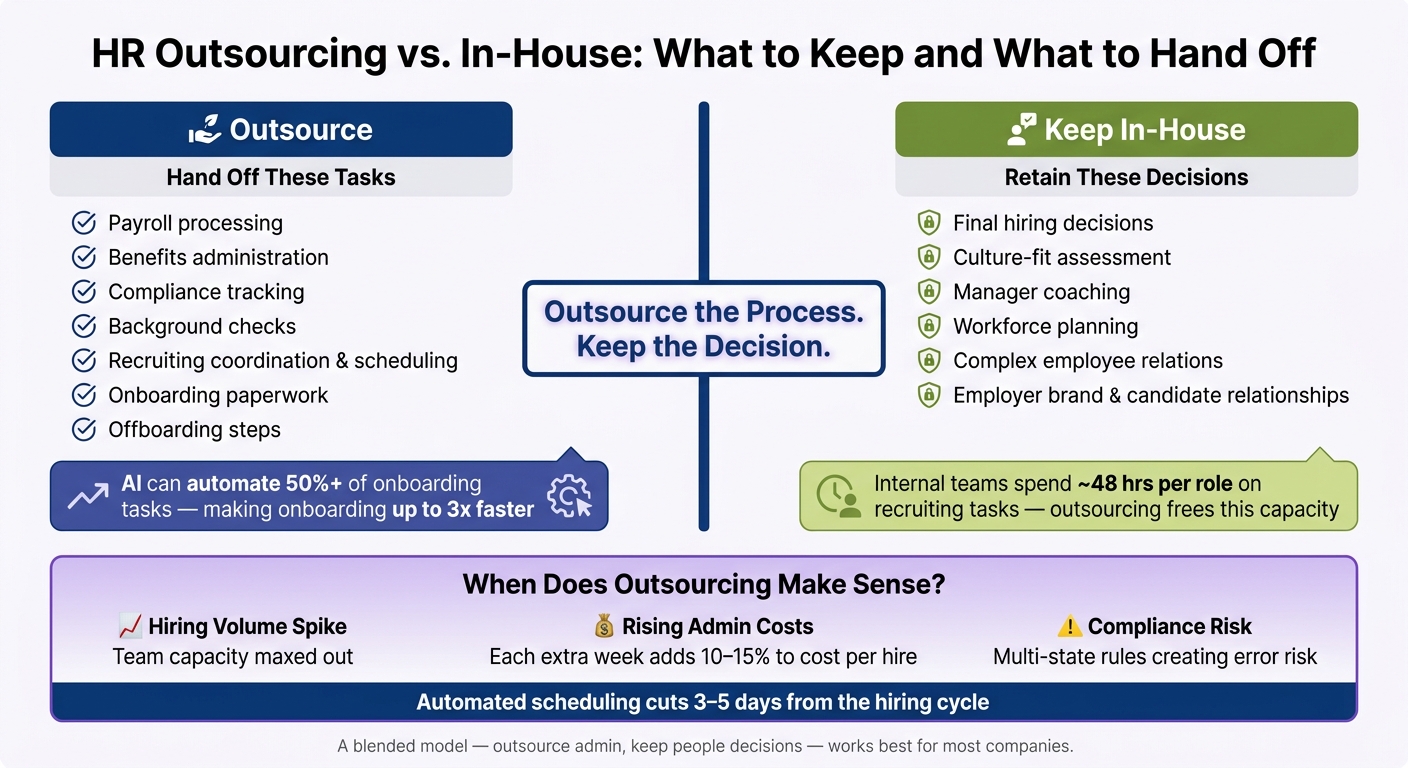
HR Outsourcing vs. In-House: What to Keep and What to Hand Off
What HR outsourcing typically covers
HR outsourcing usually covers admin work with clear steps and repeatable rules. These are the tasks companies most often hand off because they depend on consistency, not judgment.
Payroll, benefits, and compliance administration
Payroll is one of the most common HR functions to outsource. That usually includes pay calculations, deductions, direct deposit processing, payroll recordkeeping, and federal and state tax filings.
Benefits administration is also a common fit. A provider can handle enrollment, plan changes, open enrollment, and routine coverage questions.
Recruiting coordination, onboarding, and offboarding
Recruiting coordination often includes screening support, interview scheduling, and hiring workflow management. But it shouldn’t replace the final hiring decision. That part should stay in-house.
Onboarding and offboarding are also common choices for outsourcing because the work tends to be standardized and procedural, much like a structured application form that walks every candidate through the same steps. In plain terms, it’s the kind of work that runs best when each step happens the same way every time.
Routine employee relations administration
Routine employee-relations administration is also often outsourced. Compliance tracking, disciplinary records, complaint logs, and contract administration can be handed off [1]. The provider manages the records and the workflow. Your internal team still owns judgment calls and escalations.
Once those outsourced functions are defined, the next step is deciding what belongs outside the company and what needs to stay internal.
What to outsource and what to keep in-house
Once you know what HR outsourcing includes, the next step is figuring out which work makes sense to hand off.
A simple rule helps here: outsource work that is standardized, deadline-driven, and heavy on paperwork. Keep work in-house when it calls for judgment, close manager ties, or deep knowledge of how your company works.
Tasks that work well as outsourcing candidates
Payroll processing, benefits administration, compliance tracking, background checks, and recruiting administration are often a good fit for outsourcing. That includes sourcing, initial screening, and scheduling. These tasks usually follow a set process and happen on a regular cadence.
Onboarding paperwork and basic orientation modules fit this model too. Generative AI can automate more than 50% of onboarding tasks, making onboarding up to 3x faster [2].
The line between what to outsource and what to keep is pretty simple: outsource the process, keep the decision.
Tasks that should stay internal
Final hiring decisions, culture-fit assessment, manager coaching, workforce planning, and complex employee relations issues should stay inside the company. These areas depend on context. You need a clear read on team dynamics, business goals, and the people involved.
Employer brand and candidate relationships should stay internal as well. Those are the parts of hiring that shape how people see your company, and they usually work best when owned by your own team.
Why a blended model often works best
For most companies, a hybrid setup works best. Let an outside partner—similar to how you might evaluate a recruiting agency for specialized hiring—handle administrative execution, and keep people decisions in-house.
In recruiting, that often means handing off sourcing volume and interview scheduling while keeping final selection and candidate relationships inside the company. Automated interview scheduling can trim an average of 3–5 days from the hiring cycle [5].
When HR outsourcing makes sense
Once you know what to outsource and what to keep in-house, the next step is timing. When is outsourcing worth it? In most cases, it pays off when one obvious bottleneck is slowing the whole team down.
HR outsourcing tends to work best when routine tasks start eating up time that should go toward planning, hiring, and employee support. A simple way to look at it is through three signals: capacity, cost, and compliance risk.
When hiring volume outpaces your HR team’s capacity
Growth can be exciting, but it also puts real strain on HR. Internal teams often spend an average of 48 hours per role on recruitment tasks [1]. That adds up fast.
When hiring demand moves past what your team can handle, outsourcing can keep recruiting and onboarding on track without adding permanent headcount. In plain terms, it helps you deal with the spike without stretching your team too thin.
When administration is driving up cost per hire
Admin work has a way of piling up in the background. Then, before you know it, your cost per hire starts creeping higher.
In that case, outsourcing can shift uneven labor costs into a fixed monthly cost. A good place to start is by calculating your true cost per hire. That means factoring in internal recruiter time, hiring manager hours, and external fees [1] — the same categories worth weighing against a platform’s own pricing plans if you’re leaning toward a software-first approach. Once you see the full number, it’s much easier to tell whether outsourcing saves money or just looks cheaper on the surface.
When compliance demands and error risk are high
Multi-state hiring is often where things get messy fast. Different states can mean different wage-and-hour rules, leave requirements, and recordkeeping duties.
Outsourcing multi-state payroll and leave tracking can cut down on errors across those varying wage-and-hour rules [4]. If your team is spending too much time double-checking rules or fixing payroll issues, that’s usually a sign the risk is getting too high to manage informally.
Conclusion: How to choose the right HR outsourcing model
Once you know when outsourcing makes sense, use a simple test to pick the right model. Score each HR task based on time, risk, and judgment. Rules-based work like payroll processing, benefits enrollment, and initial screening is often a good fit for outsourcing. Work tied to strategy, culture, and sensitive leadership decisions should stay with your internal team [2][3].
A quick way to sort it:
- Outsource: payroll, screening, and admin work
- Keep internal: employee relations and people strategy
After that, make ownership clear. Use a RACI chart to define who owns what across your internal team and your outside partner [1]. Then back it up with written service-level agreements, like a 48-hour response time, so both sides know exactly how handoffs and reply times should work [5].
The goal is to take repetitive HR work off your team’s plate so they can spend more time on judgment, strategy, and culture.
FAQs
How do I decide what to outsource first?
Start by mapping your recruitment process so you can spot the manual, repetitive, or high-volume tasks that slow everything down. The goal is simple: find the work that eats up recruiter time without needing much judgment or hands-on oversight.
That usually includes tasks like:
- initial candidate screening
- resume parsing
- interview scheduling
These jobs matter, but they can also turn into bottlenecks fast when hiring volume picks up.
To decide what to hand off or automate, look at the numbers. Cost per hire and time to hire are two of the best places to start. If one task keeps pushing costs up or dragging out the hiring timeline, that’s a strong sign it may be a good fit for outsourcing or automation.
What are the biggest risks of HR outsourcing?
The biggest risks are pretty clear: you can lose control over how your company is presented, become too reliant on an outside provider, and end up with messy gaps between your internal workflows and the systems that provider uses.
There’s also the issue of sharing sensitive employee data with a third party. That can create serious problems if security and compliance aren’t handled with care.
How can I tell if outsourcing will actually save money?
Don’t stop at the provider’s invoice. Compare that cost against your total current HR costs.
That means looking at the full picture:
- recruiter salaries
- hiring manager time
- onboarding
- administrative work
- agency markups
- the cost of unfilled roles
From there, model the return based on your hiring volume and the savings you want to hit for each role.
Outsourcing often makes financial sense when it cuts time-to-hire, helps you avoid adding headcount or paying extra variable fees, and lowers compliance risk.