




How to Choose a Recruiting Agency for Your Business
Pick the recruiting agency that matches your role, budget, and hiring pace – not the one with the best pitch. Agency hiring can add $6,000 to $10,000 per hire, and each extra week can push total hiring cost up by 10% to 15%. So when I compare recruiting agencies, I look at five things first: agency model, track record, screening, contract terms, and pilot results.
Here’s the short version:
- Define the job first: role level, hiring volume, timeline, and max budget
- Match the agency model to the hire:
- Contingency for many mid-level or high-volume roles
- Retained search for executive or private searches
- Niche recruiters for hard-to-fill roles in fields like tech, healthcare, or finance
- Ask for proof: fill rate, time-to-fill, submissions per hire, and 90-day retention
- Read the contract closely: fee terms, guarantee period, exclusivity, and candidate ownership
- Use a scorecard and pilot before making a longer commitment
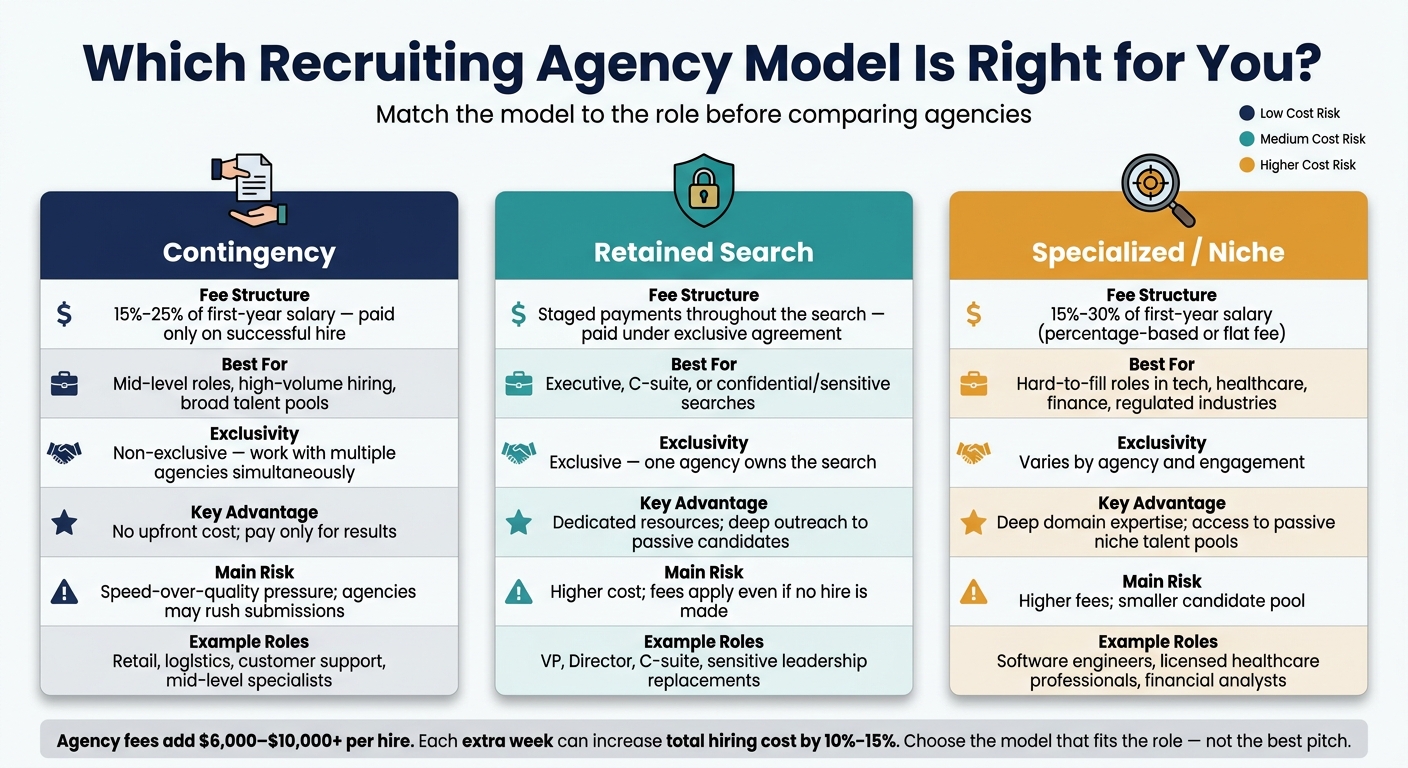
Recruiting Agency Types: Fees, Best Uses & Trade-offs
10 Questions to Ask Before Choosing a Staffing Agency | Avoid Costly Hiring Mistakes in 2026
Quick Comparison
| Agency Type | Best For | Typical Fee | Main Risk |
|---|---|---|---|
| Contingency | Mid-level and high-volume hiring | 15%–25% of first-year salary | More pressure to submit fast |
| Retained Search | Executive, C-suite, or private roles | Staged payments | Higher up-front spend |
| Specialized / Niche | Hard-to-fill or regulated roles | 15%–30% of first-year salary | Higher fee and smaller talent pool |
I’d keep the process simple: know what you need, compare agencies with the same scorecard, and test the top choice with a short pilot before you go all in.
1. Define Your Hiring Needs Before Contacting a Recruiting Agency
Before you reach out to agencies, get clear on the role, hiring volume, timeline, and budget. That way, every recruiting agency is pricing the same brief instead of reacting to a fuzzy request.
Clarify Role Type, Hiring Volume, and Urgency
The role itself shapes the search. An entry-level opening, a mid-level specialist, and an executive hire each need a different recruiting approach, budget, and timeline. The same goes for one hard-to-fill role versus high-volume hiring for jobs like retail, logistics, or customer support.
An open role costs money. Work slows down, output drops, and revenue can get pushed back. The longer the seat stays empty, the more that cost adds up. That’s why urgency should shape both your budget and the kind of recruiting agency you pick. If the search is time-sensitive, look for a recruiting agency that can move fast and keep communication tight.
Set a Realistic Recruiting Budget in U.S. Dollars
Direct-hire fees usually land between 15% and 25% of a candidate’s first-year salary [1]. So if the role pays $80,000 per year, you’re looking at $12,000 to $20,000. If it pays $150,000, that jumps to $22,500 to $37,500.
And agency fees are only one part of the bill. You also need to account for internal team time, ATS tools, job boards, background checks, recruitment marketing, and onboarding. In plain English: total hiring cost is bigger than the agency invoice.
| Role Category | Avg. Cost Per Hire (USD) |
|---|---|
| Entry-Level | $1,500 – $3,000 [1] |
| Mid-Level Specialist | $3,000 – $5,000 [1] |
| Executive | $14,000+ [1] |
| High-Volume (Retail, Logistics, Customer Support) | $900 – $2,500 [1] |
Before outreach, set two guardrails:
- A cost-per-hire ceiling
- A time-to-hire target
That makes agency conversations much easier to compare.
Decide What Level of Support You Actually Need
Not every team needs the same kind of help. Some just want sourcing and early screening. Others need full-cycle recruiting, with the agency handling everything from the job post to offer acceptance.
You’ll also see a mix of service models in the market. Some agencies focus on sourcing only. Others handle full-cycle recruiting, market mapping, employer branding, or recruitment marketing. If you’re managing hiring across several clients or brands, it helps to see what a dedicated multi-client recruitment platform for agencies looks like before you commit to one vendor’s workflow.
If your main problem is top-of-funnel candidate flow, don’t pay for a full-service package you won’t use. Pick the service model that fits the gap you need to fix, not the biggest package on the menu.
Once those needs are clear, you can line them up with the right recruiting agency model.
2. Match the Agency Model to the Roles You Need to Fill
Start with the role, the hiring timeline, and the budget. Then pick the agency model that lines up.
Contingency works well for broad searches. Retained search makes more sense for confidential or senior hires. Niche recruiters are often the better pick when talent is hard to find or the role sits in a regulated field.
That order matters. First, match the model to the job. After that, compare recruiting agencies based on results, screening, and communication.
When Contingency Recruiting Makes Sense
Contingency agencies get paid only if you hire a candidate they introduced. There’s no upfront fee. Fees usually fall between 15%–25% of the candidate’s first-year salary [1], and you can often work with several agencies at once.
That setup sounds simple, and sometimes it is. But there’s a catch: when a search isn’t exclusive, agencies may rush to submit candidates before someone else does. In plain English, speed can beat careful screening.
This model tends to work best for mid-level or high-volume hiring, especially when the talent pool is broad and filling the role fast matters.
When Retained Search Is Worth the Cost
Retained search works differently. You pay in stages under an exclusive search [1].
This is the standard model for executive, C-suite, or confidential searches. It’s built for roles that need a tighter process and more direct outreach to passive candidates, not just people who are already applying.
When to Use a Specialized or Niche Recruiter
Specialized recruiters focus on one area, such as tech, healthcare, finance, or SaaS sales. That focus gives them deeper subject knowledge and stronger talent networks in that space, which helps when you need people with scarce skills or licenses, certifications, or other regulated experience.
A generalist recruiter might know how to run a search. A niche recruiter is more likely to speak the same language as the candidates you want. That can make a big difference in fields where details matter.
Their fees can land near the top end of the range and may reach 30% of first-year salary [2]. Even so, they’re often a good match for technical or regulated roles where a generalist may not have the same network or role-specific vocabulary.
Use this snapshot to compare the models side by side.
| Model | How Fees Work | Best For | Exclusivity | Pros | Cons |
|---|---|---|---|---|---|
| Contingency | Pay-on-placement (15%–25% of salary) [1] | Mid-level, high-volume, or broad roles | Non-exclusive | No upfront fee; pay only for results | Speed-over-quality pressure; variable candidate quality |
| Retained | Staged payments under exclusive search [1] | Executive, C-suite, or confidential roles | Exclusive | Dedicated resources; deep passive talent search | Higher cost; pay even if no hire is made |
| Specialized/Niche | Percentage-based (15%–30%) or flat fee [1][2] | Tech, healthcare, finance, regulated industries | Varies | Domain expertise; access to passive talent pools | More expensive; smaller candidate pool |
3. Evaluate Track Record, Candidate Quality, and Hiring Technology
Once you’ve matched the agency model to the role, the next job is simple: separate firms that can deliver from firms that just sound polished. Don’t settle for promises. Ask for numbers. And use the same yardstick for every agency so your comparison stays objective.
Review Proof of Results and Client References
Ask each recruiting agency for four core metrics: fill rate, submissions per hire, time-to-fill, and 90-day retention.
Use this table when you compare options:
| Metric | What to Ask For | Performance Benchmark |
|---|---|---|
| Fill Rate | % of open roles successfully placed | Compare with similar roles |
| Submissions Per Hire | How many candidates submitted per hire | A very high ratio can signal weak screening |
| Time-to-Fill | Days from requisition approval to start date | Compare with similar roles and ask what delays affect the timeline |
| 90-Day Retention | % of placed candidates still employed at 90 days | Core input for Quality of Hire [3] |
The numbers matter, but they don’t tell the whole story. Ask for client references too. Those conversations can help you check whether the agency sends candidates who line up with the role requirements and your company culture on a steady basis. It’s also smart to ask how they handle reference checks and how fast they return them.
If the data holds up, the next thing to look at is how they screen candidates.
Assess the Screening Process and Candidate Quality Standards
The way an agency screens candidates matters just as much as the people it finds. Ask them to walk you through the process from start to finish: how they source talent, how they screen, how they align on role requirements, and how they run reference checks.
It is also worth asking how much of that automated candidate screening agencies use, versus manual review, since AI-driven pre-screening changes how fast a shortlist comes together. It also helps to ask for a short written note on each candidate that explains why the person fits. That extra context goes a long way. Agencies that can show fit – not just point to a résumé that matches the job description – often send better shortlists.
Watch out for firms that lean too hard on rigid keyword filters. For specialized roles, that can knock out good people for the wrong reason. Two strong candidates may have done almost the same work but described it in different terms. Ask how the agency deals with that during screening.
Then look at how they keep your team in the loop during the search.
Check Communication Habits and Recruitment Marketing Capability
A recruiter who goes quiet in the middle of a search can drag the whole process down. Ask who owns communication, how often updates come in, and when your team should expect interview feedback.
Good recruiting agencies set clear communication targets. For example, they may commit to candidate feedback within 48 hours of an interview. That kind of structure can cut the interview-to-offer cycle by up to 6 days [2]. And in a tight market, 6 days can be the difference between making a hire and losing someone to another offer.
On the tech side, ask whether the application flow works well on mobile and whether it connects to your ATS or CRM. Many recruiting agencies now run on platforms built specifically for agency workflows, so it is worth reviewing what to look for in a white-label ATS for recruitment agencies before you compare vendors side by side. A smoother candidate experience can shape offer acceptance when candidates have options.
4. Compare Fees, Guarantees, Contract Terms, and Red Flags
Once you’ve checked results, screening, and communication, it’s time to read the contract closely. This is where hidden fees and weak protections tend to show up.
Understand Fee Structures and Total Cost
Look at the fee model, when payment is due, and what’s included in the service. Before you sign, confirm the total out-of-pocket cost.
The price should match the hiring problem the agency is solving for you, not just the biggest package it wants to sell. If you’re hiring a contractor who might later move into a full-time role, get any conversion fee in writing [1].
Review Guarantees, Ownership Rules, and Compliance Terms
If the agency offers a replacement or refund guarantee, check the details. Focus on the time window, who qualifies, and what paperwork you need to provide.
You should also pin down a few contract terms before the search starts:
- Who owns submitted candidates
- Whether the agreement is exclusive
- What service levels the agency is expected to meet
That saves you from the classic “wait, who has rights to this candidate?” mess later on.
Warning Signs to Watch Before You Sign
Some red flags are easy to miss at first, but they usually point to trouble ahead. Be cautious if you see:
- Superficial intake calls
- Vague deliverables
- No measurable metrics
- Exclusivity clauses with no performance trigger
- Hiring promises without clear screening criteria
Also step back if the recruiting agency can’t explain how it finds candidates or how it plans to communicate during the search. Weak intake and poor communication usually lead to poor candidate flow and slower hiring.
Use these terms and risks in your scorecard before you commit.
5. Use a Scoring Framework and Run a Pilot Before Committing
After you compare fees, terms, and warning signs, make the final call with two simple tools: a scorecard and a pilot.
That approach keeps the choice grounded in facts, not gut feel.
Build a Weighted Scorecard for Side-by-Side Comparison
A weighted scorecard helps you compare recruiting agencies using the same standards. You score each agency on the same criteria, apply the weights, and total the results. That makes it easier to see why one agency comes out ahead.
| Criteria | Weight | What to Measure |
|---|---|---|
| Candidate Quality | 30% | Share of screened candidates who reach interview, interview-to-offer ratio |
| Role Specialization | 20% | Proven track record in your industry or function |
| Communication & Reporting | 15% | Response time, update frequency, report clarity |
| Cost & Fee Structure | 20% | Total cost per hire, hidden fees, guarantee period |
| ATS Integration and Mobile Application Flow | 15% | ATS integration, mobile-friendly applications, AI screening |
One detail matters here: weight cost based on total cost per hire, not just the fee by itself. A lower fee can look good at first glance, but not if it comes with weak screening, slow progress, or more drop-off.
Once the scorecard narrows the field, test your top option in a pilot.
Start with a Pilot and Measure Real Performance
Start with a short pilot tied to the role type you expect to hire most often. That gives you a cleaner read on how the agency will perform when the work ramps up.
During the pilot, track:
- Time-to-hire: target 21–28 days for standard roles and 7–14 days for high-volume positions [2]
- Interview-to-offer ratio
- Candidate drop-off rate
Also, set a hiring manager feedback deadline, such as 48 hours after each interview, so internal delays don’t skew the agency’s actual performance [2].
If screening is weak or candidates keep dropping out late in the process, that’s a strong sign to renegotiate or walk away before you commit to a full search.
Conclusion: Choose the Agency That Fits Your Hiring Process, Not Just the Open Role
Choose the recruiting agency that fits your hiring process, not just the open role. Use the scorecard and pilot to confirm the fit.
FAQs
How many agencies should I compare?
There’s no set number you have to contact. The better move is to compare a few agencies until you find one that lines up with your hiring goals, budget, and industry needs.
Ask several recruiting agencies for demos, then look at how they communicate, how fast they respond, their track record, the quality of their candidates, and their contract terms. From there, pick the partner that best supports your hiring needs and future growth.
What should I ask on the first agency call?
On the first call, ask questions that show how the recruiting agency works day to day. You want to gauge their responsiveness, how they communicate, and whether they’re a good fit for your hiring needs.
Get clear on how they handle your requirements, too. That matters even more if they work with multiple clients at once or need separate workflows for different roles, teams, or approvals.
It also helps to ask about:
- Their experience in your industry
- Their track record with similar hiring needs
- The quality of candidates they tend to deliver
- Whether they can support functions like marketing, compliance, and sales
- Whether they can act as a strategic partner, not just a vendor
A first call can tell you a lot. If the recruiting agency is slow to answer, vague in its process, or unclear about fit, that’s usually a sign of what working together will look like.
When should I stop using a recruiting agency?
Consider ending the partnership when the investment stops paying off or no longer fits your long-term hiring goals.
It may be time to reassess if your cost per hire keeps coming in above internal options, candidate quality stays low, or the agency falls short on transparency, steady results, or fit with your employer brand.



HR Outsourcing: What It Covers and When to Use It
September 16, 2026[…] most companies, a hybrid setup works best. Let an outside partner—similar to how you might evaluate a recruiting agency for specialized hiring—handle administrative execution, and keep people decisions […]