



What Is Automated Candidate Screening? (And How Agencies Use It)
Automated candidate screening uses AI and technology to evaluate job applications quickly and accurately. Instead of manually reviewing resumes, recruiters rely on tools that analyze qualifications, skills, and even behavioral signals to rank candidates. This method addresses the “volume crisis” caused by an overwhelming number of applications in today’s hiring landscape. Key Takeaways:- Saves Time: AI reduces resume review time by up to 70%, allowing recruiters to focus on higher-value tasks.
- Improves Accuracy: Modern AI tools achieve a Screening Precision Rate (SPR) of 78%, compared to 42% for older keyword-based systems.
- Real-Time Insights: Systems dynamically score and rank candidates, updating shortlists as applications come in.
- Bias Reduction: Features like anonymized resumes and standardized evaluation criteria help minimize unconscious bias.
Recruitment agencies benefit by integrating these tools with multi-client recruitment software like an Applicant Tracking System (ATS), automating processes like resume parsing, pre-screening, and even video interviews. This approach not only speeds up hiring but also improves the quality of shortlisted candidates, as seen with agencies like RVS iGlobal and Midwest Talent Solutions.
Automated screening is reshaping hiring by making it faster, fairer, and more efficient for recruiters managing high application volumes.Agentic AI for HR: How to Automate Resume Screening with n8n

How Automated Candidate Screening Works
Automated candidate screening systems evaluate applications through multiple layers rather than a basic pass/fail method. These platforms typically follow three steps: confirming basic qualifications, analyzing behavioral signals via pre-screen questions, and continuously scoring candidates in real time [1]. At the heart of these systems lies resume parsing, which extracts structured data from unstructured text. While older systems relied on simple keyword matching, modern tools leverage natural language processing (NLP) to understand context. This means the software can recognize synonymous job functions or distinguish between roles like “Oracle developer” and “Java developer” [1][8]. Instead of making fixed decisions, advanced systems dynamically score candidates. As applications come in, these systems rank candidates and update shortlists in real time, giving recruiters instant insight into the talent pool [1][2]. Some platforms also track behavioral signals, such as how quickly candidates respond or whether they abandon pre-screening questions, to assess engagement levels [1]. These technologies generally fall into two categories: rules-based screening and AI-driven screening, each with distinct strengths.Rules-Based Screening
Rules-based systems operate on fixed criteria, using “if-then” logic to filter candidates based on factors like keywords, location, certifications, or experience [1][2]. For instance, they might automatically reject resumes that lack the exact term “project management certification” or list fewer than five years of experience. While straightforward and easy to interpret, this approach can overlook qualified candidates who use alternative phrasing (e.g., “team leadership” instead of “people management”) [1]. On average, keyword-based systems achieve a Screening Precision Rate of just 42%. This means over half of the candidates passed by automation are found unqualified during human review [1]. While simple, these systems can lead to missed opportunities due to their rigid filters.AI and Machine Learning Screening
AI-driven screening takes a more nuanced approach, using semantic analysis to evaluate meaning instead of relying on exact keyword matches. With NLP, these systems assess patterns in experience, transferable skills, and career trajectories [1][9]. Machine learning models go a step further by predicting candidate performance based on actual role data rather than historical hiring trends. For example, one global tech company revamped its screening process using employee performance ratings. The result? Their time-to-shortlist dropped from 31 days to just 9, and the percentage of underrepresented candidates reaching interviews increased by 34% [1]. AI-powered screening systems achieve a precision rate of over 78%, nearly double that of rules-based systems [1]. These platforms evaluate structured and unstructured data – such as video responses and assessment results – to create detailed candidate rankings rather than simple pass/fail outcomes [2]. Today, around 88% of companies incorporate AI into their screening processes [7].Key Components of Automated Screening Systems
Automated screening systems combine several assessment methods to create a well-rounded view of each candidate. These elements work together within the broader automated evaluation framework. It all starts with resume parsing, which pulls structured data from unstructured text. Using natural language processing (NLP), these parsers can interpret context and identify equivalent phrases across various resumes, ensuring nothing important gets overlooked. Next, pre-screening questions play a critical role in narrowing down candidates. These questions operate on two levels. First, they apply disqualifying criteria – simple yes-or-no gates like “Do you have the right to work in the US?” to immediately filter out ineligible applicants. Then, they dig deeper with situational or experience-based prompts that contribute to a candidate’s overall score. Some platforms even integrate aptitude tests and situational judgment assessments directly into the process, transforming what used to be a multi-week evaluation into a streamlined 20–35 minute experience[1]. Beyond text-based tools, AI-powered video and chatbot screening adds a dynamic, interactive layer. These tools have moved well beyond static recordings, offering conversational interviews that include follow-up questions to explore responses in greater depth – much like a human recruiter would. For example, in April 2026, staffing agency RVS iGlobal used AI-driven screening for seven IT roles, leading to better-quality shortlists while freeing up recruiters’ time[10]. These interviews, typically 6–10 minutes long, are often completed during evenings or weekends and evaluate soft skills using a structured framework. Lastly, advanced systems analyze behavioral signals, such as how candidates engage with the screening process. This might include tracking response times, how often questions are abandoned, and whether answers are revised. These behavioral insights can reveal traits like motivation and attention to detail. The data feeds into a dynamic, ranked shortlist, giving recruiters real-time updates on their talent pool as it evolves.How Recruitment Agencies Use Automated Screening
Recruitment agencies are weaving automated screening into their daily operations, streamlining workflows, and keeping pace with changing candidate behaviors expected by 2026.Integration with ATS and Recruitment Funnels
The heart of screening automation lies in how seamlessly it connects with Applicant Tracking Systems (ATS). When candidates complete AI-driven video interviews or chatbot screenings, the results – like transcripts, scores, and evaluations – are automatically synced with the ATS. This eliminates the need for manual data transfers, saving the $4.86 average cost per data entry[12]. AI tools also take over tasks like auto-filling candidate profiles, logging meeting notes, and assigning follow-up tasks in the CRM. Considering recruiters spend about 70% of their time on administrative tasks[11], this integration allows them to focus more on building relationships and closing deals.“I love how it cuts down on manual work, letting me focus on building relationships instead of chasing admin tasks.” – Scott S, Recruitment Specialist[11]At the start of the candidate journey, conversational AI and chatbots engage applicants through SMS or web chat as soon as they interact with a job ad. These tools gather key screening details – such as work authorization, salary expectations, and availability – and feed this data directly into the ATS. Candidates are then categorized into groups like “unsuitable”, “maybe”, or “top prospects”, allowing recruiters to prioritize efficiently[12][15]. Automated outreach sequences also pause the moment a candidate responds, enabling a recruiter to step in without missing a beat[13]. A standout example of this integration is Midwest Talent Solutions, which implemented 24/7 AI screening between January and March 2026. Led by Director of Operations Sarah Chen, the agency slashed its average time-to-screen from 72 hours to just 4 hours – a 94% improvement – and boosted monthly placements by 40%, jumping from 180 to 252 placements. A key to this success was a structured interviewing framework built into their ATS, which provided recruiters with role-specific scorecards and prompts for data-backed hiring decisions[5][14]. This level of automation also extends to sourcing efforts on social media platforms.
Screening Candidates from Social Media Campaigns
Social media has become a cornerstone for sourcing passive talent, with 98% of recruiters relying on LinkedIn for job postings and outreach[19]. However, the sheer volume of applicants from platforms like Facebook, Instagram, and LinkedIn presents a challenge. To manage this, agencies use mobile-first screening tools designed for candidates who apply on their phones – even late at night or on weekends. Conversational AI plays a key role here, conducting first-round interviews on platforms like WhatsApp or web chat. These tools ask pre-screening questions and evaluate responses in real time, cutting review times by up to 75% for high-volume campaigns[17][4]. Screening tools have also advanced to verify identities and flag potential workplace issues by analyzing public social media activity. They can detect problematic behavior, such as harassment, hate speech, or violent content, across over 230 languages[16][18].“We would screen manually, doing keyword searches and quickly realized how much we were missing because this is so complex.” – M. Taylor, Senior Director of Communications, The Miami Dolphins[16]All this data – from chatbot interactions to behavioral reports and qualification scores – is synced with the ATS, giving recruiters a centralized view of candidates[17][2]. For example, CarePro Staffing, a national healthcare firm, introduced conversational AI in early 2026 to automate credential checks for nurses. CEO Michael Torres reported that this reduced screening time from 45 minutes to just 8 minutes per candidate, enabling a 40% growth in placements without adding to the recruiting team[5]. Agencies also use programmatic recruitment advertising to optimize social media campaigns, distributing job ads across the most effective channels based on performance metrics and budget[19]. Job postings with video elements attract 34% more applications, and custom branding on screening platforms can increase candidate engagement by 46%[4]. The result? A steady stream of pre-screened, qualified candidates flowing into the ATS at all hours.
Benefits of Automated Screening for Agencies
Automated screening tools bring a new level of speed and fairness to hiring processes, helping agencies handle large volumes of applications while maintaining consistent evaluation standards.Time Savings and Efficiency
One of the standout advantages of automated screening is the time it saves. While it takes about 20 minutes to manually review a single resume, AI-driven tools can process resumes in mere seconds[20]. For agencies managing thousands of applications, this time difference is a game-changer. Take the example of a mid-sized IT staffing agency: they reduced the time needed to review 100 resumes from 33 hours down to just 1 hour. This 70% reduction in effort led to a 25% increase in successful placements and cut the client shortlist time from three days to just one[20]. Automation also simplifies repetitive tasks. For instance, resume formatting, which typically takes 20 to 45 minutes, can now be done in about 30 seconds. This frees up recruiters to focus on strategic tasks, saving them 15 to 20 hours per week. Additionally, with systems running around the clock, hiring processes can be completed up to 40% faster[3][22]. These time savings not only improve efficiency but also pave the way for more equitable hiring practices, as discussed below.Reducing Bias and Meeting Compliance Requirements
Automated screening tools rely on standardized criteria – such as communication skills, expertise, and problem-solving abilities – to evaluate candidates. This uniformity helps reduce unconscious bias, which can often favor individuals with similar backgrounds to the recruiter’s own[1][5]. Many tools also anonymize resumes by removing personal details like names, gender, and photos. This ensures the focus remains on skills and qualifications alone[23]. Advanced natural language processing (NLP) features further level the playing field by recognizing equivalent experiences, even when candidates use different terminology to describe their skills[1][23]. In one instance, a technology firm found that 74% of candidates rejected by their old system came from non-Western universities. By adopting a blind screening process that removed university names and instead evaluated candidates based on employee performance benchmarks, the company increased the number of underrepresented candidates reaching structured interviews by 34% and slashed the time-to-shortlist from 31 days to just 9 days[1]. These platforms also track demographic pass rates in real time, ensuring compliance with equity standards. If the pass-rate ratio for any protected group drops below 0.8 compared to the highest-passing group, it prompts an immediate review of the criteria[1].“Automated screening done well is a bias reduction tool, not a bias amplification tool.” – Avua Glossary[1]Beyond meeting compliance standards, AI systems also improve hiring outcomes. Agencies using multi-signal screening methods report a Screening Precision Rate of over 78%, compared to just 42% with traditional keyword-based systems. Shortlist quality has also improved significantly, with rates climbing from 16% to 43%. Additionally, 62% of HR leaders believe AI helps them identify the most qualified candidates[1][3][23].
Challenges and Best Practices for Agencies
Automated screening systems can deliver impressive results, but they come with their own set of challenges. One of the biggest issues is the growing use of AI by job applicants – between 40% and 80% now use AI tools to enhance their resumes or prepare for interviews. This creates a situation where candidates may appear more qualified on paper than they actually are in practice, leading to misleading outcomes for hiring agencies [24]. In essence, agencies need smarter systems, not just faster ones, especially as concerns around fairness and transparency grow. Another issue is the perception gap. While 88% of companies rely on AI for screening, only 8% of candidates trust its fairness [7]. This skepticism isn’t baseless – 19% of organizations admit their AI tools have unintentionally screened out qualified candidates [24]. On top of this, agencies must navigate increasing compliance demands from regulations like NYC Local Law 144 and the EU AI Act, which add more complexity to the adoption process [7][25].“If employers are using AI purely to avoid human interaction and make things faster, they will create a negative set of outcomes.” – Ben Eubanks, Chief Research Officer, Lighthouse Research & Advisory [24]
How to Implement Automated Screening
To tackle these challenges, agencies need a structured approach to implementing AI screening tools. Start small by piloting the system with high-volume roles. This allows you to test the tool’s accuracy without overwhelming your team. For instance, one agency reported a 25% improvement in shortlist quality by using a phased rollout strategy [3]. A four-week roadmap can help streamline the rollout process:- Week 1: Configure the AI interview settings and define pass-rate thresholds.
- Week 2: Calibrate the system by comparing AI-generated shortlists with recruiter decisions, adjusting thresholds as needed.
- Week 3: Expand the setup to similar roles using templates.
- Week 4: Integrate the system with your ATS to automatically sync scores and interview transcripts [3].
Monitoring and Improving Performance
Once the system is live, ongoing monitoring is crucial to maintain its effectiveness. Focus on four key metrics:- Precision: The percentage of AI-recommended candidates who pass interviews.
- Recall: The number of strong candidates the AI system might have missed.
- Time-to-screen: How quickly candidates are processed.
- Adverse impact ratios: Measure how screening decisions affect different demographic groups [26][27].
“The goal is not just faster screening. It is screening that produces reliable, defensible, candidate-friendly outcomes at whatever volume your team handles.” – ScreenDesk Team [7]
Comparison: Rules-Based vs. AI Screening
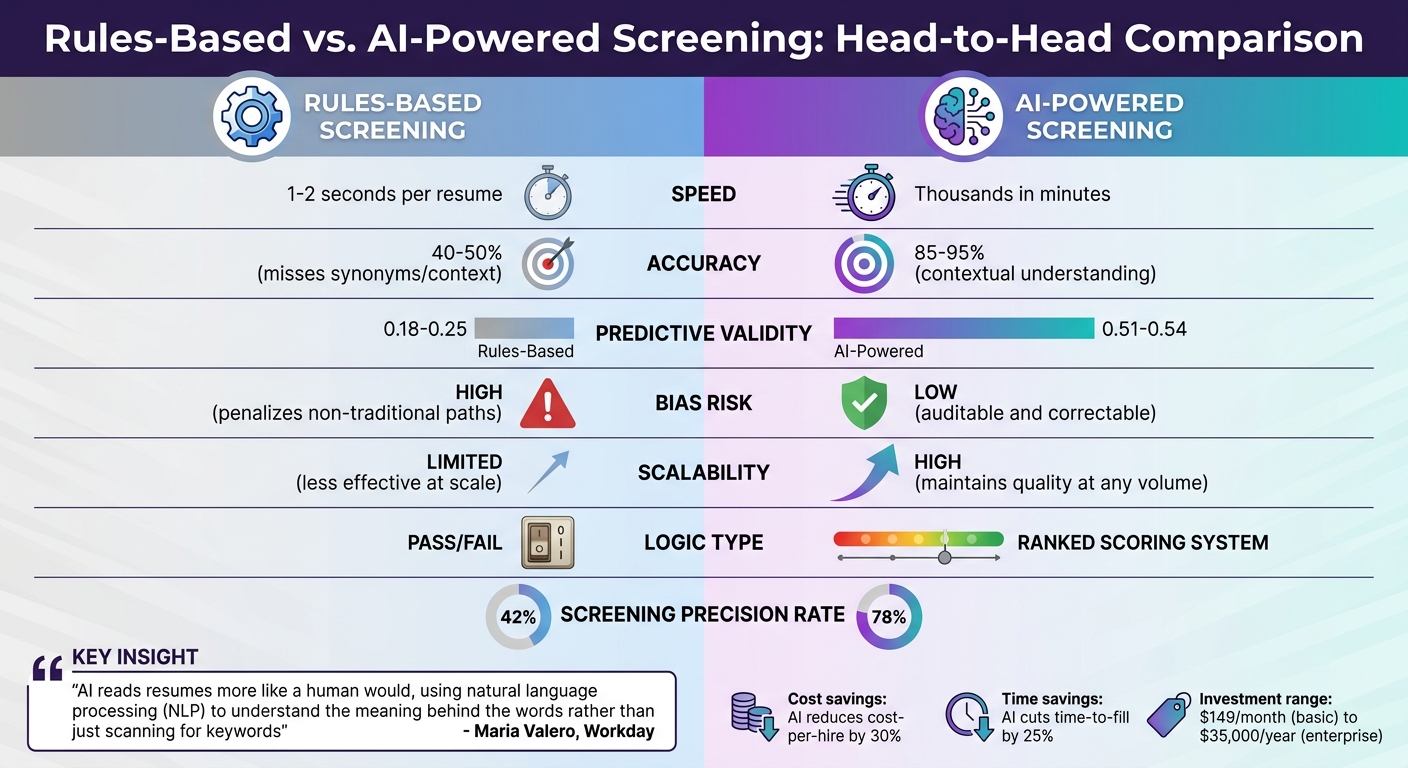
Rules-Based vs AI-Powered Candidate Screening: Performance Comparison
“AI reads resumes more like a human would, using natural language processing (NLP) to understand the meaning behind the words rather than just scanning for keywords” – Maria Valero, Workday [9]
Comparison Table
Here’s a side-by-side look at the key differences:| Feature | Rules-Based Screening | AI-Powered Screening |
|---|---|---|
| Speed | 1–2 seconds per resume [26] | Processes thousands in minutes [21] |
| Accuracy | 40–50% (misses synonyms/context) [26] | 85–95% (contextual understanding) [26] |
| Predictive Validity | 0.18–0.25 [28] | 0.51–0.54 [28] |
| Bias Risk | High (penalizes non-traditional paths) | Low (auditable and correctable) |
| Scalability | Limited (less effective at scale) [26] | High (maintains quality at any volume) [26] |
| Compliance | High (simple, auditable rules) | High (requires explainability features) [7][22] |
| Logic Type | Binary decision [26] | Ranked scoring system [26] |
Conclusion
Automated screening has reshaped the way recruitment works, turning it into a faster, more efficient process. The numbers speak for themselves: 87% of employers worldwide now incorporate AI into at least one hiring stage [4][6]. This shift has led to 75% reductions in screening time [4] and 30% lower cost-per-hire [4][6], making automation a game-changer for recruitment agencies. The key to success lies in thoughtful implementation. Agencies that once spent days screening candidates now complete the process within hours, significantly increasing placements without adding staff. However, the true value of automation is in its ability to support human decision-making rather than replace it.“The best automated screening systems do not try to predict who will get hired. They try to predict who will perform.” – Liz Ryan, Founder, Human Workplace [1]To see results quickly, start with roles that generate high application volumes. Define clear criteria upfront to separate qualified candidates from unsuitable ones before setting up the system. Regular demographic audits – done quarterly – can help identify and address potential biases early, avoiding legal complications. Most importantly, keep human oversight in place for final decisions and building meaningful relationships with candidates. The agencies thriving in 2026 won’t be those drowning in manual resume reviews. Instead, they’ll be the ones reclaiming 15+ hours per week per recruiter [3], engaging with the 67% of candidates who apply outside traditional business hours [5], and focusing on what truly matters: creating strong connections and making strategic matches. By adopting these practices, you can ensure every candidate is assessed fairly and efficiently, setting the stage for long-term recruitment success.
FAQs
Will AI screening reject qualified candidates unfairly?
AI screening tools are designed to streamline the hiring process and minimize biases, but their effectiveness depends entirely on how recruiters set up the criteria and algorithms. If these criteria are too restrictive or flawed, there’s a risk of unfairly excluding qualified candidates. On the flip side, when these systems are thoughtfully configured with inclusive and well-rounded parameters, they can contribute to a more equitable hiring process. However, poorly designed tools may unintentionally dismiss capable applicants due to narrow or biased settings.How do agencies audit AI screening for compliance?
Agencies help ensure fairness and compliance in AI screening processes by taking several key steps:- Establishing job-related, skills-based criteria to guide AI decision-making.
- Incorporating human-in-the-loop checkpoints to review and validate AI-driven outcomes.
- Conducting regular adverse-impact testing to identify and address potential biases.



How to Choose a Recruiting Agency for Your Business
September 15, 2026[…] is also worth asking how much of that automated candidate screening agencies use, versus manual review, since AI-driven pre-screening changes how fast a shortlist […]