

How to Post Jobs on Social Media at Scale: A Guide for Recruitment Agencies
Social media recruitment for agencies has changed dramatically in the past two years. Social media is now a key tool for recruitment, with 92% of companies using it to hire. Unlike traditional job boards, social platforms can reach 70%-75% of passive candidates who aren’t actively job hunting but might be interested in the right opportunity. However, managing job posts across platforms like LinkedIn, Facebook, Instagram, and TikTok can be overwhelming without the right strategy.
Here’s what you need to know:
- Why Social Media Matters for Hiring: It’s not just about posting jobs; candidates use your social media presence to evaluate your company culture. Well-crafted posts can attract more applications and boost your brand.
- Platform Selection: LinkedIn is great for professionals, but Instagram, Facebook, and TikTok are better for reaching younger or diverse audiences. TikTok, for example, now surpasses LinkedIn among Gen Z job seekers.
- AI and Automation: Tools like HireLab.io can automate job posting, create branded campaigns, and optimize application funnels, saving time while increasing efficiency.
- Tailored Content: Each platform requires unique posts. AI can reformat job info to fit LinkedIn’s professional tone, Instagram’s visual style, or TikTok’s short and catchy format.
- Key Metrics: Focus on application conversion rates, cost per applicant, and ad frequency to refine your campaigns and avoid wasted spending.
How to Recruit on Social Media: Reelist’s “Easy Button” for Frontline Hiring
Selecting the Best Social Media Platforms for Job Posting
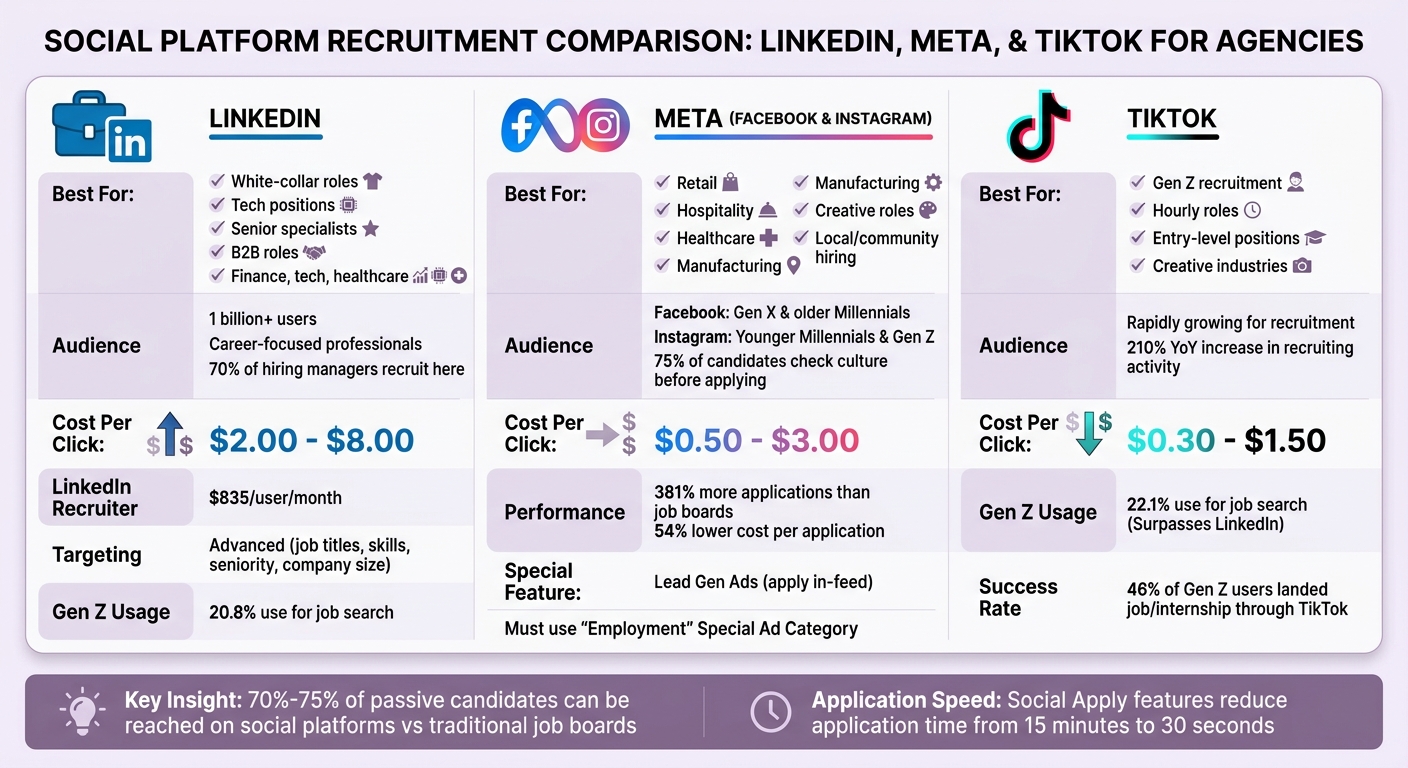
Social Media Platform Comparison for Recruitment: Costs, Audiences, and Performance
When deciding where to post job openings, the platform should align with the role you’re hiring for and the behavior of potential candidates. While LinkedIn often comes to mind first, it can be pricey and doesn’t reach the approximately 70% of job seekers who spend their free time on platforms like Instagram and TikTok instead of professional networks [1].
The trick lies in leveraging each platform’s strengths to meet your hiring goals. For instance, LinkedIn is ideal for white-collar, tech, and senior specialist roles where users are career-focused. On the other hand, Facebook and Instagram are better suited for industries like retail, hospitality, healthcare, and manufacturing – fields where candidates may not be actively searching for jobs. TikTok is also making waves in Gen Z recruitment, with 22.1% of Gen Z using it for job searches, surpassing LinkedIn’s 20.8% [1]. Even more compelling, 46% of Gen Z users have landed a job or internship through TikTok [2].
Cost is another factor to weigh. LinkedIn ads range from $2.00 to $8.00 per click, while Facebook/Instagram ads cost between $0.50 and $3.00, and TikTok ads are even lower at $0.30 to $1.50 per click [1]. Features like “Lead Ads” or “Social Apply” streamline the application process, cutting it down from 15 minutes to just 30 seconds by allowing candidates to apply directly on the platform [1].
Here’s a closer look at what each platform offers for recruitment.
LinkedIn: Reaching Professional Audiences
LinkedIn remains unmatched for hiring professionals, B2B roles, and specialists in industries like finance, tech, and healthcare. With over 1 billion users, it offers powerful targeting options based on job titles, skills, seniority, and company size [1][8]. However, this precision comes at a cost. LinkedIn Recruiter, for example, is priced at around $835 per user per month, and ad costs are generally higher than other platforms [8].
Despite its expense, LinkedIn’s audience is highly career-focused, making it worth the investment. In fact, 70% of hiring managers have successfully recruited through social media [6]. The platform is especially effective for reaching passive candidates – those who aren’t actively job hunting but are open to new opportunities. As Adway points out:
Posting a job link on LinkedIn? That’s not social recruiting – that’s just posting a job. Real social recruiting means running targeted ads to specific audience segments [1].
To get the best results, prioritize sponsored content and InMail campaigns rather than relying solely on organic posts. While LinkedIn is great for targeting professionals, Meta platforms provide broader reach and diversity.
Meta Platforms (Facebook and Instagram): Expanding Your Reach
Meta platforms, including Facebook and Instagram, are excellent for reaching a wide range of candidates, including those who may not be actively job hunting. Facebook’s advanced geo-targeting features make it particularly effective for local hiring and community-based roles.
The demographics of each platform also play a role. Facebook appeals more to Gen X and older Millennials, making it a strong choice for experienced workers in fields like skilled trades and healthcare. Meanwhile, Instagram attracts younger Millennials and Gen Z, which is ideal for creative roles, hospitality, and brands that emphasize workplace culture [2][3]. Instagram’s visual format also allows you to showcase your company culture through Stories and Reels, which 75% of candidates look for before applying [2]. TikTok, with its growing popularity among Gen Z, further enhances your ability to connect with younger job seekers.
Meta platforms are also cost-effective. They’ve been shown to generate 381% more applications than traditional job boards while cutting the cost per application by 54% [1]. Features like “Lead Gen Ads” allow candidates to submit their information directly within the feed, reducing drop-off rates [7].
One thing to keep in mind: when running recruitment ads on Meta, you must use the “Employment” Special Ad Category. This ensures compliance with anti-discrimination laws by restricting targeting based on age, gender, or zip code [6]. It’s a necessary step to keep your campaigns both effective and legally compliant.
Using AI Tools to Improve Job Post Quality
Crafting job posts that grab attention on social media can be tough, especially when you’re dealing with a high volume. That’s where AI tools come in – they make the process faster without sacrificing quality. Instead of reusing the same post across platforms, AI can help maintain your brand’s voice while tailoring content for each platform.
Here’s how: feed your AI tool around 20 of your best-performing posts. This helps it learn what works for your audience, from the language and tone to the style that drives engagement [5]. You can also set it up with your brand guidelines, approved hashtags, and tone-of-voice preferences, ensuring every draft aligns with your brand [5]. This consistency is particularly valuable during busy hiring periods when human teams might struggle to keep up [5].
A smart strategy is to focus on your Employee Value Proposition (EVP) rather than the full job description. Social media users scroll quickly, so it’s more effective to showcase what makes your workplace stand out rather than listing every requirement [9]. AI can rework the same job info into platform-specific formats – professional for LinkedIn, visual and story-driven for Instagram, or short and catchy for TikTok [9]. This tailored approach is essential, especially with 92% of recruiters now relying on social media for hiring [9].
Next, let’s look at how AI can elevate your headlines and visuals.
Creating Clear Headlines and Job Descriptions
Your headline is your first impression – it needs to stop someone mid-scroll. AI tools can help by analyzing successful posts and suggesting attention-grabbing alternatives. They can also break up text with emojis or bullet points and ensure the post is easy to read on mobile. Include key details like the role title, location, and an application link to make it actionable [9].
AI doesn’t just create catchy headlines; it adds depth. For example, instead of a generic “We’re hiring a Warehouse Manager”, try something like, “Ready to lead a team that keeps 50,000+ orders moving every week?” This not only highlights the role but conveys its impact in a way that resonates.
Once your text draws people in, visuals can amplify your message.
Adding Visuals and Maintaining Brand Consistency
Visuals are key to making your posts feel relatable. Real photos of your team or workspace help candidates imagine themselves in the role, while stock images often lack that personal touch [9]. AI platforms can simplify design by generating branded ads, carousels, or short videos directly from a job URL. This keeps your visuals consistent without requiring advanced design skills [10][11].
Templates are another great way to ensure consistency. Create go-to designs for different job levels – like one for entry-level roles and another for senior positions – and let AI fill in the details. This approach keeps your visual identity cohesive across platforms, encouraging more applications and reinforcing your brand.
Automating Job Posting with HireLab.io

Posting jobs manually across various platforms can eat up valuable hours that could be better spent interviewing or vetting candidates. HireLab’s multi-client recruitment software simplifies this process by taking a single job URL and transforming it into a full-blown social media campaign in less than 15 minutes [4]. From ad creation to publishing, the platform removes the hassle of dealing with tools like Meta Business Manager or complex design software. This approach helps streamline recruitment workflows right from the start.
But it doesn’t stop at just scheduling posts. HireLab.io is smart about choosing the right channels for your target audience. For instance, it directs Gen Z-focused hourly roles to TikTok while steering skilled trades or healthcare positions to Facebook [3]. Using seed data from your ATS or previous applicant lists, the system builds lookalike audiences, targeting passive candidates who display similar professional behaviors [3].
The platform also eliminates technical headaches. Forget about setting up tracking pixels, ad formats, or campaign structures manually. HireLab.io automatically launches ads on Facebook and Instagram, fully configured and ready to go [4]. For agencies juggling multiple clients, the multi-client dashboard makes it easy to manage several campaigns at once. Plus, white-label landing pages ensure each client’s branding stays front and center [4]. This level of automation is especially helpful for recruitment agencies running multiple hiring campaigns simultaneously.
Building Recruitment Funnels with HireLab.io
Automation is only half the battle. To attract top-quality candidates, you need a well-designed recruitment funnel that guides them from clicking on your ad to completing an application. HireLab.io’s Page Builder creates mobile-optimized landing pages that seamlessly integrate with your social media campaigns [4]. These aren’t cookie-cutter templates – you can customize them to reflect each client’s unique employer brand while keeping the process quick and efficient.
The platform’s Smart Forms feature helps reduce drop-offs. Traditional forms can lose up to 92% of applicants [4] due to lengthy fields or document upload requirements. HireLab.io replaces these with conversational forms that use built-in screening logic to qualify candidates in real-time [4]. For even faster results, the WhatsApp Apply feature leverages an AI assistant to guide applicants through screening questions and shortlist them in under a minute [4]. This speed is crucial when competing for high-volume roles where candidates are likely applying to multiple positions at once.
Scheduling and Publishing Posts Automatically
After building your recruitment funnel, HireLab.io ensures your job ads stay visible by automating the scheduling and publishing process. It creates and tests ad creatives automatically, optimizing posting frequency to keep your ads fresh while avoiding overexposure to the same audience [3]. This way, your job posts consistently reach new candidates without annoying existing ones.
The platform also streamlines lead management by routing qualified applicants directly to your team or your ATS [3]. If you don’t have an ATS, no problem – HireLab.io includes a free built-in system that organizes up to 50 applicants on the free plan, with unlimited capacity on paid tiers [4]. This ensures no candidate slips through the cracks, even if you’re managing multiple campaigns across various clients and platforms. By automating these tasks, HireLab.io integrates seamlessly into your broader social recruiting strategy.
Reaching Passive Candidates on Social Media
Finding passive talent means going beyond automated posting and AI tools. Since 70% of the global workforce consists of passive candidates who rarely browse job boards, the key is to connect with them where they’re already active – on social media [2].
While organic posts can engage your current followers, reaching passive candidates requires sponsored ads. Platforms like Facebook or LinkedIn allow you to use lookalike audiences by uploading seed data from your ATS, such as recent hires or top applicants. This helps the platform identify users with similar professional traits and behaviors, all while staying compliant with Equal Employment Opportunity guidelines [3].
Keep an eye on your ad frequency score – the number of times the same person sees your ad. If it hits 5 or more, you risk overspending and causing ad fatigue [3]. And to truly capture passive candidates, make sure your application process is simple and quick.
Qualifying Candidates with Smart Forms
Passive candidates aren’t actively seeking jobs, so they won’t stick around for a complicated application process [12]. Long forms and clunky uploads are a surefire way to lose them. Tools like HireLab.io’s Smart Forms tackle this problem with conversational, mobile-friendly designs that qualify candidates in real time.
These forms ask focused, upfront questions like, “Do you have a valid work permit?” or “Are you available to start within 30 days?” This helps filter out unqualified candidates early, saving time and effort. Speed matters when competing for passive talent who may be juggling multiple offers.
Using Data to Improve Campaign Targeting
Data isn’t just for tracking – it’s for refining. Labeling leads as “high-quality” or “low-quality” trains algorithms to improve your campaign’s efficiency over time [3].
Focus on metrics that matter. Cost per application shows whether social ads are more cost-effective than job boards, while the application-to-hire rate reveals which platforms deliver the best candidates [1]. Adding UTM parameters to your job links can pinpoint which posts and platforms drive applications [2]. HireLab.io’s analytics dashboard makes it easier to track results and tweak your strategy as needed.
Keeping Your Employer Brand Consistent Across Platforms
When your branding varies across platforms, it can damage the trust candidates have in your company. Think about it – if your messaging or visuals are inconsistent, candidates may feel confused or even disengaged. A fragmented brand doesn’t just look unprofessional; it leaves candidates questioning what your company truly represents.
This challenge becomes even bigger when managing recruitment campaigns on a large scale. Without a centralized system, teams might create multiple versions of the same job post, each with different colors, fonts, or messages. This lack of cohesion can weaken your clients’ brand identity, making your agency seem disorganized and leaving candidates uncertain about a company’s values.
“One of the most pressing challenges is maintaining consistent messaging across different communication channels, especially in an era of remote work and hybrid models.” – Universum [13]
The solution? A unified digital experience. By directing all social media traffic to consistent, mobile-friendly landing pages, you can ensure candidates experience the same branding no matter where they interact. Using standardized templates, matching color schemes, and cohesive messaging helps solidify your clients’ employer brands. Whether a candidate clicks on a Facebook ad or visits an application page, the transition should feel smooth and familiar – like they’re engaging with the same company throughout.
Using Templates and Mobile-Friendly Design
To create a consistent brand experience across the candidate journey, platforms like HireLab.io offer tools that make it easier to stay on-brand. For example, their branded templates allow you to create job ads with a unified look across platforms like Facebook, Instagram, and Stories – no advanced design skills required [14]. This template library ensures every post is visually aligned while still offering room for customization based on specific roles or clients. For agencies juggling multiple clients, their white-label landing pages feature enables you to maintain professional, distinct branding for each client [14].
Since mobile usage dominates, this aspect is more critical than ever. Over 72% of U.S. adults use social media daily [3], with most accessing it on mobile devices. HireLab.io’s Smart Forms are designed with mobile-first in mind, ensuring candidates have a seamless experience regardless of their device. This prevents the disconnect of clicking on a sleek Instagram ad only to land on a clunky, desktop-only application page. Instead, candidates get a polished and consistent journey from start to finish.
Tracking Performance and Improving Your Campaigns
Launching a social media recruitment campaign is just the start. The real impact comes from understanding what’s working and refining what isn’t. Without tracking, you’re essentially guessing which platforms are bringing in quality candidates. The good news? You don’t need advanced skills to measure success. Let’s break down the metrics that truly matter for recruitment.
Important Metrics to Monitor
Not every number is worth your time. Sure, follower counts and likes might look impressive, but they don’t fill open positions. Instead, focus on metrics that directly influence recruitment outcomes, like:
- Application conversion rate: The percentage of people who click on your ad and complete an application.
- Cost per applicant: How much you’re spending to get each application.
- Engagement rate: How often people interact with your posts.
One often-overlooked metric is the frequency score – how many times the same person sees your ad. If this number exceeds 5, you’re likely wasting your budget. As HireLab.io explains:
“If your job ad frequency hits 5+, and you’re still spending budget to hit that person again and again, you’re burning dollars [3].”
At this point, your ad becomes invisible to candidates – they’ve seen it so many times that they start scrolling past without even noticing.
Platforms like HireLab.io simplify tracking by automating pixel setup and offering tools like an AI-powered Match Score. This score (e.g., 95%) appears next to each applicant’s name, instantly showing which campaigns are bringing in top-tier candidates. Instead of manually sorting through applications, you can quickly see which platforms are delivering quality over quantity. Combined with insights from automated processes, this ensures your campaigns are fine-tuned for success.
Using UTM parameters on your job links is another powerful strategy. These tags let you pinpoint exactly which platform and post drove each application, making it easier to allocate your budget effectively.
Adjusting Campaigns Based on Results
Once you’ve identified which ads are thriving and which aren’t, it’s time to take action. Scale up the campaigns that are working and cut back on those that aren’t. For example, if one platform consistently delivers applications at a lower cost, shift more of your budget there.
You can also improve results over time by feeding quality data back into social media platforms. If you track which applicants get hired or perform well in interviews, platforms like Meta can use that data to refine their algorithms and target similar candidates. This creates a feedback loop that makes future campaigns even more effective.
Refreshing your ad creatives is another essential step. Social media ads tend to lose their effectiveness after about 21 days. If you notice engagement dropping or costs creeping up, it’s time for a change. A full overhaul isn’t always necessary – sometimes, small tweaks like changing the image, adjusting the headline, or refining your audience targeting can make a big difference. Regular A/B testing of different creatives, headlines, and audience segments can also help you figure out what resonates most with candidates before committing your full budget.
| Metric | What It Measures | Why It Matters |
|---|---|---|
| Click-Through Rate (CTR) | % of people who click after seeing the ad | Shows if your ad content and targeting are effective [16] |
| Cost Per Applicant (CPA) | Total spend divided by applications | Indicates how cost-efficient your campaign is [15] |
| Conversion Rate | % of clicks that result in completed applications | Highlights potential issues in the application process if low [16] |
| Frequency | Average number of times a person sees the ad | High frequency (>5) signals ad fatigue and wasted spend [3] |
| Quality of Hire by Source | Performance of hires from specific channels | Helps decide where to focus your budget [16] |
Conclusion
Posting jobs on social media at scale doesn’t have to mean endless manual effort or compromising on quality. The agencies that thrive in this space are those that embrace automation, utilize AI-powered tools, and recognize that social recruiting is a long-term strategy. It’s about connecting with passive talent – the 70% of the workforce who aren’t actively job hunting but would consider the right opportunity[2].
The key is to focus on a few essential principles: choose platforms where your ideal candidates spend their time, leverage AI to ensure consistent branding and messaging, and automate time-consuming tasks that bog down your team. Tools like HireLab.io make it possible to launch fully branded campaigns with optimized landing pages and smart forms in under 15 minutes – all from a single job URL[11]. This isn’t just about saving time; it’s about creating seamless, mobile-friendly experiences that can prevent losing up to 92% of potential applicants due to clunky application processes[11].
Keep the 80/20 rule in mind: dedicate most of your content to telling your employer brand story, leaving only a small portion for direct job promotion. This strategy keeps passive candidates engaged and builds trust well before they’re ready to apply[2]. Combine this with smart tracking – like UTM parameters and monitoring quality metrics – and you’ll have a clear picture of which platforms deliver results worth scaling.
The recruitment game has changed. With 92% of companies now using social media for hiring and platforms like TikTok seeing a 210% increase in recruiting activity year-over-year[2], sticking to outdated methods isn’t an option. The good news? You don’t need a huge team or advanced tech skills to stay competitive. With the right tools and systems, you can work smarter – not harder – and stay ahead of the curve.
FAQs
How do I choose the best platform for each role?
To find the right platform, start by understanding where your ideal candidates spend their time online. For active job seekers, platforms like LinkedIn are a great choice because they offer professional targeting features. On the other hand, if you’re trying to reach passive candidates, consider using platforms like Facebook, Instagram, or TikTok, where you can leverage targeted ads to grab attention.
It’s also important to match the platform to the type of role you’re hiring for. For roles that rely on visuals, such as design or creative positions, Instagram or TikTok are ideal. Meanwhile, more technical or professional roles are better suited for LinkedIn. To make this process easier, consider using automation tools to manage and optimize your efforts efficiently.
What should I automate first to post jobs at scale?
Automating your social media management can be a game-changer. Start by setting up tools to schedule and distribute job posts across various platforms. This ensures your openings get consistent visibility while saving you valuable time. You can also automate the process of targeting and boosting sponsored job ads, helping you connect with passive candidates more effectively. These strategies simplify the process of managing high-volume job postings while keeping things efficient and accurate.
How do I measure if social job ads are worth it?
To determine whether social job ads are worth the investment, focus on ROI metrics like candidate quality, candidate quantity, ad engagement, and cost-per-hire. It’s also important to track long-term outcomes, such as how these ads contribute to pipeline growth over a period of 6–12 months. Use tools like analytics platforms and social listening to gauge how far your ads are reaching and resonating with your audience. If the ads help you attract better candidates, strengthen your employer brand, and reduce recruitment costs, they’re likely delivering real value.