

Benefits of Social Media Recruitment: Why Modern Companies Are Making the Switch
The benefits of social media recruitment are reshaping how modern companies attract and hire talent. Instead of relying on outdated methods that only reach active job seekers, businesses are using platforms like LinkedIn, Facebook, X (Twitter), and TikTok to connect with both active and passive candidates. This shift reduces hiring costs, improves candidate quality, and strengthens employer branding in a highly competitive job market
Key Takeaways:
- 92% of employers now hire through social media, reaching a wider audience.
- 73% of job seekers aged 18-34 found their last job on social platforms.
- It’s cost-effective – social recruiting costs less than older methods and delivers better results.
- Social media allows companies to showcase workplace culture through videos, employee stories, and interactive content.
- Tools like LinkedIn and Facebook offer precise targeting and analytics to streamline hiring.
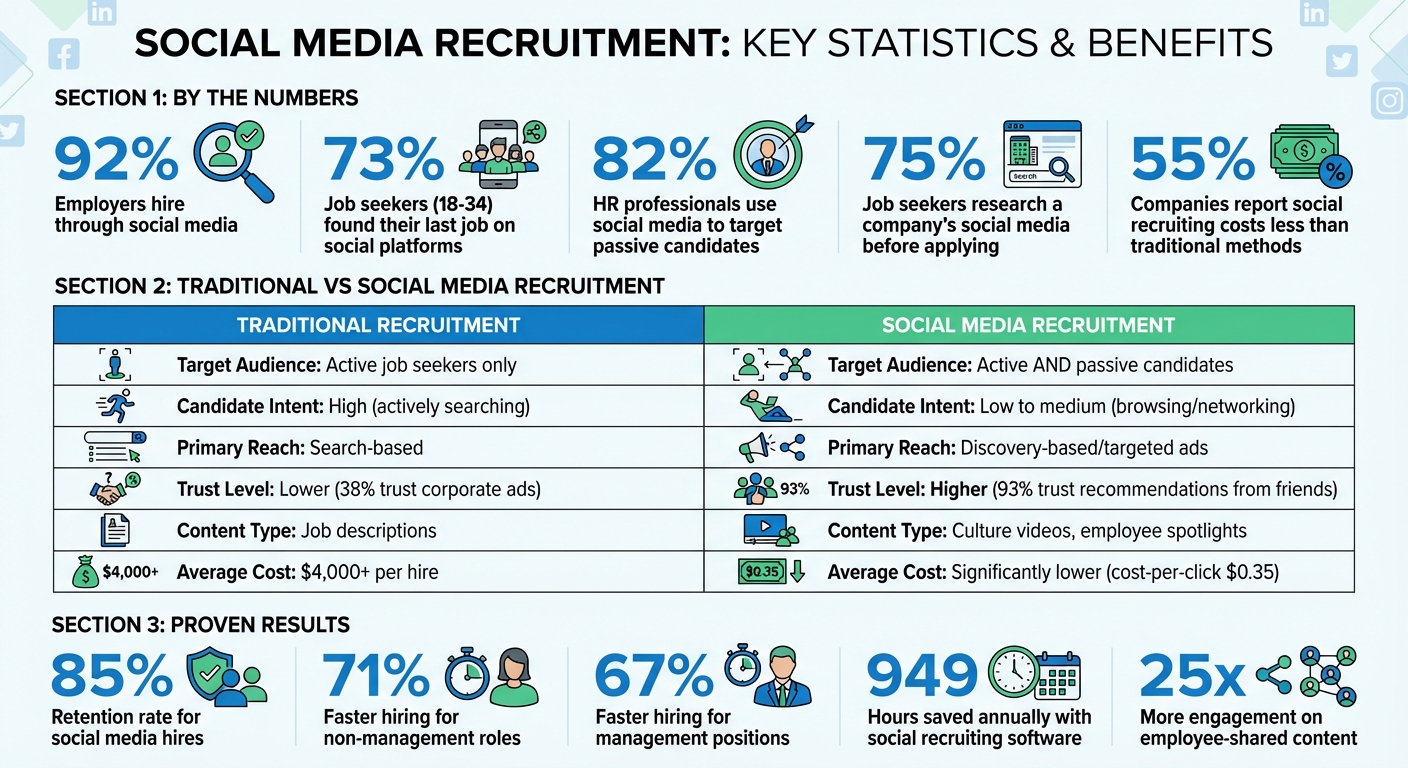
Social Media Recruitment Statistics and Benefits Comparison
Social Media Recruitment in 2025 – March 20, 2025 Webinar
Problems with Traditional Recruitment Methods
Before the rise of social media recruitment, companies leaned heavily on job boards, recruitment agencies, and career fairs to find talent. While these methods still play a role, they come with some serious limitations, prompting organizations to explore more effective alternatives. These shortcomings have paved the way for a more focused and efficient approach through social media.
High Costs and Limited Reach
Traditional recruitment methods often come with hefty price tags. From agency fees to print ads and job board subscriptions, the costs can quickly add up. And the worst part? These methods usually target only active job seekers, which means you’re paying for a pool of candidates that might not even include the right fit for your role. On top of that, these methods often result in an overwhelming number of unqualified applications. Sorting through them takes time, effort, and even more money.
Then there’s the issue of candidate drop-off. A staggering 92% of candidates abandon online job applications due to overly complicated forms or unnecessary steps. That means a big chunk of your recruitment budget is wasted on processes that discourage applicants before they even finish applying.
But it’s not just the cost – it’s also about reach. Traditional methods struggle to connect with a broader audience, especially those who aren’t actively job hunting.
Difficulty Reaching Passive Candidates
One of the biggest blind spots in traditional recruitment is its inability to reach passive candidates – those talented individuals who aren’t actively searching for jobs but might be open to the right opportunity. These folks won’t be scrolling through job boards, which means your carefully crafted job posting never even crosses their radar.
This is where the benefits of social media recruitment comes in. 82% of HR professionals say they use social media specifically to target passive candidates. Unlike traditional methods, which are essentially a call for applications, social media allows companies to build relationships with potential candidates through engaging content and a strong employer presence. It’s about planting the seed long before a job opening even exists.
Weak Employer Branding
Another major drawback of traditional recruitment? It does little to showcase your company’s culture. Job boards are great for listing openings, but they don’t help candidates get a feel for your workplace or values. And that’s a problem because today’s job seekers want more than just a paycheck – they want to work for a company whose culture aligns with their own.
Here’s the reality: 75% of job seekers research a company’s social media presence before applying. And 68% of millennials specifically check out a company’s social media to assess its employer brand. Yet traditional methods can’t match the authenticity and visibility that social media offers. To make matters worse, only 38% of people trust traditional advertising, while 93% trust recommendations from friends and family.
As Hootsuite puts it: “People apply to companies, not jobs”. If your employer brand isn’t visible and relatable where candidates are spending their time, you’re already falling behind.
| Feature | Traditional Recruitment | Social Media Recruitment |
|---|---|---|
| Target Audience | Active job seekers only | Active and passive candidates |
| Candidate Intent | High (actively searching) | Low to medium (browsing/networking) |
| Primary Reach | Search-based | Discovery-based/targeted ads |
| Trust Level | Lower (corporate ads) | Higher (employee advocacy/social proof) |
| Content Type | Job descriptions | Culture videos, employee spotlights |
These limitations don’t just drain resources – they also make it harder to connect with top talent. It’s clear that businesses need to rethink their approach if they want to stay competitive in today’s hiring landscape.
Main Benefits of Social Media Recruitment
Now that we’ve discussed the drawbacks of traditional recruitment methods, let’s dive into the benefits of social media recruitment. These benefits address the high costs, limited reach, and weak employer branding often associated with older hiring practices.
Wider Reach and Access to Passive Talent
Did you know that the main benefit of social media recruitment is to open the door to a much larger pool of potential candidates? With 90.71% of mobile users active on social platforms, you’re connecting with people where they already spend a significant amount of time. This includes passive candidates – those who aren’t actively job hunting but could be intrigued by the right opportunity.
For instance, 73% of job seekers aged 18 to 34 found their last job through social media. That’s a huge audience that traditional methods simply can’t tap into.
Social platforms also help expand diversity in hiring. Platforms like Facebook, Instagram, and Twitter are widely used by Black and Hispanic Americans, making it easier to build a more inclusive talent pipeline. In fact, 33% of companies use social media specifically to connect with underrepresented groups, such as women, minorities, and veterans.
Employee advocacy further amplifies this reach. When your employees share job openings on their own profiles, they act as powerful brand ambassadors, reaching networks that your company’s official page might not. And it works – 92% of recruiters use social media to find candidates they consider “high quality”.
Beyond reach, social recruiting also makes a noticeable dent in hiring expenses.
Lower Recruitment Costs
Another major benefit of social media recruitment is cost efficiency, as companies can significantly reduce spending on job boards, agencies, and career fairs. Traditional hiring can be expensive. Between job board subscriptions, agency fees (often 15-25% of a hire’s salary), and career fair costs, the average expense to hire through these methods tops $4,000. Social media recruitment, on the other hand, can significantly reduce these costs.
Platforms like LinkedIn, Facebook, and Instagram let you post job openings, share team highlights, and showcase your company culture for free through organic content. Even if you invest in paid social ads, the advanced targeting tools ensure your budget reaches the right candidates – not just a general audience.
The numbers back this up: 55% of companies report that social recruiting is less expensive than traditional methods. It’s why 49% of HR professionals plan to increase their investment in social recruiting.
Real-world successes highlight the cost-efficiency of social hiring. In 2021, Texas Roadhouse used social media to attract over 400,000 applicants in just one year, achieving their lowest-ever cost per hire. Similarly, during a holiday hiring push, Ulta Beauty saw a 53% year-over-year increase in hires through social platforms. Boston Market even reported an 85% retention rate for employees hired via social media, saving money on turnover costs.
“Job posts are now one of our highest drivers of traffic; they consistently perform better than ads promoting products and services.” – Manager of Creative Services and Design, Security Provider
Employee advocacy adds yet another layer of savings. If 100 employees each share a job post with their 150 followers, that’s 15,000 people reached – for free. Plus, 93% of people trust job information shared by friends and family, compared to just 38% who trust traditional ads.
In addition to cost and reach, social media elevates your employer branding to a whole new level.
Better Employer Branding
Traditional job boards might explain what your company does, but social media gives candidates a glimpse of who you are. This matters because today’s job seekers don’t just look for positions – they look for companies that align with their values and culture.
Strengthening employer brand visibility is one of the most valuable benefits of social media recruitment, especially for companies competing for high-quality talent.
Social media allows you to showcase your workplace personality through behind-the-scenes content, employee stories, day-in-the-life videos, and office culture highlights. It’s no surprise that 75% of active job seekers are more likely to apply for a job if the employer actively manages its brand on social platforms. Plus, 49% of professionals follow companies on social media to stay updated on job opportunities.
Trust plays a big role here. Content shared by employees is seen as 25 times more authentic than posts from official brand accounts. When your team shares updates and job openings, they provide valuable social proof.
Companies are seeing results from this approach. In 2020, NJ Transit used Twitter and Facebook – reaching over 245,000 followers – to highlight employees and community initiatives while recruiting bus operators. The result? A 60% increase in resumes. Similarly, in 2018, 84 Lumber automated job postings across Facebook, Twitter, and LinkedIn to compete with bigger rivals. Their Recruiting Manager, AnneMarie Korach, described it as “the slingshot approach we needed to beat the big-box giants at acquiring top talent”.
“Beyond optimizing the delivery of our jobs on social media, CareerArc also helps us reinforce our brand. As a marketer, I like being able to create, save, and schedule social media content all within one platform.” – Clare Hogan, Marketing Coordinator, Hyde Engineering + Consulting
Some companies have taken it a step further by creating dedicated career-focused social accounts, like @LifeAtGoogle or @StarbucksPartners, to build communities specifically for potential hires. Cactus Club Cafe even uses a TikTok recruitment account to share behind-the-scenes clips, drink-pouring videos, and fun challenges, successfully attracting younger talent.
In short, social media transforms your employer brand from static job descriptions into a dynamic, engaging story about why your company is a great place to work.
How Social Media Recruitment Improves Candidate Quality
Social media recruitment enhances the quality of candidates by leveraging precise targeting, using social profiles for pre-screening, and employing analytics for smarter decision-making. These tools address the gaps left by traditional recruitment methods and bring efficiency to the hiring process.
For HR teams looking to turn these advantages into daily hiring practices, applying proven recruitment on social media tips helps ensure consistency, compliance, and better hiring outcomes across roles.
Targeted Advertising for Precision
Social platforms are equipped with powerful targeting features that allow job ads to reach the right audience with smarter job ads. You can filter candidates by job title, industry, skills, education, and location. For instance, LinkedIn enables targeting based on seniority and years of experience, while Facebook allows you to focus on candidates by their employer or professional memberships. Tools like Facebook Pixel and LinkedIn Insight Tag take it a step further, re-engaging users who’ve already visited your careers page.
It’s no surprise that 92% of recruiters rely on social media to find top-tier candidates, and 63% of job seekers say they’ve applied for jobs they discovered on these platforms. As Lilly Chesser from Zippia puts it:
“Advertising on social media allows you to focus more on hiring for specific positions, and can ultimately result in a quicker hiring process.”
This precision ensures that the right candidates see your job postings, making the hiring process more efficient and effective.
Pre-Screening with Social Profiles
Social media profiles act as living resumes, offering more than just a snapshot of a candidate’s work history. Recruiters can explore career achievements, skills, and even communication styles before initiating contact. In fact, 71% of U.S. hiring decision-makers believe that reviewing social profiles is a valuable way to screen applicants. LinkedIn, for example, is great for verifying professional qualifications, while platforms like Twitter or Instagram can provide a sense of a candidate’s personality and workplace fit.
This method not only saves time but also improves the quality of hires. 73% of recruiters report successful hires through social media, and 69% of hiring managers say referral programs driven by social media yield excellent candidates. By tapping into these profiles, recruiters can make more informed decisions before even reaching out.
Data-Driven Decision Making
Social media platforms also offer analytics that help recruiters fine-tune their strategies. Metrics like engagement, click-through rates, and application submissions reveal what works and what doesn’t. This data allows for continuous improvement in targeting and outreach. For instance, 71% of employers report shorter hiring times for non-management roles, and 67% note faster hiring for management positions when using social media recruitment strategies.
Why Companies Should Invest in Social Media Recruitment
Social media recruitment offers measurable results, simplifies the hiring process, and ensures businesses are ready to meet future talent demands.
Return on Investment (ROI)
When evaluating long-term hiring performance, the measurable ROI stands out as one of the strongest benefits of social media recruitment.
Recruiting through social media is cost-effective, speeds up hiring, and improves the quality of hires. In fact, 55% of companies report that social recruiting costs less than traditional methods. For example, the average cost-per-click for job-related posts on social media is just $0.35, which is 68.2% lower than other recruitment marketing approaches.
By using social media recruitment software, organizations save an average of 949 hours of work annually, giving hiring managers more time to focus on evaluating candidates. The results speak for themselves: 71% of companies see faster hiring for non-management roles, while 67% report quicker placement for management positions.
Additionally, employee referral programs, often boosted by social media sharing, lead to hires who stay 70% longer than those sourced through other methods. Social media also helps companies reach passive candidates directly, eliminating the need for costly third-party recruiters or agencies, which can charge thousands of dollars per placement.
These savings not only improve current hiring processes but also lay the groundwork for future recruitment strategies.
Preparing for the Future of Hiring
Beyond cost savings, social media recruitment aligns with how today’s workforce looks for jobs. 73% of job seekers aged 18 to 34 found their most recent job through social media, and 48% of Gen Z and Millennials have applied to roles they discovered on these platforms. As these groups become the dominant workforce, social media will remain a key channel for talent acquisition.
The numbers back this up: social media users exceeded 4.95 billion in late 2023, while reliance on traditional job boards has dropped by 13% since 2020. With 92% of internet users accessing the web via mobile devices – and spending 50% of their time on social and communication apps – companies that skip social media recruitment risk missing out on where candidates are most active.
“Social media has transcended its roots in social connectivity, morphing into the de facto platform for consuming all forms of digital content – breaking news, restaurant recommendations, and, increasingly, job applications.” – Shafiur Rahman, CEO at ChatterWorks
Social media also helps build diverse and lasting talent pipelines. 82% of workers are more likely to click on job opportunities shared by someone in their network, and employee-shared content gets shared 25 times more often than posts from company accounts. These platforms enable targeted outreach to underrepresented groups and allow companies to showcase their diversity initiatives through authentic employee stories. With 49% of HR professionals planning to expand virtual recruitment efforts, social media is becoming the backbone of flexible, real-time hiring strategies.
Specialized tools make it easier for companies to leverage these benefits.
Tools to Simplify Social Media Recruitment
Managing recruitment campaigns across multiple social platforms can feel overwhelming, but the right tools simplify the process.
Take HireLab.io, for instance. This platform automates social media recruitment, turning job postings into engaging, conversion-friendly landing pages using AI. Smart forms help pre-qualify candidates and reduce the 92% drop-off rate often seen with lengthy online applications. Its campaign builder creates complete recruitment funnels optimized for both desktop and mobile users in just minutes.
HireLab.io integrates seamlessly with platforms like Meta (Facebook, Instagram) and LinkedIn, allowing you to manage campaigns from a single dashboard. Built-in ad optimization and automation free up time and resources, letting hiring teams focus on evaluating candidates. For companies without an applicant tracking system, HireLab.io even provides a free ATS to organize and capture applicant data.
Whether you’re launching your first social media recruitment campaign or scaling an existing one, tools like HireLab.io eliminate the technical hurdles, allowing you to connect with candidates where they already spend their time.
Conclusion
In essense, the benefits of social media recruitment go far beyond lower costs, offering companies faster hiring cycles, stronger employer branding, and access to higher-quality candidates.
Traditional recruitment methods have their place, but social media strategies are reshaping how companies connect with talent. Today, 92% of recruiters use social media to find top-tier candidates, making it clear that this approach is more than a passing trend – it’s the new standard in hiring success. Ignoring this shift means risking the loss of exceptional talent to competitors who are already engaging candidates where they spend the majority of their time. After all, traditional job boards simply can’t match the reach to the 70–80% of the workforce that is open to new opportunities but not actively job hunting. The result? Faster, more efficient hiring processes.
The numbers speak for themselves – social media recruitment isn’t just cost-effective; it fosters stronger connections with candidates. Beyond saving money, it helps companies build genuine employer brands that resonate with potential hires, delivering measurable results.
Adopting this approach doesn’t have to be complicated. Platforms like HireLab.io simplify the transition with tools like campaign automation and mobile optimization. Their AI-powered landing pages and smart forms tackle the 92% application drop-off rate that derails most online recruitment efforts. Plus, their free applicant tracking system ensures no qualified candidate slips through the cracks. Here is a guide that will help you follow the step-by-step social media recruitment process.
The benefits are undeniable. Companies leveraging social media recruitment report 85% retention rates for hires sourced through these channels, and content shared by employees generates 25 times more engagement than standard corporate posts. With nearly 49% of HR professionals expanding their virtual recruitment efforts, it’s clear that now is the time to align your hiring strategy with the digital workforce.
FAQs
How does social media recruitment help companies find better candidates?
Social media recruitment enhances the hiring process by connecting employers with a wider and more engaged pool of potential candidates. Platforms like LinkedIn, Instagram, and Facebook offer tools to target individuals based on specific criteria such as experience, skills, and industry. This method not only attracts active job seekers but also reaches passive candidates who might not be browsing traditional job boards. The result? A pool of applicants who are better aligned with the company’s needs and values.
These [social media recruitment platforms] also provide a glimpse into a candidate’s professional accomplishments, public work, and even personal interests, giving recruiters valuable insight before the interview process begins. By engaging with individuals who connect with the company’s brand and mission, social media recruitment helps ensure a stronger alignment between the role and the new hire, ultimately improving the overall quality of employees brought on board.
How does social media recruitment help reduce hiring costs?
Social media recruitment can help companies save money by cutting back on expensive job board postings and traditional advertising methods. Many social platforms provide free or affordable ways to promote job openings, offering a cost-effective solution for hiring needs.
It also speeds up the hiring process. Recruiters can directly connect with potential candidates, which simplifies communication and ensures they reach the right talent faster. This efficiency not only saves time but also reduces the costs tied to lengthy recruitment efforts.
How can companies effectively highlight their employer brand on social media?
Companies can effectively highlight their employer brand on social media by maintaining a consistent and engaging presence that mirrors their values and workplace vibe. Start with a well-defined employee value proposition (EVP) that showcases your mission, perks, and growth opportunities. Make sure this EVP shines through in the visuals, tone, and messaging across platforms like LinkedIn, Instagram, and TikTok.
Sharing genuine, relatable content is key to building trust and sparking interest. Encourage employees to share behind-the-scenes glimpses, success stories, or “day-in-the-life” videos that bring your workplace to life. Take advantage of platform-specific features like Instagram Reels or LinkedIn Stories to offer candidates a closer look at your company culture. Quick, engaging posts about employee perks, diversity efforts, or community projects can also leave a lasting impression.
Boost interaction by hosting Q&A sessions, running polls, and inviting followers to ask about your company. Keep an eye on engagement metrics – likes, shares, comments – to fine-tune your approach and ensure your employer brand stays fresh and appealing to prospective candidates.