

What Is Social Media Recruitment? A Complete Beginner’s Guide
Social media recruitment is the practice of using platforms like LinkedIn, Instagram, Facebook, TikTok, and X (formerly Twitter) to find, attract, and hire candidates. It goes beyond posting job ads – it’s about showcasing your company’s personality, connecting with passive talent (80% of the workforce), and engaging candidates through authentic content.
Key takeaways:
- 92% of companies now use social media for hiring.
- 73% of millennials found their last job through social media.
- 63% of active job seekers apply for roles they see on their feeds.
- Social media helps target passive candidates, who aren’t actively applying but are open to opportunities.
- Companies using this strategy report a 50% increase in candidate quality.
Social media recruitment combines direct outreach (messaging, ads) with indirect engagement (videos, employee stories). Each platform serves a unique purpose:
- LinkedIn: Professional roles and networking.
- Instagram & TikTok: Visual storytelling for younger audiences.
- Facebook: Local and targeted hiring.
This approach saves time, cuts costs, and improves candidate quality by reaching a broader audience while building trust and transparency.
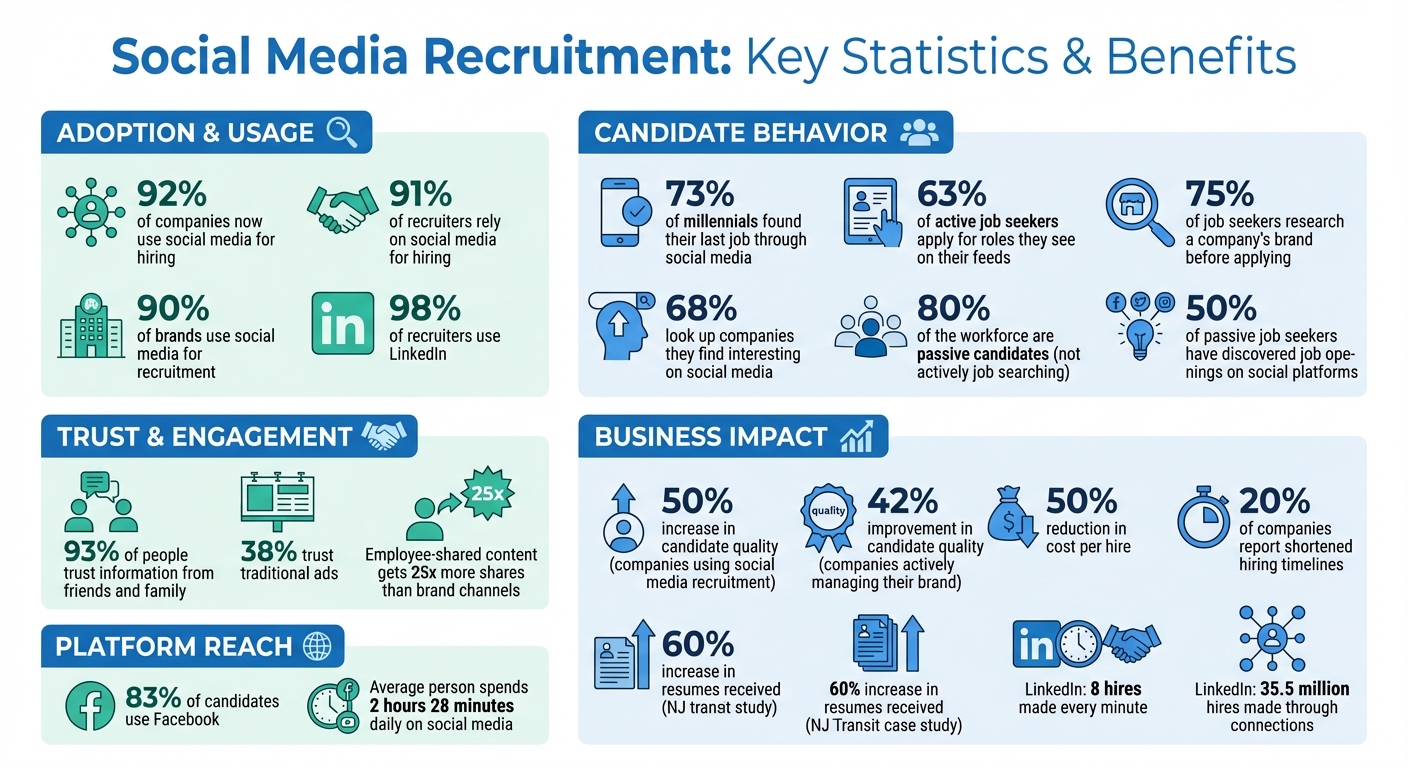
Social Media Recruitment Statistics and Key Benefits
The Ultimate Guide to Recruiting on Social Media
What Is Social Media Recruitment?
If you want to understand what is social media recruitment in a business context and why companies are rapidly adopting it, this shift toward social recruitment explains how it delivers faster, more cost-effective hiring results.
Social media recruitment involves using platforms like LinkedIn, Facebook, Instagram, TikTok, and Twitter to find, attract, engage, and hire candidates. But it’s so much more than just posting job ads – it’s about building relationships with potential hires and giving them a glimpse into your company’s culture.
This method combines direct outreach, like sending messages or running ads, with more subtle efforts, such as sharing authentic content. Think day-in-the-life videos, employee testimonials, or behind-the-scenes posts. Together, these strategies create a dynamic way to connect with both active job seekers and passive candidates.
Social Media Recruitment Definition
“Social recruiting is the practice of using social media to find, attract, engage, and encourage candidates to apply at your company.” – Hootsuite
At its heart, social media recruitment blends active tactics (like job postings and direct messages) with passive ones (such as sharing workplace stories and culture). It’s not just about broadcasting opportunities – it’s about creating a dialogue. Recruiters can answer questions, build trust, and offer a transparent view of the workplace, often before a candidate even applies. This shift in strategy has redefined how companies approach hiring.
The History of Social Media Recruitment
Social media recruitment took off with the launch of LinkedIn in the early 2000s. Originally designed for professional networking, LinkedIn quickly became a go-to platform for recruiters to search for candidates and advertise jobs. Its success sparked interest in using other platforms to reach different audiences.
As platforms like Instagram and TikTok gained traction, recruitment started incorporating short-form video content to highlight company culture in engaging ways. Today, it’s all about using the right platform for the right role: LinkedIn for professional positions, Instagram for creative roles, GitHub for tech talent, and TikTok to connect with Gen Z. This multi-channel approach has turned recruitment into an ongoing conversation, rather than a one-time transaction.
How Social Media Recruitment Works
Social media recruitment combines active outreach with passive brand-building strategies. Companies actively search for potential hires, engage with them directly, and showcase their workplace culture. This approach aims to connect with both job seekers actively looking for opportunities and those who might not be searching but could be intrigued by the right offer.
The process involves tools like direct messaging, targeted advertisements, and consistent sharing of content that reflects the company’s culture. One powerful tactic is leveraging employee advocacy. Since 93% of people trust information from friends and family, compared to just 38% who trust traditional ads, encouraging employees to share company updates can significantly boost reach and credibility.
This strategy also tailors its messaging to fit different platforms: LinkedIn for professional connections, Instagram for visual storytelling, Twitter for live updates, and TikTok for quick, engaging videos. By meeting candidates on platforms they already frequent, recruiters avoid relying solely on traditional job boards. Let’s break down the essential elements that make this approach effective.
If you’re looking to apply these ideas in practice, our guide on Recruitment on Social Media: Essential Tips for HR Professionals breaks down proven tactics recruiters use to attract better candidates.
Key Components of Social Media Recruitment
Successful social media recruitment revolves around three key elements: audience targeting, employer branding, and candidate engagement.
- Audience Targeting: This starts with identifying your ideal candidate. What skills do they have? What values do they prioritize? What platforms do they use most? By answering these questions, recruiters can focus their efforts on the right platforms and avoid wasting time casting an overly broad net.
- Employer Branding: Instead of just telling candidates what makes your company great, show them. Share employee testimonials, behind-the-scenes office clips, day-in-the-life videos, or highlights from volunteer events. With 84% of job seekers willing to switch jobs for a company with a better reputation, demonstrating a strong workplace culture can make all the difference.
- Candidate Engagement: Building connections means more than just posting content – it’s about two-way communication. Recruiters should respond promptly to comments and messages, join industry conversations, and use tools like chatbots to handle FAQs. Platforms like Facebook even reward responsive pages with badges that boost credibility. Slow replies, on the other hand, can push qualified candidates toward competitors.
By combining these elements, recruiters can create a dynamic and engaging presence that resonates with potential hires.
Common Social Media Recruitment Activities
The daily work of social media recruitment involves a variety of tasks. One of the most important is sharing content about company culture – not just when positions are open, but consistently. This might include Instagram Stories featuring employee takeovers, Reels showcasing team events, blog posts about company values, or updates on community initiatives. Adding targeted hashtags and video content to job postings can increase application rates by 34%. With 90% of brands using social media for recruitment, staying active is key to maintaining visibility.
Another critical activity is running paid ad campaigns. These ads are particularly effective for reaching passive candidates – people who aren’t actively job hunting but might be open to the right opportunity. In fact, 80% of employers say social recruiting helps them connect with these individuals. Ads can be tailored based on factors like job title, location, industry, and even current employer, ensuring they reach the right audience.
Here’s how different platforms support these efforts:
| Platform | Usage | Feature |
|---|---|---|
| Direct sourcing and professional networking | InMail messaging and “Easy Apply” | |
| Targeted ads and local hiring | Demographic targeting and “Job Openings” tabs | |
| Visual culture showcasing | Stories, Reels, and employee takeovers | |
| Real-time engagement and industry conversations | Hashtag discovery and direct networking | |
| TikTok | Creative content for Gen Z | #CareerTok videos and video job descriptions |
Benefits of Social Media Recruitment
Social media recruitment stands out by offering three key advantages that traditional hiring methods often can’t match: reaching a wider pool of candidates, boosting employer branding, and saving both time and money.
Reaching a Larger Candidate Pool
One of the biggest perks of social media recruitment is its ability to connect with passive candidates – those who aren’t actively searching for jobs but might be tempted by the right opportunity. These individuals make up about 80% of the talent pool. Instead of browsing job boards, they’re spending an average of 2 hours and 28 minutes daily on social media, often scrolling during their downtime.
Social media places job opportunities directly in their path. In fact, 50% of passive job seekers have discovered job openings on social platforms that caught their interest.
Employee advocacy can amplify this reach even further. When your employees share job openings or company updates on their personal profiles, they tap into networks that traditional recruiting methods simply can’t access. Statistics back this up: employee-shared content gets 25 times more shares than content from official brand channels. Plus, employees referred through these networks tend to stay longer – 70% longer than non-referral hires. Trust plays a huge role here too: 93% of people trust information shared by friends and family, compared to just 38% who trust traditional ads.
This extended reach not only connects you with more candidates but also sets the stage for building a strong employer brand.
Building a Stronger Employer Brand
Social media gives you the chance to show candidates what your company is really like, beyond the formal job descriptions. Through employee testimonials, behind-the-scenes videos, and day-in-the-life content, you can create an authentic image of your workplace. This matters because 75% of job seekers research a company’s brand before applying, and 68% look up companies they find interesting on social media.
A strong employer brand doesn’t just attract more candidates – it attracts better ones. Companies that actively manage their brand on social media report a 42% improvement in candidate quality. And a positive reputation can influence loyalty too, with 84% of job seekers willing to leave their current job for a company with a better reputation. On top of that, a compelling employer brand can cut hiring costs significantly, reducing the cost per hire by up to 50%.
Saving Time and Cutting Costs
Social media recruitment doesn’t just broaden your reach and strengthen your brand – it’s also a cost-effective and time-saving solution.
Platforms like LinkedIn and Facebook allow free job postings, which means you can avoid the hefty fees associated with job boards or external recruiters. Paid ads on these platforms also let you target specific groups of candidates based on their skills, location, and interests, ensuring your budget is spent wisely.
The speed factor is another major advantage. Social media enables instant communication, helping to streamline the hiring process. In fact, 20% of companies report that social media has shortened their hiring timelines. A great example comes from NJ Transit, which used Twitter and Facebook in 2020 to recruit bus operators. By showcasing current employees and community initiatives, they saw a 60% increase in resumes received.
When you combine lower costs, faster hiring, and access to passive talent, social media recruitment emerges as one of the most efficient ways to find the right candidates.
Top Platforms for Social Media Recruitment
Not all social platforms are created equal – each attracts different audiences and serves unique purposes. Understanding where your ideal candidates spend their time and how they interact on these platforms is key to using your resources wisely. Let’s break down how each platform can play a role in your recruitment efforts.
LinkedIn for Professional Hiring
LinkedIn is the go-to platform for professional recruitment. With 98% of recruiters using it and 8 hires made every minute, it’s clear why this platform is indispensable for finding top talent. LinkedIn is particularly effective for executive, B2B, and specialized roles, thanks to features like “Easy Apply.” This tool simplifies the application process, which is crucial when 92% of candidates abandon lengthy forms.
The platform also helps boost employer branding, as 75% of job seekers turn to LinkedIn when making career decisions. Posts mentioning AI, for example, receive 17% more applications. LinkedIn’s networking power is massive, with over 35.5 million hires made through connections on the site. If you’re looking for candidates actively seeking career growth, LinkedIn is your best bet.
Meta Platforms (Facebook and Instagram) for Candidate Engagement
Facebook and Instagram excel at engaging both active and passive candidates. 83% of candidates use Facebook, and its advanced targeting tools allow you to filter by location, age, and job title – perfect for local hiring or high-volume positions. Even though Facebook removed its “Jobs” section in 2023, you can still use Meta Ads Manager to target specific job titles or even current employers.
Instagram, on the other hand, is a visual powerhouse. It’s ideal for showcasing your company culture and creating excitement around your brand. Features like “Story Highlights” let you keep career-related content visible beyond the typical 24-hour window. Real-world examples show the impact: Ulta Beauty saw a 53% year-over-year increase in hires through social media recruiting during a holiday rush, while Texas Roadhouse attracted over 400,000 applicants and reduced its cost-per-hire significantly by leveraging a robust social media strategy.
Other Platforms (Twitter, TikTok, and More)
Twitter is a great tool for real-time engagement and outreach. Its audience skews younger, with the 25-34 age group dominating the platform, making it ideal for tech, media, and creative roles. Hashtags like #NowHiring or industry-specific tags (e.g., #PHPdeveloper) can amplify your reach. With 326 million monthly users, Twitter offers an endless stream of conversations where you can connect with potential candidates.
TikTok, meanwhile, is redefining how companies connect with Gen Z. The platform thrives on authentic, relatable content rather than polished corporate videos. Fun fact: Gen Z remembers ads in just 2 seconds, so your content needs to grab attention immediately. TikTok features like #TikTokResumes allow candidates to showcase their skills in creative ways that go beyond traditional resumes.
Other platforms can also enhance your strategy. YouTube is perfect for sharing longer, in-depth employer branding videos. For highly specialized roles, niche platforms like GitHub, StackOverflow, and Reddit are invaluable, as they connect you directly with technical communities.
Not sure which platforms matter most right now? This breakdown of the Best Social Media Platforms for Recruitment in 2026 explains where modern hiring is actually happening.
Each platform has its strengths, and together they form a well-rounded social media recruitment strategy. Up next, we’ll dive into actionable steps to turn these platform-specific advantages into successful hiring campaigns.
Social Media Recruitment Strategies That Work
Choosing the right platforms is just the starting point. The real challenge? Turning that knowledge into campaigns that bring in top-tier talent.
Once you understand what is social media recruitment, the next step is building a structured strategy that aligns platforms, content, and performance metrics for consistent hiring success.
Let’s dive into how you can craft a recruitment strategy that delivers results.
Creating a Social Media Recruitment Plan
Start by setting SMART goals – Specific, Measurable, Attainable, Relevant, and Time-Bound. Swap out vague objectives for clear targets, like aiming to boost qualified applicants by 25% within three months. Next, define your target candidate personas. Think about the demographics, skills, experience, and interests of your ideal hire. For instance, a Gen Z designer might gravitate toward TikTok and Instagram, while a seasoned software engineer is more likely to be on LinkedIn or GitHub.
Build a content calendar to plan your recruitment posts weeks in advance. This ensures consistent messaging and helps you post during peak engagement times – on platforms like Facebook and LinkedIn, mid-mornings between 9 AM and 2 PM on weekdays work best. To streamline communication, establish clear guidelines for your team, such as response time standards and a system for tracking candidate interactions.
Don’t underestimate the power of employee advocacy. Programs like Salesforce’s have generated over 1 billion impressions and 100,000 leads.
With your strategy and calendar in place, your next focus should be crafting job ads that grab attention.
Writing Job Ads That Get Attention
Even with a solid plan, your job ads need to stand out. Motion-based content – like GIFs or short videos – can make a big difference since it’s more eye-catching than static visuals. If you’re using videos, include subtitles; research shows that 80% of viewers are more likely to finish watching if captions are available.
Be upfront about what candidates care about most: pay, benefits, and time off. Highlighting these details saves time for both applicants and recruiters. And instead of a generic “Apply Now” button, go for something more engaging, like “Sign up today – land your dream job tomorrow”.
Boost visibility with a mix of general hashtags (like #NowHiring) and niche ones (such as #TechJobs or #NYCJobs). Campaigns like Amazon’s “Amazon Campus Challenge” on TikTok, featuring #AmazonFutureEngineer, and General Electric’s “6 Second Science Fair” with #GEsciencefair, show how hashtags can help you reach a wider audience.
“People apply to companies, not jobs.”
– Hootsuite
Take inspiration from HubSpot’s dedicated Twitter account, @HubSpotLife, which grew to over 50,000 followers and averaged 10,000 impressions per tweet by sharing employee stories and behind-the-scenes content.
Using Data to Improve Your Campaigns
Once your campaigns are live, data is your best friend for refining your approach. Track engagement metrics – likes, comments, shares, and clicks – to find out what resonates with your audience. While engagement is important, conversion rates are the real goal. A post with 1,000 likes won’t matter if it doesn’t lead to applications. Use source tracking to pinpoint which platforms are delivering the most qualified candidates.
A/B testing can help you fine-tune everything from posting times to the tone of your messaging. For example, try posting the same job ad at different times or with varied headlines to see which performs better. Additionally, tools like Meta Pixel or LinkedIn Insight Tag can help you retarget candidates who visited your career site but didn’t apply.
Targeted social ads can make a big impact, increasing qualified applicants by 25% and cutting time-to-fill by 30%, all while delivering up to $3 for every $1 spent. Setting measurable benchmarks before launching your campaign ensures you can track progress and adjust as needed.
Using HireLab.io for Social Media Recruitment

Managing recruitment across multiple social media platforms can feel like a juggling act. From crafting landing pages and fine-tuning ads to tracking candidates, recruiters often find themselves buried in administrative work instead of focusing on connecting with top talent. That’s where HireLab.io comes in. This platform simplifies the process – covering everything from building campaigns to enhancing the candidate experience. Let’s dive into how HireLab.io can transform your social media recruitment efforts.
Building High-Converting Recruitment Campaigns
HireLab.io leverages AI-powered tools to create recruitment landing pages tailored specifically for social media traffic. Instead of sending potential candidates to a generic career site, you can design branded, mobile-friendly pages that speak directly to your audience. Why does this matter? Social media posts with relevant visuals see a 94% higher response rate compared to text-only content.
Its campaign builder makes designing recruitment funnels quick and painless – no coding required. With pre-designed templates optimized for social media and AI-driven features, you can attract 17% more applications. These tools give your recruitment campaigns the edge they need to stand out.
Once your campaigns are up and running, the next step is to streamline the process with automation.
Automating Your Social Media Recruitment
Considering that 91% of recruiters now rely on social media for hiring, automation is no longer a luxury – it’s a necessity. HireLab.io takes the hassle out of social media recruitment by automating key tasks like candidate sourcing, ad optimization, and campaign management across platforms like LinkedIn and Meta (Facebook and Instagram).
The platform’s ad optimizer continuously monitors your campaigns, refining targeting to boost performance. You can publish ads directly to Meta, track which platforms yield the best candidates, and manage everything from a single, user-friendly dashboard. If you don’t already have an applicant tracking system (ATS), HireLab.io provides one for free, automatically collecting candidate information and eliminating the need to switch between tools.
By automating these processes, recruiters can save valuable time and focus on creating a seamless experience for candidates.
Creating a Better Candidate Experience
Even the most powerful campaigns and automation tools won’t succeed without a smooth candidate experience. One of the biggest hurdles in social media recruitment is application drop-off – 92% of candidates abandon job applications due to unnecessary steps. HireLab.io tackles this issue with smart forms that only ask for essential details, allowing candidates to upload their resumes as PDFs instead of manually entering information.
With 63% of active job seekers applying through social media, mobile-friendly design is non-negotiable. HireLab.io’s mobile-optimized pages, streamlined forms, and automated responses help reduce drop-offs and create a hassle-free application process. The platform also integrates chatbots to provide instant engagement, answering common questions about salary, benefits, or remote work options. This immediate interaction helps candidates feel valued right from the start.
Common Challenges in Social Media Recruitment
Social media offers access to a vast pool of potential candidates, but it also introduces unique obstacles that can derail even the most carefully planned recruitment efforts. Recognizing these challenges – and knowing how to address them – can mean the difference between wasted resources and building a strong talent pipeline.
Targeting the Right Candidates
Not everyone on social media is a fit for your open roles. Sifting through countless profiles can lead to missed opportunities or even falling for exaggerated skill claims. Demographic biases can also creep in; for example, with the average Facebook user being 38 years old, you might unintentionally bypass seasoned professionals. Bots further complicate matters by inflating application numbers.
To cut through the noise, take advantage of advanced platform filters to refine your search based on location, interests, and demographics. Avoid limiting yourself to one platform – choose the right channel for the role. For instance, GitHub is ideal for sourcing engineers, while Instagram might better attract creative talent. Adding bot protections, such as CAPTCHA or “I am not a robot” verifications, can help weed out fake applications. Beyond job postings, highlight your company culture to engage passive candidates who might not be actively job searching.
These targeting challenges also influence how well your brand resonates across platforms.
Keeping Your Brand Message Consistent
Managing your employer brand across platforms like LinkedIn, Facebook, and Instagram can feel chaotic. Each platform has its own style and audience, which can lead to mixed messages if not handled carefully. Given that 92% of companies now use social media for recruiting, candidates are likely to check multiple platforms before applying. Inconsistent messaging can create doubt about your organization.
Instead of duplicating content across all platforms, adapt your tone while sticking to a unified employer value proposition. For example, use professional language on LinkedIn and share more casual, behind-the-scenes content on Instagram. Planning a content calendar in advance can help ensure a steady and consistent presence. Branded hashtags (like #YourCompanyNameCareers) also make it easier for candidates to find and engage with your posts.
“It takes 20 years to build a reputation and five minutes to ruin it. If you think about that, you’ll do things differently.” – Warren Buffet
Consistency becomes even more critical when platform algorithms dictate how visible your content is.
Working with Platform Algorithms
Even after finding what works, algorithm changes can disrupt your recruitment strategy. Social media platforms frequently update how they prioritize content, which can directly impact the visibility of your job posts. Typically, algorithms favor native content – like polls, videos, or Q&A features created within the platform – over external links to career sites.
To combat this, focus on creating high-quality, engaging content rather than flooding platforms with generic posts. Short-form videos, such as Reels or TikToks, tend to perform better than static images. Timing also plays a role – schedule posts during peak engagement hours (e.g., weekdays from 10 AM to 2 PM on Instagram, mid-mornings on Facebook, or Tuesdays through Fridays on TikTok).
“Native content always wins. Social media audiences love when users create native content instead of linking to third-party content.” – Kayla Nelson, Media Planning & Buying
Encouraging employees to share job posts through their personal networks can also expand your reach, as peer-shared content often carries more trust and credibility.
Conclusion
Social media has reshaped the way companies approach recruitment, transforming it from a traditional process into a dynamic and engaging strategy. Today, nearly every organization incorporates social platforms into their hiring efforts. It’s not just about reaching active job seekers – it’s about tapping into the 70-80% of professionals who might not be actively looking but are open to the right opportunity.
The advantages go beyond just reach. Social media recruitment can significantly reduce hiring costs – by as much as 50% per hire – while also improving the quality of candidates. For example, platforms like Instagram allow companies to showcase workplace culture, Facebook enables targeted campaigns, and LinkedIn connects directly with industry professionals. These tools provide access to talent that traditional job boards often miss, especially among younger candidates.
The key to success lies in being genuine, consistent, and efficient. Share real stories from your team, highlight meaningful workplace moments, and ensure the application process is smooth and mobile-friendly. With 63% of applicants more likely to apply when the process is seamless and optimized for mobile, automation becomes a crucial element.
This is where tools like HireLab.io come into play. Their platform simplifies the entire social recruitment process, offering features like high-converting landing pages, automated campaign management, and AI-powered tools to create engaging job pages in minutes. Smart forms also help reduce application drop-offs while capturing richer candidate data.
Start small – focus on one platform, refine your strategy, and expand based on results. Social media recruitment isn’t just about posting jobs; it’s about building lasting relationships with potential candidates. By combining authentic engagement with smart automation, social media becomes an indispensable part of modern hiring strategies.
Ready to go deeper? Our Social Media Recruitment: The Complete Guide for Modern Hiring covers advanced strategies, tools, and real-world examples.
FAQs
How does social media recruitment help attract better candidates?
Social media recruitment opens the door to a broader range of potential candidates, including those highly skilled individuals who may not be actively job hunting but are open to the right opportunity. By sharing engaging content that highlights your employer brand and showcases your company culture, you can draw in candidates who share your values and vision. Plus, social platforms simplify the process of tapping into employee referrals, boosting your chances of connecting with top-tier talent.
What are the best social media platforms to find passive job candidates?
To engage with passive candidates, focus on platforms where professionals naturally connect and share ideas. LinkedIn stands out as a go-to option, offering detailed profiles, professional groups, and advanced search features to find individuals who aren’t actively job hunting but might be open to the right opportunity. Facebook, with its massive user base and niche groups, provides a more casual way to interact with potential candidates. Meanwhile, Twitter can be a powerful tool for identifying talent through real-time discussions and relevant industry hashtags.
For connecting with younger audiences, Instagram and TikTok are becoming increasingly popular. These platforms let businesses showcase their company culture through eye-catching visuals and short, engaging videos – perfect for those who appreciate creative content. Additionally, employer-review sites like Glassdoor play a crucial role in reaching candidates who are researching companies, making them valuable for passive recruitment efforts.
How can social media recruitment help cut hiring costs?
Social media recruitment offers a cost-effective way for employers to tap into a massive, worldwide talent pool. With minimal expenses, companies can directly connect with potential candidates, whether they’re actively job hunting or not, reducing reliance on pricey job boards or recruitment agencies.
Using social platforms, businesses can simplify their hiring process, quickly reach skilled candidates, and allocate resources more effectively. This approach not only saves time but also cuts down on hiring costs significantly.