

Social Media Recruitment Statistics 2026: Key Data Every Recruiter Should Know
Social media is now a dominant force in hiring, making it essential for talent acquisition teams to stay updated on the latest social media recruitment statistics.
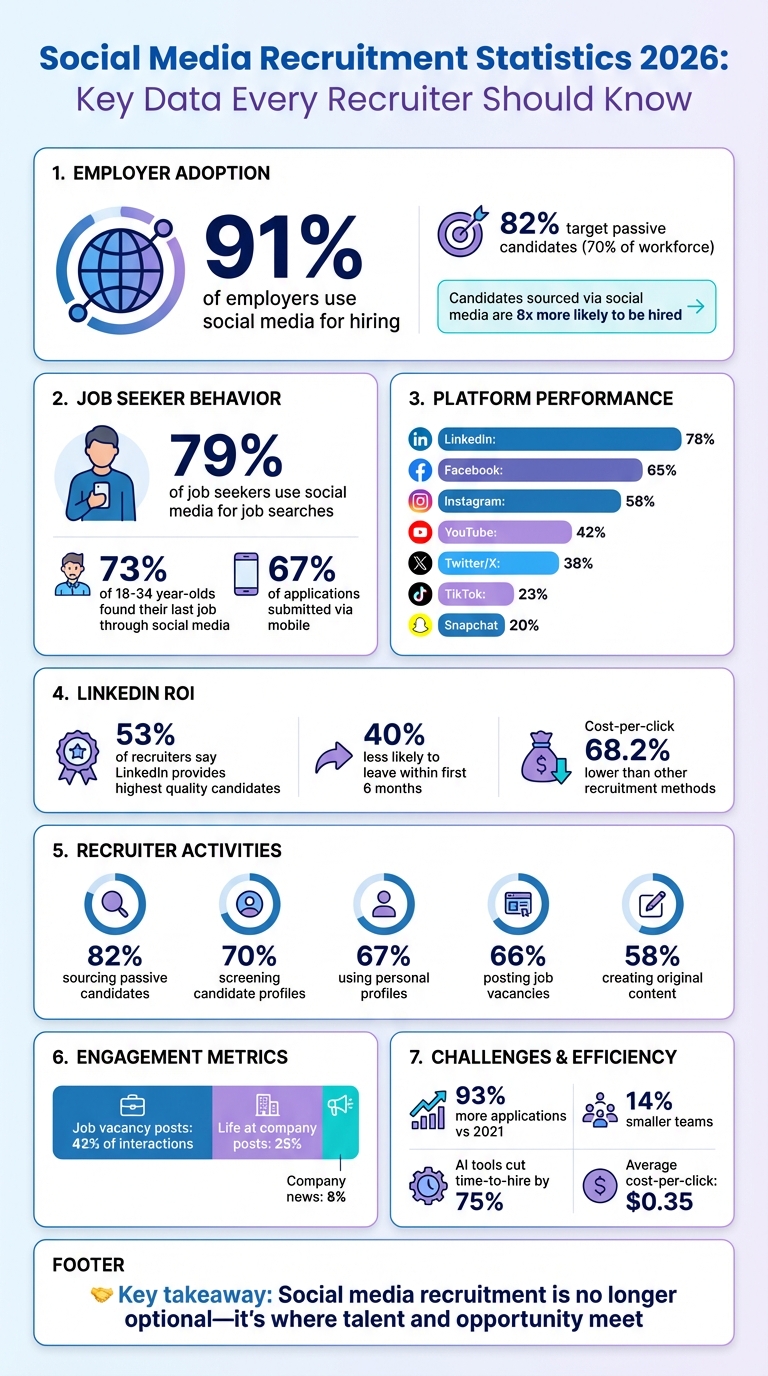
- 91% of employers use social media to hire, with 82% targeting passive candidates (70% of the workforce).
- 79% of job seekers rely on platforms like LinkedIn, Instagram, and TikTok for job searches, with 73% of 18-34-year-olds finding their last job through social media.
- Candidates sourced via social media are 8x more likely to be hired than those from traditional job boards.
LinkedIn leads with 78% recruiter adoption and the highest ROI, while TikTok and Instagram are gaining traction for younger audiences. Recruiters face challenges, managing 93% more applications with 14% smaller teams than in 2021. Tools like social recruitment landing pages and automated campaigns streamline the process, cutting costs and saving time.
Social media is no longer optional – it’s where talent and opportunity meet.
Social Media Recruitment Statistics 2026: Key Data for Recruiters
Social Media Recruitment Statistics for 2026
91% of Employers Use Social Media for Hiring
By 2026, an impressive 91% of U.S. employers are turning to social media platforms for hiring, with 82% focusing on reaching passive candidates. These social media recruitment statistics highlight how social outreach has become a cornerstone of modern recruitment strategies.
Candidates contacted directly through social media are eight times more likely to be hired than those applying through traditional job boards. Moreover, 46% of sourced hires in 2026 come from rediscovered candidates already stored in a company’s CRM or ATS.
Some companies have seen exceptional results with social media recruiting. For example, Texas Roadhouse attracted over 400,000 applicants in a single year, achieving its lowest cost-per-hire to date. Ulta Beauty, during a crucial holiday hiring period, reported a 53% year-over-year increase in hires, hanks to its specific social media recruitment statistics-driven strategy. Similarly, Boston Market boasted an 85% retention rate for employees sourced through social media.
These figures illustrate how employers are harnessing social platforms to connect with talent, setting the stage for how job seekers are increasingly using these tools to find opportunities.
Social Media Recruitment Statistics: Candidate Behavior
In 2026, 79% of job seekers are using social media to explore job opportunities, and 86% are incorporating these platforms into their broader job search strategies. Traditional job boards are losing traction, with usage dropping by 13% since 2020, as candidates flock to social and professional networks.
This social media recruitment statistic is particularly noticeable among younger professionals. According to current social media recruitment statistics, Seventy-three percent of job seekers between the ages of 18 and 34 found their latest job through social media, and nearly half of Gen Z and Millennials with work experience applied for roles they discovered in their social feeds. Mobile devices also play a significant role, with 67% of job applications now submitted via mobile.
Job seekers aren’t just hunting for openings – they’re also researching potential employers. Fifty-eight percent of candidates use social media to investigate companies before applying. Millennials, in particular, are paying close attention: 68% review company social profiles to assess employer branding, and 63% check for insights on workforce diversity. However, this scrutiny goes both ways, as 54% of employers have rejected candidates based on their social media activity.
With job seekers and employers actively engaging on social platforms, understanding which platforms deliver the best outcomes becomes essential.
LinkedIn vs. Other Platforms: Social Media Recruitment Statistics
When it comes to socual media recruitment statistics, LinkedIn stands out as the clear leader in return on investment. Fifty-three percent of recruiters say LinkedIn provides the highest quality candidates. Employees sourced through LinkedIn are 40% less likely to leave within their first six months compared to hires from other channels.
The platform’s dominance is reflected in recruiter activity: 78% of recruiters use LinkedIn for sourcing, far surpassing Facebook (65%) and Instagram (58%). Meanwhile, newer platforms like TikTok are gaining attention for employer branding, particularly among recruiters under 50. Despite this, LinkedIn remains the top choice for professional hiring.
Cost efficiency is another major advantage. Social media recruitment offers an average cost-per-click that’s 68.2% lower than other recruitment marketing methods.
Job posts are now one of our highest drivers of traffic; they consistently perform better than ads promoting products and services. – Manager of Creative Services and Design, Security Provider
Social Media Recruitment Statistics and Trends in 2026
Industries Leading in Social Media Recruitment
Social media has become a cornerstone of modern hiring strategies, with 92% of recruiters actively using these platforms to find talent. However, the adoption of social media recruitment varies by industry, with some sectors leading the charge.
The cybersecurity industry is a prime example. With a 38% increase in demand for professionals, companies in this field have turned to platforms like LinkedIn and TikTok to connect with qualified candidates. Across industries, candidates sourced through social media are nearly eight times more likely to be hired compared to those who apply directly. Interestingly, while direct sourcing only accounts for 2.6% of applications, it contributes to 11% of hires. Another trend is the growing reliance on rediscovering talent already stored in CRM or ATS systems, which now accounts for 46% of sourced hires. These shifts show how companies are not only expanding their reach but also maximizing the potential of existing resources.
Platform Usage by Recruiters
LinkedIn continues to dominate the social media recruitment statistics, with 78% of recruiters leveraging it for sourcing talent. Facebook and Instagram follow, with adoption rates of 65% and 58% respectively. Platforms like YouTube (42%) and Twitter (X) (38%) also remain popular.
Emerging platforms are gaining traction, especially among younger recruiters. TikTok, for example, has seen its usage more than double since 2020, reaching 23% adoption. Recruiters aged 25 to 34 are particularly drawn to TikTok, using it far more than their older counterparts. Snapchat is also part of the mix, with a 20% usage rate among recruiters.
| Social Media Platform | Recruiter Adoption Rate |
|---|---|
| 78% | |
| 65% | |
| 58% | |
| YouTube | 42% |
| Twitter (X) | 38% |
| TikTok | 23% |
| Snapchat | 20% |
Pinterest is gaining attention, especially for companies selling physical products or books, thanks to its strong external link conversion rates. Meanwhile, social search is reshaping how people explore opportunities. About one in three consumers – and over half of Gen Z – now start their search on platforms like TikTok, Instagram, or YouTube instead of Google. These trends are influencing how recruiters approach their strategies on each platform. For a deeper dive into which channels will dominate your strategy this year, read our guide on the Best Social Media Platforms for Recruitment in 2026.
Recruiter Activities on Social Media
Recruiters are increasingly focusing on engaging passive candidates – those who aren’t actively job hunting but are open to new opportunities. In fact, 82% of organizations use social media specifically to target this group, which makes up about 70% of the workforce. Screening candidate profiles is also common, with 70% of recruiters using social platforms for this purpose. Additionally, 67% use their personal profiles for recruitment efforts, and 66% post job vacancies on social channels.
Content creation has become a priority for recruitment teams, with 58% now producing their own images and videos instead of relying on marketing departments. To expand their reach, 90% of successful recruitment teams encourage employees to share and engage with recruitment-related posts.
| Recruiter Activity on Social Media | Percentage |
|---|---|
| Sourcing passive candidates | 82% |
| Screening candidate profiles | 70% |
| Using personal profiles for recruitment | 67% |
| Advertising job vacancies | 66% |
| Creating original video/image content | 58% |
When it comes to engagement, job vacancy posts lead the way, generating 43% of interactions. Posts showcasing “life at the company” follow at 25%, while company news and event promotions trail behind at just 8%. Audiences are increasingly drawn to authentic, behind-the-scenes content rather than polished, corporate-style materials. This shift highlights the importance of creating relatable and unfiltered content. To learn how to move from basic posting to a professional strategy, see our walkthrough on Social Media Recruitment Campaigns: How to Create High-Impact Campaigns.
“People follow people, not brands. The hype around just a brand name is fading. Audiences want personality and consistency from faces they recognize.” – Angelo Castillo, Creator
How to recruit using social media in 2026
How HireLab.io Improves Social Media Recruitment

Turning casual social media interest into actual job applications can be a tough nut to crack – until HireLab.io enters the picture. This multi-client recruitment software offers tools specifically designed to convert passive candidates into active applicants. Let’s break down how these tools help transform social media engagement into top-notch hires.
AI-Powered Recruitment Landing Pages
When someone clicks on a job post from platforms like LinkedIn or Instagram, they don’t want to land on a generic careers page. They need a page that speaks directly to their concerns. That’s where HireLab.io’s AI-powered landing pages shine. These pages are tailored to address the questions passive candidates are asking – things like work-life balance and flexibility, which 48% of job seekers research on social media. By featuring employee stories, workplace highlights, and clear job descriptions, these pages make a strong case for why candidates should apply.
And the numbers back it up. Companies using social media recruiting tools see 2.4 times more candidate engagement. Plus, job-related social posts are incredibly cost-effective, with an average cost-per-click of just $0.35 – a whopping 68.2% lower than other recruitment marketing methods. Since 67% of job applications are now submitted via mobile, these landing pages are optimized for mobile users, ensuring a smooth experience.
Automated Social Media Campaigns
Recruiters are busy, and managing campaigns across multiple platforms can be overwhelming. HireLab.io simplifies this by automating the entire process. It generates platform-specific content and manages campaigns on LinkedIn, Instagram, and even TikTok. Each post is tailored to the platform – professional and polished for LinkedIn, visually engaging for Instagram, and short, snappy videos for TikTok.
The platform’s advanced filters allow recruiters to target candidates based on location, skills, industry, and experience. Automated scheduling ensures posts go live at the times they’re most likely to be seen – weekdays for LinkedIn and evenings or weekends for Instagram. Considering that 92% of recruiters now use social media for sourcing, and AI tools can cut time-to-hire by up to 75%, automation is a game-changer. It’s especially crucial as recruitment teams handle a 93% increase in applications compared to 2021.
Analytics and Performance Tracking
More engagement is great, but what really matters is knowing what works. Many recruitment teams focus on the wrong metrics, such as follower counts, which only 19-34% of high-performing teams prioritize. HireLab.io shifts the focus to actionable metrics like application volume, reach, and website traffic – key indicators of success.
The platform also helps recruiters make the most of their existing talent pools. Performance data can uncover qualified candidates already sitting in a company’s CRM or ATS systems – a strategy responsible for 46% of sourced hires. With 47% of HR executives already using AI tools in talent acquisition, and another 49% planning to adopt them within the next two to five years, HireLab.io’s analytics provide the clarity teams need to refine strategies and justify budgets with confidence.
Conclusion
The social media recruitment statistics paint a clear picture: social media recruitment is no longer just an option – it’s a necessity. With 91% of employers leveraging social platforms for hiring and 79% of job seekers using these platforms in their search, the trend is undeniable. The real challenge lies in navigating this landscape effectively, especially as teams contend with leaner resources and a 93% increase in applications.
The opportunity is massive, particularly when you consider that 70% of the global workforce consists of passive talent – people who aren’t actively scouring job boards but are spending time on platforms like LinkedIn, Instagram, and TikTok. Ignoring this group could mean missing out on candidates who could give your company a serious edge.
To succeed, recruiters need to find the right balance between automation and genuine engagement. Automation can take care of crafting platform-specific content, running campaigns across various channels, and tracking meaningful metrics. With an average cost-per-click of just $0.35 and the potential to save 949 hours of work annually, it’s a game-changer.
At the same time, job seekers are looking for more than just job descriptions – they want authenticity. They’re drawn to content that showcases real employee stories, highlights workplace culture, and provides transparency about work-life balance. Companies that focus on sharing this kind of content and simplifying the mobile application process will stand out in the race for top talent.
When smart data meets authentic engagement, the result is a hiring strategy that works. Social media recruitment connects with candidates where they already spend their time, delivering content that resonates and tools that turn interest into action. Recruiters who adapt stay updated on social media recruitment statistics and embrace the right technology will not only fill positions faster but also build strong, resilient teams for the future.
FAQs
How can recruiters use social media to attract passive candidates?
Recruiters can connect with passive candidates on social media by prioritizing relationship-building over simply posting job openings. Start by figuring out where your target audience spends their time. For professionals, platforms like LinkedIn are ideal. Meanwhile, Instagram, TikTok, and X (formerly Twitter) resonate more with younger or creative professionals. Share meaningful and engaging content, such as employee stories, behind-the-scenes glimpses, or workplace highlights, to showcase your company’s personality and spark organic interactions.
Take advantage of platform-specific tools to reach the right audience. LinkedIn’s advanced search features, for instance, let you filter candidates by skills, industry, or seniority. On Instagram and TikTok, you can craft targeted ads that align with candidates’ ambitions. Additionally, participating in online discussions, commenting on industry-related posts, and answering questions can help establish your brand as a trusted voice, ensuring your company remains visible to passive candidates.
Don’t forget to measure your efforts. Monitor metrics like engagement rates and conversions to fine-tune your approach. By blending genuine storytelling, strategic outreach, and data insights, recruiters can effectively attract and build connections with passive candidates on social media.
How does AI improve social media recruitment strategies?
AI is reshaping how social media recruitment works by taking over repetitive tasks and boosting overall efficiency. For instance, it can sift through massive amounts of data on platforms like LinkedIn to spot top passive candidates, rank them based on their skills, and even draft tailored outreach messages. This frees up recruiters to do what they do best – connect with people and build meaningful relationships at scale.
Beyond that, AI improves decision-making by diving into engagement metrics like likes, comments, and shares. It helps pinpoint the best types of content and the ideal times to post, ensuring recruiters get the most responses from potential candidates. On top of that, AI simplifies processes like resume parsing, scheduling interviews, and conducting initial screenings. This not only speeds up hiring but also helps ensure better-quality hires. All these advancements make AI an essential part of today’s social media recruitment strategies.
Why is LinkedIn the top platform for recruiting talent?
LinkedIn stands out as the leading platform for recruitment, offering a direct connection between employers and a massive network of professionals actively searching for new opportunities. In fact, more than half of recruiters turn to LinkedIn as their primary tool for finding top-tier candidates, cementing its reputation as an essential resource in talent acquisition.
What sets LinkedIn apart is its ability to consistently provide the best return on investment (ROI) for recruitment efforts. This is largely due to its professional networking focus and advanced features, which allow recruiters to pinpoint the ideal candidates with precision. Its widespread popularity among job seekers only reinforces its status as the preferred platform for hiring professionals.