


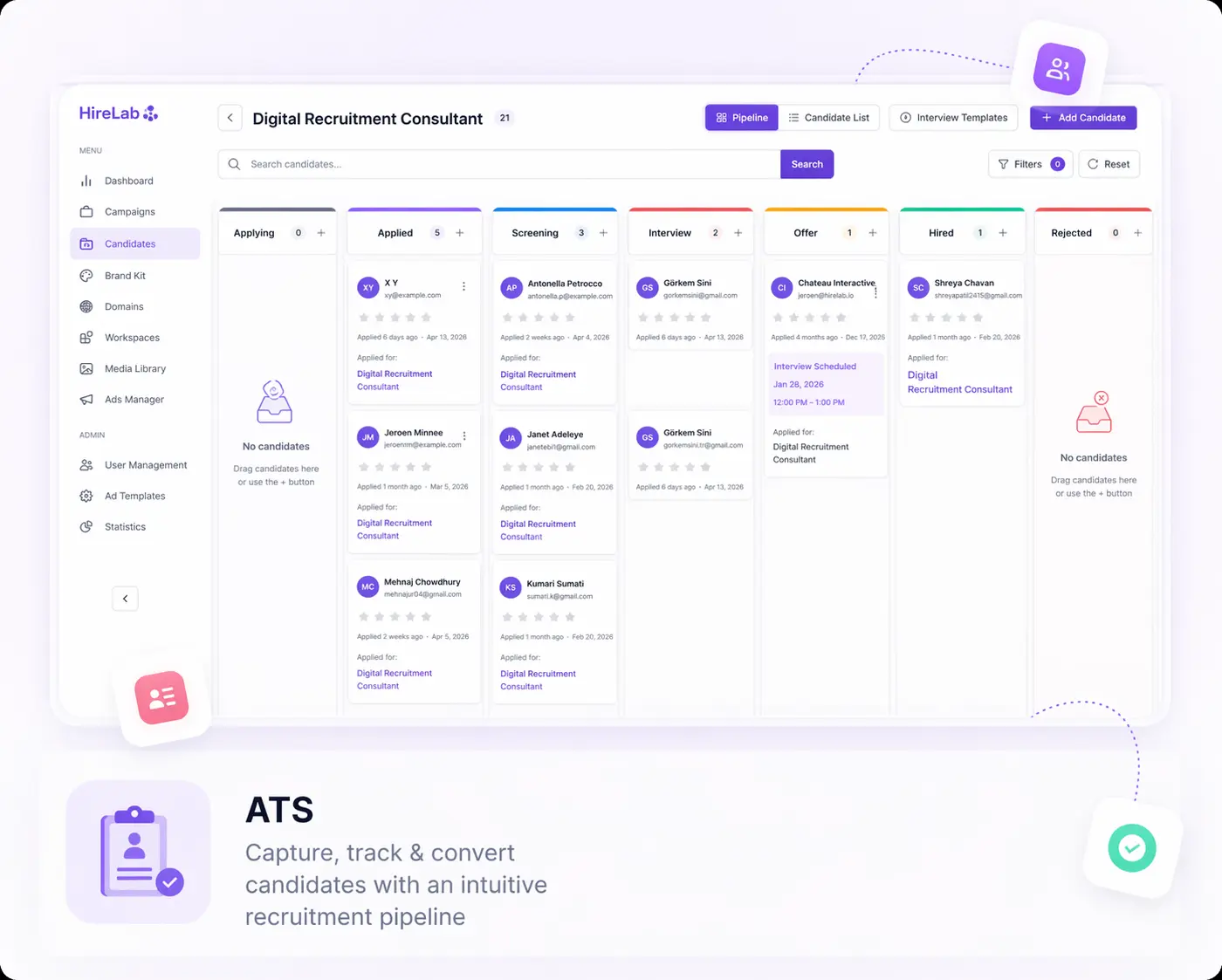

White-Label ATS: What Recruitment Agencies Should Look For in 2026
White-label ATS platforms allow recruitment agencies to rebrand and use advanced applicant tracking systems without building software from scratch. In 2026, agencies need to prioritize tools that focus on AI-driven candidate matching, custom branding, and seamless integrations to stay competitive. These systems not only streamline hiring processes but also improve client retention and revenue generation through features like multi-tenancy, compliance tools, and real-time analytics.
Key takeaways:
- AI-Powered Tools: Reduce time-to-hire by up to 35% and improve candidate quality.
- Custom Branding: Maintain agency identity with rebranded portals and career pages.
- Integration Capabilities: Connect with job boards, messaging apps, and HR tools for efficiency.
- Scalability & Multi-Tenancy: Manage multiple clients securely and grow operations without complexity.
- Data Security & Compliance: Ensure privacy and meet regulations like GDPR and CCPA.
- Cost Considerations: Understand pricing structures, from subscriptions to implementation fees.
Agencies should test platforms through trials, evaluate vendor support, and focus on systems that simplify workflows while delivering measurable results. The right ATS can enhance operational efficiency and strengthen client relationships.
HiringThing’s White-Label ATS Empowers HR Platforms To Add Hiring & Onboarding | Town Hall Debut
Core Features to Prioritize in a White-Label ATS
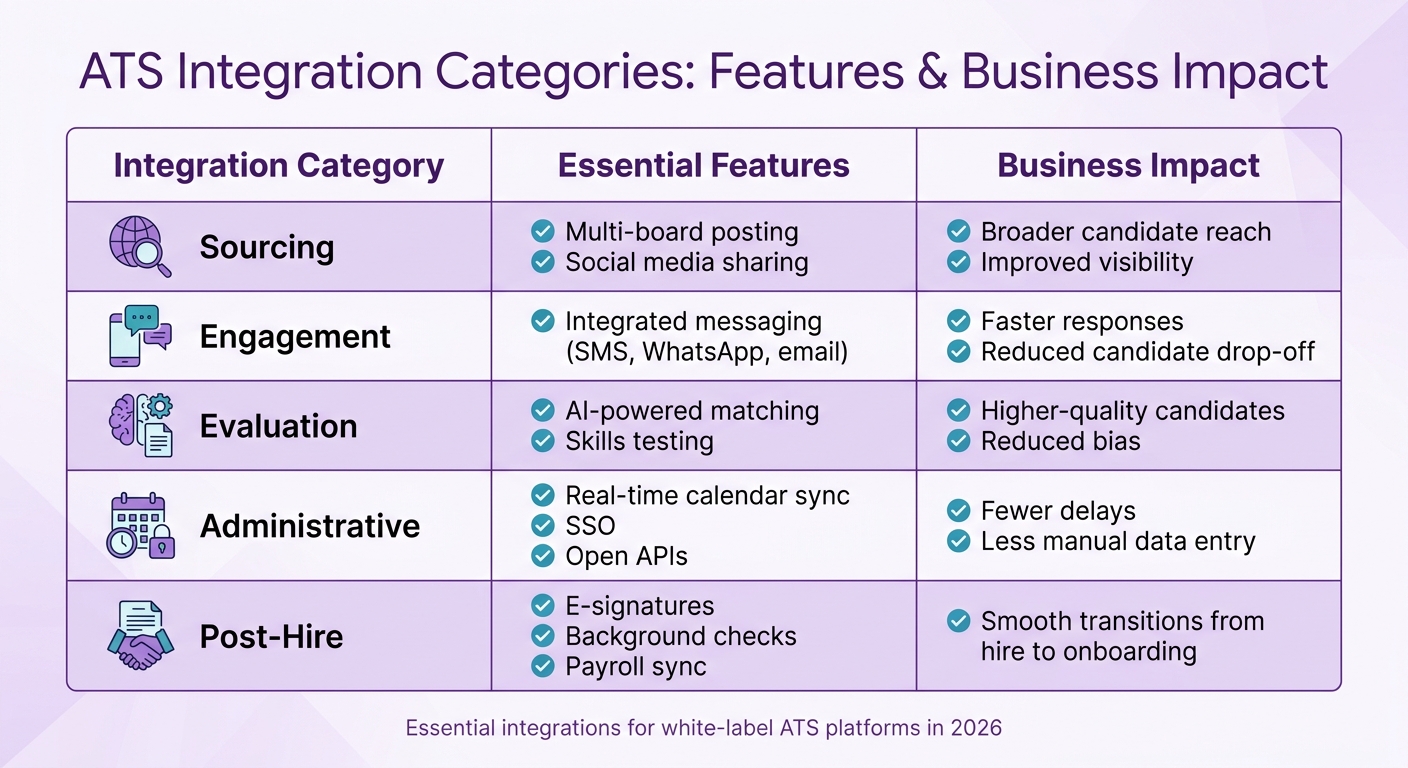
White-Label ATS Integration Categories and Business Impact Comparison 2026
A white-label ATS should go beyond simply tracking applicants. It should enhance every aspect of the recruitment process – sourcing, screening, and candidate engagement – through AI-driven workflows that combine smart automation, customization, and seamless integration [9]. These features are the backbone of building a competitive ATS strategy for 2026.
When choosing a platform, pay attention to three key areas that directly impact your agency’s success: AI-powered candidate matching, branding tools to highlight your agency, and integration capabilities that connect all parts of your recruitment tech stack. These features not only streamline operations but also elevate your brand while improving recruitment outcomes.
AI-Powered Candidate Matching and Screening
Modern AI screening tools use machine learning to analyze skills, experience, and career paths, moving far beyond basic keyword matching [9]. Companies using these tools report a 35% reduction in time-to-hire and a 28% boost in candidate quality scores [4].
AI-powered resume screening can cut down manual review time by 70–80%, freeing up your team to focus on building relationships instead of administrative tasks [9]. In fact, 76% of recruiters say AI tools have improved the quality of their hires [4].
Look for platforms that include conversational AI assistants to handle initial screenings, answer candidate questions around the clock, and schedule interviews [9]. For instance:
- Chipotle used Paradox’s conversational assistant “Ava Cado” to increase application completion rates from 50% to 85% and shorten the time from application to hire from 12 days to just 4 [9].
- Unilever processed 1.8 million applications annually using AI-driven assessments and recorded interviews, saving 70,000 hours of interview time [9].
“The goal isn’t to replace human judgment. It’s to make sure human judgment gets applied to the right candidates.” – HiringThing [2]
Speed is another factor: the best platforms can parse resumes in under 30 seconds [4]. Also, prioritize platforms with transparency features that notify candidates when AI is being used and offer a clear “human fallback” option to maintain trust [9]. With regulations like NYC’s AEDT and the EU AI Act requiring bias audits for AI tools, choose vendors that clearly document how their AI models are trained and tested [9].
Branding and Customization Capabilities
Your ATS should fully reflect your agency’s identity, from custom domains to logos and colors, erasing any trace of the vendor [2]. This is more than aesthetics – businesses with strong employer branding see a 43% reduction in cost-per-hire [5].
Make sure the platform supports custom domains and removes all “powered by” branding [2].
“The spotlight stays on your brand, not a third-party provider’s.” – Chris Smith, CEO, GoHire [10]
Custom career pages are especially important for agencies serving multiple clients. These portals can mirror each client’s culture and values, helping attract better candidates while showcasing your agency as a strategic partner [8][10].
Integration with Recruitment Marketing Tools
Your ATS should act as the central hub for your multi-client recruitment software ecosystem, connecting seamlessly through open APIs and webhooks [11][13]. Beyond branding, integration is key to operational efficiency. Features like one-click job distribution allow you to post across job boards, social networks, and talent databases simultaneously [2][12][13].
Effective communication tools – such as SMS and WhatsApp integration – are critical for reaching candidates on their preferred platforms [2][11]. For staffing agencies, integration with Vendor Management Systems like Fieldglass or Beeline is essential for managing contingent workforces [4].
Integration doesn’t just simplify workflows; it amplifies the impact of your ATS.
| Integration Category | Essential Features | Business Impact |
|---|---|---|
| Sourcing | Multi-board posting, social media sharing | Broader candidate reach and improved visibility |
| Engagement | Integrated messaging (SMS, WhatsApp, email) | Faster responses and reduced candidate drop-off |
| Evaluation | AI-powered matching, skills testing | Higher-quality candidates and reduced bias |
| Administrative | Real-time calendar sync, SSO, open APIs | Fewer delays and less manual data entry |
| Post-Hire | E-signatures, background checks, payroll sync | Smooth transitions from hire to onboarding |
Don’t overlook essentials like Single Sign-On (SSO), which eliminates the hassle of multiple logins, and real-time calendar sync to avoid scheduling delays [3]. Additionally, integrations with background check providers, e-signature tools (like Form I-9 and E-Verify), and payroll systems ensure the hiring process continues smoothly after the offer stage [2][3][13].
Before committing to an ATS, map out your current recruitment process to identify bottlenecks caused by manual tasks [13]. Test how well the platform handles switching between branded environments and workflows for multiple clients [4]. If the integration feels clunky, recruiters are likely to abandon it, no matter how advanced the system’s features may be [3].
Multi-Tenancy and Scalability Requirements
Managing Multiple Clients Under One Platform
Recruitment agencies juggling 10 to 50 clients need a system that keeps each client’s data securely separated without creating a logistical nightmare [4]. A multi-tenancy architecture is key here, creating isolated environments within a single platform. This ensures that Client A’s candidate data – like interview feedback or shortlists – remains completely hidden from Client B [7].
“The partitioning is not just a UI preference – it is a confidentiality requirement. Client A cannot know that their shortlisted candidate is also being evaluated by Client B.” – Treegarden [7]
This setup goes beyond basic user permissions. Each client gets a custom-branded portal, centralizing oversight while eliminating the need to maintain separate software instances for each office or franchise [2][3][4]. Your team can seamlessly switch between client accounts and easily identify which workflows apply to which client [4].
The benefits are especially clear in day-to-day tasks. For example, manually reformatting CVs for clients typically takes around 25 minutes per candidate. With multi-tenant platforms powered by AI, this process can be cut down to just 30 seconds [4]. For an agency handling 100 candidates a month, that’s a time savings of 42 hours – roughly a full workweek – and translates to approximately $1,435 in labor costs [4].
As the number of clients grows, having a scalable infrastructure becomes even more essential.
Scaling Operations Without Added Complexity
While secure multi-tenancy is critical, scalability ensures that growth doesn’t add unnecessary complexity. A well-designed scalable infrastructure allows agencies to manage increasing volumes of jobs, candidates, and users without performance issues or the need for additional technical resources [3][14]. Whether you’re managing 50 or 5,000 active candidates, the platform should maintain consistent speed and reliability.
As your operations expand to include integrations with payroll systems, background check providers, and HRIS tools, scalability becomes even more important. A platform built for growth ensures smooth performance while accommodating these additional tools. Agencies using an ATS report being 40% more productive, and 86.1% of talent professionals say it has significantly boosted their hiring speed [14].
It’s also worth evaluating the costs tied to future growth. For high-volume accounts, per-placement fees can quickly eat into your margins [4]. SaaS platforms offering at least four integrated solutions tend to achieve an 80% customer retention rate, so look for systems that grow with your agency without requiring a costly migration down the line [1].
Data Security, Compliance, and Privacy Standards
In addition to scalability, ensuring strong data security, compliance, and privacy is critical for safeguarding sensitive candidate information and maintaining client trust.
Data Protection Best Practices
Recruitment agencies manage highly sensitive data, including Social Security numbers, home addresses, and resumes. A single breach can lead to legal complications and a loss of trust from both clients and candidates.
To mitigate these risks, implement end-to-end encryption for data both at rest and in transit. Use granular access controls to limit who can access specific information, and maintain comprehensive audit logs to track activity. Enabling Single Sign-On (SSO) can also reduce vulnerabilities tied to password management across integrated tools.
“Security is equally non-negotiable. The ATS will handle sensitive personal data. That includes resumes, addresses, social security numbers, and more.” – HiringThing
It’s also essential to work with vendors who conduct regular security audits and hold certifications like ISO 27001 and FedRAMP. Ask how often they update their security protocols and whether they incorporate user feedback. Additionally, confirm that automated backup systems are in place to prevent data loss and ensure business continuity.
While securing data is vital, staying compliant with evolving regulations is equally important for protecting your agency’s operations.
Meeting Regulatory Requirements
Compliance is crucial to maintaining your agency’s reputation and avoiding penalties. By 2026, recruitment platforms must adhere to various regulations, including GDPR for European data, CCPA for California residents, and emerging laws like New York City’s Automated Employment Decision Tools law. When reselling a white-label system, remember that you inherit its strengths and weaknesses – compliance cannot be overlooked.
“Issues of compliance, often a complex web to navigate, are taken care of by the provider, adding another tick in the pros column for a white-label ATS.” – Chris Smith, GoHire
In a white-label setup, compliance updates are typically managed by the provider. Verify that their platform supports the regulations most relevant to your client base.
Modern ATS platforms now incorporate compliance tools directly into the hiring process. Features like Form I-9, E-Verify, and background checks help ensure steps aren’t missed. Automated compliance alerts and standardized audit trails further reduce risks by ensuring protocols are consistently followed.
As AI-driven screening tools become more common, transparency is key. Platforms should allow administrators to turn AI features on or off and provide candidates with the option to request a human review of automated decisions. This human-in-the-loop approach helps meet fairness standards and builds trust with candidates.
“In 2026, being able to prove your recruiting AI is fair and compliant is becoming just as important as the efficiency gains it promises.” – Mike Popchuk, Executive, OneWayInterview
Analytics, Reporting, and ROI Measurement
After securing your data and ensuring compliance, the next step is proving your agency’s value through measurable performance metrics. A white-label ATS can turn raw hiring data into actionable insights, helping you refine operations and showcase results to your clients. Let’s dive into the key hiring metrics that reflect your agency’s efficiency and impact.
Monitoring Key Hiring Metrics
Tracking the right metrics is essential for improving profitability and keeping clients satisfied. Start with time-to-hire and cost-per-hire. For instance, the average cost per hire climbed to $4,700 in 2025 – a 14% increase from 2019 – and for executive roles, this figure can go beyond $28,000 [6].
Another critical area is source effectiveness. It’s not just about the number of applicants; it’s about understanding which job boards, social media platforms, or referral programs consistently deliver top-quality candidates. Additionally, monitoring pipeline conversion rates can help identify where candidates drop off during the hiring process, allowing you to address inefficiencies.
For agencies, timestamped submission records are indispensable. These records document candidate ownership, helping avoid commission disputes and ensuring smooth collaboration [4].
“Choosing an applicant tracking system is one of the most consequential decisions a Talent Acquisition team makes. Your ATS shapes daily workflows, determines what recruiting data you can access, and ultimately influences how quickly you can hire quality candidates.” – SJ Niderost, Content Marketing Manager, Gem
Don’t overlook the importance of diversity and compliance reporting. In 2026, DEI analytics have become critical for meeting both regulatory requirements and client expectations. A strong ATS should provide detailed insights into pipeline diversity while safeguarding candidate privacy.
Showing Measurable Results to Clients
Clear communication of data is vital. Leveraging your agency’s custom branding, a white-label ATS should include customizable, branded dashboards and secure client portals. These features allow clients to review candidates and track progress in real time, eliminating the back-and-forth of manual emails or PDF updates. Real-time dashboards not only enhance transparency but also build trust.
Reports that highlight your agency’s achievements – like reduced time-to-first-response or improved candidate quality scores – can further demonstrate your value. When clients can track their hiring funnel in real time, seeing how many candidates are in screening, scheduled for interviews, or stuck at bottlenecks, they’ll feel more confident in the process and less reliant on constant status updates.
Additionally, look for platforms that support multi-brand reporting. Whether working with a Fortune 500 company needing advanced analytics or a small business preferring simple weekly summaries, your ATS should adapt to both scenarios seamlessly. According to industry data, 94% of recruiters say their ATS has improved their hiring processes, and using the right system can cut cost-per-hire by 40% [16].
Cost Analysis and Vendor Support Evaluation
When it comes to running a successful agency, keeping costs predictable and ensuring strong vendor support are two key factors. The staffing agency software market, which was valued at $591 million in 2025, is expected to grow to $2.3 billion by 2033 [6]. To protect your profit margins, it’s crucial to understand the full scope of costs and evaluate the level of support offered.
Comparing Pricing Structures
The wrong pricing model can eat into your margins quickly [6]. Subscription plans for applicant tracking systems (ATS) can range anywhere from $50 to $500 per month. On an annual basis, small agencies typically spend between $250 and $3,000, mid-sized agencies allocate $3,000 to $15,000, and enterprise-level systems can cost more than $125,000 when factoring in custom implementations and integrations [6].
Per-user pricing models can also become expensive as your team grows, with some starting at $85 per user per month [6]. On the other hand, some vendors offer unlimited user tiers within specific plans, making budgeting more predictable. Be mindful of additional costs like implementation, customization, and migrating data from legacy systems. Advanced AI features, such as sophisticated candidate ranking, can add between $80,000 and $300,000 to your expenses [5]. Fragmented systems can also lead to margin leakage of about 15% to 25% due to inefficiencies and blind spots [6].
To manage costs effectively, audit your third-party subscriptions. Consolidating these can save you 30% to 50% overall. Additionally, make sure your contract includes provisions for clean data export to avoid being locked into a vendor or facing high migration costs later. If you’re considering building a custom ATS, expect to spend between $312,500 and $937,500 [10].
Once you have a handle on pricing, it’s time to evaluate vendor support to ensure your investment delivers long-term value.
Evaluating Onboarding and Support Services
Price is just one piece of the puzzle. Strong vendor support and efficient onboarding are critical to maximizing your ATS’s return on investment.
“A good partner will equip you to support your clients. A weak one will leave you scrambling.” – HiringThing [3]
Support packages typically cost between $100 and $400 per month. Look for vendors that offer clear Service Level Agreements (SLAs) and 24/7 support to safeguard your placement revenue [6]. Technical issues can directly impact your ability to deliver results, so reliable support matters.
Implementation speed is another important consideration. For enterprise-level ATS rollouts, data migration and training often take 4 to 8 weeks [17]. However, modern platforms can sometimes be up and running in just days – or even minutes. Request a 30-day implementation plan with weekly milestones to ensure a smooth process [17].
“The vendor you choose must stand behind you with real partnership. This is not just about a phone number to call. It is about training, documentation, and a culture of responsiveness.” – HiringThing [3]
The best vendors go beyond fixing technical issues; they also provide guidance on marketing, compliance, sales, and customer success. During the demo phase, ask direct questions to gauge the vendor’s communication style and responsiveness. If your agency manages multiple clients on one platform, confirm that the vendor’s support team is equipped to handle isolated environments [2]. With 62% of fast-growing agencies planning new software purchases in 2026 to enhance outreach and engagement [6], choosing a vendor who acts as a partner – not just a service provider – is essential for long-term growth.
Conclusion
Selecting a white-label ATS in 2026 is more than just a software decision – it’s a reflection of your agency’s reputation and brand credibility [2]. With the staffing agency software market projected to hit $2.3 billion by 2033 and AI adoption among agencies climbing to 61% in 2025 [6], it’s clear that speed, branding, and AI integration are no longer optional – they’re essential. Notably, top-performing agencies are four times more likely to leverage AI, and 78% of high-growth firms have AI embedded directly in their ATS [15].
To seize these opportunities, start testing platforms immediately. Look for systems that offer complete branding control – no “powered by” watermarks – and ensure they provide true multi-tenancy to fully protect client data [2]. Conduct a trial using real candidate workflows for 14–30 days to pinpoint any inefficiencies. Evaluate the total cost of ownership, factoring in implementation, data migration, and training expenses. Also, confirm that your contract allows for clean data export to avoid being locked into a single vendor [6][1][17].
“The agencies that survive and grow will be the ones that operate more efficiently, respond faster to client needs, and demonstrate measurable value through data.” – HiredAi [6]
The right white-label ATS should serve as a competitive edge, not just another tool. It should enable faster candidate submissions, enhance presentation quality, and allow for seamless scaling without unnecessary complexity. Choose a vendor that acts as a real partner, offering top-tier training, clear documentation, and reliable support. This partnership can solidify your agency’s ability to stay ahead, aligning with the core principles of AI integration, branding, and scalability – critical for long-term success.
FAQs
How can I verify an ATS’s AI is compliant and unbiased?
When evaluating an ATS (Applicant Tracking System) for compliance and fairness, there are a few critical factors to consider. Start by checking if it aligns with established data security and fairness standards, such as GDPR (General Data Protection Regulation) or EEOC (Equal Employment Opportunity Commission) guidelines. These frameworks ensure the system handles data responsibly and treats candidates equitably.
Transparency is another essential factor. Look for platforms that openly explain how they match candidates to roles. Ensure the system has been tested for bias across various demographic groups. Platforms that provide detailed documentation or certifications related to fairness and compliance are generally more trustworthy.
Some ATS platforms go a step further by offering features like anonymized profiles or conducting fairness audits. These tools help reduce unconscious bias and promote impartiality in hiring decisions. Choosing a platform that prioritizes these aspects can make a big difference in ensuring unbiased AI operations.
What’s the easiest way to test multi-tenancy with real client data?
The easiest way to test multi-tenancy is by using a white-label ATS that supports this functionality. Start by setting up a test environment with multiple client accounts. Then, import real client data – such as resumes and job postings – into the system.
From there, test key aspects like:
- Workflows
- Access permissions
- Integrations
This approach helps ensure the system can securely handle multiple clients while maintaining data integrity and smooth operations.
Which hidden costs should I budget for beyond the monthly fee?
In addition to the monthly fee, you’ll need to account for other expenses like system setup, customization, tool integrations, ongoing support, and optional add-ons such as AI modules or compliance tools. These extra costs can differ widely, so it’s a good idea to get a clear breakdown upfront to avoid unexpected charges.



How to Choose a Recruiting Agency for Your Business
September 15, 2026[…] platforms built specifically for agency workflows, so it is worth reviewing what to look for in a white-label ATS for recruitment agencies before you compare vendors side by side. A smoother candidate experience can shape offer acceptance […]