
Social Media Marketing for Recruitment: Combining Marketing and Hiring Excellence
Social media marketing for recruitment has completely changed how companies attract and hire talent. Instead of relying only on job boards, businesses now use platforms like LinkedIn, Instagram, and TikTok to promote open roles, build employer branding, and engage both active and passive candidates in real time. Here’s why it works:
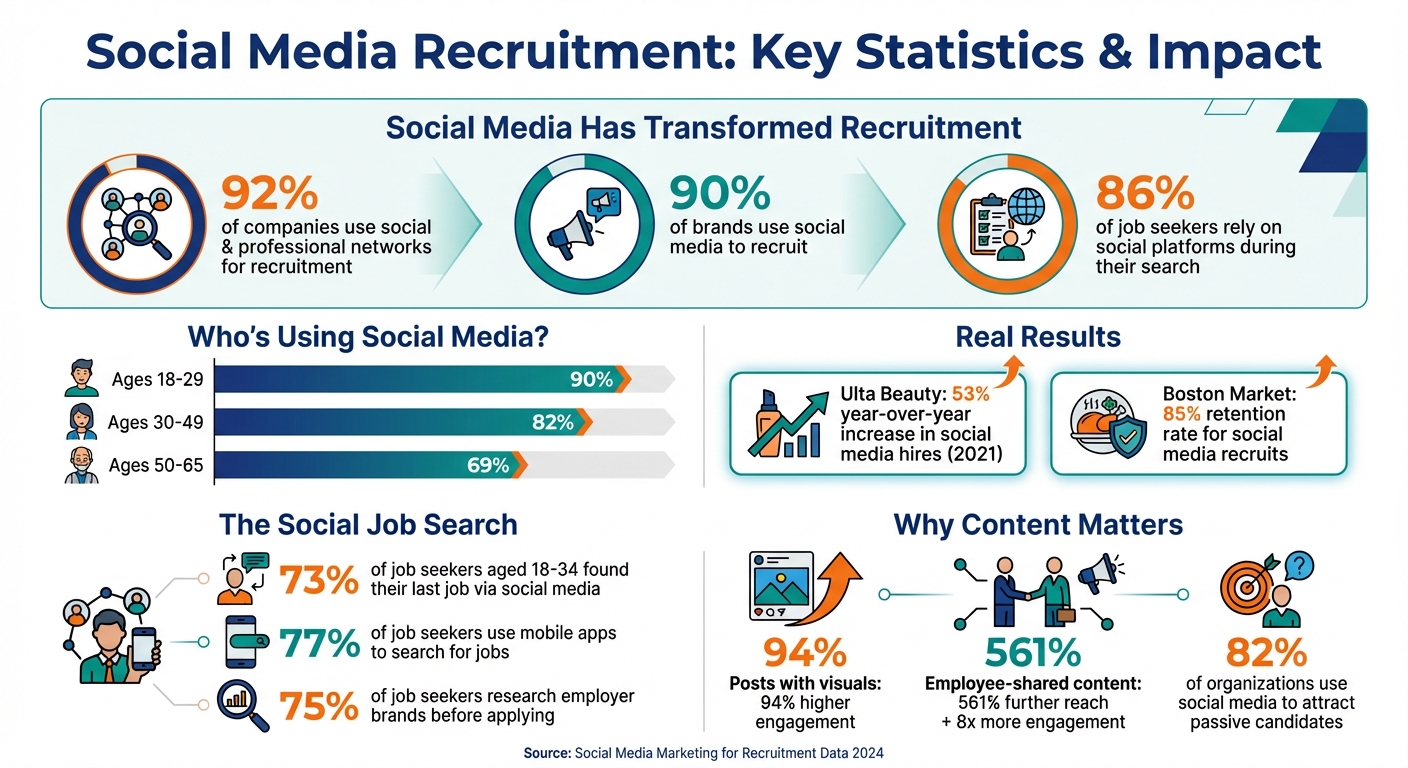
- 9 out of 10 brands use social media to recruit.
- 86% of job seekers rely on these platforms during their search.
- 73% of job seekers aged 18-34 found their last job via social media. If you want the most up-to-date numbers and platform-specific hiring insights, check out Social Media Recruitment Statistics 2026: Key Data Every Recruiter Should Know.
Key strategies include creating engaging content (like videos and employee stories), strengthening employer branding, and setting up social recruitment pages to reach specific candidates. Tools like HireLab.io simplify this process by combining job pages, smart forms, and ad management into one platform. Whether you’re a small business or a large organization, leveraging social media for recruitment can improve hire quality and reduce costs.
Social Media Marketing for Recritment Recruitment Statistics and Impact
Job Bank VC: Using Social Media Marketing for Recruitment| 22.12.2025
What is Recruitment Marketing on Social Media?
Recruitment marketing on social media involves using tailored content, paid advertising, and engagement techniques to strengthen your employer brand. Instead of passively waiting for applications to roll in, this strategy encourages building relationships with potential candidates – even before job openings exist. In fact, 82% of organizations cite attracting passive candidates as their primary reason for leveraging social media in recruitment. The sections below explore how these strategies can transform hiring and deliver measurable outcomes.
This method turns hiring into a genuine dialogue. Rather than simply posting it establishes meaningful connections. Plus, it’s incredibly agile – campaigns can be ob openings and hoping for responses, it allows for real-time interaction with potential candidates. You can answer questions, address concerns, and establish meaningful connections.
This approach makes social media marketing for recruitment more strategic because it focuses on long-term engagement instead of quick job posting tactics.
How Social Media Improves Recruitment
Social media provides unparalleled access to a diverse and expansive talent pool. Today, 92% of companies use social and professional networks for recruitment, surpassing even employee referrals (87%) and job boards (82%). Each platform serves a unique purpose: LinkedIn enhances professional credibility, Instagram offers a window into company culture, Facebook builds community, and TikTok captures the attention of younger audiences.
Consider the results: During a 2021 holiday hiring surge, Ulta Beauty implemented a social media-driven recruitment strategy, achieving a 53% year-over-year increase in hires sourced through these platforms. Similarly, Boston Market reported an impressive 85% retention rate among employees recruited via social media efforts. If you want a deeper breakdown of ROI and real hiring outcomes, check out Why Modern Companies Are Making the Switch.
Core Elements of Recruitment Media Marketing for Recruitment
Effective recruitment marketing is about more than just widening your reach – it’s about crafting a strategy rooted in engaging content, a strong employer brand, and actionable insights.
Content creation focuses on producing posts, videos, and visuals that highlight your company’s culture and job opportunities. Posts paired with high-quality visuals can boost engagement by 94%. Short-form videos, particularly on platforms like Instagram Reels and TikTok, are especially impactful, as 77% of job seekers rely on mobile apps to search for jobs.
Employer branding involves showcasing what sets your company apart. This could mean sharing employee testimonials, behind-the-scenes snapshots of daily work life, or emphasizing your core values and benefits.
"Great recruiting is a lot like marketing. You have to sell your open roles much like you would a product or service".
It’s worth noting that 86% of job seekers say a company’s social media presence influences their decision to apply.
Analytics is the backbone of refining your approach. By tracking metrics like engagement rates, career page clicks, and application conversions, you can identify what’s working and what needs adjustment. Paid social media ads take this a step further, allowing for precise targeting based on factors like job title, location, interests, and demographics. This precision often outperforms organic reach alone.
How to Build an Employer Brand Through Social Media Marketing for Recruitment
Your employer brand is what sets you apart in the competitive talent market. With 75% of job seekers researching employer brands before applying, your social media presence often serves as the first impression. To stand out, focus on crafting optimized profiles, sharing authentic stories, and showcasing your employees. These steps lay the groundwork for targeted campaigns and stronger engagement with potential candidates.
Optimize Company Profiles for Recruitment
Start by ensuring your social media profiles align with your recruitment goals. Secure consistent handles, like @CompanyCareers, and claim vanity URLs to make your profiles easy to find. Use your bio strategically by including industry-specific keywords, geo-tags, hashtags, and tracking links to improve discoverability. For example, if you’re hiring software engineers in Austin, Texas, include terms like "tech careers" and hashtags like #AustinJobs.
Visuals are just as critical. Use high-quality logos and banners that reflect your company’s personality. Ensure your "link in bio" directs job seekers to a mobile-friendly careers page, as 77% of candidates rely on mobile apps for job searches. Add tracking parameters (UTMs) to these links to monitor which platforms drive the most traffic. Take advantage of platform-specific features, such as LinkedIn’s "We’re Hiring" profile frames or the mission statement section on Facebook.
Use Storytelling to Show Company Culture
Job seekers want to connect with the people behind your brand. In fact, candidates watch videos of hiring managers 2.5 times more often than company overviews and 10 times more often than HR messages. Short, engaging videos – under 90 seconds – can give candidates a glimpse into your company’s culture. Highlight workspaces, team events, or a typical day in the role to help potential hires picture themselves on your team.
"In under 90 seconds you can build a compelling picture with video of what it’s like to work with your company, helping candidates put themselves in the shoes of one of your employees and sparking an emotional connection." – Tamara Grigg
Show, don’t just tell. If work-life balance is a core value, share clips of employees leaving on time for family dinners or participating in wellness activities. Stick to the 70/30 content rule – 70% focused on your products or services and 30% on company culture and team moments. Platforms like Instagram Reels, TikTok, and YouTube Shorts are perfect for this type of quick, engaging content. To amplify your reach, tap into employee advocacy.
Encourage Employee Advocacy
Your employees are your most trusted messengers. Content shared by employees reaches 561% further and generates eight times more engagement than content shared by brands. When employees share their real experiences, they can bypass social media algorithms and connect with passive job seekers who might not follow your company page.
"Always do your best to highlight and showcase your employees – people respond to people more than they do brands." – Tony Prudente, Senior Specialist, Employer Branding, Recruitment Marketing & Social at Brother
Make it easy for employees to participate. Provide pre-approved posts, images, and tools to streamline sharing. Create a branded hashtag like #LifeAtCompany for employees to use when posting about their experiences. To encourage participation, offer rewards like gift cards, company swag, or shoutouts during team meetings. You can also get creative with Instagram or TikTok takeovers, where employees manage the company account for a day to share their perspective. For even more impact, integrate advocacy into your employee referral program by giving employees personalized social media links.
If you want a full roadmap beyond quick tactics, check out Social Media Recruitment Strategy blog.
Best Practices for Social Media Marketing for Recruitment
Once you’ve established and showcased your employer brand, it’s time to put strategies in place to connect with the candidates you want to attract. The key is meeting them where they already spend their time – scrolling through social feeds and engaging with content. By building on your employer brand, these strategies can help you actively reach and engage top talent.
The focus should be on understanding your audience, creating content that resonates, and leveraging paid advertising to expand your reach. The most successful companies treat social media marketing for recruitment as a full funnel strategy, not just a posting schedule.
Define Your Target Audience
Start by creating detailed candidate profiles that outline the skills, experience, interests, and goals of the people you’re looking to hire. Talk to current employees in similar roles to learn which platforms they use and what type of content they find engaging. For example, if you’re recruiting software developers, LinkedIn might be your go-to for professional insights, while Instagram could be ideal for showcasing your company culture.
Social media demographics are essential to consider. 90% of Americans aged 18-29 use social media, along with 82% of those aged 30-49, and 69% of adults between 50 and 65. Platform preferences also vary by ethnicity – Instagram is used by 52% of Hispanic Americans, 49% of Black Americans, and 35% of white Americans.** Use these insights to align your platform choices with your audience. To measure success, apply UTM parameters to your links and track which platforms drive the best applications.
"Knowing the platforms and their audiences is imperative because finding quality talent means tapping into the right platform and audience." – Recruitics
Create Engaging Content
Your content should do more than list job openings; it should grab attention and spark interest, even among passive candidates. Posts with relevant visuals generate a 94% higher engagement rate than text-only posts. Create a mix of content, such as employee testimonials, short videos from team events, and posts with industry-specific hashtags like #NYnursejobs to help candidates find your openings. Don’t forget to include subtitles in your videos – 80% of viewers are more likely to finish a video when captions are available.
If you want more ideas and real examples, check out our guide on Social Media Recruitment Content: How to Create Posts That Attract Top Talent.
Short-form videos are especially effective on platforms like Instagram Reels, TikTok, and YouTube Shorts. Tailor your tone to fit each channel – use LinkedIn for professional insights and Instagram or Facebook for behind-the-scenes glimpses of your workplace.
Use Paid Advertising
While organic content is great for engagement, paid advertising can take your recruitment efforts to the next level. Platforms like Meta (Facebook and Instagram) and LinkedIn offer advanced targeting options, allowing you to reach candidates based on job titles, skills, locations, and interests. This precision helps reduce the time spent sifting through irrelevant applications. Just make sure your paid ads stay true to your employer brand.
Begin with one platform that aligns with your hardest-to-fill roles. Test your approach, refine it, and then expand. Focus on quality over quantity by tracking how many social-sourced candidates move beyond initial screenings and how well they stay with your company. For example, Boston Market reported an 85% retention rate for employees recruited through social media channels. Use native content formats like polls, live Q&As, and videos, as these tend to perform better with social media algorithms than external links. And since 77% of job seekers use mobile apps to search for jobs, ensure your ads and landing pages are optimized for mobile devices.
"Job posts are now one of our highest drivers of traffic; they consistently perform better than ads promoting products and services." – Manager of Creative Services and Design, Security Provider
How to Create a Social Media Marketing Plan for Recruitment
Building a strong recruitment plan starts with setting clear objectives, choosing the right platforms, and utilizing tools that make the process efficient. This approach helps you showcase your employer brand, engage with top talent, and create strategies tailored to your goals.
Set Recruitment Goals and KPIs
Start by defining your goals using the SMART framework – Specific, Measurable, Attainable, Relevant, and Time-bound. For example, aim to "increase qualified applicants by 25% next quarter."
Stay away from vanity metrics like likes or follower counts. Instead, focus on metrics that directly impact your recruitment efforts. For instance, 86% of job seekers say a company’s social media presence influences their decision to apply. Track actions like clicks to your career page, application submissions, and how candidates progress through the hiring process.
To get a full picture, divide your metrics into three categories:
- Social Impact: Does your content drive actions like click-throughs and applications?
- Social Authority: How credible is your brand, and what share of voice do you hold in your industry?
- Social Reach: Are you growing your audience and increasing visibility among your target candidates?
Use UTM parameters to track which platforms and posts deliver results. Go beyond tracking applications – monitor how many candidates advance to interviews and accept offers.
"Recruitment success in social media isn’t about impressive numbers in isolation – it’s about whether your social presence is actually helping you attract and hire the right talent." – PeopleScout
Choose the Right Platforms and Content
Identify where your target candidates spend their time online. For example, LinkedIn is a go-to for recruiting professionals like software developers through industry insights, while Instagram works well for showcasing company culture to younger audiences.
Once you’ve chosen your platforms, create a content calendar that includes a mix of employee testimonials, behind-the-scenes videos, job postings, and industry updates. The 70/30 rule can guide your strategy: dedicate 70% of your content to job value and professional growth, and the remaining 30% to company culture and engaging moments.
Tailor your content to each platform’s strengths. LinkedIn is ideal for professional updates and thought leadership, while Instagram and TikTok thrive on short, engaging videos that highlight your workplace environment. Facebook, with its diverse user base, is great for building a community. For example, Ulta Beauty reported a 53% year-over-year increase in hires during a holiday rush by leveraging social media recruiting.
Start small – focus on one or two platforms, analyze what works, and expand from there. Since 77% of job seekers use mobile apps to search for jobs, ensure that your content and landing pages are mobile-friendly for a seamless experience.
"The best social media platform to use is the platform that makes sense for YOUR business! It’s not about what’s hot right now but whether it makes sense in relation to your goals and target audience." – Marielle Reussink, Founder of The Emms
With your platforms and content strategy ready, you can now incorporate these elements into full recruitment campaigns.
Build Campaigns Using HireLab.io
Once your goals and platforms are set, streamline your efforts with tools like HireLab.io, which simplifies recruitment marketing. This platform offers all-in-one solutions that make campaign creation straightforward, even if you lack design or coding skills.
HireLab.io’s AI-powered page builder lets you create custom recruitment landing pages that reflect your brand. Mobile-friendly smart forms reduce drop-off rates by pre-qualifying applicants, making it easier for candidates to complete their applications.
The campaign builder brings everything together – landing pages, forms, and tracking – into a single workflow. You can launch campaigns optimized for both desktop and mobile users. For social media recruitment, HireLab.io integrates directly with platforms like Meta (Facebook and Instagram) and LinkedIn, allowing you to publish ads.
Its built-in ad optimizer ensures your advertising budget is used effectively by testing different creatives and adjusting targeting in real time. For those without an ATS, HireLab.io offers a free applicant tracking system for up to 50 applicants. As your recruitment needs grow, you can upgrade to plans like Optimize ($99/month) or Advance ($249/month) for features like A/B testing, detailed analytics, and recruiter workspaces to scale your campaigns efficiently.
Using HireLab.io for Recruitment Marketing
HireLab.io simplifies recruitment marketing by bringing everything – job postings, candidate management, and interview scheduling – into one easy-to-use platform. By cutting down on steps and streamlining the application process, it helps boost candidate conversion rates.
The platform uses AI-powered automation to ensure your job posts reach both active job seekers and passive candidates who might be open to new opportunities. It also lets you create dedicated job pages, which not only improve your organic visibility but also work alongside paid ads. This combination expands your reach without adding extra work.
Here are some standout features that make recruitment more efficient:
- AI-powered page builder: Turn plain job descriptions into visually appealing landing pages that showcase your brand – no coding or design skills required.
- Smart forms: These forms are mobile-friendly and ask pre-screening questions to weed out unqualified applicants, saving you time during the review process.
- Ad optimizer: AI automatically tests and tweaks ad creatives and targeting options, improving campaign performance in real time.
- Free ATS: Manage up to 50 applicants with a built-in applicant tracking system, offering an all-in-one solution.
- External ATS integration: Higher-tier plans let you sync the platform with your existing recruitment tools.
- Direct social platform integration: Connect with Meta (Facebook and Instagram) and LinkedIn to create, publish, and monitor ads from one dashboard.
- Campaign builder: Combine landing pages, forms, tracking, and ad placement into a single, streamlined workflow that works seamlessly on both desktop and mobile.
Benefits of Using HireLab.io for Social Media Recruitment
HireLab.io eliminates common obstacles that cause candidates to abandon applications. With mobile-optimized forms and fast-loading landing pages, it keeps potential applicants engaged from the moment they click to the final submission, helping to improve conversion rates.
The platform’s smart forms also pre-qualify candidates, filtering out those who don’t meet your basic criteria. This means your team can spend less time sorting through irrelevant applications and more time focusing on qualified candidates. Plus, real-time analytics highlight which platforms and ad creatives perform best, allowing you to allocate your budget more effectively.
For teams aiming to refine their campaigns, the Advance plan includes A/B testing. This feature lets you compare different landing page designs, form layouts, and messaging to see what works best. By using this data-driven approach, you can continually improve your recruitment strategies and achieve better results.
HireLab.io Plans for Scaling Recruitment Campaigns
HireLab.io offers pricing plans tailored to different recruitment needs:
| Plan | Monthly Cost | Active Funnels | ATS Capacity | Key Features |
|---|---|---|---|---|
| Free | $0 | 1 | Up to 50 applicants | AI tools, 3 premium templates, auto form builder, mobile-friendly design |
| Optimize | $99 | 5 | Unlimited applicants | Full template library, custom domains, remove HireLab branding, live support |
| Advance | $249 | 15 | Unlimited applicants | External ATS integration, A/B testing, smart tag automation, advanced analytics, team workspaces |
The Free plan is perfect for small businesses or teams new to social media recruitment. It offers robust AI tools and templates at no cost, though it’s limited to one active campaign and 50 applicants in the ATS.
The Optimize plan ($99/month) is a great fit for growing companies managing multiple campaigns. With five active funnels and unlimited ATS capacity, it allows for consistent branding, custom domains, and the removal of HireLab branding.
The Advance plan ($249/month) is designed for high-volume hiring or recruitment agencies. It includes external ATS integration, A/B testing for campaign refinement, advanced analytics, and team workspaces to enhance collaboration and efficiency.
Conclusion
In today’s hiring market, social media marketing for recruitment is no longer optional because it directly influences visibility, candidate trust, and application volume. Social media marketing has reshaped the way companies attract and hire talent. With 92% of companies now using social and professional networks for recruitment, this approach has become the standard for engaging both active and passive candidates.
The most effective recruitment strategies take this shift to heart, treating hiring as a form of marketing. By focusing on strong employer branding, crafting targeted content, and encouraging employee advocacy, companies consistently attract top-tier talent. These methods don’t just boost the number of applicants – they improve the quality of hires, delivering measurable results.
Gone are the days of relying solely on traditional job boards. Modern recruitment calls for a deeper focus on metrics that directly influence hiring success, such as applicant conversion rates, hire quality, and cost-per-hire. It’s not just about which posts get the most likes or shares but identifying which platforms deliver candidates who advance through your interview process.
Taking an omnichannel approach further strengthens your efforts. Not all job seekers are on LinkedIn. In fact, 73% of job seekers aged 18 to 34 found their last job through social media, often across multiple platforms. Tailor your messaging to fit the tone and style of each platform, maintain a consistent posting schedule, and mix organic content with paid ads to maximize visibility. For a balanced look at the pros and potential drawbacks, read Social Media Recruitment Advantages and Disadvantages.
To make the most of these strategies, you need the right tools. Platforms like HireLab.io simplify the process by combining landing pages, smart forms, ad management, and applicant tracking into one seamless system. Having the right technology paired with a solid strategy makes all the difference.
FAQs
How does social media help improve hiring quality?
Social media plays a key role in improving hiring quality by offering a personalized and engaging recruitment experience that attracts candidates who align with your company’s values and culture. Platforms like LinkedIn, Instagram, and TikTok give you the chance to highlight your employer brand with real, relatable content – think team milestones, workplace culture snapshots, and employee success stories. This not only helps candidates see if they’re a good fit but also weeds out unqualified applications, leaving you with a stronger pool of talent.
On top of that, social media’s advanced targeting tools allow recruiters to zero in on specific audiences based on skills, interests, and career aspirations. By crafting job ads and content tailored to the right people, you simplify the hiring process and improve the alignment between applicants and roles. These platforms also make it easy to connect directly with candidates, fostering trust and giving them a clearer picture of your organization – ultimately leading to better hiring outcomes.
What makes recruitment marketing on social media effective?
Effective recruitment marketing on social media blends strategy, creativity, and data-driven decisions. Start by crafting a well-defined plan that pinpoints your hiring objectives, identifies your target audience, and establishes clear metrics to measure success. Then, focus on selecting the right platforms – whether it’s LinkedIn for connecting with professionals, Instagram for visually showcasing your workplace, or TikTok to engage with younger job seekers.
Next, develop compelling, shareable content that showcases your company’s culture, highlights open positions, and emphasizes employee perks. Adjust your tone and messaging to suit each platform, ensuring a consistent yet tailored experience for your audience. Lastly, monitor and refine your strategy by analyzing key metrics like engagement, reach, and application rates, making adjustments to improve your results over time.
When these elements come together, you’ll strengthen your employer brand and attract the talent your company needs through social media.
How can companies use employee advocacy to enhance social media recruitment?
Employee advocacy is a powerful way to showcase your employer brand. It works by enabling your team to share authentic, behind-the-scenes content on platforms like LinkedIn, Instagram, TikTok, and X. Start by identifying team members who are excited about your company culture and willing to share their experiences. Provide them with pre-approved posts, videos, and personal stories that they can easily share with their networks. When employees post genuine content, it resonates more with candidates – peer-generated posts often feel more trustworthy than official corporate messages.
To make this process smooth, establish clear guidelines and offer user-friendly tools for sharing. Encourage your team to post “day-in-the-life” videos, celebrate milestones, and share stories about their career growth. Keep them informed about hiring priorities, recognize their efforts, and offer feedback to keep them motivated. By equipping your employees to share authentic content, you can attract stronger candidates, enhance your employer brand, and even cut down on hiring expenses.