Recruitment Marketing Software: What It Does and Who Needs It
If your hiring team gets traffic but not enough applications, this software may fix the top of your funnel. I’d sum it up like this: recruitment marketing software helps me bring in more candidates before they apply, track which channels lead to hires, and cut drop-off on career pages and forms.
Here’s the short version:
- It is not the same as an ATS. An ATS starts after someone applies. Recruitment marketing software works earlier.
- It helps with career pages, landing pages, social ads, job distribution, CRM, nurture campaigns, and reporting.
- It matters most when I’m hiring at volume, across many roles, or trying to reach passive candidates, who make up 73% of the global workforce.
- It can help lower waste in hiring, which matters when median U.S. cost-per-hire is about $1,200 for non-executive roles and $10,625 for executive roles.
- It is often a fit for in-house TA teams, HR teams, fast-growing companies, high-volume employers, and agencies.
What I’d look for first is simple:
- ATS integration
- Mobile-first apply flows
- Role-specific landing pages
- Social campaign tools
- CRM and nurture features
- Source-of-hire reporting
A few numbers stand out. 92% of employers use social media for sourcing. Candidates from social are 8x more likely to be hired than those from older job boards. And 46% of hires in 2026 come from people already in a company database.
So my read is simple: if I’m stuck with disconnected tools, weak apply conversion, and poor channel tracking, this type of software is built to solve that exact problem.
The rest of the article explains what these tools do, how they affect hiring results, and which teams are most likely to need them now.
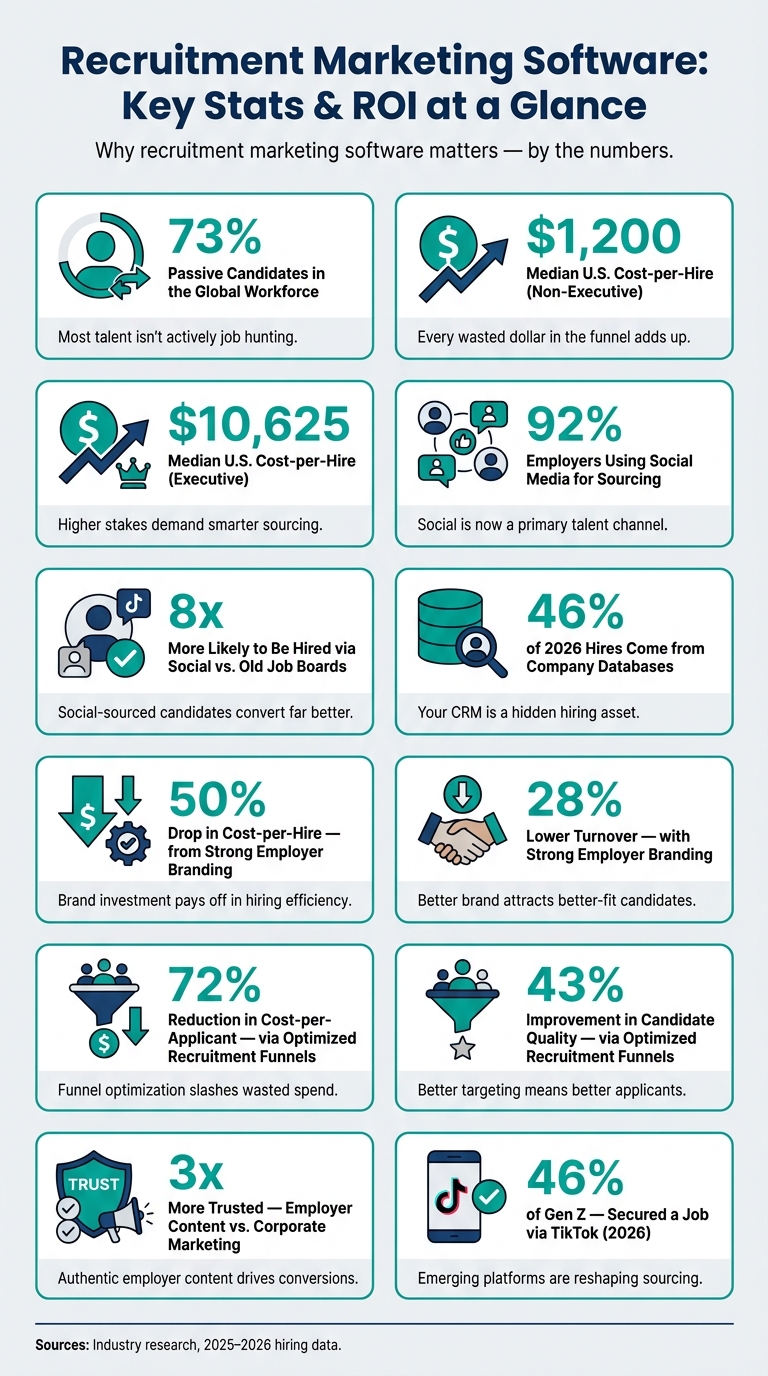
Recruitment Marketing Software: Key Stats & ROI at a Glance
Best Recruiting Software 2026: Top Platforms for Small, Midmarket, and Enterprise Organizations
What recruitment marketing software does
Recruitment marketing software helps employers reach candidates before they apply and move them from interest to action. It shapes the whole path, from job visibility to follow-up.
Career sites, landing pages, and smart application forms
Your career site is often the first real impression a candidate gets of your company. If that page feels generic or hard to use, people leave fast.
Recruitment marketing software gives teams a way to build branded career pages and job-specific landing pages with culture content, employee videos, and custom design without needing code — HireLab’s own landing page builder is built for exactly this kind of no-code setup.
Old apply flows tend to slow people down. Newer tools cut that friction with mobile-first smart forms that use built-in screening logic to pre-qualify candidates in under a minute [2][4]. Some platforms also offer conversational apply flows through channels like WhatsApp [2][4]. The payoff is simple: fewer people drop off between the click and the application.
Once the page turns interest into action, the next job is getting that opening in front of the right people.
Job advertising, social sourcing, and campaign distribution
Posting to one job board is passive. Recruitment marketing software pushes one job posting across many channels and tracks which campaigns bring in applicants. It uses trackable links so teams can see exactly where applicants came from.
Social media is now a major sourcing channel. 92% of employers now use social media to find talent, and candidates sourced through social are 8x more likely to be hired than those from old-school job boards [5]. The move toward platforms like TikTok is happening too. 46% of Gen Z candidates have secured a job or internship through TikTok as of 2026 [1]. Recruitment marketing software helps teams run paid social campaigns and measure performance by channel.
Programmatic advertising adds more control. Instead of having someone manually decide how much to spend on each channel, the system shifts budget toward the channels and audiences that are converting, which cuts wasted spend in real time [1].
Those candidate records can then move into CRM and nurture workflows.
CRM, nurture campaigns, analytics, and AI assistance
Not every candidate who visits your career site is ready to apply today. A candidate relationship management (CRM) system stores interested candidates in talent pools, so you can reconnect with past applicants in your database when the right role opens up [5]. That gives recruiting teams a measurable audience for later campaigns.
Nurture campaigns work a lot like email marketing for recruiting. They use automated sequences to keep your organization in front of candidates until they’re ready to make a move. Some tools also use AI match scores to help recruiters spot high-fit candidates faster [2][4].
On the analytics side, funnel dashboards show where candidates are dropping off, whether that’s on the career site, in the application form, or somewhere in between. Source reporting connects each hire to the channel that produced it, which gives hiring teams hard numbers for budget and process decisions.
How these features improve hiring results
Stronger employer brand and more consistent candidate experience
These features improve hiring in three main ways.
First, a polished career site builds trust fast. Career sites and landing pages give candidates a clearer, more human view of your brand. That matters because employer content is trusted 3x more than corporate marketing [5]. When people trust what they see, brand awareness grows and more visitors turn into applicants.
The apply process matters too. Mobile-first, conversational flows make it easier for people to finish an application on their phone, which helps reduce drop-off [2]. And when the experience feels smooth from the start, it shapes how candidates see the company.
There’s also a direct business impact. Companies with strong employer branding see a 50% drop in cost-per-hire and 28% lower turnover [1]. Those same tools can also help improve applicant quality.
Better applicant quality and higher funnel conversion
Better targeting helps clean up the funnel from the start.
Programmatic and social campaigns can reach candidates who are more likely to convert, instead of pulling in large volumes of weak-fit applicants. That shift improves funnel efficiency. Optimized recruitment funnels can cut cost-per-applicant by 72% and improve candidate quality by 43% [3].
CRM nurture campaigns add another layer. They help teams build talent communities and re-engage people already in the database, so warm candidates don’t go cold while they wait for the right opening. That’s a big deal, especially when hiring needs change from month to month.
In fact, 46% of hires in 2026 come from candidates already in a company’s database [5].
Clearer reporting for budget and process decisions
The last advantage is visibility.
A lot of teams talk about quality of hire, but far fewer can track it in a useful way. Source-of-hire reporting shows which channels produce actual hires, not just clicks [1]. That makes budget decisions much easier.
With that view, teams can spot underperforming spend, cut waste, and shift budget based on evidence instead of guesswork.
Who needs recruitment marketing software most
Recruitment marketing software is a fit for teams that need to attract, engage, and convert candidates at scale. It starts to matter most when hiring volume goes up, channels pile up, or passive-candidate outreach gets too hard to manage by hand. Put simply, this software makes the most sense for teams that need to market open roles, not just collect applications.
In-house TA teams, HR departments, and growing companies
In-house talent acquisition teams often deal with more applications while working with lean staffs, so manual workflows can fall apart fast. If you’re hiring for several roles or across different locations at the same time, the strain builds in a hurry.
Growing companies run into a similar issue from a different angle. They need to build an employer brand from the ground up – or reshape one – while going up against bigger, more established companies. That’s not easy.
Custom career pages and targeted social campaigns can help these companies reach candidates who may never find them through job boards alone. For these teams, the main gains usually come from:
- Faster campaign launch
- Better conversion from job page visits to completed applications
- A candidate experience that lines up with the employer brand
High-volume employers and recruitment agencies
Retail, hospitality, logistics, and healthcare are fields where hiring rarely slows down. High-volume employers need short, mobile-first applications because every extra step can push people to quit halfway through. The job is to keep the pipeline moving without losing candidates to friction.
Agencies face another layer of complexity. They need one system to manage multiple client campaigns, talent pools, and brands without doing the same work over and over. Running several client pipelines at once, each with its own branding and funnel, gets messy fast. Automation for social ad creation and candidate screening is what helps agencies grow output without piling on manual work. Choosing the right recruitment agency software to sit alongside these campaigns keeps client reporting and candidate data from fragmenting across tools.
How to decide if your team needs it and what to look for
Signs your current recruitment process has a marketing problem
If your team already matches one of the common use cases above, these signs can tell you whether the software is needed.
A pipeline that leans almost entirely on inbound applications usually means your top-of-funnel reach is too limited. Put simply, your awareness and interest stages aren’t doing enough work.
Another red flag is a stack of disconnected tools. Ads, landing pages, and candidate data sit in separate systems, which leads to manual uploads and slower hiring [2]. And if you can’t connect hires to specific channels, budget choices turn into guesswork.
Low conversion is another signal. If career site traffic rarely turns into applications, there’s friction in the funnel. When these problems show up together, it’s time to compare platforms based on integrations, campaign tools, reporting depth, and pricing.
Key buying criteria and final takeaways
Start with ATS integration. It’s nonnegotiable because it cuts out manual uploads and helps prevent lost candidates [1][2].
After that, look for three things:
- Role-specific landing pages that your team can build without developer help
- Native social and LinkedIn campaign creation
- CRM and nurture tools for hard-to-fill roles [1][2]
Use a small set of metrics to judge whether the software improves both volume and quality. Focus on click-to-apply rate, cost-per-hire, and source-of-hire quality [1].
| Metric Type | Key KPI to Track | Why It Matters |
|---|---|---|
| Activity | Reach & Engagement Rate | Measures brand awareness and interest [1] |
| Efficiency | Cost-per-Hire | Measures financial ROI of marketing spend [1] |
| Quality | Source-of-Hire | Identifies which marketing channel produces the best employees [1] |
If your team is still dealing with disconnected tools, manual uploads, and career pages that don’t convert, recruitment marketing software deserves a close look now.
FAQs
How is recruitment marketing software different from an ATS?
They play different roles in the hiring funnel.
An ATS is the system of record. It handles compliance, keeps hiring organized, and manages the workflow after a person applies.
Recruitment marketing software comes in earlier. It helps you attract candidates, build your brand, create landing pages, run social ads, and nurture passive talent so you keep a steady flow of qualified applicants coming in.
When does a company need recruitment marketing software?
A company needs recruitment marketing software when hiring can’t rely on simple job posting alone. At that point, social and paid recruiting need to work like a measurable conversion funnel, especially for high-volume, frontline, local, or hard-to-fill roles where teams need to reach – and track – passive candidates.
It also helps when hiring teams need to launch campaigns fast, manage candidates in one place, and improve results with attribution and analytics. For example, teams can see which channel leads to completed applications instead of guessing what worked. Agencies use it to scale client campaigns without adding extra overhead.
What results should I expect after implementing it?
You should expect better recruitment funnel performance: more ad clicks and site visits turning into engaged candidates and completed applications, fewer drop-offs, and stronger candidate quality.
You may also see faster campaign launch and iteration – from 60 hours to 6 minutes – plus better funnel tracking, with clearer source attribution, conversion rates, and interview-ready outcomes.