




How to Choose an HR Staffing Agency
The wrong HR staffing agency costs more than a higher fee. If hiring drags by even one extra week, total cost per hire can climb by 10% to 15%, and internal teams already spend about 48 hours per role on recruiting work.
If I were choosing an HR staffing agency, I’d keep it simple. I’d look at five things first:
- Fit for the role: temp, temp-to-hire, direct hire, executive search, or RPO
- Industry and location match: same role types, same market, multi-state knowledge if needed
- Candidate quality: sourcing channels, screening steps, scorecards, backup pipeline
- Process and communication: feedback timing, named contact, system fit
- Risk and cost: compliance ownership, insurance, guarantees, markup, and hidden fees
Here’s the core idea: don’t choose based on price alone. I’d compare agencies on hiring speed, retention, interview-to-hire ratio, compliance handling, and total cost in U.S. dollars, not just the quote.
A few numbers stand out:
- 56% of recruiters say their best candidates come from social media
- 37% say their best candidates come from job boards
- Typical time-to-fill ranges often look like:
- 7–14 days for entry-level or high-volume roles
- 18–25 days for mid-level roles
- 30–45 days for senior or specialized hires
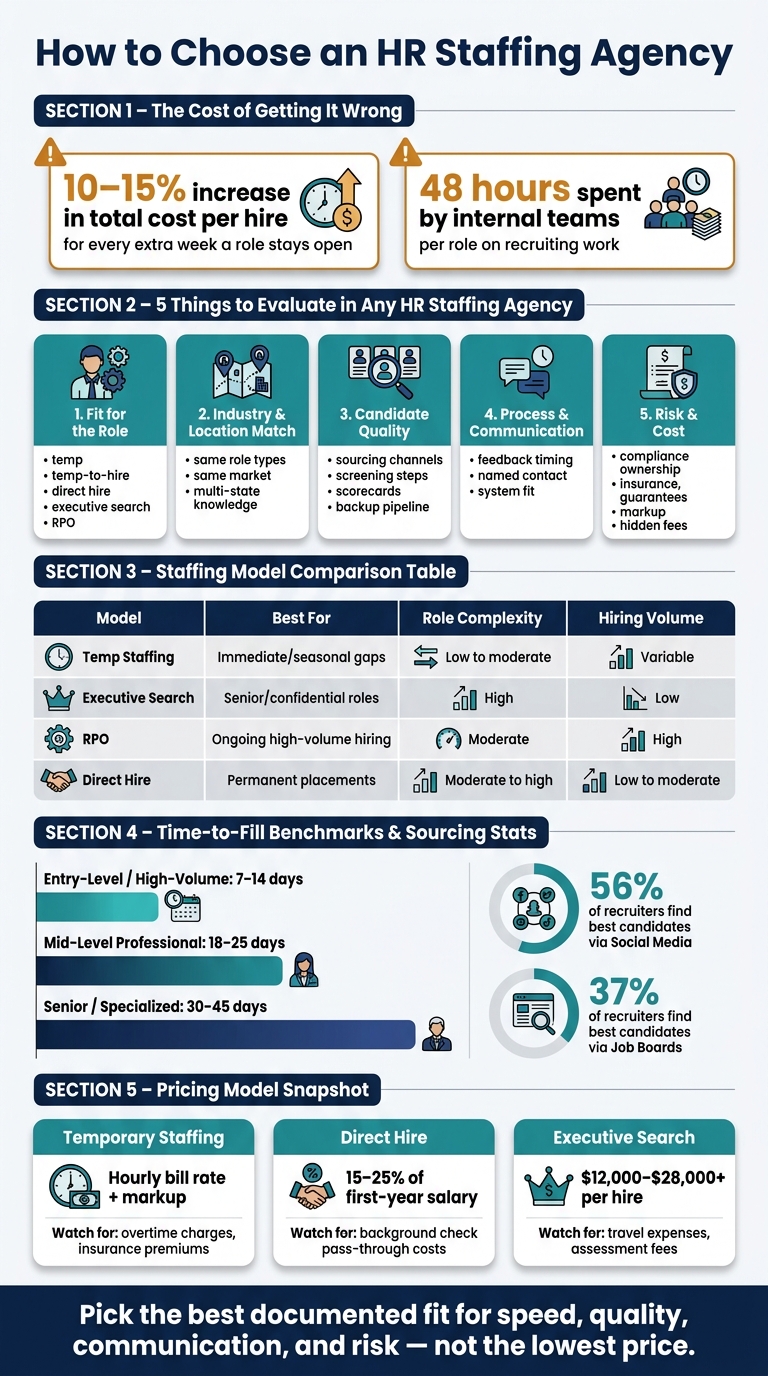
How to Choose an HR Staffing Agency: Key Evaluation Criteria & Cost Benchmarks
Quick comparison
| What I’d check | What I’d want to see |
|---|---|
| Hiring brief | Role, level, location, hiring type, start date, volume, budget |
| Agency type | Clear match between service model and hiring need |
| Sourcing | More than job boards; use of LinkedIn, social, and talent pools |
| Screening | Standard scorecards and a clear review process |
| Delivery | Fast feedback, clear ownership, no extra admin burden |
| Compliance | Worker classification, payroll, tax, I-9/W-4, background check ownership |
| Pricing | Full quote, replacement terms, overtime/admin fees, pass-through costs |
| Proof | References, retention data, offer acceptance rate, invoice accuracy |
My rule of thumb: pick the agency with the best documented fit for speed, quality, communication, and risk control – not the lowest sticker price.
Match the HR Staffing Agency to Your Roles, Industry, and Hiring Timeline
Check Industry Focus, Role Coverage, and Geographic Reach
Once you’ve confirmed the agency model, the next step is simple: make sure it fits your hiring needs. Our guide on how to choose a recruiting agency for your business covers the broader comparison.
That means looking past broad claims like “we work across many sectors” and asking for proof. Ask for examples of placements in your industry and in roles close to the ones you’re hiring for. A general background in recruiting isn’t the same as knowing your market.
Geographic reach matters too, especially if you’re hiring across more than one state. Wage laws, leave rules, and recordkeeping requirements can change from state to state, so the agency needs to know the rules in each target market [1].
It’s also worth asking how the agency reaches passive candidates. Do they rely only on job boards, or do they also use LinkedIn, social media, and talent communities? That matters more than many teams think. Fifty-six percent of recruiters say they find their best candidates through social media, compared with 37% through job boards [5].
That leads to the next step: picking the service model that matches how you hire.
When to Use Temp Staffing, Executive Search, or RPO
The right model depends on four things: urgency, role complexity, hiring volume, and how much internal recruiting support you have.
| Model | Urgency | Role Complexity | Hiring Volume | Internal Capacity |
|---|---|---|---|---|
| Temp Staffing | High (immediate/seasonal) | Low to moderate | Variable | Low |
| Executive Search | Moderate (confidential) | High (senior/niche) | Low | Low |
| RPO | Ongoing | Moderate | High | Overwhelmed |
Here’s the practical way to think about it:
- Temp staffing works best when you need people fast, such as for immediate gaps or seasonal demand.
- Executive search makes sense for confidential, senior, or hard-to-fill roles that call for a tight network and closer candidate handling [2].
- RPO fits teams with steady hiring volume when the internal function needs help with sourcing, screening, scheduling, and the rest of the recruiting workflow [1][6].
The next section looks at candidate quality, recruiting process, and delivery standards across the agencies that make it through these checks.
How to Evaluate Candidate Quality, Recruiting Process, and Delivery Standards
Once you’ve matched the agency type to your hiring needs, the next step is simple: can that agency actually deliver?
That’s where a lot of hiring teams get tripped up. An agency can talk all day about “rigorous screening,” but that phrase doesn’t mean much unless there’s a clear process behind it – one you can check before you sign anything.
Ask How the Agency Sources and Screens Candidates
After you know the agency is the right fit on paper, look at how it finds people and how it filters them. That’s what tells you whether you’ll get a stack of resumes or a shortlist of people you’d want to interview.
Ask how the agency reaches passive candidates beyond job boards. That should include channels like social media, LinkedIn Recruiter, and talent communities.
Screening is just as important. Ask whether recruiters use standardized 0–5 scorecards to review candidates in a consistent way [4]. If one recruiter is strict and another is loose, candidate quality can swing all over the place.
It also helps to ask whether the agency keeps a backup pool of candidates in a CRM. If someone drops out late in the process, that backup bench can save you from starting the search from scratch.
Use a Scorecard to Compare Agencies on the Same Criteria
When you’re narrowing it down to two or three finalists, gut feel can lead you off course. A simple scorecard makes the comparison much cleaner. You’re looking at the same factors across every agency, not just reacting to who gave the best pitch.
Weight each item based on what matters most for your hiring situation.
| Scorecard Criteria | Why It Matters |
|---|---|
| Time-to-fill benchmark | Entry-level/high-volume roles: 7–14 days; mid-level professional roles: 18–25 days; senior/specialized roles: 30–45 days [3] |
| Interview-to-hire ratio | Shows how well the agency is screening candidates before submission |
| Candidate drop-off | Reveals friction in the agency’s process or candidate experience |
| 90-day and 180-day retention | Measures whether placements actually stick long term |
| Source of hire | Shows which channels are producing the strongest results |
Use the same scorecard for every finalist so price and instinct don’t skew the decision.
Confirm Communication Standards and System Compatibility
Delivery comes down to process discipline, not just candidate volume. Before you commit, get clear on how communication will work day to day.
Ask whether the agency follows a 48-hour feedback SLA for interview results and candidate updates [5]. That kind of turnaround can keep searches moving and cut down on candidate drop-off. You should also ask for a responsibility matrix so it’s clear what the agency owns and what your internal team owns [5].
System fit matters too, and multi-client recruitment software for agencies shows what a well-integrated setup looks like. Check that the agency’s tools, reporting, and approval steps match your workflow without adding extra manual work. If their process creates more admin for your team, that’s a red flag.
Review Compliance, Contracts, and Total Cost Before You Sign
After you assess delivery quality, look closely at the contract terms that affect risk and total cost. Don’t pick an agency based on price alone. Check compliance controls, contract terms, and the full cost before you sign.
Verify Compliance Controls and Insurance Coverage
Before you agree to anything, make sure the agency handles federal and state tax filings, pay calculations, and payroll deductions the right way. Multi-state wage-and-hour rules can get messy fast, so those controls should be documented, not left vague [1].
Ask direct questions about worker classification rules too. A solid agency should be able to show you a documented process, not just say, “We handle that.”
It also helps to pin down responsibility for background checks, I-9/W-4 verification, and EEOC reporting. Write out each compliance task and assign ownership in plain language so there’s no confusion later [1][5].
Data security deserves the same level of scrutiny. Ask where candidate data is stored, who can access it, and what the agency does if there’s a breach. If something goes wrong, you don’t want to find out the process after the fact.
Understand Pricing, Markups, Guarantees, and Hidden Fees
Once compliance is sorted out, compare how each agency prices its services; our plain-English guide to how recruiting firms get paid explains the common fee models. The quote usually isn’t the whole story. Depending on the engagement type, you may run into conversion premiums, background check pass-through costs, overtime charges, or admin fees that didn’t show up in the first conversation [2].
| Pricing Model | Typical Cost | What’s Usually Included | Watch Out For |
|---|---|---|---|
| Temporary Staffing | Hourly bill rate + markup | Payroll taxes, workers’ comp, admin fees | Overtime charges, insurance premiums |
| Direct Hire | 15%–25% of first-year salary [2] | Sourcing, screening, placement guarantee | Background check pass-through costs, replacement guarantees |
| Executive Search | $12,000–$28,000+ per hire [2] | Specialized headhunting, high-touch vetting | Travel expenses, assessment fees |
Read the replacement guarantee with care so you know exactly what it covers, how long it lasts, and what conditions apply if a hire doesn’t work out. When you compare agencies, put the quote, guarantee terms, and your internal labor cost side by side. That’s usually where the actual price starts to come into focus.
Check References, Spot Red Flags, and Make Your Final Decision
Use references and red flags to test an agency’s claims before you sign anything.
Ask for References, Metrics, and Comparable Placements
Before you move forward, ask each agency for at least two references from clients with hiring needs like yours, especially in the same industry and for the same role types.
When you speak with those references, ask for documented performance data. Zero in on these four checks:
- Retention after placement – Shows whether hires stay and fit the role over time
- Replacement handling – Shows what happens when a placement falls short
- Offer acceptance rate – Gives you a read on how well the agency presents your role to candidates
- Invoice accuracy – A simple but telling sign of day-to-day admin discipline
Also ask for recent placements that match your industry, role type, and location. A firm may sound great in a pitch, but the proof is in work that looks like your search.
Red Flags That Point to a Poor Agency Fit
Some warning signs are hard to ignore. If you spot any of these, it may be time to walk away:
- The agency can’t clearly explain how it sources passive candidates
- There’s no named account manager for your account
- The agency pushes you to sign fast without time to review terms
- Replacement terms are vague
- There are no written service-level agreements
- Compliance documents are missing, or the agency dodges direct questions
If ownership feels fuzzy, ask for a responsibility matrix that spells out who handles screening, scheduling, and onboarding. That one document can save a lot of back-and-forth later. Fast pressure to sign and murky answers about who owns what usually point to trouble down the road.
Conclusion: Choose the Best Documented Fit, Not the Lowest Fee
The lowest fee rarely means the lowest total cost. Every extra week a role stays open can add 10% to 15% to your total cost per hire [1][5], and slower hiring can cut the odds of offer acceptance by 16% [5].
If an agency clears these checks, you’ve got enough evidence to make the call. Pick the one with the best documented fit for quality, speed, communication, risk control, and total cost.
FAQs
How many agencies should I compare?
Compare 2 to 5 HR staffing agencies for each hiring need. That’s usually enough to size up pricing, candidate quality, recruiting methods, plus compliance and communication support without turning the process into a slog.
Go beyond that range only when the roles are highly specialized or when you’re still sorting out whether temp staffing, executive search, or HR process outsourcing fits your goals best.
What should I ask on the first call?
On your first call with an HR staffing agency, pay close attention to how they communicate, how fast they respond, and whether they show up like a real partner instead of just another vendor.
You should also ask how they recruit, which industries they know best, and how they judge candidate quality. If they support more than one client at a time, ask whether their team can work well in isolated environments.
That quick conversation can tell you a lot. It helps you see if their approach lines up with your hiring needs and business goals.
How do I measure agency performance?
Measure agency performance by setting clear accountability at each hiring stage and tracking key metrics in real time, especially time-to-hire and cost-per-hire.
Also look at source effectiveness, pipeline conversion rates, candidate quality scores, and response times. That makes it easier to spot bottlenecks and check that the agency stays in step with your hiring goals.


