


How Recruiting Firms Get Paid: A Plain-English Guide
How recruiting firms get paid comes down to one rule: if you hire through one in the U.S., you pay the firm – not the candidate. Most direct-hire fees at recruiting firms land around 15%–25% of first-year salary, retained search often runs 25%–35%, and contract staffing is usually billed through an hourly spread between pay rate and bill rate.
Here’s the short version:
- Contingency recruiting: you pay only if you hire
- Retained search: you pay for the search process, usually in stages
- Engaged search: you pay a deposit upfront, then the rest on hire
- Contract staffing: you pay an hourly bill rate above the worker’s hourly pay
- Temp-to-hire: you may pay hourly first, then a conversion fee if you hire the worker full time
Just as important as the fee itself:
- Guarantee periods are often 30, 60, or 90 days
- Candidate ownership terms can decide who gets paid
- Exclusivity can change how hard a firm works on your role
- Conversion clauses can add extra cost later
- A lower fee is not always the lower total cost
A simple example: if I hire someone at $100,000 on a 20% contingency fee, I pay $20,000. If I use contract staffing instead, I might pay $45.00/hour while the worker gets $30.00/hour. That $15.00/hour spread is how the firm earns revenue.
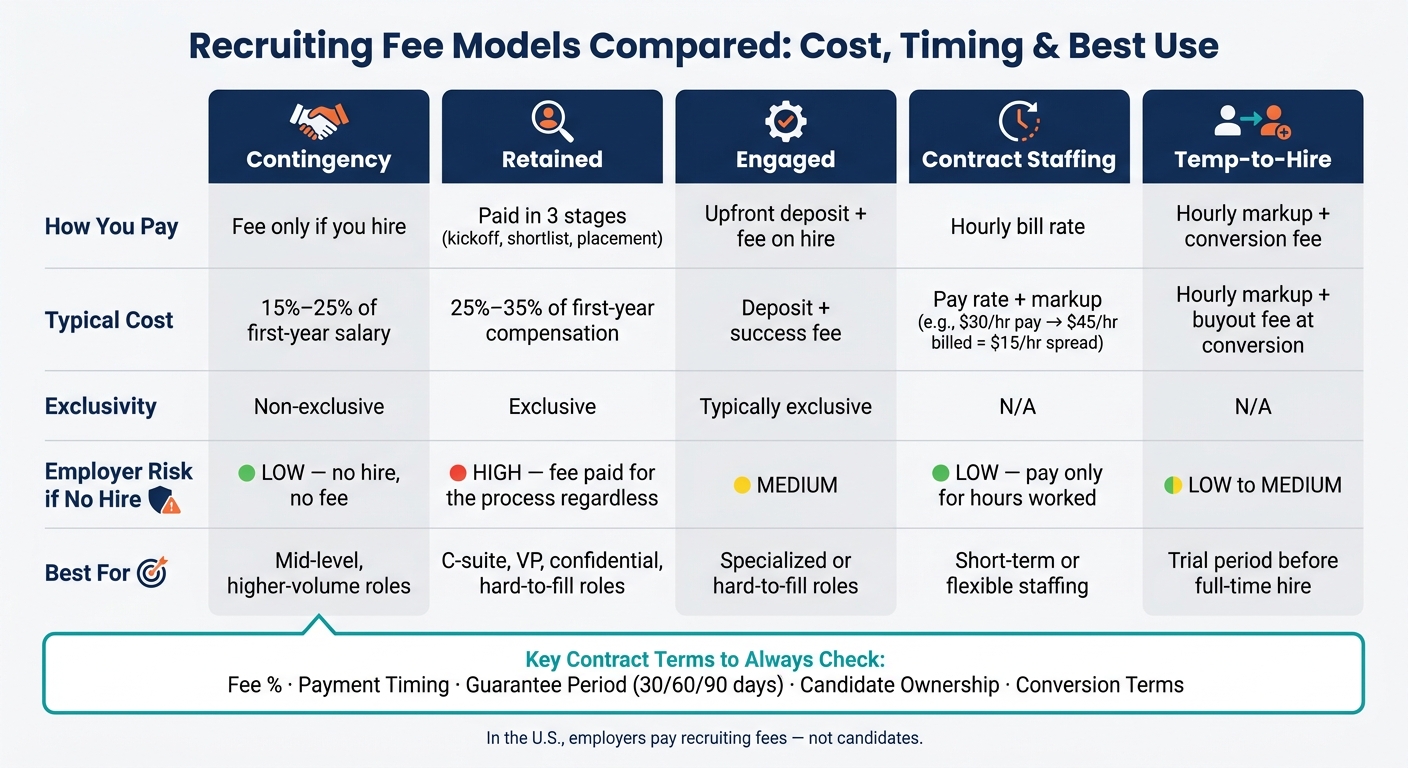
Recruiting Fee Models Compared: Cost, Timing & Best Use
RECRUITING FEES (EXPLAINED)
How Recruiting Firms Get Paid: Quick Comparison
| Model | How I Pay | Common Cost | Best For | Main Risk |
|---|---|---|---|---|
| Contingency | Only on hire | 15%–25% of salary | Mid-level roles, higher volume | Short guarantee or weak refund terms |
| Retained | In stages during search | 25%–35% of compensation | Executive, confidential, hard-to-fill roles | I pay even if the search takes longer |
| Engaged | Deposit + fee on hire | Deposit plus success fee | Specialized roles | Upfront cost |
| Contract Staffing | Hourly bill rate | Pay rate + markup | Short-term or flexible staffing | Hourly cost adds up over time |
| Temp-to-Hire | Hourly first, then buyout if hired | Markup + conversion fee | Trial period before full-time hire | Extra fee at conversion |
If I were reviewing an agreement from one of the recruiting firms on your shortlist, I’d focus on five things first: fee, payment timing, guarantee, ownership rules, and conversion terms. Those lines often matter more than the headline rate.
Contingency Recruiting: Pay Only If You Hire
Contingency recruiting is the pay-only-if-you-hire model that many recruiting firms offer. You pay a fee only if you hire a candidate the firm introduced, usually on or shortly after the start date. So if you make a $100,000 hire and the fee is 20%, the cost is $20,000.
As a result, that setup puts most of the pressure on speed and candidate ownership. Why? Because these searches are usually non-exclusive. The employer can fill the role through another recruiter, an internal team, or another channel, so recruiters tend to move fast.
How Fees and Guarantees Typically Work at Recruiting Firms
Most contingency contracts include a guarantee window, often 60 to 90 days from the hire’s start date [1]. If the new employee leaves during that window, what happens next depends on the contract.
That clause is your main safeguard in a contingency deal. Some contracts offer a replacement search. Others may offer a full or partial refund. The key is simple: check the guarantee clause before you sign and make sure the remedy is spelled out clearly.
Retained search is different. In that model, recruiting firms are paid for running the search itself, not only for making the hire.
How to Compare Contingency Proposals Before Signing
A lower fee percentage doesn’t always mean a better deal. A proposal with a smaller fee but a short guarantee window can leave you holding more risk than one with a slightly higher fee and better protection terms.
This is where side-by-side comparison helps. Small contract details can change the total cost if the hire doesn’t work out.
| Contract Element | What to Look For |
|---|---|
| Fee percentage | Typical range is 15%–25%; some agreements reach 30% [1] |
| Guarantee window | 60–90 days is common [1] |
| Refund or replacement terms | What remedy applies if the hire leaves during the guarantee period? |
| Exclusivity | Is the search non-exclusive, and how does that affect candidate submissions? |
One more thing: define "first-year salary" before you sign. If that term isn’t clear, the fee could be calculated on an inflated base.
Retained and Engaged Search: Paying for a Deeper, Exclusive Process
Unlike contingency, retained search pays for the process, not just the hire. It’s most often used for senior or hard-to-fill roles [1]. The fee is usually split into three parts: kickoff, shortlist, and placement. Total cost tends to land between 25% and 35% of first-year compensation [1], and the search is exclusive.
That higher price tag comes with a lot more work behind the scenes. Retained searches usually involve heavier screening, more stakeholder input, and a longer timeline than contingency roles. Executive vacancies can cost 2–4x more than mid-level roles [3]. So what are you paying recruiting firms for? Things like dedicated research, market mapping, outreach to passive candidates, and alignment across the hiring team.
Engaged search sits in the middle. You pay an upfront deposit so the firm gives the role more focus, then pay the rest when someone is hired. It makes sense for specialized or hard-to-fill roles when you want more commitment than contingency, but don’t want the full price of retained search.
When Retained Search Makes More Sense Than Contingency
This choice usually comes down to four things: role seniority, talent scarcity, confidentiality, and process complexity.
If the role is senior enough that a bad hire could throw off an entire team or function, retained search often makes more sense. The same goes for roles where the talent pool is thin and passive outreach is the main path in. And if the search is sensitive enough that you can’t post it in public, exclusivity starts to matter a lot more.
Contingency at recruiting firms is still a solid fit for mid-level, higher-volume hiring. But when speed without precision creates more risk than help, paying for the search process – not just the end result – can be the smarter move.
Contingency, Retained, and Engaged Search: Side-by-Side Comparison
Use this table to compare cost, timing, and service level before picking a model. The main differences show up in when you pay, whether the search is exclusive, and how much risk the employer takes on.
| Feature | Contingency | Retained | Engaged |
|---|---|---|---|
| Fee Range | 15%–25% of salary [1] | 25%–35% of salary [1] | Upfront deposit + success fee |
| Payment Timing | 100% upon hire | 1/3 kickoff, 1/3 shortlist, 1/3 hire | Deposit upfront, balance on hire |
| Exclusivity | Non-exclusive | Exclusive | Typically exclusive |
| Risk if No Hire | Low – no hire, no fee | High – fee paid for the process | Medium |
| Best Fit | Mid-level, higher-volume roles | C-suite, VP, confidential searches | Specialized, hard-to-fill roles |
Before you sign anything, get the payment triggers, candidate ownership terms, and service scope in writing. If you are still shortlisting partners, our guide on how to choose a recruiting agency for your business walks through the questions to ask first.
Contract Staffing and Temp-to-Hire: How Markups and Conversion Fees Work
When the fee is hourly instead of one-time, the math changes.
Contract and temporary staffing, which staffing firms run at scale, use hourly billing rather than a single placement fee. The firm charges the employer a higher bill rate than it pays the worker. That gap is where the agency makes money on each hour worked, so it has a clear reason to keep the assignment filled and compliant.
That markup covers payroll processing, benefits administration, compliance tracking, and overhead [2].
Bill Rate, Pay Rate, Markup, and Margin: A Simple Example
Say a worker earns $30.00 per hour. The agency bills the employer $45.00 per hour. The $15.00 difference is the spread.
Here’s where people often get tripped up: markup and margin are not the same thing. They use different formulas.
- Markup % = (Bill Rate − Pay Rate) ÷ Pay Rate = $15 ÷ $30 = 50%
- Gross Margin % = (Bill Rate − Pay Rate) ÷ Bill Rate = $15 ÷ $45 = 33%
Same dollars, different math.
And that’s exactly why conversion terms matter just as much as the hourly rate. A bill rate may look fine at first glance, but the total cost can change if you decide to bring the contractor on as a permanent employee.
If you hire the contractor permanently, the agency may charge a conversion fee, also called a contractor-to-perm fee. In plain English, you’re paying for flexibility up front, then paying a separate fee if you convert the worker to permanent status. That fee may be a flat amount or a percentage of salary, and the contract should say exactly when it applies [1].
Direct Hire, Contract Staffing, and Temp-to-Hire: Side-by-Side Comparison
| Feature | Direct Hire | Contract Staffing | Temp-to-Hire |
|---|---|---|---|
| Pricing Basis | % of first-year salary (15%–25%) [1] | Hourly bill rate with markup | Hourly markup + conversion fee [1] |
| Key Cost Drivers | Commissions and recruitment marketing [1] | Payroll, benefits, compliance, and overhead [2] | Ongoing administrative costs plus a final buy-out fee [1] |
In temp-to-hire deals, check the conversion fee and how it is calculated before you sign.
Once you understand hourly billing and conversion fees, the next step is matching the pricing model to the role.
How to Match the Fee Model to the Role and Read the Contract Clearly
Start with the role itself. A simple way to pick the right fee model is to estimate what it costs each day that the role stays empty. For leadership and VP-level jobs, the daily revenue impact can be about $1,000 or more, which means a 30-day vacancy can cost more than $30,000 [3]. When the cost of waiting is that high, retained search can make sense.
For frontline or high-volume roles, the math usually looks different. If the daily impact is much lower, contingency or temp-to-hire is often the better fit.
Use vacancy cost and role criticality to narrow the choice. This table shows which model tends to fit best based on vacancy impact and hiring difficulty [3][1]:
| Role Type | Estimated Daily Revenue Impact | Recommended Fee Model |
|---|---|---|
| Leadership (VP/C-level) | $1,000+ | Retained or engaged search |
| Sales Executive | $500 | Contingency or retained search |
| Software Engineer | $400 | Contingency or retained search |
| Frontline / Retail | $150 | Temp-to-hire or contract staffing |
In the U.S., recruiting firms are paid by employers, not candidates. For background on the profession, see the U.S. Bureau of Labor Statistics’ overview of human resources specialists. And because fees are often tied to a percentage of first-year salary, recruiters have a reason to help candidates land a strong offer [1].
A Contract Review Checklist for HR and Finance Teams
After you choose the model, the contract is where the actual cost takes shape. This is where small details can turn into extra charges later, so HR and Finance should read it line by line.
Check these terms before signing:
- Total expected cost – Turn any percentage-based fee into a dollar amount using the target salary range.
- Payment timing – Confirm exactly when the fee is due.
- Exclusivity – If the search is exclusive, make sure that appears in writing.
- Candidate ownership – Ask for timestamped submissions to avoid disputes [4].
- Guarantee and replacement policy – Get replacement or refund terms in writing.
- Temp-to-hire conversion terms – Review how the conversion fee is calculated and when it applies [1].
- Response-time expectations – Put handoffs and timing in writing, such as a 48-hour response time [2].
It also helps to set an internal rule for when each model applies. For example, you might use retained search for leadership hires, contingency for mid-level roles, and temp-to-hire for high-volume hiring when you want a trial period before making a full commitment.
These terms can matter more than the fee you see at the top of the agreement.
Conclusion: Key Terms and Cost Drivers to Remember
Employers pay the fee when recruiting firms place a hire. Candidates in the U.S. should not be charged. Direct-hire fees usually fall between 15% and 25% of first-year salary [1]. For contract and temp staffing, agency revenue comes from the hourly markup between what the agency pays the worker and what it bills you. Temp-to-hire deals can also include a conversion premium if you decide to hire the worker full time [1].
The headline rate is rarely the full picture. Guarantee terms, candidate ownership records, and conversion fee triggers can all change the actual cost. That’s why it makes sense to read those sections of the contract just as closely as the fee percentage itself.
Once you know which model fits the role and what the contract actually says, it becomes much easier to make the case internally for the right hiring approach. However, if you run a recruiting business yourself, HireLab’s multi-client recruitment software for agencies shows how you can manage clients and candidates in one place.
FAQs
How do I choose the right fee model for a role?
Choose based on hiring urgency, budget predictability, and the role’s impact.
Start by estimating your total cost per hire. That should include internal recruiter time, hiring manager hours, and vacancy costs. If you skip those pieces, the math can look better on paper than it does in practice.
If the role is critical and tied to revenue, a retained search may be worth the added cost. Put the recruiting firm’s fee next to your internal costs and see how the numbers shake out. The goal is simple: make sure the hiring model matches your business goals.
What should I negotiate before signing with recruiting firms?
Before you sign, get clear on the fee structure. That means more than the base price. Ask about contract-to-hire conversion premiums, plus any setup, customization, or support costs that could show up later.
You’ll also want to confirm that data export is clean and simple. No one wants to get stuck with messy records or a painful handoff. On top of that, review the SLAs so you know what kind of support response and uptime you can expect.
Finally, make sure replacement policies and candidate performance guarantees are spelled out in plain language. If a hire doesn’t work out, the next steps should be clear from day one.
When is a lower recruiting fee not actually cheaper?
A lower recruiting fee may look cheaper on paper. But that falls apart fast if it leads to higher total business costs or weaker hiring results.
Push costs down too far, and the tradeoff can be rough: lower candidate quality, more employee churn, or roles sitting open longer than they should.
And if a lower-fee service slows hiring, the numbers can turn against you fast. Cost per hire can climb by 10% to 15% for each extra week a role stays open, and the chance of offer acceptance can drop by 16%.



What Is Boutique Recruiting? When to Use It
October 15, 2026[…] recruiting fees usually fall into three models. It helps to know how each one works before you kick off a […]