What Is Boutique Recruiting and When Should You Use It?
Boutique recruiting makes sense when a role is hard to fill, private, or high-stakes. If you need niche talent, passive candidates, or extra search help, it can be worth the fee. If you’re hiring at scale or filling entry-level roles, it often is not.
Here’s the short version:
- I’d use boutique recruiting for executive, niche technical, hard-to-fill, and confidential roles.
- I would not use it first for retail, warehouse, call center, or other high-volume jobs.
- Typical fees are 15% to 25% of first-year salary for contingency searches, and 25% to 33% of total pay for retained searches.
- It works best when your ideal hire is likely part of the 73% of workers who are passive candidates.
- It can also help when internal teams are stretched, since recruiting for one role can take 48+ hours.
- Delay matters: each extra week a role stays open can add 10% to 15% to hiring cost.
If I had to boil it down to one rule, it would be this: pay for boutique recruiting when the cost of an empty seat, a weak hire, or a missed search is higher than the recruiting fee.
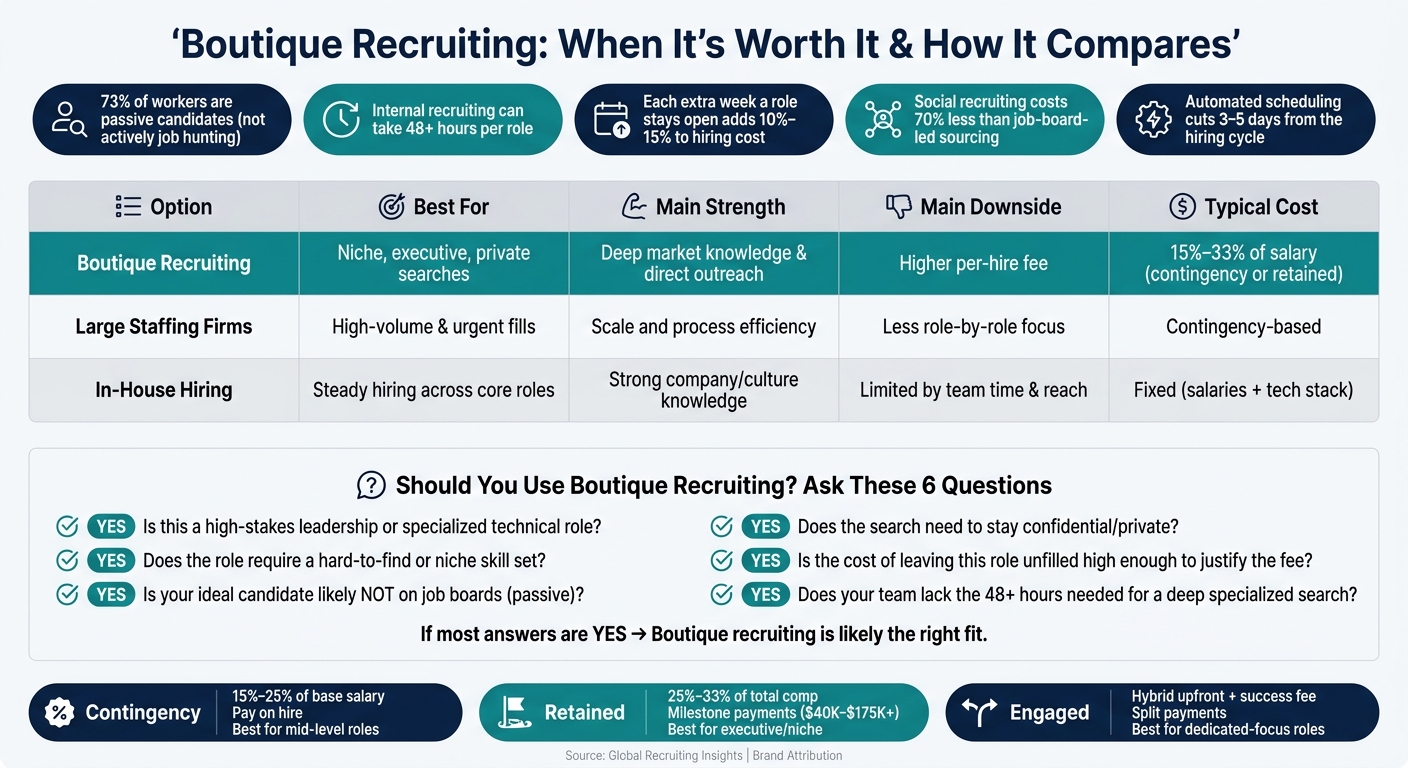
Boutique Recruiting vs. Large Staffing Firms vs. In-House Hiring
Quick comparison
| Option | Best for | Main strength | Main downside | Typical cost shape |
|---|---|---|---|---|
| Boutique recruiting | Niche, executive, private searches | Deep market knowledge and direct outreach | Higher per-hire fee | Variable; 15%–33% depending on model |
| Large staffing firms | High-volume and urgent fills | Scale and process | Less role-by-role focus | Often contingency-based |
| In-house hiring | Steady hiring across core roles | Strong company knowledge | Limited by team time and reach | Fixed payroll and tool costs |
So before choosing a hiring path, I’d ask:
- Is the role hard to source?
- Is the best candidate likely not applying on job boards?
- Does the search need to stay quiet?
- Is my team short on time or market reach?
- Does vacancy cost more than the fee?
If most answers are yes, boutique recruiting is probably a fit.
What is boutique recruiting?
Boutique recruiting is a targeted search model for specific, hard-to-fill roles. These firms focus on a certain industry, job function, or seniority level. Before they start sourcing, they spend time defining the role and mapping the market. The goal is depth, not volume: fewer searches at one time, closer attention to fit, and a process shaped around what the job actually needs.
That’s why boutique recruiting works best when a role calls for precision more than volume.
How boutique recruiting differs from high-volume agency recruiting
The contrast stands out most in how candidates are sourced. High-volume staffing is built to fill a lot of openings fast. It usually supports roles with large hiring needs, like retail, warehouse, and call center jobs. To move at speed, it leans on job boards, ATS filtering, and automated screening to sort through big applicant pools.
Boutique recruiting works in the other direction. It’s proactive. Recruiters use direct outreach, social sourcing, CRM tools, and personalized communication to connect with people who aren’t actively browsing job boards.
| Dimension | High-Volume Staffing | Boutique Recruiting |
|---|---|---|
| Candidate pool | Active job seekers | Passive candidates |
| Sourcing approach | Reactive: post and filter | Proactive: targeted outreach and relationship building |
| Primary tools | Job boards and ATS filtering | Social sourcing, CRM, and personalized outreach |
| Recruiter role | Automated screening at scale | Manual, precision-led search |
| Priority | Placement speed and volume | Quality of fit and cultural alignment |
This setup matters most when the talent pool is small and the job has tight requirements.
Common roles and industries that use boutique recruiters
Boutique recruiting is often the better fit for hard-to-fill, niche, technical, executive, and confidential searches. In these cases, quality of hire matters more than raw speed, and the search depends on deep market knowledge.
You’ll see this model often in technology, healthcare, finance, manufacturing, and B2B SaaS sales roles. These fields tend to have more role complexity and more specialized talent pools.
How boutique recruiting compares with large staffing firms and in-house hiring
This comparison shows where boutique recruiting tends to help most: specialized searches, lean internal teams, and roles that need deeper market reach. The main question is simple: does this role need specialization and reach more than speed and volume?
A clean way to judge that is to compare boutique recruiting with the two most common options: large staffing firms and in-house hiring.
Boutique recruiting vs. large staffing firms
Both are outside partners, but they work in very different ways.
Large staffing firms are built for scale. They handle high-volume searches across many industries and often rely on standardized processes. Boutique firms, by contrast, focus on a narrower set of roles or sectors and work each search more closely, usually with fewer clients per recruiter.
That difference matters. Boutique recruiters often spend more time shaping outreach to fit the role and the people they want to reach. For specialized searches, the best partner is usually the one that can reach candidates your team can’t find fast on its own.
| Feature | Boutique Recruiting | Large Staffing Firms |
|---|---|---|
| Specialization | Deep niche expertise | Broad, multi-industry coverage |
| Recruiter involvement | High | Lower |
| Flexibility | Customized to the search | Standardized process |
| Search depth | Passive and niche talent | Active applicants and large databases |
| Message customization | Tailored to role and audience | Standardized |
| Typical use cases | Executive, niche, confidential roles | High-volume, entry-level, urgent fills |
| Fee structure | Premium; retained or contingency | Contingency-based |
The tradeoff shifts again when the other option is your own recruiting team.
Boutique recruiting vs. in-house hiring
In-house teams run the process day to day. Boutique firms step in when a search is too narrow, too sensitive, or too urgent for the team’s current bandwidth.
Your internal team usually knows the company culture best. That’s hard to match. But boutique firms can add outside reach and extra sourcing power for specialized searches, especially when the role calls for passive candidates or niche networks.
Cost structure is another major difference. In-house hiring comes with fixed costs, like recruiter salaries and your tech stack, whether you fill a few roles or many. Boutique agencies charge a variable fee, usually 15%–25% of the candidate’s first-year salary [2]. That makes boutique recruiting a better fit for occasional, high-value searches than everyday hiring.
| Feature | Boutique Recruiting | In-House Hiring |
|---|---|---|
| Cost shape | Variable (15%–25% per hire) | Fixed (salaries + tech stack) |
| Cultural knowledge | External; learned over time | Deep; inherent |
| Access to passive and niche talent | High (specialized networks) | Moderate (depends on team) |
| Hiring volume | Best for low-volume, high-value roles | Best for steady or high-volume hiring |
| Scalability | High (on-demand) | Low (limited by headcount) |
| Ideal scenario | Executive, niche, or confidential searches | Core team growth and culture-fit roles |
A practical split often works best: use boutique recruiting for market mapping, outreach, and screening, then keep final interviews and hiring decisions in-house. That leads straight to the next question: when does the boutique model actually make sense?
When should you use boutique recruiting?
Use boutique recruiting when the role is specialized, hard to source, or too sensitive for a public search.
Where boutique recruiting fits best: executive, niche, hard-to-fill, and confidential searches
Boutique recruiting works best when a role calls for judgment, targeted outreach, and relationship-driven hiring, not just a high-volume process.
That usually includes executive searches, like a VP of Engineering. It also fits niche technical roles, such as AI/ML specialists or Data Infrastructure Engineers, where the pool of qualified talent is small and the search has to be precise. In cases like these, recruiters often need tight filters to find people with the right tech stack and background.
It also makes sense for confidential searches. If a public job post could create problems, boutique firms can handle the search through discreet outreach and private networks, keeping things quiet until the right candidate is ready to talk.
In these searches, depth matters more than speed.
Cases where boutique recruiting is not the right model
Boutique recruiting is not the right fit for every opening.
High-volume hiring – like retail associates, warehouse staff, call center agents, or multi-site hiring – runs on a different playbook. These roles usually need speed, process efficiency, and a low cost-per-hire. In that setup, boutique fees of 15%–25% of first-year salary can be tough to justify, especially when the role can be filled through automation or a high-volume staffing model [2].
The same goes for routine entry-level hiring. If there’s a large pool of active applicants, extra sourcing work may not add much.
A decision checklist for employers
Before you contact a boutique firm, look at these six questions. If the answer is yes to most of them, the fee may make sense.
| Decision Criteria | Key Question |
|---|---|
| Is this a high-stakes role? | Is this a leadership or specialized technical position with major business impact? |
| Is the skill set hard to find? | Does the role require a hard-to-find skill set or niche industry background? |
| Is the candidate likely passive? | Is your ideal candidate likely not actively looking on job boards? |
| Does the search need to stay private? | Does the search require no public postings? |
| Does the cost of delay justify the fee? | Is the cost of leaving this role unfilled high enough to justify a placement fee? |
| Does your team have time for a deep search? | Does your team lack the 48+ hours per role needed to run a deep, specialized search? [1] |
There’s also a simple business case behind this. Internal teams can spend 48+ hours per role on recruiting tasks [1]. And every extra week a position stays open can add 10% to 15% to the total cost per hire [3].
So if most of your answers are yes, the next step is to look at the fee and service model – and see whether they match the role.
What boutique recruiting costs, what service to expect, and how technology supports results
Typical US pricing models and service levels
Boutique recruiting fees usually fall into three models. It helps to know how each one works before you kick off a search.
Contingency search means you pay only if a hire is made. Fees are usually 15%–25% of the candidate’s first-year base salary [2].
Retained search is the most hands-on option. Fees often land at 25%–33% of first-year total compensation and are usually paid in three parts: at kickoff, at the shortlist stage, and when the hire is completed. For senior executive searches, total fees can run from $40,000 to $175,000+, depending on scope and complexity. In exchange, you get a tighter, more structured search process.
Engaged search sits in the middle. You pay a smaller upfront fee to secure dedicated recruiter time, and the rest is due when the hire is made.
| Model | Typical Fee | When You Pay | Best For |
|---|---|---|---|
| Contingency | 15%–25% of base salary [2] | Upon successful hire | Mid-level, high-volume roles |
| Retained | 25%–33% of total comp | Milestone-based | Executive, niche, confidential |
| Engaged | Hybrid (upfront fee + success fee) | Split | Roles needing dedicated focus |
The fee matters, of course. But the bigger issue is whether the firm runs a solid process and stays on top of the search.
How to evaluate a boutique recruiting partner
Once you’ve matched the fee model to the role, look closely at how the firm works day to day. This is where a lot of searches either move cleanly or get bogged down.
You want a partner with real industry knowledge, a clear search method, steady communication, and reporting that tells you what’s happening without making you chase for answers.
Strong boutique firms use a 48-hour feedback standard to keep candidates engaged and reduce drop-off [3]. If a recruiter can’t tell you how often you’ll hear from them, what updates look like, or how feedback will move between your team and candidates, that’s a red flag.
| Evaluation Area | What to Ask |
|---|---|
| Industry focus | Do you understand our industry and compensation norms? |
| Role fit | What’s your sourcing strategy for passive candidates in this function? |
| Process clarity | What does your search process look like, week by week? |
| Fee model | Is this retained, contingency, or engaged – and what’s included? |
| Reporting quality | What data and updates will we receive, and how often? |
A good boutique recruiter should be able to walk you through the search in plain English. No fog, no vague promises.
How recruitment technology can improve boutique search results
Technology should make the search move faster. It shouldn’t take over the parts that need human judgment.
Boutique firms use tech to find, contact, and follow up with passive candidates more quickly. Social recruiting can cost 70% less than job-board-led sourcing [2], and automated scheduling tools can cut 3–5 days from the hiring cycle [1].
In practice, technology often helps with:
- Market mapping
- Candidate outreach and follow-up
- Scheduling
That said, software doesn’t close the hire on its own. The tools keep the process moving, the recruiter manages the relationship, and the hiring team makes the call.
Conclusion: When boutique recruiting is worth the investment
The choice usually comes down to three things: how hard the role is to fill, how fast you need to fill it, and what an empty seat is costing you.
Boutique recruiting makes sense for specialized, hard-to-fill, or confidential roles when your team doesn’t have the time or network to reach passive candidates. And that gap can get expensive fast. Every extra week a role stays open can increase total search costs by 10%–15% [3]. That’s a big deal, especially because boutique search is built to reach passive talent that won’t respond to a standard job post.
On the other hand, it’s often a poor fit for routine, high-volume roles. In those cases, high-volume hiring systems tend to keep costs lower and fill roles faster.
A simple way to look at it: compare the fee against the cost of vacancy, the time your team would spend on the search, and the risk of a bad hire. If the role is specialized and delays have a clear cost, the fee often looks a lot more reasonable than it does at first glance.
Recruitment CRM tools can also help keep passive candidates warm without losing the relationship-driven style that makes boutique search work.
FAQs
How long does a boutique search usually take?
A boutique search timeline comes down to two things: how complex the role is and what you need from the hire.
These searches are usually used for specialized, hard-to-fill, or executive roles. So they tend to take a more hands-on, longer-range approach than standard high-volume hiring.
That extra time isn’t trivial. Each added week can increase cost per hire by 10% to 15%. That’s why the goal isn’t just to move fast. It’s to get the right person in the seat.
What should I prepare before hiring a boutique recruiter?
Before you hire a boutique recruiter, get your internal team on the same page about the search. That means agreeing on the number of roles, your hiring timeline, and the budget that’s been approved.
You’ll also want to define the role itself. Be clear about the skills the person needs, what they’ll handle day to day, and where the role sits within your team structure. Just as important, assign ownership early for hiring decisions, interviews, and stakeholder communication before the search starts.
What results should I expect from a boutique recruiting firm?
Expect a specialized, high-touch approach that puts precision ahead of volume. Boutique recruiting firms often send candidates who are a better fit, especially for niche, executive, or hard-to-fill roles. They can also reach passive candidates who usually won’t apply through job boards.
You should also expect a more collaborative partnership, clear communication, and help with complex or confidential searches. Fees may be higher, but the payoff is often faster hiring for tough roles and less admin work for your team.