


Staffing Firms 101: What Employers Need to Know
Staffing firms can help when the cost of an open role is higher than the hiring fee. If a Sales Executive vacancy can cost about $500 per day and a Software Engineer vacancy about $400 per day, outside recruiting help may make sense when your team is short on time or struggling to fill a role.
Here’s the short version: I’d look at four service types first – temporary, contract, temp-to-hire, and direct-hire. Then I’d check who handles payroll, how fees work, how fast the firm fills roles, and what happens if I want to hire the worker full-time. For direct-hire, fees often land around 15% to 25% of first-year salary.
Before I sign with any firm, I’d make sure I know:
- When staffing help fits: urgent openings, hiring spikes, project work, and hard-to-fill roles
- What I’m paying for: hourly markup, placement fee, or conversion fee
- What can go wrong: vague job scope, weak screening, hidden conversion terms, and poor candidate handling
- What to compare: fill time, screening steps, industry track record, and retention data
Bottom line: I’d use a staffing firm when I need faster access to talent, but I’d choose the service model based on cost, hiring timeline, and payroll control.
A Closer Look on How Staffing Agencies Work
Quick Comparison
| Model | Payroll | Main Use | Common Cost |
|---|---|---|---|
| Temporary | Staffing firm | Short-term coverage | Hourly bill rate |
| Contract | Staffing firm | Project or skill-based work | Hourly bill rate |
| Temp-to-hire | Starts with staffing firm, then moves to employer | Try before full-time hire | Hourly rate + conversion fee |
| Direct-hire | Employer | Permanent roles | 15%–25% of first-year salary |
If I were deciding today, I’d compare the fee against the cost of delay, then pick the model that gives me the right mix of speed, budget control, and hiring control.
Types of Staffing Firms and Their Service Models
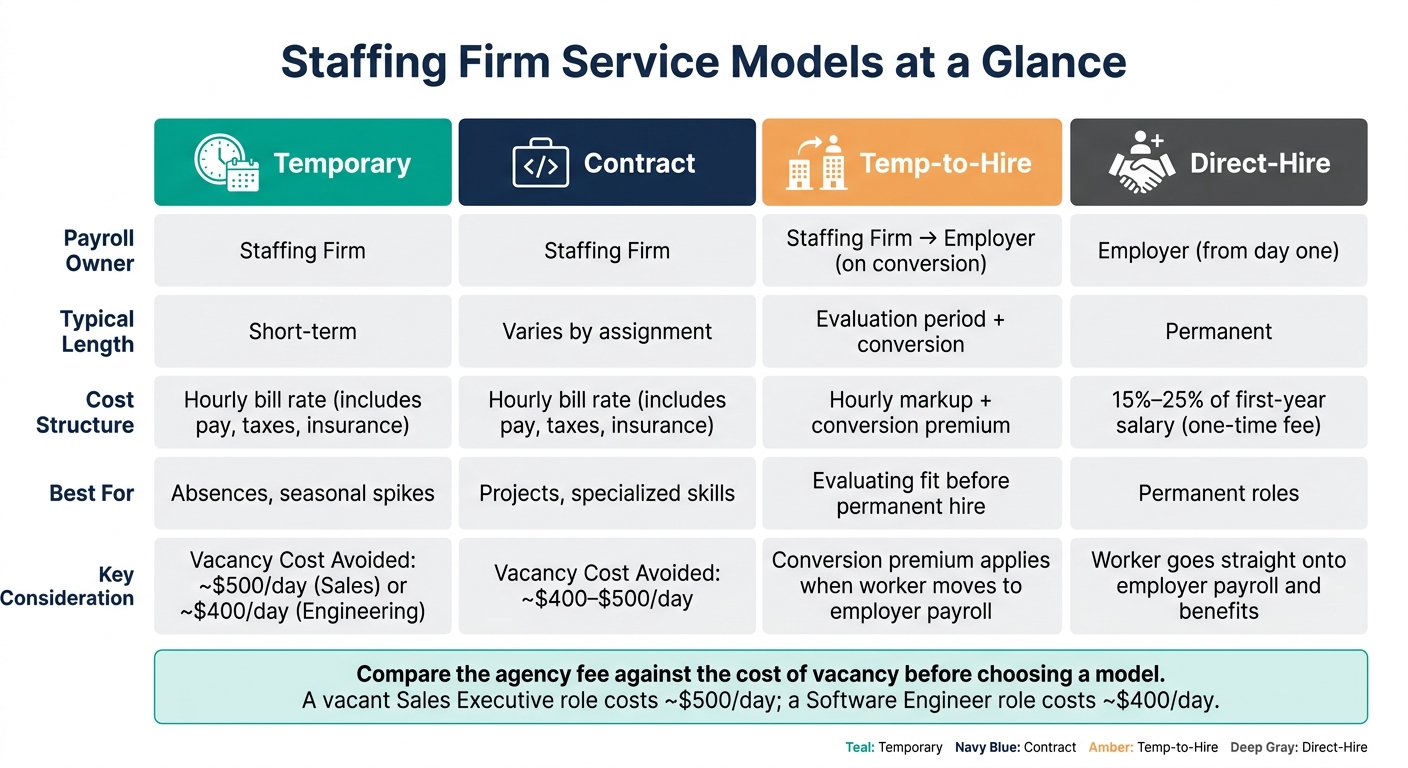
Staffing Firm Service Models: Cost, Payroll & Best Use Compared
Most staffing firms, as explained in our guide on how staffing and recruiting companies differ, work through four core service models: temporary, contract, temp-to-hire, and direct-hire. The one you pick shapes three big things: speed, cost, and who owns payroll. That’s where a lot of the tradeoffs come from.
Temporary, Contract, Temp-to-Hire, and Direct-Hire: What Each Model Means
Temporary staffing is built for short-term coverage. Think call-outs, busy seasons, or a sudden gap on the schedule.
Contract staffing works a lot like temporary staffing from a payroll standpoint, but it’s more often used for project work or roles that need specialized skills. In both cases, the staffing firm handles payroll and taxes, and you pay an hourly markup.
Temp-to-hire (also called contract-to-perm) gives you a trial run. The worker starts on the staffing firm’s payroll, which gives you time to see how things go on the job. If the fit is there, you can bring that person onto your own payroll. When that happens, a conversion premium often applies [1].
Direct-hire is a permanent placement from the start. The staffing firm finds candidates and sends them to you for review. Once you hire someone, that worker goes straight onto your payroll. Direct-hire fees usually range from 15% to 25% of the new hire’s first-year salary [1].
Side-by-Side Comparison of Service Models
| Service Model | Who Handles Payroll | Typical Length | Cost Structure | Best For |
|---|---|---|---|---|
| Temporary | Staffing firm | Short-term | Hourly markup | Absences, seasonal spikes |
| Contract | Staffing firm | Varies by assignment | Hourly markup | Projects, specialized skills |
| Temp-to-Hire | Staffing firm → Employer | Evaluation period + conversion | Hourly markup + conversion premium | Evaluating fit before a permanent hire |
| Direct-Hire | Employer (from day one) | Permanent | 15%–25% of first-year salary [1] | Permanent roles |
Once the service model is clear, the next piece is how staffing firms source, screen, and place candidates.
How Staffing Firms Work and What Employers Pay
The Workflow From Intake to Placement
You start by defining the role. From there, the staffing firm sources candidates, screens them, and puts together a shortlist. You review the finalists and interview the people you want to move forward with.
For direct-hire searches, the setup is pretty simple: the firm takes care of sourcing and screening, and once you make a hire, that employee joins your payroll and benefits structure [1].
Once that process is clear, cost is usually the next thing employers want to pin down.
Fee Structures, Markups, and Conversion Terms
What you pay depends on the hiring model.
For temporary and contract roles, firms usually charge an hourly bill rate. That rate covers the worker’s pay, recruiter time, payroll taxes, and insurance [1]. For direct-hire placements, the fee is a one-time charge that usually lands between 15% and 25% of the candidate’s first-year salary [1]. Also, if you bring on a temp worker as a permanent employee, a temp-to-hire conversion can come with a conversion premium when that person moves to your payroll [1].
| Cost Type | When It Applies | Typical Range |
|---|---|---|
| Hourly bill rate | Temporary or contract roles | Varies by industry; includes worker pay, recruiter time, payroll taxes, and insurance [1] |
| Direct-hire fee | Permanent placements | 15%–25% of first-year salary [1] |
| Conversion premium | Temp-to-hire converted to permanent | Applies when conversion occurs [1] |
That’s why the hiring model matters so much. A temp role, a direct hire, and a temp-to-hire plan can all lead to very different costs, even when you’re filling the same job.
When to Use a Staffing Firm and How to Choose One
Hiring Situations Where Staffing Firms Help Most
After you pick a service model, the next question is simple: when is staffing help worth paying for? In most cases, it makes sense when you need to move fast, cover urgent project work, or fill roles your team keeps struggling to close.
The math can make the decision pretty clear. A vacant Sales Executive role costs about $500 per day in lost revenue impact, and a Software Engineer role costs about $400 per day [2]. If the cost of leaving the role open is higher than the agency fee, bringing in a staffing firm is worth a serious look [2].
Staffing firms also tend to help most with hard-to-fill roles in tech, healthcare, and finance, where hiring often takes longer and the pool is tighter [1] [3]. Another plus: they can reach passive candidates – people who aren’t applying on their own but may be open to the right offer [3].
Once the hiring need is clear, the next step is figuring out which firm can fill the role fast and with less guesswork.
How to Evaluate a Staffing Partner
Not every staffing firm works the same way. And a bad fit can drag out hiring instead of fixing it. Before you sign, focus on the checks that tend to predict a better result:
| Evaluation Criteria | Check | Why It Matters |
|---|---|---|
| Industry Expertise | Specific placement history in your niche | Shows they understand the specialized skills your roles require |
| Speed | Average time to shortlist and fill | Helps reduce the damage from costly vacancies |
| Clear Pricing | Markup rates and conversion/buyout terms | Helps avoid surprise costs when converting a contractor to permanent |
| Vetting Process | What their screening process actually includes | Shows whether shortlisted candidates are actually qualified |
Use those criteria to ask for proof, not polished sales talk, and use a standardized scorecard to evaluate staffing and recruiting firms side by side. Ask for hard numbers on time-to-hire, source of hire, retention, and manager satisfaction scores [3]. If a firm can’t share that data, that’s a warning sign.
How Digital Hiring Tools Support Staffing Outcomes
Digital channels still play a big part. Job seekers use social media, recruiters use it to find top candidates, and a strong employer brand can lower hiring cost and turnover [3]. The best staffing firms don’t just blast out job ads and hope for the best. They pair those channels with disciplined screening and a clear process. For example, if you run part of your hiring in-house, an applicant tracking system keeps candidates from the firm and your own channels in one pipeline.
Even with strong sourcing and employer branding, the right partner still comes down to fit, pricing, and how they actually run the search.
Common Risks, Misconceptions, and How to Decide
Risks and Misconceptions Employers Should Know
Before you choose a staffing partner, look at the mistakes employers make most often. The biggest one? Picking a staffing firm based on the wrong assumptions about cost, speed, and control.
They work well when a role requires niche sourcing, access to passive candidates, or specialized expertise.
Fee alone is not the full cost. Direct-hire fees often run 15%–25% of first-year salary [1]. However, that number, by itself, doesn’t tell the whole story. The cost of vacancy for a key role averages about $12,000 per month [2], so it makes more sense to weigh the fee against the cost of leaving the role open [1][2].
Unclear requirements slow the search and weaken candidate quality. If the role isn’t defined well, the search can drift fast. A competency-based scorecard helps set clear expectations before the search starts and keeps the staffing firm and hiring team on the same page [1].
Poor candidate experience can hurt your employer brand. That’s why it helps to check GDPR, data minimization, and human review of AI-assisted screening to lower compliance and bias risk [3].
Once you’ve looked at those risks, the next step is simple: decide whether staffing support fits your hiring timeline and budget.
Conclusion: Does Staffing Support Fit Your Recruitment Strategy
If the costs, risks, and hiring needs line up, staffing support can make sense. Use staffing support when vacancy cost, role complexity, and access to specialized talent outweigh the fee [1][2][3].
FAQs
How do I choose the right staffing model?
Choose the right staffing model based on your hiring goals, timeline, and budget. Start by figuring out what you need most: fast support at scale or a more focused plan for harder-to-fill roles.
If you need to hire fast or fill a large number of openings, a broad sourcing approach often makes the most sense. If you’re hiring for niche or hard-to-fill roles, a targeted model is usually a better fit.
Either way, match the staffing model to your team’s capacity. And keep an eye on results like application quality and source of hire so you can see what’s working.
What should I ask before signing with a staffing firm?
Before you sign anything, figure out whether the staffing firm can work as a long-term partner, not just a vendor you call when you need extra help. That means looking past the sales pitch.
Ask how they communicate, how fast they respond, and what day-to-day work with them actually looks like. If you manage multiple clients, get clear on whether they can support isolated environments without creating extra friction for your team.
You’ll also want to check their compliance standards. Ask about data security, fairness audits, and rules such as GDPR or EEOC guidelines. And make sure their support includes clear SLAs, so technical problems don’t interfere with business continuity.
How do I know if the fee is worth it?
Start by calculating your baseline cost-per-hire: add your internal costs, like recruiter salaries and referral bonuses, to external costs such as job board fees and past agency spend, then divide that total by your total hires.
Then compare that number with the staffing firm’s fee.
In many cases, the fee makes sense if the firm cuts time-to-fill, helps you reach specialized talent, or handles high-volume hiring without bogging down your team. That’s the part many teams miss: the cheapest option on paper doesn’t always save money in practice.
It also helps to look beyond the upfront price. Retention and on-the-job performance matter just as much, because a lower-cost hire can end up costing more if that person underperforms or leaves soon after joining.



What Is Boutique Recruiting? When to Use It
October 15, 2026[…] staffing firms are built for scale. They handle high-volume searches across many industries and often rely on […]