Staffing and Recruiting Companies: How They Differ
Staffing and recruiting companies are not the same. If I need people for short-term, hourly, or seasonal work, staffing is often the better fit. If I need someone for a permanent, hard-to-fill, or leadership role, recruiting is often the better choice.
Here’s the short version of how staffing and recruiting companies differ:
- Staffing companies fill temporary, contract, seasonal, and temp-to-hire jobs.
- Recruiting companies fill permanent, direct-hire, niche, and leadership jobs.
- Staffing often moves in 7–14 days. It may cost about $1,500 to $3,000 per hire for entry-level roles.
- Recruiting often takes 18–45 days. It often charges 15%–25% of first-year salary. Executive hires often cost $12,000+.
- With staffing, the agency is often the employer of record. It handles pay, taxes, and onboarding.
- With recruiting, the worker joins the client’s payroll on day one.
If I’m hiring, the choice comes down to three things: how fast I need help, how long the role will last, and how skilled the work is. If I’m job hunting, staffing can get me working sooner. Recruiting is often a better path for a long-term career move.
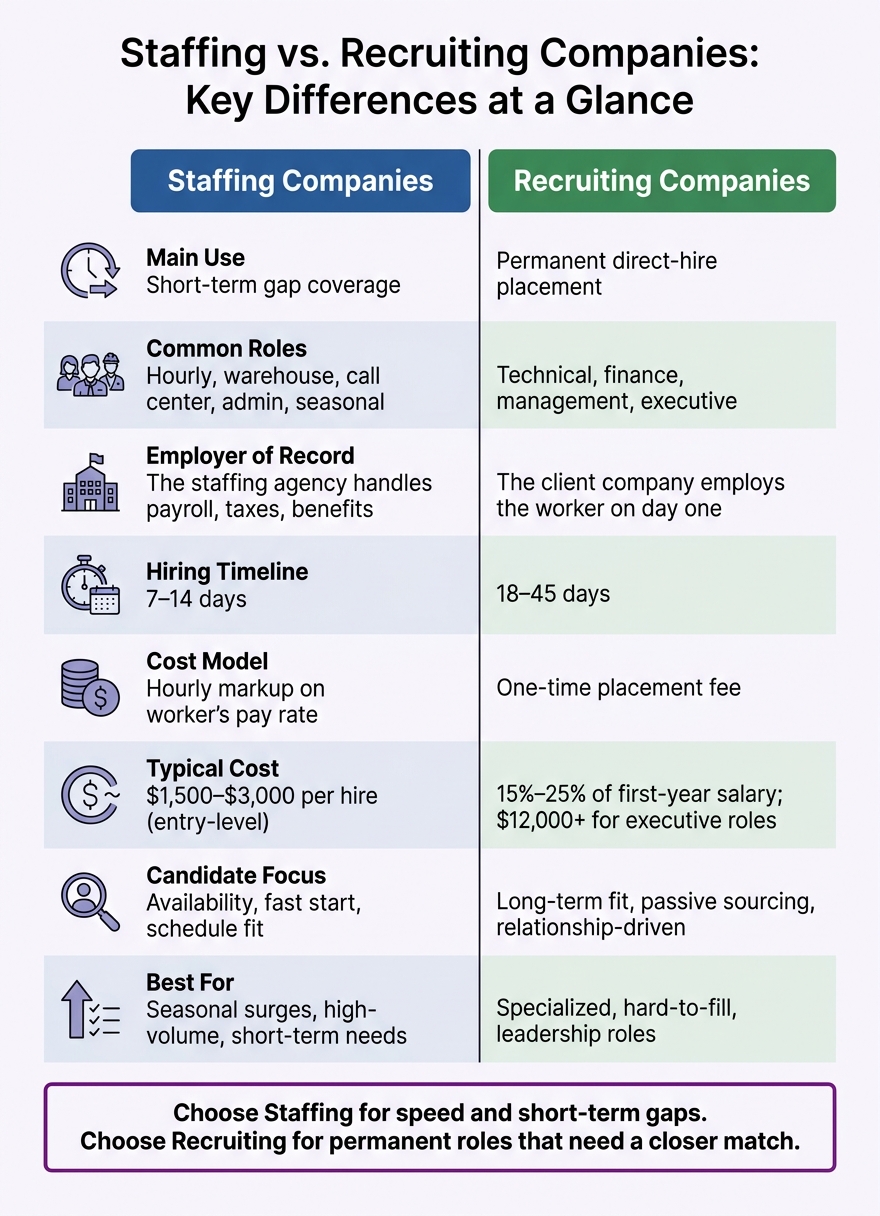
Staffing vs. Recruiting Companies: Key Differences at a Glance
Staffing and Recruiting Companies: What’s Best for Your Business?
Quick Comparison
| Criteria | Staffing Company | Recruiting Company |
|---|---|---|
| Main use | Short-term coverage | Permanent hiring |
| Common roles | Hourly, high-volume, entry-level | Salaried, specialized, leadership |
| Employment setup | Agency often employs the worker | Client employs the worker |
| Hiring timeline | 7–14 days | 18–45 days |
| Cost model | Hourly markup | One-time placement fee |
| Typical cost | $1,500–$3,000 per hire | 15%–25% of first-year salary |
| Candidate focus | Availability and fast start | Long-term fit and deeper screening |
| Best for | Seasonal, admin, warehouse, call center | Technical, finance, management, executive |
Bottom line: staffing helps fill short-term gaps; recruiting helps fill permanent roles that need a closer match.
How Staffing Companies Work
A staffing company sends workers to client businesses for temporary or contract jobs. It often acts as the employer of record. That means it handles pay, taxes, onboarding, and legal checks [1]. For more background, see the American Staffing Association. The client directs the daily work. The staffing firm handles the employment side.
Most jobs fall into four types: temporary, contract, seasonal, and temp-to-hire. You often see staffing firms in warehouse, call center, store, and office work.
Roles, Timelines, and Cost Structure
Staffing firms often fill high-volume roles. Examples include warehouse workers, call center agents, receptionists, support staff, and light industrial workers. For these jobs, hiring often takes 7–14 days [2].
The pricing is simple. Staffing firms bill by the hour. They pay the worker’s wage and add a markup. The markup covers recruiter pay, benefits, legal rules, and HR admin [1]. For entry-level roles, the cost per hire is often $1,500 to $3,000 [1].
This model shapes how staffing firms screen people and how fast they move.
How Staffing Firms Engage Candidates
Staffing firms look for who is free now, who fits the schedule, and who can start fast [2]. In plain terms, they ask three things. Can this person start soon? Can they work the hours? Can they step in with little delay?
That’s why the process is often quick. You apply on your phone, get a fast reply, and start work. The goal is to get good people into open jobs without delay.
Recruiting firms work in a different way. They focus on a deeper match and direct hires.
How Recruiting Companies Work
Recruiting companies run direct-hire searches. The person joins the employer’s payroll on day one. Staffing works differently. Workers often start on the agency’s payroll.
The goal is a long-term fit, not short-term cover. So the process goes deeper. There are more checks. More people help make the call. And there is more focus on whether the person will stay.
Roles, Timelines, and Fee Structure
Recruiting firms fill roles where a bad hire costs a lot. Think software developers, accountants, plant managers, and senior leaders.
These searches take longer. There is candidate search, a few interviews, and approval from many people. Mid-level jobs often take 18–25 days to fill. Senior or niche jobs often take 30–45 days [2].
The price is a one-time placement fee. It is often 15%–25% of the first-year base salary [1]. Executive searches cost much more, often $12,000–$15,000+ per hire [1].
There is no hourly billing and no ongoing markup. You pay once, when the right person says yes to the offer.
How Recruiting Firms Engage Candidates
Recruiting firms often reach passive candidates through direct outreach and professional networks. The aim is a long-term hire. So the approach is more personal than a fast staffing search.
A recruiter may hold a few talks with one person. They learn about career goals, pay hopes, and reasons to move. That time matters. A candidate can look great on paper. But if the role doesn’t fit what they want, the deal can fall apart late.
The recruiter also manages the moving parts:
- Setting up interviews
- Speeding up feedback
- Handling offer talks
Each extra week adds cost. It also makes an accepted offer less likely. So recruiters work to keep things moving.
The side-by-side view below makes the gap clear.
Staffing vs. Recruiting: Side-by-Side Comparison
Staffing covers short-term gaps. Recruiting fills direct-hire jobs.
That’s the simplest way to tell staffing and recruiting companies apart.
Employment Type, Timeline, and Employer Relationship
With staffing, the agency is often the employer of record. It handles pay, taxes, and benefits. The worker does the job for your business. With recruiting, the person joins your company directly. So you take on those employer duties right away [1].
The timeline differs too. Staffing is built for urgent hiring. Roles can often be filled in 7–14 days [2]. Recruiting takes longer because the search is about long-term fit. For niche direct-hire roles, it often runs 30–45 days [2].
Costs, Candidate Experience, and Best-Fit Roles
The price of staffing and recruiting companies depends on the route you pick.
Staffing firms bill by the hour. They add a markup to the worker’s pay rate. The markup covers payroll, benefits, and the agency’s margin. Recruiting firms charge a one-time fee, often 15%–25% of the person’s first-year salary. Executive searches sit at the high end [1].
The person’s experience changes too. Staffing moves fast and focuses on who is free. Recruiting puts more weight on long-term fit.
Here’s a fast side-by-side view:
| Dimension | Staffing Company | Recruiting Company |
|---|---|---|
| Employment Type | Temporary, contract, seasonal | Permanent, direct-hire |
| Employer of Record | The staffing agency | The client company |
| Role Type | Hourly, high-volume, entry-level | Salaried, niche, executive |
| Hiring Speed | 7–14 days [2] | 30–45 days [2] |
| Fee Model | Hourly markup [1] | 15%–25% of first-year salary [1] |
| Candidate Journey | Quick and simple | Relationship-driven |
| Best-Fit Roles | Seasonal warehouse roles, office cover | Leadership, technical, niche roles |
The next section turns these points into a simple guide for choosing between staffing and recruiting companies.
When to Use Each Model and Key Takeaways
Once the differences between staffing and recruiting companies are clear, the next step is easy. Pick the option that fits the role. The choice depends on three things: how long the role will last, how fast you need to fill it, and how skilled the work is.
Decision Guide for Employers and Job Seekers
A staffing firm makes sense when you need people fast for routine, high-volume jobs. Think seasonal warehouse work or other short-term cover. When speed matters most, staffing is often the better route. For example, our guide on choosing a staffing solution for your business size helps you match the model to your team size.
A recruiting firm is the better fit for permanent roles, and hard-to-fill ones. That includes senior tech jobs, leadership hires, and other roles where a close match matters more than speed.
For job seekers, the choice is simple:
- If you need income soon or want short-term work, staffing can get you working faster.
- If you’re making a career move, a recruiting firm will spend more time finding the right long-term role for you.
Put simply, staffing fills short-term gaps. Recruiting fills permanent roles that need a deeper match. Match the model to the role: staffing for seasonal cover, recruiting for niche direct hires. Agencies that run both models can manage clients and candidates in one place with HireLab’s multi-client recruitment software for agencies.
FAQs
How do I choose between staffing and recruiting?
Choose based on your hiring need, timeline, and role type.
Staffing firms fit best when you need people fast. That means temporary, seasonal, or high-volume roles.
Recruiting firms often fit better for long-term, direct-hire roles. That is true for niche tech jobs and leadership roles, where fit matters most.
Can a temporary role turn into a permanent job?
Yes. It can happen through a contractor-to-perm conversion. That means someone starts on contract and later moves to a full-time job.
For employers, it is a simple way to test a person’s work and fit before a long-term hire. The tradeoff is cost. The move to full-time often comes with a conversion premium fee.
Who handles payroll and benefits in staffing?
In staffing, the firm is the employer of record for the workers it places. That means it handles payroll, tax withholding, and benefits admin.
For the client, that takes the paperwork and payment work off their plate during the placement.