

What a Creative Staffing Agency Does and When to Use One
I’d use a creative staffing agency when a design or writing role is hard to fill, urgent, or temporary. For permanent hires, expect fees of about 15%–25% of first-year salary – and compare that cost with your team’s time and the cost of leaving the role open.
Here’s how I’d approach the choice:
- Choose the placement: Freelance, contract, contract-to-hire, or permanent.
- Define the work: Set skills, portfolio standards, budget, and deadlines before the search starts.
- Divide the tasks: The agency sources and screens candidates; your team makes the final hiring decision.
- Check the agreement: Confirm payroll, payment terms, work ownership, conversion fees, and replacement terms.
- Keep hiring moving: Assign interview owners and aim to return feedback within 48 hours.
My rule: Use agency support when you need help finding and reviewing candidates. Hire directly when your team has the time, reviewers, and applicant pool to do it well. Either way, compare the total cost, not just the fee.
How Agencies Find and Place Talent
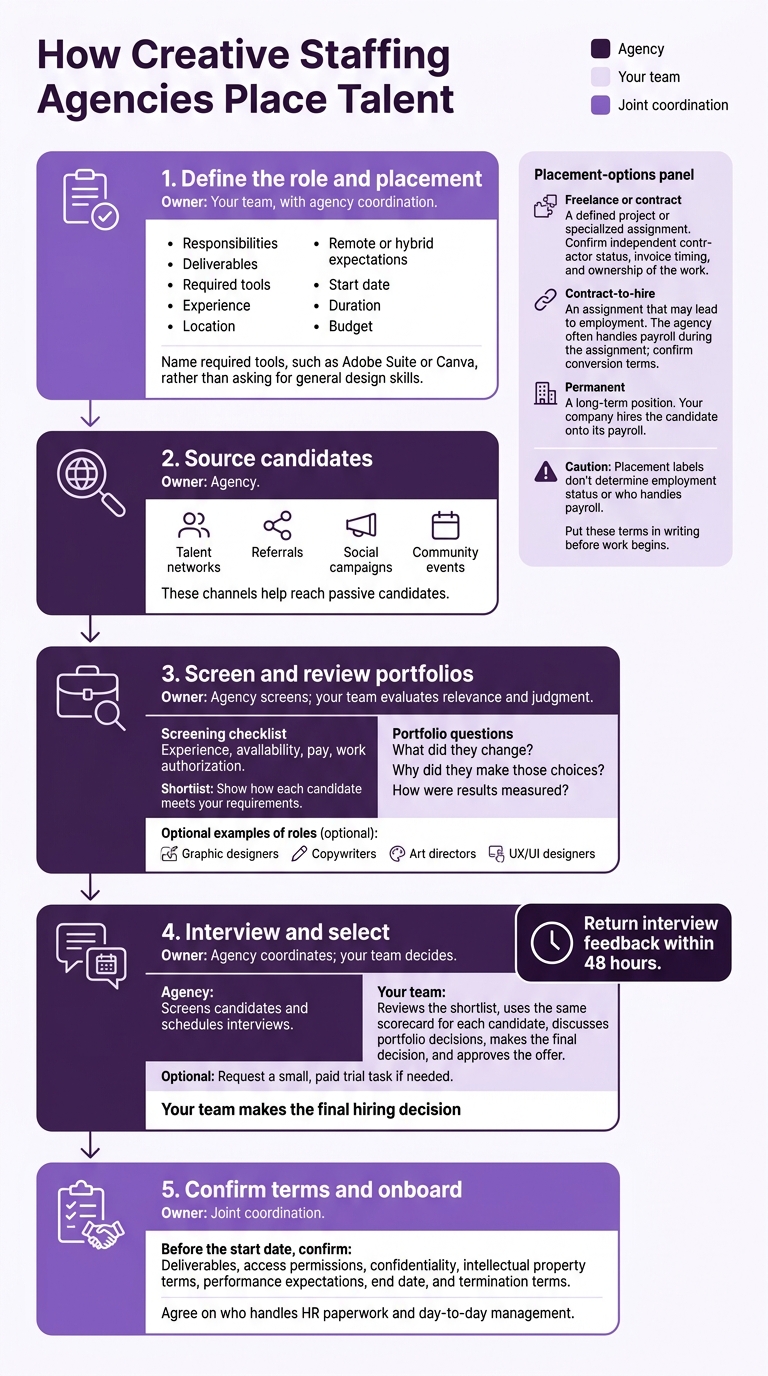
How Creative Staffing Agencies Place Talent
Define the Role and Placement Type
Start with a brief that covers responsibilities, deliverables, required tools, experience, location, remote or hybrid expectations, start date, duration, and budget.
Name required tools, such as Adobe Suite or Canva, rather than asking for general design skills.
A clear brief helps the agency match candidates to the work, seniority level, and hiring constraints. It also guides the search toward a freelancer, contractor, or permanent hire. [4][3][5]
| Placement type | Scope | Employment and payment terms to confirm |
|---|---|---|
| Freelance or contract | A defined project or specialized assignment | Confirm independent contractor status, invoice timing, and ownership of the work. |
| Contract-to-hire | An assignment that may lead to employment | The agency often handles payroll during the assignment; confirm conversion terms. |
| Permanent | A long-term position | Your company hires the candidate onto its payroll. |
Put these terms in writing before work begins. Placement labels don’t determine employment status or who handles payroll. For project work, spell out payment timing and intellectual property (IP) ownership, too. [4]
Source Candidates and Review Portfolios
With the brief in place, a creative staffing agency uses talent networks, referrals, social campaigns, and community events to reach passive candidates. It then screens for experience, availability, pay, and work authorization. Ask for a shortlist that shows how each candidate meets your requirements. [1][5]
A portfolio should show more than good-looking work. Check its relevance to your role and the judgment behind it. For graphic designers, copywriters, art directors, and UX/UI designers, ask what they changed on a project, why they made those choices, and how the results were measured. [3][4]
Interview, Select, and Onboard
The recruiter screens candidates and schedules interviews. Your team reviews the shortlist, makes the final decision, and approves the offer. Use the same scorecard for each candidate, discuss their portfolio decisions, and request a small, paid trial task if needed. Return interview feedback within 48 hours.
Before the start date, confirm deliverables, access permissions, confidentiality, intellectual property terms, performance expectations, the end date, and termination terms. Also agree on who handles HR paperwork and day-to-day management. [2][4][5][6]
When to Use a Creative Staffing Agency
Use a creative staffing agency when a role requires specialized skills, needs temporary coverage, or is too urgent for your usual hiring process.
| Situation | Urgency | Fit | Information to prepare |
|---|---|---|---|
| Specialized hiring | Moderate to high | Specialty placement | Portfolio benchmarks, specialized skills |
| Temporary coverage | High | Temporary | Handover notes, core duties |
| Peak campaign demand | High | Freelance or contract | Asset list, brand guidelines |
Fill Specialized or Hard-to-Fill Roles
A creative staffing agency can help you vet portfolios more thoroughly when internal recruiters lack the software expertise or industry knowledge a role requires. Before moving forward, vet the agency to confirm it can assess candidates in that specialty.
Cover Absences and Campaign Deadlines
For time-bound needs, flexibility matters more than a permanent hire.
Temporary placements can cover parental leave, medical leave, vacation, or a resignation.
For launches, rebrands, and seasonal campaigns, freelance or contract placements add production capacity without an ongoing position.
Staff Variable Workloads and Urgent Needs
When workloads fluctuate, compare the total assignment cost with the cost of unfinished work, rather than focusing only on the hourly rate.
Agencies can speed up sourcing, but results still depend on clear requirements and fast feedback.
Next, compare agency costs and contract terms with direct recruiting.
Agency Support vs. Direct Recruiting
A creative staffing agency helps when your applicant pool is small or your team can’t source and screen candidates fast enough. Direct recruiting works better when you already attract qualified applicants and want control over your brand and culture fit. With agency support, the agency handles sourcing and screening, but your team makes the final choice. [1][2]
Here’s how the two options compare.
| Factor | Agency support | Direct recruiting |
|---|---|---|
| Sourcing | Uses agency networks and reaches passive candidates | Relies on your employer brand and existing talent pipeline |
| Portfolio evaluation | Adds specialist screening before candidates are submitted | Requires qualified internal reviewers |
| Speed | Can move quickly for urgent roles | Depends on pipeline strength and team availability |
| Internal workload | Handles sourcing, screening, and scheduling | Leaves those tasks with your team |
| Placement flexibility | Supports freelance, contract, and permanent placements | Mostly focuses on permanent or steady hiring |
| Costs | Placement fees or hourly markups, plus internal time | Recruiting tools, advertising, staff time, and vacancy costs |
| Employer control | Shares candidate communication with an outside team | Gives you direct control over messaging and the candidate experience |
For direct recruiting, assign internal owners for sourcing, portfolio review, and interview coordination.
Compare Costs and Contract Terms
Compare quotes for the same role, hours, and duration. For permanent hires, ask about the placement fee and how the agency calculates it. For contract work, ask what the hourly bill rate includes and what markup applies.
Then compare those quotes with your internal recruiting time, hiring-manager hours, advertising, and vacancy costs. Direct recruiting isn’t cost-free; your team’s time belongs in the calculation.
Get written terms covering billing, payment timing, overtime, temp-to-perm conversion fees, guarantee periods, replacement provisions, and cancellation. Check exclusivity terms, too. To avoid duplicated work, agree on who owns sourcing, screening, feedback, and the final decision. [2][6]
Check Whether Agency Support Fits
Use the cost and scope comparison above to decide whether agency support fits this hire. A creative staffing agency can help when the role is complex, urgent, temporary, or hard to fill – and your team doesn’t have time to source candidates quickly. Before choosing a placement type, confirm whether you need temporary or long-term support. [1][2]
A single hire can take about 48 recruiter hours. Use that estimate to check whether your team has enough time to handle the search. [1][2]
Prepare Your Hiring Brief
If agency support fits, write your brief before outreach begins. Include must-have skills, portfolio standards, deliverables, and whether the person will execute approved work or lead strategy. Specify compensation or bill-rate limits, location, time zone, work authorization requirements, and the start date. [3][4]
Assign interview owners and a final decision-maker. Set a 48-hour feedback deadline for candidate submissions and internal feedback. Before the search starts, define what “qualified” means based on the brief. Then track how long it takes to get a qualified shortlist, the quality of submissions, and whether deliverables arrive on time. [2][6]
Conclusion: Choose the Right Hiring Route
Choose a creative staffing agency when specialization, urgency, or gaps in team capacity outweigh the added cost. Recruit directly when your internal team has enough resources. [1][2]
FAQs
How can I verify an agency’s creative expertise?
Check the agency’s track record filling roles like yours, such as graphic design or UX. Ask for references from clients similar in size to your company to assess reliability and performance [1].
Look at how clearly the agency communicates and how open it is throughout hiring [2]. Confirm it has a structured process for reviewing portfolios and testing technical skills – one that separates polished presentations from a candidate’s ability to plan work and make sound decisions [2][3].
How soon should I expect a qualified shortlist?
Hiring timelines depend on how complex the role is and how the agency works. Still, staffing agencies aim to speed up hiring for urgent or hard-to-fill positions [1].
They usually start by matching your requirements against their existing talent pool or active sourcing channels [2][3]. Automated screening, resume parsing, and structured candidate databases help them put together a targeted shortlist in less time [2][3][4].
What happens if a placement doesn’t work out?
Start by checking whether the problem lies with the person’s skills or your internal processes. Before deciding the hire was a mistake, look for unclear expectations, slow approvals, or missing access to the assets they need.
Give the new hire structured onboarding, clear performance goals (KPIs), and regular feedback. If they still fall short, check your processes again. Performance gaps often point to internal roadblocks, not a lack of ability.