
Staffing and Recruiting Agencies: How to Vet Them
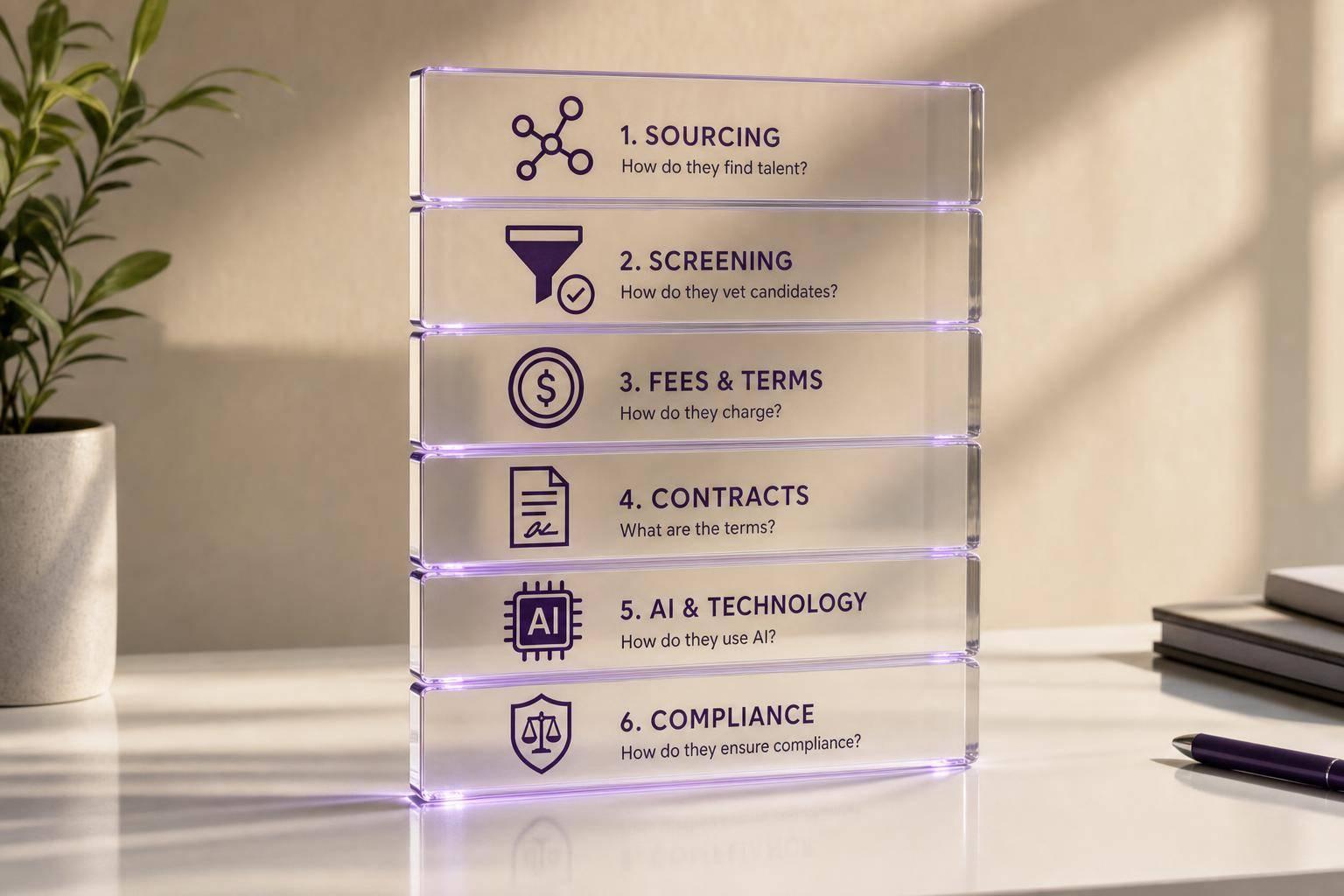
Most agency problems show up before you sign. If you want better hires, lower risk, and less wasted time, I’d vet staffing and recruiting agencies on a short list of hard checks: role fit, fill history, sourcing reach, screening steps, candidate communication, AI use, fees, contract terms, and compliance.
Here’s the short version:
- I’d start with my own hiring brief: role, level, must-have skills, location, hiring type, volume, and target start date.
- I’d judge staffing and recruiting agencies on quality of hire, not resume count. The article notes that 30% of respondents in Employ’s 2025 Recruiter Nation Report named quality of hire as the top recruiting-success metric.
- I’d ask for role-specific proof from the last 12 to 24 months, not company-wide averages.
- I’d check whether the agency can reach passive talent, since about 73% of the global workforce is passive.
- I’d inspect screening in detail. If the agency is just forwarding resumes, that’s a bad sign.
- I’d test how recruiters explain my job to candidates, because they speak for my brand.
- I’d get service levels, reporting, AI rules, data handling, pricing, guarantees, and compliance duties in writing.
- I’d stop the process if the agency avoids references, can’t explain fees, pushes me to sign fast, or sends vague answers on screening, ownership, or legal duties.
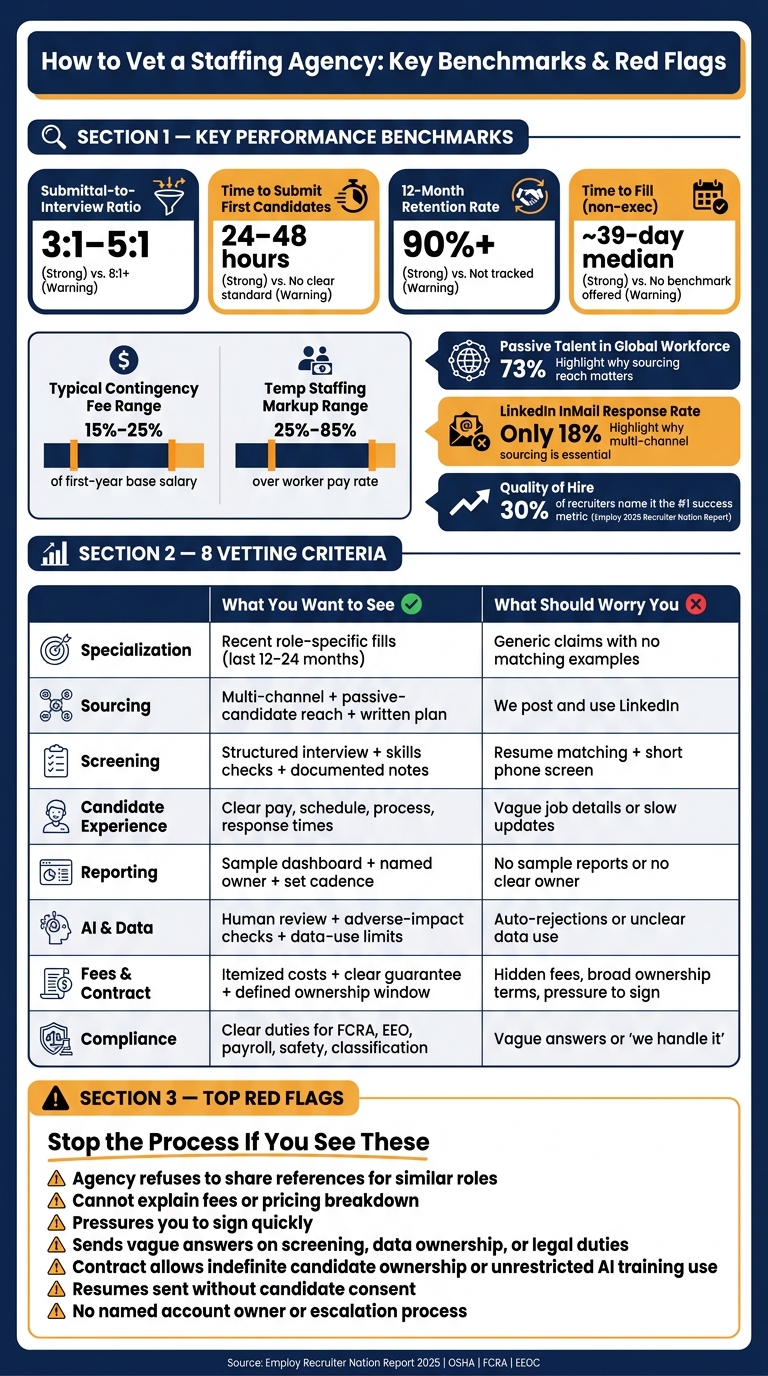
A few numbers matter right away. A submittal-to-interview ratio above 8:1 can point to weak screening. A 24–48 hour time to submit is a common benchmark. And if my team takes more than five business days to review candidates, I’m likely part of the problem too.
How to Vet a Staffing Agency: Key Benchmarks & Red Flags
20 Questions to Ask a Staffing Agency BEFORE Hiring Them
Quick Comparison
| What I’d Check | What I Want to See | What Would Worry Me |
|---|---|---|
| Specialization | Recent fills for the same role, level, and market | General claims with no matching examples |
| Sourcing | Multi-channel plan, passive-candidate reach, written search plan | “We’ll post and use LinkedIn” |
| Screening | Structured interview, skills checks, credential checks, documented notes | Resume matching and a short phone screen |
| Candidate experience | Clear pay, schedule, process, and response times | Fuzzy job details or slow updates |
| Reporting | Sample dashboard, named owner, set cadence | No sample reports or no clear owner |
| AI and data | Human review, adverse-impact checks, data-use limits | Auto-rejections or unclear data use |
| Fees and contract | Itemized costs, clear guarantee, defined ownership window | Hidden fees, broad ownership terms, pressure to sign |
| Compliance | Clear duties for FCRA, EEO, payroll, safety, and classification | Vague answers or “we handle it” with no detail |
This article is about one thing: I should not trust the pitch alone. I should verify how the agency finds people, screens them, talks to them, charges for them, and handles risk before I sign anything.
Define your hiring requirements before you review staffing and recruiting agencies
Before you reach out to staffing and recruiting agencies, get specific about what you need. Write it down. A clear brief pushes every firm to respond to the same set of needs instead of steering the conversation with a polished pitch. It also gives you a simple scorecard you can use across every agency you review, much like a buyer’s checklist for staffing and recruiting services.
Document the roles, volume, locations, and hiring timeline
Your brief should spell out the basics and the details that matter:
- Role title
- Seniority level
- Must-have skills
- Trainable skills
- Hiring type: temporary, temp-to-hire, or direct hire
- Hiring volume
- Work location
- Onsite or remote setup
- Target start date
Also include your internal interview loop. How many stages will candidates go through before an offer? Staffing and recruiting agencies need that context so they can set expectations early and screen people with the full process in mind. A vague brief gets expensive fast, especially when you’re hiring for specialized or urgent roles [3].
Set internal responsibilities and measurable success metrics
Decide who owns scheduling, feedback, offers, and agency updates before the search starts. If no one owns those steps, things slip. A simple RACI chart can help here: Responsible, Accountable, Consulted, and Informed across your internal team and the agency.
Use these benchmarks to compare staffing and recruiting agencies:
| Metric | Strong Agency Standard | Warning Signal |
|---|---|---|
| Submittal-to-Interview Ratio | 3:1 to 5:1 [4] | 8:1 or higher [4] |
| Time to Submit | 24–48 hours [5] | No clear turnaround standard |
| 12-Month Retention Rate | 90%+ [5] | Not tracked or shared |
| Time to Fill (non-exec) | Around the 39-day median [4] | No benchmark offered |
A submittal-to-interview ratio above 8:1 usually points to weak screening [4]. Put another way, if an agency keeps sending resumes that don’t make it to interviews, you’re paying for noise.
You should also set a rule for your own team. If hiring managers take more than five business days to review submissions, top candidates start dropping out [1]. That’s not an agency problem. That’s an internal speed problem.
Once these benchmarks are in place, you can compare staffing and recruiting agencies on specialization, sourcing, screening, and communication using the same yardstick.
Evaluate specialization, track record, and sourcing capability
Check industry focus, role history, and recent performance data
Start with the role brief from the previous section and pressure-test fit. You want to know if the agency has filled this exact type of search before, not something vaguely similar.
Ask who will actually run the search. Not just the account lead. Not just the person on the sales call. Ask which recruiter will own the work day to day, then request comparable placements from the last 12 to 24 months.
Push for role-specific results instead of company-wide averages. Big averages can hide weak results in the exact function you need. A firm may look strong on paper and still struggle with your kind of hire.
Use this scorecard so all staffing and recruiting agencies on your list are measured the same way:
| Evaluation Criterion | Evidence to Request | Scoring Question |
|---|---|---|
| Relevant specialization | Recent placements by role, industry, level, and location | How closely does the agency’s experience match our requisitions? |
| Named recruiter experience | Assigned recruiter history and comparable placements | Has this recruiter personally filled similar roles? |
| Fill performance | Role-specific fill rate and search volume | Does the data show consistent delivery, not one isolated win? |
| Speed | Median time to first qualified submission and time to fill | Is the agency fast enough for our hiring timeline? |
| Candidate quality | Retention rate, manager satisfaction, replacement rate | Do placements perform and stay? |
| Verifiable references | Recent, role-specific client references | Can reported claims be independently confirmed? |
When you speak with references, keep the questions blunt:
- Did submitted candidates match the brief?
- How many candidates were submitted before a hire?
- Were placements still employed after 90 days?
- Did the agency honor its replacement guarantee?
Those answers usually tell you more than a polished pitch deck ever will.
Review sourcing methods and passive-candidate reach
Once the agency clears the track-record check, look at how it finds talent.
Ask the team to walk you through the sourcing mix they would use for one of your sample roles. That should include proprietary databases, direct outreach, referrals, niche communities, and recruiter-led outreach. Then ask what share of similar placements came from passive candidates.
This matters for a simple reason: about 73% of the global workforce is considered passive talent. [2] If an agency leans mostly on inbound applicants, it will miss a huge part of the market.
There’s another clue here. One sourcing reference puts the average LinkedIn InMail response rate at just 18%. [6] So if an agency says its plan is basically “we’ll message people on LinkedIn,” that’s not much of a plan. A solid team should explain how it improves response rates through personalization, follow-up, referrals, and multiple channels, including social recruitment campaigns that reach people who never open InMail. Not one platform blast and crossed fingers.
For hard-to-fill or high-volume roles, ask for a written sourcing plan. Don’t settle for a verbal walkthrough. The plan should spell out:
- the target talent pool
- the outreach sequence
- expected response rates
- what the agency will change if the first two weeks bring too few qualified candidates
That’s where you see whether the recruiter can spot a sourcing issue and adjust, instead of just sending more resumes and hoping one sticks.
Next, verify that the agency’s screening process turns that reach into qualified submissions.
Inspect screening quality and candidate experience
Verify the screening process before candidates are submitted
Once sourcing is in place, the next question is simple: can the agency filter out weak candidates before they hit your inbox?
Ask the agency to walk you through the full path from application review to the point when a resume reaches your team. That process should go past a resume scan and a quick phone chat. You want a job-specific checklist that confirms skills, experience, employment dates, gaps, work authorization, location, availability, compensation, schedule, and role interest before submission. For regulated or licensed roles, required licenses or certifications should also be checked at this stage.
Ask to see a redacted candidate profile, interview guide, recruiter notes, and a submission summary that shows what was verified, what still needs to be verified, and what remains open. A good recruiter should confirm core requirements, separate facts from guesses, and verify dates, responsibilities, results, reason for leaving, work setup, and motivation. If the agency used an assessment, the summary should show the result too.
The table below shows the gap between weak screening and screening that actually does the job:
| Screening Step | Weak Agency Approach | Strong Agency Approach |
|---|---|---|
| Resume review | Keyword matching, then forwarding | Job-specific checklist plus recruiter validation |
| Recruiter interview | Informal call, no recorded criteria | Structured guide tied to required competencies |
| Skills evaluation | Candidate self-report only | Job-relevant test, work sample, or technical screen |
| Credential verification | Candidate says it is current | License, certification, or education verified through an appropriate source |
| Background checks | Unsupported claim of full vetting | Named provider, written disclosure, authorization, consistent decision rules, and dispute process |
Without that proof, you’re not getting a screened candidate. You’re getting a forwarded resume.
Background checks need extra attention. The EEOC says employers and employment agencies may not use background information in a way that denies equal employment opportunity [7][10]. The Fair Credit Reporting Act also requires a stand-alone written disclosure and the applicant’s written authorization before a consumer report is obtained [8][9]. Ask which screening provider the agency uses, who orders the report, how adverse information is reviewed, and how disputes are handled. If the agency can’t explain that workflow in plain English, it’s not ready to run screening for you.
Qualification is only one side of the coin. The other side is how the agency talks to candidates about your role.
Test how the agency communicates with candidates on your behalf
After screening, make sure the agency can explain your role clearly and protect candidate trust.
Every recruiter who reaches out on your behalf is speaking for your employer brand. If they get the role wrong, overstate the pay, or gloss over the schedule, good candidates can walk away fast. Your reputation can take a hit too. One of the best ways to test this is a role-play. Ask the recruiter to explain one of your open roles to a mock candidate. Listen for clear, accurate details on pay range, location, schedule, work model, employment type, qualifications, selection stages, and timeline. If the answers sound fuzzy or off, take that as a warning.
It also helps to set response-time standards upfront. Cover basics like:
- application acknowledgment
- interview details
- candidate questions
- post-decision updates
Be clear about ownership too. The agency should handle routine candidate communication, and your team should give prompt feedback after interviews.
You should also define how the agency handles rejections, withdrawals, and competing offers. Recruiters need to notify candidates fast, use respectful language, and avoid making up reasons or sharing confidential feedback. If a candidate withdraws or accepts another offer, the recruiter should log the reason, tell you right away, confirm whether the candidate still has interest, and avoid pushing the candidate. If the agency can’t describe a clear process for those moments, that’s a problem worth addressing before you let them represent your brand.
Review communication, technology, AI, fees, contracts, and red flags before signing
Confirm service levels, reporting, and responsible use of technology and AI
After screening the agency and checking the candidate experience, pin down the operating terms that shape service quality, cost, and risk. Start with ownership on the agency side. You want one accountable account owner, a backup contact, and a plain answer on who handles offers, onboarding, worker issues, and escalations. Without that setup, small misses pile up fast.
Get service commitments in writing. For example, the agreement might say the agency will acknowledge a new role within one business day, send an initial candidate slate within five business days, and ask for your feedback within two business days after an interview. Match that with a weekly reporting dashboard that covers:
- open roles
- sourcing activity
- submissions
- interviews
- offers
- hires
- withdrawals
- time-to-fill
- reasons candidates were rejected
If an agency can’t show you a sample report before you sign, that’s a bad sign.
On the tech side, confirm whether the agency can connect with your applicant tracking system. Get specific: which fields sync, how duplicate candidates are flagged, and whether you can export all relevant data if the relationship ends. Then dig into AI. Ask exactly where AI is used – sourcing, résumé matching, outreach, interview scheduling, assessments, or screening. Ask whether AI only makes recommendations or whether it can reject applicants on its own. You should require a human review step before any rejection. Also ask for documented adverse-impact testing by protected group and a human review step before any rejection [11][14].
Data security needs the same level of care. Ask where data is stored, who can access it, how long it is kept, and whether it is used to train AI models. The FTC recommends spelling out security expectations in service-provider contracts and checking that providers actually follow them, instead of taking promises at face value [12][13]. Require written breach-notification duties and the right to delete or retrieve all data when the contract ends.
Compare pricing, contract terms, compliance controls, and warning signs
Once the tech and compliance terms are clear, look just as hard at the money side. Compare total cost, not just the headline fee. However, before you negotiate, it helps to understand how recruiting firms get paid. Contingency hires often run 15%–25% of first-year base salary [15][16]. Temp staffing bill rates should break out pay, taxes, benefits, and markup [17][20]. Temp-to-hire terms should spell out conversion fees and when those fees drop to $0 [15].
Ask for an itemized bill-rate breakdown. Published examples show markups ranging from about 25% to 85% over the worker’s pay rate, depending on the role, assignment length, benefits, and services included [16][17][19]. Fee clarity tells you a lot. If an agency can’t explain its pricing cleanly, don’t expect clear answers on sourcing, screening, or reporting either.
Define candidate ownership windows, what counts as a valid introduction, and the direct-hire guarantee period, remedy, and exclusions [19].
For compliance, ask the agency to explain how it handles equal employment opportunity rules, ADA accommodation procedures, wage-and-hour rules, worker classification, payroll-tax duties, background-check duties under the FCRA, work authorization, pay-transparency rules, and any state privacy laws that apply. For temporary workers, the contract should clearly state whether the agency or your company handles payroll, overtime, timekeeping, workers’ compensation, safety training, and required notices. OSHA treats staffing agencies and host employers as joint employers for temporary-worker safety, so vague contract language can leave both sides exposed if each assumes the other owns the task [18].
Before you sign with any of the staffing and recruiting agencies on your shortlist, watch for warning signs like these:
- No proof of sourcing reach, screening rigor, or adverse-impact testing
- Refusal to share references for similar roles or recent performance data
- Pressure to sign fast or pushback on legal or procurement review
- Inability to explain candidate ownership or duplicate-submission rules
- Contract language that allows indefinite candidate ownership or unrestricted use of your data for AI model training
- Large upfront fees with no milestones, deliverables, or refund terms
- Résumés sent without candidate consent or with experience you can’t verify
- Fee quotes that don’t say whether they include overtime, benefits, payroll taxes, insurance, conversion, or replacement costs
- No named account owner, no reporting cadence, and no escalation process
Require every answer in writing.
FAQs
How many agencies should I vet before choosing one?
Start with a short list. Then dig deeper into the final two or three staffing and recruiting agencies.
That keeps the process simple. You can compare capabilities, pricing, and contract terms without feeling buried in details. It also helps you spot which agency lines up best with your hiring goals, budget, and the kind of candidate experience you want to deliver.
What should I get in writing before I sign?
Before you sign, get a few things in writing. It can save you stress, money, and a lot of back-and-forth later.
Ask for:
- a detailed implementation plan with weekly milestones
- a full cost breakdown, including setup, customization, integrations, training, and add-ons
- data export rights, a similar client reference, and written SLAs for communication
- compliance documentation covering data security, audit logs, and any AI screening transparency or bias audits
This is the stuff that shows you what the rollout will look like, what you’ll actually pay, and how the vendor handles support, security, and AI-related risk.
When is a staffing agency not the right fit?
A staffing agency may not be the best fit when hiring turns into a steady, urgent, or high-volume need. In those cases, an in-house recruiting team or an RPO can make more sense.
It can also be a weaker choice if your focus is long-term employer branding or building your own passive talent pool. And there’s the cost issue too: agency fees usually run 15% to 25% of a hire’s first-year salary. If that price tag ends up outweighing the value of hiring faster, the math may not work in your favor.