

Executive Recruiting Companies: How the Search Process Works
If you’re hiring for a CEO, CFO, CTO, CHRO, VP, or another top role, executive search is usually a direct, private, multi-step process – not a job post and a pile of resumes. In most cases, executive recruiting companies define the role, map target companies, contact passive candidates, run structured interviews, check references, and help close the offer. For senior hires, a shortlist often lands at 3 to 7 candidates, and feedback should come back within 48 hours to keep the search moving.
Here’s the short version of how it works:
- Step 1: Set the role clearly. I’d define the scope, first-year outcomes, pay range, interview team, and decision owner before outreach starts.
- Step 2: Map the market. Executive recruiting companies build a target-company list, remove off-limits companies, and create a long list.
- Step 3: Contact passive candidates. Many top executives are employed, so direct outreach matters more than public ads.
- Step 4: Narrow to a shortlist. The firm filters for track record, interest, pay fit, and location.
- Step 5: Run structured interviews. Everyone uses the same scorecard so candidates are reviewed the same way.
- Step 6: Check references and close fast. Final pay may include base salary, bonus, equity, LTI, relocation, and start date. Verbal and written offers should go out right after the choice is made.
- Step 7: Stay involved after acceptance. Good firms check in at 30 and 90 days to help the transition stick.
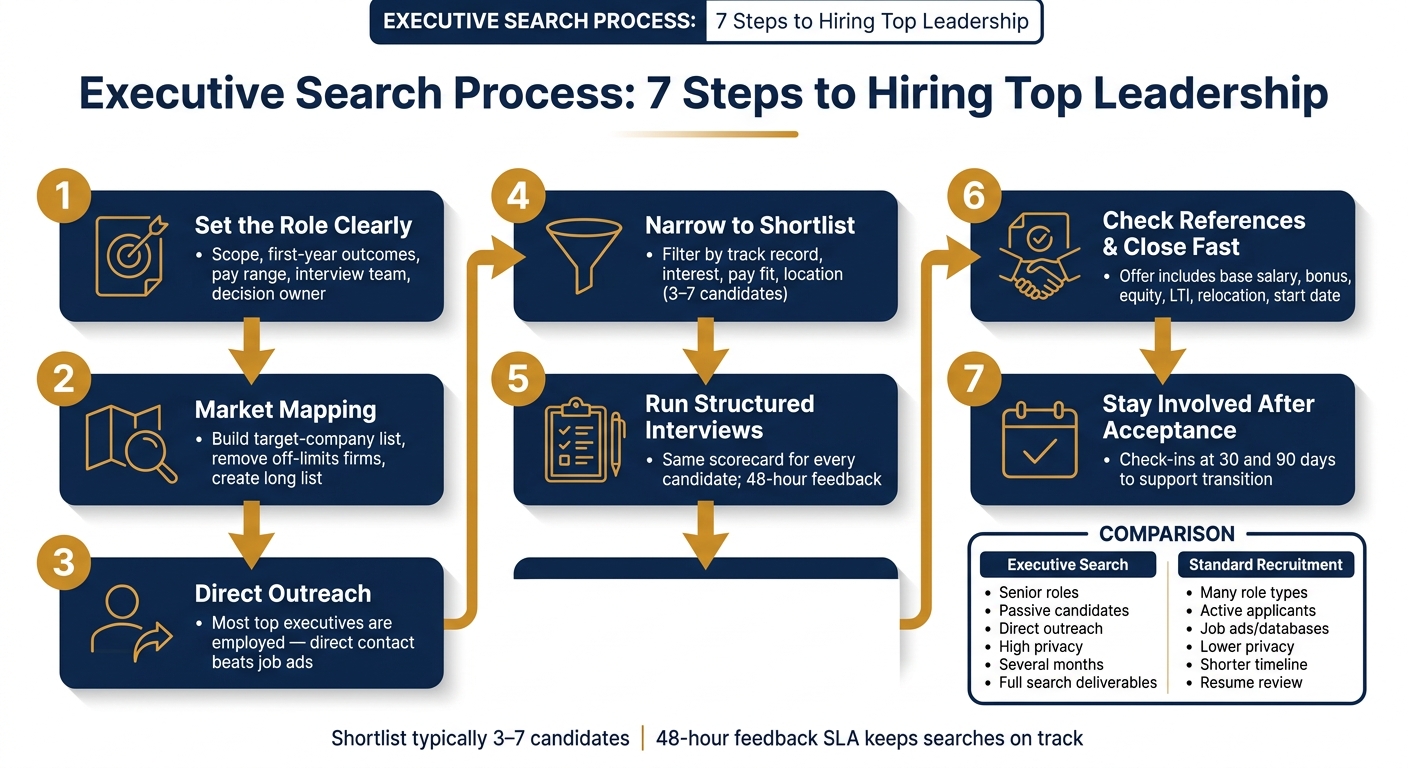
Executive Search Process: 7 Steps to Hiring Top Leadership
What Is Executive Search? | Executive Recruitment Explained
Quick Comparison
| Area | Executive Search | Standard Recruitment |
|---|---|---|
| Roles | Senior leadership | Many role types |
| Sourcing | Direct outreach and market research | Job ads, databases, referrals |
| Candidate type | Often passive executives | Mostly active applicants |
| Privacy | Often high | Usually lower |
| Timeline | Often several months | Often shorter |
| Output | Search plan, market map, shortlist, references, offer support | Resume review and interview scheduling |
My main takeaway: executive recruiting companies work best when the role is senior, the talent pool is small, the search must stay private, or the cost of a bad hire is high. The process is less about volume and more about clear role definition, market research, tight feedback loops, and clean decision-making.
Define the Role, Scope the Search, and Align Stakeholders
Before any outreach starts, the search firm should run a structured kickoff with the client. The aim is simple: lock down the role scope, define what success looks like, assign interview ownership, and set compensation guardrails. It also helps to run a premortem and ask why this hire could fail. That one question can bring hidden problems into the open early, like fuzzy requirements, unrealistic expectations, or conflict between decision-makers.
The kickoff should cover role scope, stakeholders, logistics, compensation, and confidentiality. In addition, professional bodies such as the Association of Executive Search and Leadership Consultants set standards for how reputable firms operate.
| Kickoff Category | Information to Gather |
|---|---|
| Business Context | Growth goals, turnaround needs, or specific market entry targets |
| Leadership Profile | Required capabilities, success profile outcomes, and team fit |
| Reporting Lines | Hiring manager, direct reports, and key cross-functional stakeholders |
| Logistics | Location, travel frequency, and work authorization |
| Compensation | Base salary, bonus structure, equity, and benefits parameters |
| Search Logistics | Confidentiality needs, exclusivity, and reporting cadence |
Use a RACI to make ownership clear for role scoping, interviews, and the final decision. Without that clarity, searches slow down and candidates lose interest.
Turn a Job Description into a Success Profile
A job description tells you what the company wants on paper. A success profile shows what the person actually needs to get done.
To build it, the search firm asks the hiring team a few direct questions: What should this executive accomplish in the first year? What problems will they walk into? What does failure look like in this role? The answers tie the job to business outcomes, not just credentials. That profile then becomes the lens for market mapping and candidate review.
Agree on the Search Plan and Core Deliverables
After the success profile is set, the firm should document the full search plan. Hiring teams should expect a written position specification, a candidate scorecard with clear evaluation criteria, an approved compensation range, and a stakeholder interview plan .
Set a 48-hour feedback deadline before interviews begin. As a result, the process keeps moving and the team holds a steady pace as it shifts into candidate outreach and interviews.
With the scope, scorecard, and decision rules in place, the firm can map target companies and start outreach.
How Executive Recruiting Companies Map the Market and Build the Pipeline
Once the success profile is set, the search firm maps the market and starts building the candidate pipeline.
Build the Market Map, Target List, and Long List
Researchers group companies by industry, company size, ownership structure, geography, and business model. They also look at adjacent titles and transferable experience when the right background can come from a nearby sector, not just the exact same one.
At this stage, researchers at executive recruiting companies also flag off-limits organizations. These are companies the firm can’t recruit from because of current client agreements or ethical conflicts. Those companies come off the target list before any outreach starts.
Approach Passive Candidates with Confidentiality
The aim here is to find current leaders and contact them directly. Initial outreach is usually discreet, often through LinkedIn or other social channels, without naming the client right away. If both sides show interest, the search firm then shares more about the role and the employer, while keeping the process confidential for everyone involved.
Once a candidate shows interest, the firm screens that person against the success profile.
Narrow the Pipeline from Long List to Shortlist
From there, the firm starts narrowing the field. The main filters are:
- Leadership track record
- Motivation to move
- Compensation alignment
- Location flexibility
Researchers handle active applicants, referred candidates, and passive executives through different sourcing and confidentiality workflows.
The long list then becomes a shortlist of candidates who fit the success profile and agree to the search conditions. The hiring team reviews that shortlist before formal interviews begin. After that, those candidates move into structured assessment and interviews.
Assess Candidates, Run Interviews, and Close the Hire
With the shortlist approved, the job shifts from sourcing to validation and closing.
Use Structured Assessment to Support Shortlist Decisions
Interviewers use the approved scorecard to rate each candidate against the success profile. Assessment tools can add more data, but they should support human judgment, not replace it.
Coordinate Interviews and Collect Consistent Feedback
Executive recruiting companies handle scheduling across executives, board members, and other key stakeholders. Candidates get a brief before each meeting, including who they’ll meet and which topics will come up. That small step helps people show up prepared instead of walking in cold.
Feedback should come in within 48 hours of each conversation. Every interviewer submits ratings and written notes against the same criteria set during intake. That keeps the process fair, clear, and easier to compare across candidates.
| Stage | Search Firm / Coordinator | Employer / Hiring Team | Candidate |
|---|---|---|---|
| Interview Stage | Manages logistics, scheduling, and provides candidate prep materials | Conducts interviews using the approved scorecard and evaluates fit against the success profile | Participates in interviews and responds promptly to scheduling requests |
| Feedback | Collects feedback within 48 hours of each interview | Submits ratings and qualitative notes | Receives timely status updates |
| Closing | Mediates compensation talks and manages background checks | Makes the final hiring decision and approves the total compensation package | Negotiates terms and signs the offer letter |
Once feedback is in, the firm moves finalists into reference checks and offer discussions.
Handle References, Offer Terms, and Transition Support
Final references are checked against the success profile as a direct test of comparable results. Background checks and onboarding paperwork should move forward right after acceptance, not days later.
Senior-level executive compensation usually includes:
- Base pay
- Annual performance bonus
- Long-term incentives (LTI)
- Equity
- Relocation support
- A negotiated start date
The search firm mediates compensation talks, while the hiring team makes the final call and approves the package. Issue the verbal offer the same day the decision is made. Then send the written offer right away. Speed matters here. A slow handoff can create doubt at the worst possible moment.
After acceptance, good executive recruiting companies stay involved. Follow up at 30 and 90 days to confirm integration and expectations. These post-acceptance check-ins help protect the placement and surface issues early.
The next step is defining when executive search is the right fit and what to clarify before kickoff.
How to Use an Executive Search Firm Effectively
When Executive Recruiting Companies Are the Right Choice
Once the search is scoped, the next step is simple: decide whether executive search is the right model.
Executive search makes sense when a senior role needs to stay confidential, the target talent pool is small, or the internal team doesn’t have the bandwidth to run a tightly focused search while still handling day-to-day hiring. In those cases, executive recruiting companies can give the role the time and attention it needs. However, not every firm delivers the same quality, so our guide on how to identify a strong executive recruiting firm shows what to check first.
If the firm is the right fit, the next move is to lock in the engagement terms and the rules for how decisions will be made.
What to Clarify Before the Search Begins
Before any outreach starts, get the basics nailed down. For example, our plain-English guide to how recruiting firms get paid explains the common fee models. Also confirm:
- fee model
- payment terms
- guarantee period
- exclusivity
- deliverables
You should also set decision owners and a 48-hour feedback SLA before candidate outreach begins. That sounds small, but it matters. Slow feedback can stall market mapping, interviews, and offer talks.
When these terms are clear from the start, the firm can move from intake to outreach without getting stuck.
How HireLab.io Supports Public-Facing Leadership Hiring
When a leadership search includes a public-facing application step, HireLab.io can support branded landing pages, smart forms, and mobile-friendly recruitment funnels.
The split is pretty clear: the search firm manages confidential outreach and evaluation, while the public-facing layer helps with candidate capture.
FAQs
How long does an executive search usually take?
Executive searches usually take longer than standard hiring because they’re high-touch and more complex. There’s more ground to cover: stakeholder alignment, market mapping, candidate screening, and several rounds of interviews.
The timeline also shifts based on the role’s seniority and how hard the search is. A C-suite hire, for example, often takes more time than a lower-level leadership role. To keep things moving, firms lean on structured interviews and fast feedback loops. Some tools can help speed up screening, but executive search is still a deliberate, relationship-driven process.
What should we prepare before hiring a search firm?
Before you bring in an executive search firm, get your internal team aligned on three basics:
- Number of roles
- Hiring timeline
- Approved budget
Then get clear on the role itself. Define the scope, the skills the person must have, the day-to-day work, and where the role sits on your team.
That clarity matters more than most teams expect. If the firm starts without a sharp brief, the search can drift fast.
It also helps to spell out what success looks like and who owns what. Many teams do this with a RACI chart, which makes responsibilities clear from the start and helps the firm move into the search with less back-and-forth.
How do executive recruiters keep a search confidential?
Executive recruiters keep a search confidential by using precise sourcing methods to reach people for specific roles without making the search public. They also limit access to candidate and client data to authorized staff only.
To protect privacy even more, recruiters keep client records, branding, and search data separate in dedicated workspaces. That setup helps them approach passive candidates discreetly without revealing the hiring organization’s identity.