




How to Identify a Strong Executive Recruiting Firm
The top executive recruiting firms prove fit with facts, not polish. When I assess one, I look at six things first: similar placements from the last 24 months, fill and retention data, how the team reaches passive candidates, who owns each step, whether updates are set on a 48-hour rhythm, and what the fee agreement says about add-on costs and replacement terms.
If I had to sum up the article in one line, it would be this: pick the firm with the clearest proof for your exact role, industry, and hiring problem. A known brand is not enough. For a CFO, CTO, or VP search, I want to see named consultants, referenceable clients, a defined search process, and written terms on fees, confidentiality, and back-up coverage if the hire leaves in 3 to 6 months.
Here’s the full checklist I’d use before making a choice:
- Define the role first
- business goal for the next 12 to 18 months
- reporting line, team scope, and budget
- pay range in U.S. dollars
- location, travel, and confidentiality needs
- hiring date and a written scorecard
- Check past results
- 3 to 5 similar executive placements
- same function, industry, company stage, and hiring challenge
- fill rate, search completion data, and retention at 12 and 18 months
- Check who will do the work
- named lead consultant
- what that person will handle directly
- what goes to researchers or junior staff
- Check how candidates are found
- outbound search for passive leaders
- referrals and target-company mapping
- sample sourcing logic, such as a Boolean string
- Check how candidates are judged
- role-based scorecard
- structured interviews
- timing for references and background checks
- Check search control
- confidentiality steps
- conflict checks
- update cadence and feedback rules
- Check the contract
- retained fees often run 15% to 25% of first-year cash compensation
- add-on charges for assessments, background checks, or admin costs
- replacement terms in writing
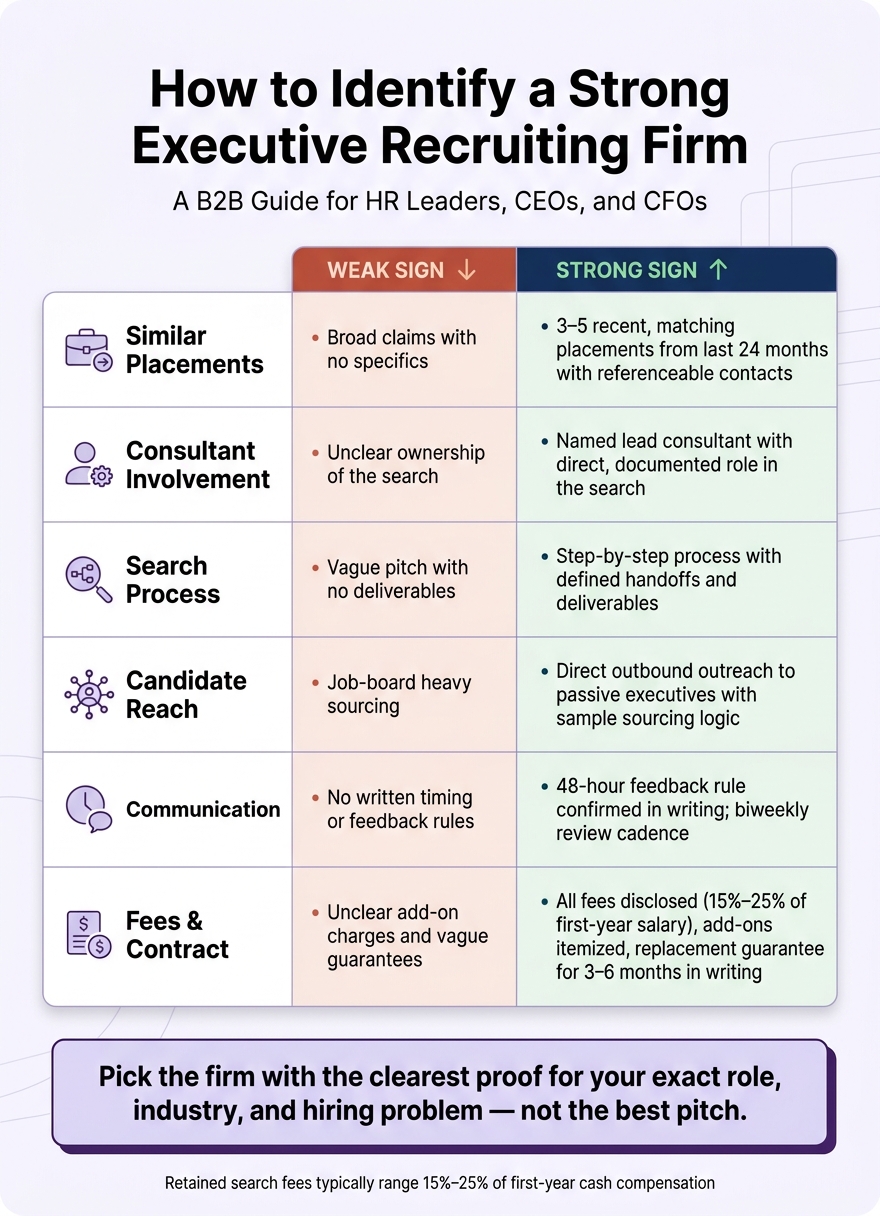
How to Identify a Strong Executive Recruiting Firm: Weak vs. Strong Signs
How to Navigate the Executive Recruitment Process
Quick Comparison
| What I check | Weak sign | Strong sign |
|---|---|---|
| Similar placements | broad claims | recent, matching searches with references |
| Consultant involvement | unclear ownership | named lead with direct search role |
| Search process | vague pitch | step-by-step process with deliverables |
| Candidate reach | job-board heavy | direct outreach to passive executives |
| Communication | no written timing | 48-hour feedback rule in writing |
| Fees | unclear extras | all charges and guarantee terms listed |
Bottom line: if a firm cannot show matching placements, explain its search steps in plain language, and put accountability in writing, I would lower its score fast.
Check Specialization and Proof of Relevant Executive Placements
Once the role is clear, the next step is simple: find out whether the firm has filled this kind of job before.
Industry and Functional Focus That Matches the Role
A firm can say it “specializes” in your area. That doesn’t mean much unless it can show recent placements that look like yours. [8][11][14]
This is your first hard proof point in the broader review process. Ask who will run the search, which similar searches that person has finished, how much of the work they will do themselves, and what parts will be handled by researchers or junior recruiters. The reply should name the lead consultant and spell out that person’s role in the search.
It also helps to split broad experience from team-level focus. You’re not looking for a generalist who gets assigned to every opening. You want named consultants who work in your function – finance, technology, operations, or people leadership – and who know the space well. [7][11]
If the firm can’t point to similar placements, shift the conversation to retention and reference quality.
Placement History, Retention, and Reference Quality
Ask for three to five similar placements from the last 24 months. [8][10] Each one should line up with your search in a few key ways:
- executive level
- functional area
- industry
- company size and stage
- business challenge, such as a turnaround, fast growth, or post-merger integration
Then ask for a plain breakdown of how many similar searches were started, filled, and not filled or withdrawn. After that, ask for 12-month and 18-month retention rates, plus the calculation method and sample size. A retention figure on its own doesn’t tell you much. It only means something when you know how many hires it covers and over what period. [9][12][13]
The table below makes the gap pretty clear:
| Weak evidence | Stronger evidence |
|---|---|
| Total placements without context | Placement count, completion rate, and retention rate |
| A long list of recognizable clients | Comparable assignments with outcomes and referenceable contacts |
| Firm-wide expertise | Direct evidence of the proposed consultant’s personal role in similar searches |
| Anonymous testimonials | References from similar organizations discussing process, candidate quality, and after-hire performance |
For references, ask for two or three contacts from organizations that look like yours in size, ownership structure, and hiring challenge. Ask each reference whether the executive was still in the role after 12 or 18 months. Then ask a separate question: did the consultant personally lead the search?
That second question matters more than many buyers think. A reference might praise the firm, but if the named consultant barely touched the assignment, that praise doesn’t tell you much. The best reference can speak to both the process and whether the hire actually stayed and performed. [6][10]
A firm’s track record carries more weight when the named consultant’s history and the reference checks point in the same direction.
Review Search Methodology, Candidate Reach, and Assessment Rigor
Once past performance checks out, the next step is simple: find out whether the firm can do it again with a steady, repeatable process. Don’t wait until the search starts. Have the firm walk you through exactly how it works before any engagement begins.
The Core Steps of a Sound Executive Search Process
A good firm should be able to explain each stage in plain English: scoping, market mapping, confidential outreach, structured interviews, shortlist presentation, reference checks, background verification, and post-offer support. You also want to know who owns each step and what moves the process to the next handoff.
| Stage | What to Confirm |
|---|---|
| Scoping | Written position spec with success criteria and team fit |
| Market mapping | Named target companies and a mapped candidate universe |
| Outreach | Confidential outbound methods, referrals, and targeted social campaigns |
| Shortlist | Structured presentation with candidate summaries and rationale |
| After offer acceptance | Reference checks, background verification, and onboarding support triggered immediately |
Ask for response-time commitments too. For example, a 48-hour hiring-manager feedback rule helps keep the search on track. When feedback drifts, the whole process slows down. And each extra week raises cost and lowers offer acceptance.[4][3]
Next, make sure the firm can actually get in front of the kind of executives you need.
How to Judge Passive-Candidate Sourcing and Network Strength
Senior candidates are often passive. They’re not scrolling job boards or sending out résumés. That means the firm needs real outbound reach.
Ask how it contacts leaders who aren’t actively applying. The answer should cover outbound outreach, referrals, and targeted search methods. It’s also smart to ask for a sample Boolean string for your role.[1]
Research support matters too. Executive-level market mapping takes a team that can build target-company lists and spot likely candidates by title and tenure. If a firm can’t explain who does that work, or how deep that bench is, that’s a warning sign.
Assessment Tools That Improve Shortlist Quality
Use a competency-based scorecard tied to the role. That keeps the evaluation grounded in what the job actually needs, not vague ideas about leadership.
Skills or competency tests can help, but only if they predict on-the-job performance. If a test measures broad leadership traits without a clear link to the role, it may add noise instead of clarity.
You should also ask when reference checks happen. Strong firms trigger them immediately after offer acceptance, so there’s no dead zone before day one.[3]
Once the assessment process is clear, confirm how the firm protects the search and documents accountability.
Test Confidentiality, Communication, and Contract Terms
After you’ve checked search quality and candidate reach, the next step is simple: make sure the firm can protect the search and stay accountable when things get messy.
This is where the fine print starts to matter.
Confidentiality Standards and Conflict Checks
Before you sign anything, get clear on who handles confidentiality, conflict checks, background checks, and offer management. Don’t leave this fuzzy. Strong firms use a responsibility map that shows exactly who owns each sensitive step [4][2].
That matters because executive searches often deal with private company plans, internal org changes, and high-stakes candidate outreach. If ownership is vague, problems can slip through the cracks fast.
Communication Cadence and Accountability During the Search
Once the search is live, communication rhythm tells you a lot about how the firm works. A steady cadence usually means the team is organized and paying attention.
Ask for:
Those two checkpoints help keep the search moving. They also make it easier to spot issues early, before delays turn into a bigger problem.
Retained Search Fees, Guarantees, and Hidden-Cost Checks
Retained executive search fees usually range from 15% to 25% of the candidate’s first-year salary [5].
Get a written breakdown of every extra charge. That includes background checks, assessments, and administrative markups [5]. If those items aren’t spelled out early, the final bill can drift higher than expected.
You’ll also want to confirm the replacement guarantee. Check how long it lasts and what it covers if the hire leaves within 3–6 months [5]. Then add those items to your scorecard so you can compare firms side by side instead of relying on sales talk.
| Contract Term | What to Confirm in Writing |
|---|---|
| Fee basis | Percentage of first-year salary |
| Add-on charges | Background checks, assessments, administrative markups |
| Replacement guarantee | Period and coverage if the hire leaves within 3–6 months |
Score the Top Executive Recruiting Firms and Choose the Right Partner
Use the evidence above to score each firm side by side before you choose.
Build a Weighted Evaluation Scorecard
The scorecard below covers the same areas already reviewed: specialization, search process, candidate reach, confidentiality, communication, and fee terms. Give more points to the factors that matter most for this hire, then total the scores before you decide.
| Evaluation Factor | Evidence to Verify |
|---|---|
| Industry & functional fit | Comparable placements in your sector |
| Consultant accountability | Named senior consultant with clear responsibility for each step |
| Search process | Documented sourcing examples, not just a description [1] |
| Candidate reach | Reach to passive executives |
| Fee clarity | All fees disclosed in writing [5] |
| Written response commitment | 48-hour feedback confirmed in writing [2][3] |
| Timeline realism | Estimate tied to your brief, not a generic number [3] |
A simple scorecard helps cut through a polished pitch. Instead of picking the firm that sounds the best on the call, you can compare what each one can actually prove.
Weight the factors that matter most to your situation, and keep every candidate and note in one white-label applicant tracking system so the comparison stays in one place.
Warning Signs That Should Lower a Firm’s Score
A weak score in one category isn’t always a deal breaker. But weak proof across several categories is a problem.
Some warning signs slip by during a smooth sales conversation. Be careful with firms that can’t point to a specific comparable placement. The same goes for firms that talk around their sourcing process but can’t show real sourcing examples. If a firm leans mostly on job boards, it will miss passive executives.
Communication habits also tell you a lot. If a firm won’t put a 48-hour feedback commitment in writing during the evaluation stage, don’t expect faster updates once the search starts. Slow searches cost more and make acceptance less likely.
The firm with the strongest evidence, not the best pitch, should win.
Conclusion: Choose the Firm With the Clearest Evidence
The right executive recruiting firm shouldn’t rely on reputation alone. Choose the firm with the clearest evidence.
FAQs
How many firms should I compare before choosing one?
There’s no fixed number. The better move is to choose a firm that matches your hiring volume, workflow complexity, and business goals.
Instead of comparing a set number of firms, look at how each one performs in the areas that matter most:
- Industry expertise
- Executive placement track record
- Search methodology
- Communication quality
- Confidentiality standards
- Fee structure
That gives you a much clearer picture of fit than chasing a specific number ever will.
What should I ask for if a firm won’t share client names?
Ask for anonymized case studies that show how the firm runs its search process, where it has deep industry focus, and how it has performed on similar roles. You can also ask which leadership assessment tools they use and what results those tools helped produce.
If you can, request references from past clients who are open to talking about the firm’s communication quality and its ability to deliver qualified senior-level talent. That gives you a way to check the firm’s track record without putting confidentiality at risk.
When is a retained search worth the cost?
A retained search is worth the cost when hiring strong senior-level talent fast is the top goal, especially for roles where an empty seat gets expensive.
If the cost of a slow hire or the wrong hire is higher than the agency fee, retained search makes sense as a business decision. You’re paying for focused attention on a role that can’t sit open for long, which helps cut vacancy costs and leads to better hiring results.


