



Recruiting Coordinator Role: Responsibilities and Skills
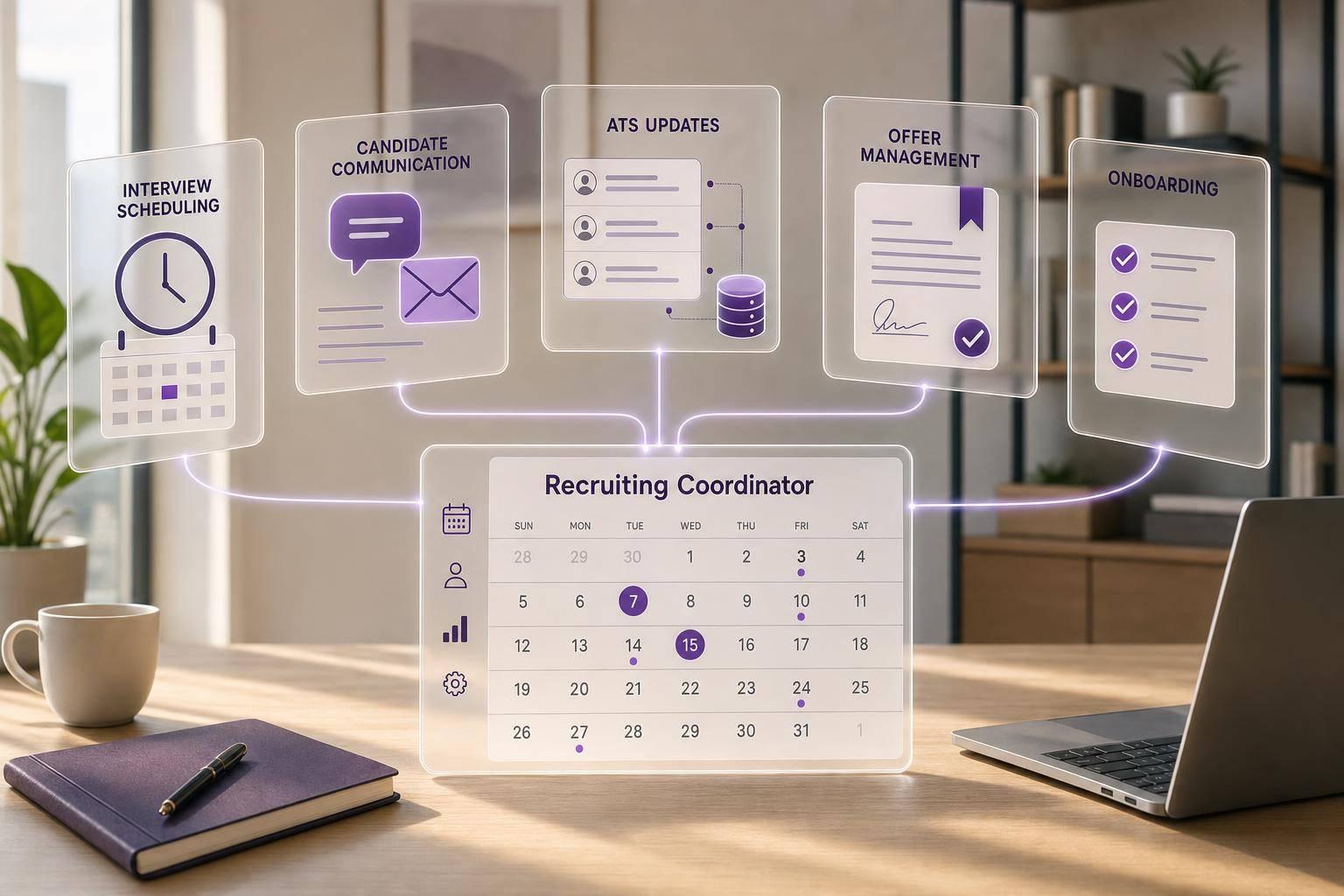
Most hiring delays are process problems, not candidate problems. From my view, a Recruiting Coordinator keeps hiring moving by handling interview scheduling, candidate updates, ATS records, offer steps, and the handoff into onboarding.
Here’s the short version:
- I see this role as the process owner for day-to-day hiring flow
- It is different from a recruiter, who focuses on sourcing and selection
- It is different from an HR assistant, who handles broader HR admin work
- The job often includes:
- Interview scheduling
- Candidate communication
- ATS data updates
- Job posting checks
- Offer paperwork
- Background and reference check support
- Onboarding handoff
- The main skills are:
- Organization
- Attention to detail
- Clear communication
- Time management
- Tool fluency
- Data accuracy
- The role also supports AI-based hiring tools by fixing errors, handling reschedules, and keeping process steps aligned
A few numbers show why this job matters. Hiring teams spend 6.2 hours per hire on interview scheduling. 65% of candidates report uneven communication, and 47% say poor communication can make them leave the process. On top of that, manual checks can add 3 to 10 days before a hire starts.
If I had to sum it up in one line: a Recruiting Coordinator helps stop delays, missed updates, and messy hiring records before they cost the team a hire.
| Role | Main focus | Common work |
|---|---|---|
| Recruiter | Finding and assessing candidates | Sourcing, screening, offer talks |
| Recruiting Coordinator | Hiring process flow | Scheduling, candidate emails, ATS updates |
| HR Assistant | HR admin support | Payroll help, records, benefits paperwork |
That’s the core of the role, and it explains why this position has become a key part of modern hiring teams.
Evolving the Recruiting Coordinator Role from Scheduling to Strategy with Dan Seifert, Marqeta
What a Recruiting Coordinator does
Recruiter vs. Recruiting Coordinator vs. HR Assistant: Role Comparison
A clear definition of the role
A Recruiting Coordinator, sometimes called a Talent Acquisition Coordinator, keeps hiring on track from application to interview, offer, and early onboarding. They own the process around the hiring decision. That includes scheduling, communication, ATS updates, and handoffs from one stage to the next.
Day to day, that often means coordinating multi-round interview loops, sending calendar invites, updating candidate stages in the ATS, and making sure every candidate gets a response on time. As a result, the coordinator becomes the main point of contact for everyone in the loop.
However, the role can look different depending on the company. At a startup, one coordinator might handle scheduling, job postings, and light screening. At a larger company, the work is often split across bigger interview volume and tighter ATS reporting. Those lines matter most when the role starts to overlap with recruiters and HR assistants.
How this role differs from recruiters and HR assistants
It’s easy to mix up this role with recruiter or HR assistant work. But the ownership is different. Each one handles a different part of hiring.
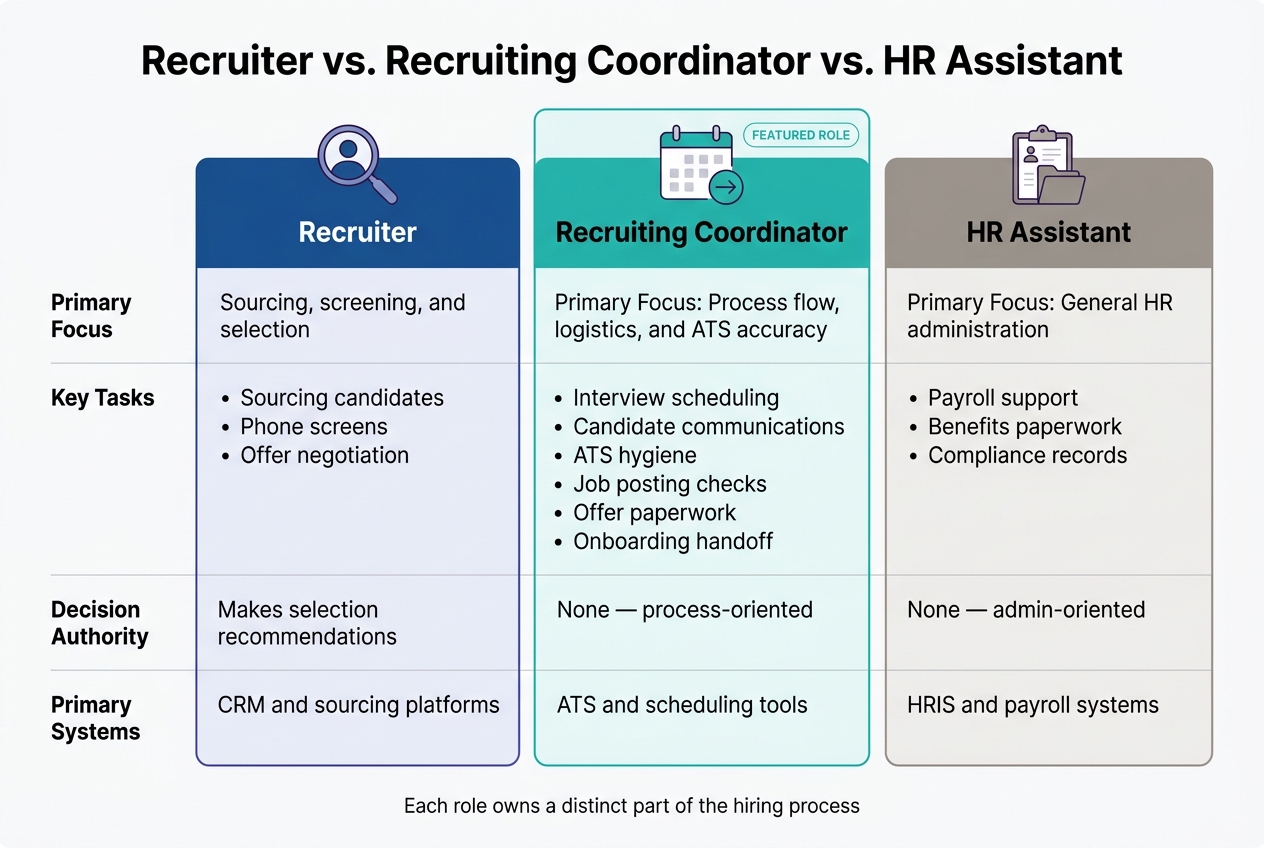
Recruiters focus on sourcing, screening, and evaluating candidates. They build pipelines, run phone screens, guide hiring managers, and may handle offer discussions. Recruiting Coordinators keep the process moving. They manage calendars, keep the ATS up to date, send candidate messages, and make sure each step in the funnel happens when it should. HR Assistants support broader HR admin work, such as benefits paperwork, personnel records, payroll support, and general HR questions.
| Recruiter | Recruiting Coordinator | HR Assistant | |
|---|---|---|---|
| Primary focus | Sourcing, screening, and selection | Process flow, logistics, and ATS accuracy | General HR administration |
| Key tasks | Sourcing, screening, offer negotiation | Scheduling, candidate communications, ATS hygiene | Payroll, benefits, compliance records |
| Decision authority | Selection recommendations | None – process-oriented | None – admin-oriented |
| Primary systems used | CRM and sourcing platforms | ATS and scheduling tools | HRIS and payroll systems |
You can see those lines most clearly in the day-to-day work that comes next.
Core responsibilities in day-to-day hiring
Interview scheduling and hiring team logistics
Interview scheduling takes up a big chunk of a Recruiting Coordinator’s day, and when it drags, hiring drags with it. SHRM benchmarking data shows hiring teams spend an average of 6.2 hours per hire on interview scheduling logistics, including calendar coordination, email back-and-forth, and confirmations. [4]
That means the coordinator is often the person keeping everything from slipping into chaos. They line up calendars across candidates, recruiters, hiring managers, and interview panels, sometimes across multiple time zones. Then they make sure each person gets the right details: the calendar invite, video link, interviewer name, and any prep materials.
For on-site interviews, the job usually gets more hands-on. It can include:
- Room reservations
- Parking instructions
- Visitor check-in details
- Travel or reimbursement support
And when schedules shift, which they often do, the coordinator handles the reschedule and keeps everyone in the loop.
Pre-block interview slots with hiring managers before a role goes live to avoid last-minute scheduling delays.
Candidate communication, ATS updates, and job posting support
Scheduling is only part of the job. Communication is what keeps candidates from going cold. Candidate experience depends a lot on how clear and steady that communication is. Research shows 65% of candidates report inconsistent communication during recruitment, and 47% say poor communication would cause them to withdraw from the process. [5] The coordinator helps prevent that.
Day to day, that usually means sending acknowledgment messages, interview confirmations, prep materials, and follow-up notes after each stage. It also means keeping the ATS candidate records up to date by moving candidates through pipeline stages, logging notes, and recording disposition reasons so nothing gets missed.
For example, good ATS hygiene isn’t just about staying organized. It supports reporting, compliance, and gives hiring managers a live view of where each candidate stands.
Coordinators also support job posting accuracy across the careers page, job boards, and internal channels. Titles, locations, and requirements need to match everywhere. If they don’t, confusion starts fast.
Offers, pre-employment checks, and onboarding support
Once an offer is accepted, the coordinator moves into the final stretch of the process. This is often where candidate drop-off starts if things slow down or feel unclear. The coordinator helps keep momentum by preparing offer documents, tracking approval signatures, starting background and reference checks, and confirming start-date logistics.
Speed matters here. Manual background and reference checks can slow hiring by 3 to 10 days. [3] One simple fix is to collect reference contact details earlier in the process so checks can start as soon as the offer is accepted.
After the offer is signed, the coordinator passes a complete candidate record to HR operations or the onboarding team, with accurate data and a confirmed start date. That handoff helps keep the transition on course.
All of this comes back to the same core skills: strong organization, clear communication, and close attention to detail.
Skills needed to succeed as a Recruiting Coordinator
Those day-to-day tasks only work if the coordinator is organized, clear in how they communicate, and steady with tools and process.
Organization, attention to detail, and time management
A Recruiting Coordinator usually juggles several open roles at the same time. Each one can have a different hiring manager, a different timeline, and a different group of candidates. If organization slips, things go sideways fast: interviews get missed, follow-ups stall, and ATS records stop matching reality.
The pressure is not small. Recruiters are handling 93% more applications with 14% smaller teams than in 2021 [2]. On top of that, longer hiring cycles push up cost-per-hire and hurt offer acceptance [1][2][3]. That’s why the coordinator needs one clear source of truth in the ATS, a tight handle on deadlines, and a habit of spotting delays early. A small scheduling miss today can turn into a week of drift later.
Communication, stakeholder coordination, and professionalism
The coordinator is often the person keeping everyone in sync: candidates, recruiters, hiring managers, and HR. And each group needs something a little different. Candidates need updates and clarity. Hiring managers need schedules and reminders. Recruiters need status checks. HR needs clean handoffs. The job is to keep all of that moving without dropping the ball.
One simple example is the 48-hour feedback deadline. HubSpot put strict 48-hour feedback deadlines in place and tracked them through internal dashboards. That cut their interview-to-offer cycle time by 6 days and improved offer acceptance rates [3]. A coordinator who watches for missing feedback and nudges people when needed helps keep good candidates from getting stuck in limbo.
Professionalism matters just as much as speed. Candidates share sensitive information during the hiring process, and the way that information is handled affects how they view the company.
Technology fluency, data accuracy, and process adaptability
This role also calls for comfort with tech. A Recruiting Coordinator needs to move easily between ATS platforms, scheduling tools, video interview software, spreadsheets, and team chat tools. On some days, that means bouncing between all of them within an hour.
The clearest proof of that skill is clean data. Every stage change, timestamp, and disposition note in the ATS feeds the numbers hiring teams watch: time-to-hire, source effectiveness, and funnel drop-off rates [2]. If records are wrong, bottlenecks get hidden and bad decisions follow. And as automation takes over more routine scheduling work, the coordinator’s job shifts more toward handling exceptions, reschedules, and fixing process issues.
As more of the basic admin work gets automated, that ability to adjust becomes even more important.
How the role fits into AI-enabled recruitment workflows
AI is now common in U.S. hiring, but it doesn’t replace the coordinator’s job. It changes what that job looks like each day.
The coordinator makes sure automation sends candidates to the right place and steps in when something goes wrong. That can mean fixing bad time zones, broken links, or mixed messages. In plain terms, the coordinator is the human checkpoint between automation and a smooth hiring process.
Supporting LinkedIn recruitment funnels and reducing application drop-off
That same kind of oversight matters even more in high-volume hiring, where small gaps can hurt applicant flow fast. The coordinator keeps job titles, pay ranges, requisition IDs, and equal opportunity language aligned across the ATS, recruitment landing pages, tracking links, and application forms.
They also keep recruiters and hiring managers on the same page about messaging and application stages, so nothing slips out of sync. When ATS data shows candidates dropping off during the application or assessment stage, the coordinator digs into the cause. Maybe the form is too long. Maybe mobile instructions aren’t clear. Maybe reminder timing is off.
The work shifts away from simple task handling and toward process control, clean data, and steady candidate follow-through.
FAQs
Who should a Recruiting Coordinator report to?
A Recruiting Coordinator usually reports to someone on the talent acquisition or human resources team, such as a Recruiting Manager, Talent Acquisition Manager, or HR Director.
That reporting line helps keep hiring workflows on track. It also supports clean data, a smooth candidate experience, and alignment with the company’s hiring goals. Just as important, it gives candidates a clear sense of where the role sits in the organization and who handles day-to-day guidance.
What tools does a Recruiting Coordinator use most?
Recruiting Coordinators usually lean on a small set of tools to keep hiring organized and details up to date:
- ATS for candidate records, pipeline tracking, and compliance
- Scheduling tools like Calendly or GoodTime for interview coordination
- Recruitment marketing and landing page tools for job posting support
- Email, SMS, and WhatsApp integrations for candidate communication and updates
When should a company hire a Recruiting Coordinator?
A company should hire a Recruiting Coordinator when hiring volume starts to outgrow the internal team’s capacity and creates bottlenecks.
If recruiters are spending too much time on repetitive admin work, like interview scheduling, ATS data hygiene, and candidate communication, a coordinator can make the process run more smoothly and free recruiters up to focus on higher-level work.


