What Does a Talent Acquisition Specialist Do?
A Talent Acquisition Specialist helps a company make better hires, not just fill open jobs. I’d sum the role up like this: they plan hiring needs, find candidates, screen people, run interview steps, help close offers, and track hiring data to fix weak spots.
Here’s the short version:
- I see this role as part sourcing expert, part process manager, and part hiring partner
- It covers workforce planning, intake meetings, screening, interview coordination, offers, and pipeline care
- It often uses tools like ATS platforms, CRM systems, sourcing tools, automation, and analytics dashboards
- Success is tied to hire quality, retention, candidate experience, and hiring speed
- It is broader than recruiting because it includes future hiring needs, employer brand, and passive candidate outreach
A few numbers show why the role matters:
- Non-executive hires cost about $1,200 on average
- Executive hires can reach $10,625
- 73% of the global workforce is not actively job hunting
- Slow feedback can add days to hiring, and each extra week can push hiring costs up by 10% to 15%
If you want the plain answer: a Talent Acquisition Specialist builds and runs a hiring system that helps companies hire the right people faster and with fewer mistakes.
What Does a Talent Acquisition Specialist Do?
Core Responsibilities Across the Hiring Process
A Talent Acquisition Specialist runs hiring from intake to start date. The job is to keep three things in balance: speed, hiring quality, and candidate experience.
Workforce Planning, Intake, and Job Setup
Before sourcing starts, the specialist meets with the hiring manager for an intake meeting. They pin down the must-haves, agree on the salary range, and lock in the hiring timeline. They also set SLAs, like 48-hour interview feedback. That one commitment can cut time-to-hire by 3–6 days [2].
For repeat roles or planned headcount growth, specialists also help with workforce planning. In plain English, they try to spot hiring needs early, before an open seat turns into a fire drill.
With that intake work done, sourcing starts with a much clearer target.
Sourcing, Screening, and Interview Management
Once a role goes live, the specialist sources candidates with LinkedIn Recruiter and Boolean searches across LinkedIn, GitHub, and Google. They may also go back to past finalists in the talent pool when a strong-fit role opens again. Re-engaging those past finalists can shave 7–10 days off sourcing time [2].
They review ATS applications, message candidates, and match past finalists to open roles. That keeps the pipeline warm and cuts delay when new openings appear. As candidates move ahead, the specialist handles phone screens, coordinates structured interviews, and keeps communication on track.
To cut scheduling drag, many teams use self-scheduling tools and shorter interview loops that group stakeholders into one half-day session [2]. It’s a simple fix, but it can keep a process from getting stuck in calendar limbo.
From there, the work shifts to closing the finalist and keeping momentum up.
Offers, Onboarding Support, and Pipeline Improvement
After the shortlist is set, the specialist turns to offer close and process quality.
Once a finalist is chosen, the specialist confirms compensation, supports negotiation, collects signatures, and kicks off reference and background checks.
The role also includes improving the pipeline over time. Specialists track funnel performance, source quality, conversion rates, and drop-off points. They can also connect pre-hire signals to later performance and retention to measure quality of hire. A strong benchmark for time-to-hire in professional roles is 21–28 days [2].
That matters because delay gets expensive fast. Every extra week in the process can increase cost-per-hire by 10–15% and reduce the odds of offer acceptance by 16% [2]. That’s why spotting bottlenecks and fixing them is a core part of the job. These metrics show where hiring slows down and whether the process is leading to stronger hires.
Tools Talent Acquisition Specialists Use Every Day
Those day-to-day tasks run on a stack of tools that keeps hiring on track. Talent acquisition works best when those systems connect, with each one handling a different part of the hiring process.
ATS, CRM, and Sourcing Platforms
The applicant tracking system (ATS) is the main source of record. It tracks open requisitions, logs where each candidate sits in the process, stores interview notes, and helps teams stay compliant. When a specialist updates a candidate’s status in the ATS, recruiters, hiring managers, and interviewers can all stay on the same page.
The CRM (Candidate Relationship Management) platform plays a different role. It’s built for passive candidates, not just active applicants. A CRM helps teams keep in touch with past and passive candidates through segmented campaigns and reactivation efforts, so good people don’t go cold just because they weren’t ready at the right moment.
For sourcing, specialists often rely on LinkedIn Recruiter and Boolean search to find niche candidates across LinkedIn, GitHub, Stack Overflow, and Google.
Once that pipeline starts to fill up, automation helps move people through it without so much manual chasing.
AI Tools, Automation, and Analytics
AI-powered screening can read context and synonyms, which means it can surface candidates with related skills instead of looking only for exact keyword matches. That gives specialists a faster way to sort through large applicant pools without missing strong people who simply used different language on their resumes.
Automation tools take care of tasks like scheduling, reference checks, offer signatures, and reporting. In plain English: less back-and-forth, less copy-paste work, and more time for actual recruiting.
Reporting dashboards show funnel metrics such as:
- source-of-hire
- cost-per-hire
- drop-off rates
That data helps specialists spot where the process slows down. It also shows which campaigns turn interest into applicants, not just traffic.
Recruitment Marketing and Conversion Tools
Getting someone to click a job post is only half the job. The next step – turning that click into a completed application – is where recruitment marketing tools matter.
Specialists use high-converting job pages and mobile-friendly application forms to cut drop-off from social media traffic. Tools like HireLab.io help teams build branded recruitment pages, smart application forms, and campaign funnels that sync with the ATS. Tracking pixels and campaign analytics show which channels are converting, not just sending clicks, and they make it possible to retarget candidates who visited but didn’t apply.
When teams combine landing pages, forms, and analytics, they can save 15 to 20 hours of admin time per week [4].
Skills That Make a Talent Acquisition Specialist Effective
The gap between average and excellent talent acquisition often comes down to how well a specialist uses the tools in front of them. The strongest people in this role blend recruiting know-how, comfort with data, and solid people skills.
Hiring, Sourcing, and Data Skills
A talent acquisition specialist needs a clear grasp of the full hiring process, which the U.S. Bureau of Labor Statistics lists among core human resources specialist duties. That starts with writing a job post and runs all the way through building interviews that produce useful signals. Boolean search is still a big deal, especially when a company needs hard-to-find talent that automated filters can miss [3].
Data literacy matters just as much as sourcing skill. When specialists track source-of-hire and the full hiring funnel, they can spot what’s working and where things break down. Quality of hire – measured by performance, retention, and hiring manager satisfaction – is now the top priority for 89% of talent professionals, yet only 25% feel confident measuring it [1]. That gap says a lot. Specialists who connect sourcing choices to what happens after the hire can shape hiring strategy, not just fill openings.
ATS and CRM fluency also matters. Clean systems lead to cleaner data, and cleaner data leads to reporting people can actually trust.
Still, tools and metrics only go so far. They matter most when the specialist can get hiring managers and candidates on the same page.
Communication, Judgment, and Stakeholder Management
Recruiting skill by itself doesn’t close roles. A specialist spends a big part of the day working with hiring managers, candidates, and leadership. That takes clear, steady communication from every side.
One habit strong specialists build early is stakeholder alignment before sourcing starts. If everyone agrees on the role upfront, the process usually moves with less friction. Upfront role alignment and 48-hour feedback SLAs reduce cycle time and keep candidates engaged [2].
Judgment shows up just as much in candidate experience. Every interaction matters – a screening call, a follow-up email, an offer conversation. Each one shapes how a person sees the company. Companies with strong employer brands see a 50% reduction in cost-per-hire and 28% lower turnover [1]. Specialists who handle candidate experience well help protect that employer brand over time.
That’s the line between strategic talent acquisition and reactive recruiting.
Talent Acquisition vs. Recruiting, and Key Takeaways
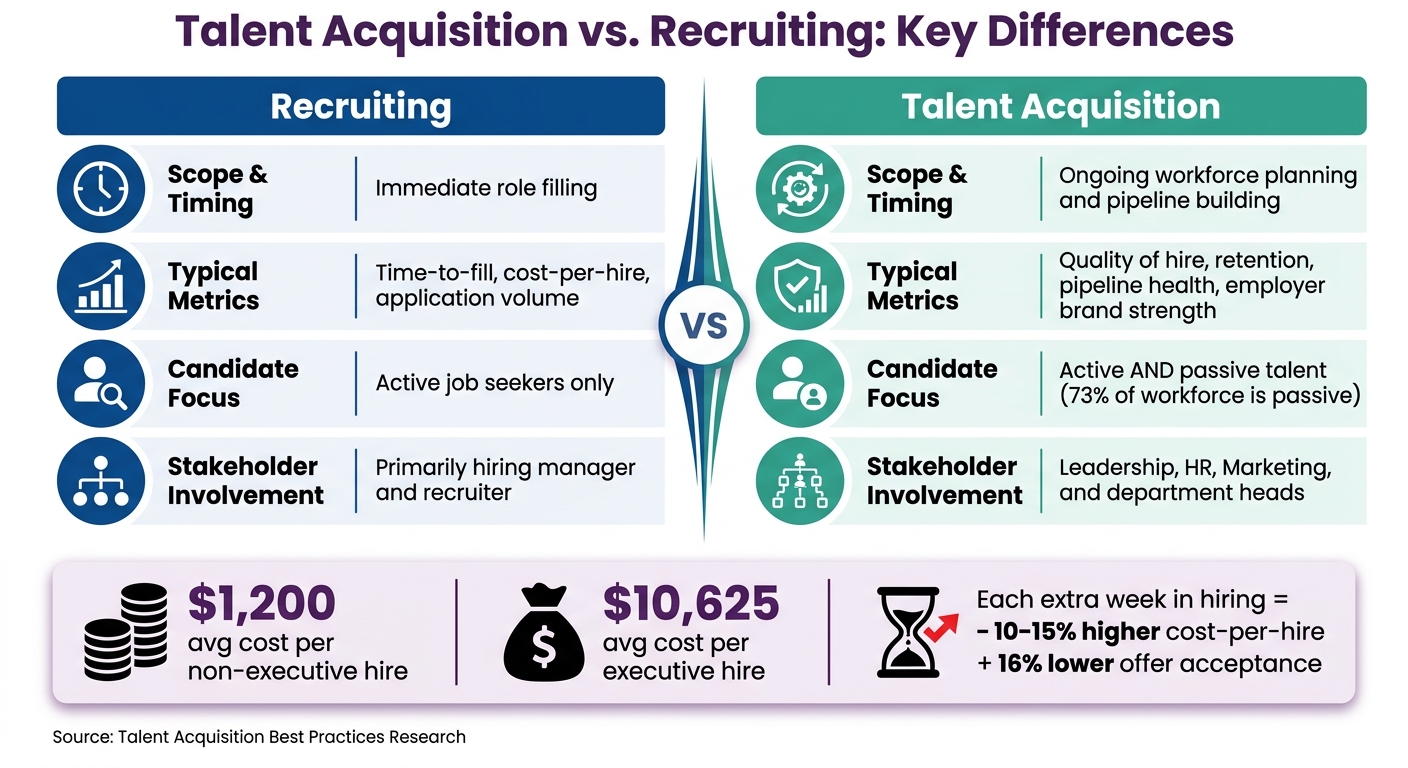
Talent Acquisition vs. Recruiting: Key Differences Explained
How Talent Acquisition Differs from Recruiting
Recruiting is about filling open roles now. Talent acquisition looks further ahead. It builds the pipeline, employer brand, and relationships that help a company fill future roles too.
That gap shows up in the work itself: the scope is broader, the metrics are different, and more people take part in the process. It also changes how teams manage the work and which tools they lean on.
| Dimension | Recruiting | Talent Acquisition |
|---|---|---|
| Scope and timing | Immediate role filling | Ongoing workforce planning and pipeline building |
| Typical Metrics | Time-to-fill, cost-per-hire, application volume | Quality of hire, retention, pipeline health, employer brand strength |
| Candidate Focus | Active job seekers | Active and passive talent |
| Stakeholder Involvement | Primarily hiring manager and recruiter | Leadership, HR, Marketing, and department heads |
Conclusion: What Outcomes This Role Owns
That broader scope is why this role should be measured by outcomes, not just activity. The point isn’t how many resumes came in or how many outreach messages went out. The point is whether the company made better hires and built a healthier hiring engine over time.
A talent acquisition specialist owns better hiring results: stronger hires, smoother processes, and healthier pipelines. For employers, HR teams, and candidates, the payoff is the same: better hires, clearer processes, and stronger long-term results. Success is measured by hire quality, retention, and pipeline health – not resume volume.
FAQs
When should a company hire a Talent Acquisition Specialist?
A company should hire a Talent Acquisition Specialist when it needs to move beyond reactive, job-board-only recruiting and build a proactive, long-term hiring strategy.
This matters most when the business is hiring for hard-to-fill, niche, or senior roles. It also makes sense when the company wants to build a stronger talent pipeline, keep employer branding consistent, and focus on high-quality hires that support long-term retention and performance.
What KPIs matter most for this role?
Track KPIs across the hiring funnel, and balance day-to-day speed with long-term hiring results. The metrics that matter most are quality of hire, time-to-hire, cost-per-hire, offer acceptance rate, and source of hire.
It also helps to watch funnel health metrics like:
- qualified candidates per opening
- application-to-interview and interview-to-offer ratios
- automated screening performance
Recruitment dashboards make it easier to spot bottlenecks and make better hiring calls.
Can a Talent Acquisition Specialist improve employer branding?
Yes. A Talent Acquisition Specialist can help improve employer branding by posting real, people-first content on LinkedIn, Instagram, and TikTok.
That can include:
- Employee stories
- Behind-the-scenes videos
- Day-in-the-life features
This kind of content helps candidates form an opinion about your company before they ever read a job description. And that matters. People don’t just apply for a role – they apply for a workplace, a team, and a story they can see themselves in.
A strong employer brand can also lower hiring costs and reduce churn. In fact, companies with strong employer brands are linked to 50% lower cost-per-hire and 28% lower turnover. That means you’re not just getting more attention – you’re more likely to attract high-quality talent too.