

Employer Branding for Talent Acquisition: A Starter Guide
I’d start employer branding for talent acquisition with proof – not promotion. Pick 1–2 roles, ask employees what the job is like, and build your employee value proposition (EVP) around promises you can support.
Here’s the approach I’d use:
- Define the promise: Connect pay, benefits, growth, and working conditions to what your target candidates need.
- Match the hiring experience: Keep job posts, recruiter messages, interviews, offers, and onboarding aligned. State pay, hours, and work location clearly.
- Test the application: Check the mobile flow, links, and ATS connection. If you use HireLab.io, review AI-written copy before publishing.
- Run a 30-day pilot: Assign owners, set response deadlines, and record starting results.
- Measure hiring results: Review qualified applications and completion rates monthly, plus offer acceptance quarterly. For example, 8 accepted offers out of 10 equals an 80% acceptance rate.
My rule: fix the job experience before rewriting the promise. Candidate and new-hire feedback should guide what you change – not just what you say.
How to Build a Successful Employer Branding Strategy in 12 Steps – Part I
Define Your EVP and Target Candidates
Use those findings to write a short EVP for the roles you hire most. As a result, your employer branding for talent acquisition starts from evidence rather than slogans. Assign ownership before you draft: recruiting writes the EVP, employees in the role check it against their daily experience, and hiring managers define role requirements and team expectations. Start with one or two priority roles, then build a short EVP and message map.
Review Employee Feedback and Recruiting Materials
Review employee surveys, interviews, career pages, LinkedIn profiles, and job postings. Look for recurring strengths, broken promises, outdated visuals, dead links, and missing details. Ask employees which claims ring true and which need clearer wording.
Support EVP Claims With Proof
Include only strengths you can back up. However, employer branding tools like employee stories and short day-in-the-life videos only add context; they don’t replace proof.
Claim/proof examples:
Claim Proof required “We support professional development.” Confirmed learning budget and internal promotion evidence “You’ll work with a supportive team.” Photos or video from team huddles and leader introductions “You’ll tackle challenging technical work.” Manager-confirmed tasks and a day-in-the-life view of the role
Check each claim: Does it apply to this team? Does it matter to the target candidate? Can you verify it? Do employees recognize it as their experience? If any answer is no, narrow the wording or drop the claim.
Once you’ve verified the claims, match them to the candidate groups you need to reach.
Match Candidate Priorities to Your EVP
Define each audience by role and what drives their decision. Use the table below to connect their priorities with your EVP, proof, concerns, and channels. Give candidates enough detail to spot fit and gaps, then decide whether to apply or move on. Check each message: Set accurate expectations and include role-specific evidence.
Audience Decision factor EVP pillar Proof to gather Concern to address Primary channel Nursing staff Support and safety Culture & belonging Photos or video from team huddles and leader introductions What does team support look like? Facebook, Instagram Senior software engineers Career growth and technical challenge Professional development Learning budget and internal promotion evidence Will I be stuck doing maintenance? LinkedIn and GitHub
Use this map to keep career pages, job posts, and recruiter messages aligned.
Use Employer Branding for Talent Acquisition Throughout Recruitment
Keep your message consistent at every hiring step, but match the proof to the stage. Give each handoff an owner so questions get answered and updates don’t get lost.
| Recruiting stage | Purpose | What candidates need to know | Proof to show | Owner |
|---|---|---|---|---|
| Outreach / sourcing | Spark interest | Role scope, salary, work arrangement, hours | Day-in-the-life story | Recruiter / sourcer |
| Screening | Check qualifications | Skills, experience, certifications | Application answers or approved requirements | Recruiter / AI tools |
| Interviews | Assess competencies | Interview topics and evaluation criteria | Leader intro or team video | Hiring manager |
| Offer | Inform the decision | Pay, benefits, work arrangement, growth path | Offer letter and current benefits | Recruiter / HR |
| Preboarding | Prepare for day one | Start date, equipment, new-hire paperwork | Welcome and readiness checklist | HR operations / manager |
Start with the career page and job post. Both should match what candidates hear in your outreach.
Write Clear Career Pages and Job Postings
Put the job title, salary information, work arrangement, and required hours at the top. Group responsibilities, benefits and eligibility, and required versus preferred qualifications under Benefits, Tasks, and Requirements. Then explain the recruitment funnel stages.
Include compensation disclosures required by U.S. law and your policy. Show salary amounts in U.S. dollars, and state whether they cover base pay or total compensation.
Make the application easy to find and complete on a phone. Check that the text is clear, navigation is simple, and apply links work. Include a recruiter contact and an application support option. Test the entire application process – not just how the page looks.
Use employee stories to back up the claims on the page.
Share Employee Stories and Align Recruiter Messages
Keep employee stories accurate when editing. Identify the person’s team or role so their experience doesn’t turn into a company-wide promise.
Give recruiters and hiring managers approved proof points for outreach, interviews, and follow-up. Set reply times they can meet and an interview-feedback target so candidates keep getting updates.
Use the same evidence and role details to shape the landing page and application flow.
Build Branded Application Journeys With HireLab.io
Use HireLab.io’s AI-powered recruitment landing pages to publish a branded application journey. Its campaign builder helps match outreach to the landing page. Keep mobile-friendly smart forms focused on information needed at that stage, with questions tied to required qualifications.
Have a person review AI-generated wording before publishing. Check for accuracy, welcoming language, and claims that lack support.
Verify the ATS connection, branding controls, accessibility, and candidate privacy settings. Submit a test application through your existing workflow. Use drop-off tracking to see where candidates leave and tracked channel links to measure qualified applications by source.
Launch and Measure Your Employer Branding Program
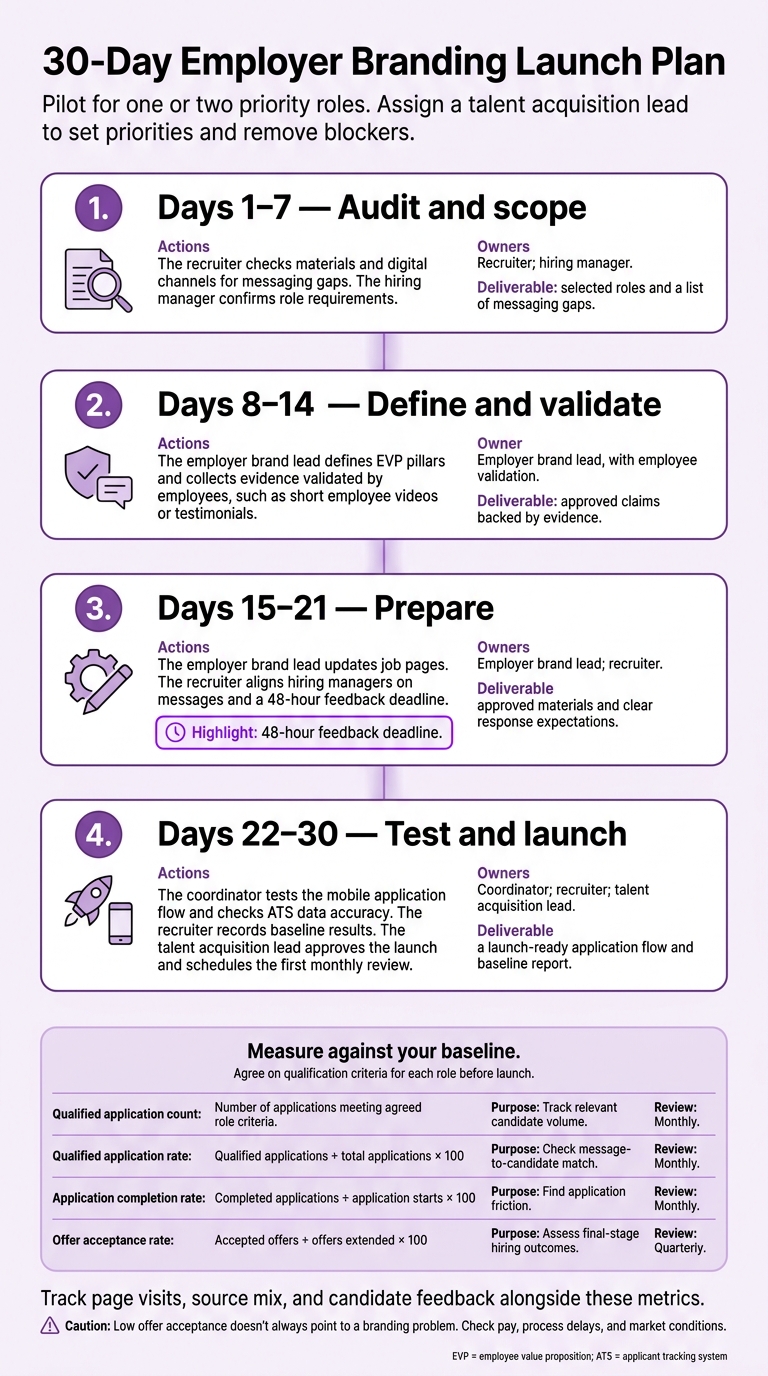
30-Day Employer Branding Launch Plan
Your First 30 Days: Launch Checklist
When your EVP, hiring messages, career page, and application flow are ready, start your employer branding for talent acquisition with a pilot for one or two priority roles. Assign a talent acquisition lead to set priorities and remove blockers.[1][3]
- Days 1–7 – Audit and scope: The recruiter checks materials and digital channels for messaging gaps. The hiring manager confirms role requirements. Deliverable: selected roles and a list of messaging gaps.[3]
- Days 8–14 – Define and validate: The employer brand lead defines EVP pillars and collects evidence validated by employees, such as short employee videos or testimonials. Deliverable: approved claims backed by evidence.[1][2][3]
- Days 15–21 – Prepare: The employer brand lead updates job pages. The recruiter aligns hiring managers on messages and a 48-hour feedback deadline. Deliverable: approved materials and clear response expectations.[1]
- Days 22–30 – Test and launch: The coordinator tests the mobile application flow and checks ATS data accuracy. The recruiter records baseline results. The talent acquisition lead approves the launch and schedules the first monthly review. Deliverable: a launch-ready application flow and baseline report.[1][2][3]
Measure Qualified Applications and Offer Acceptance
Agree on qualification criteria for each role before launch. After launch, compare performance against your baseline.[3]
| Metric | Formula | Recruiting purpose | Review frequency |
|---|---|---|---|
| Qualified application count | Number of applications meeting agreed role criteria | Track relevant candidate volume | Monthly |
| Qualified application rate | Qualified applications ÷ total applications × 100 | Check message-to-candidate match | Monthly |
| Application completion rate | Completed applications ÷ application starts × 100 | Find application friction | Monthly |
| Offer acceptance rate | Accepted offers ÷ offers extended × 100 | Assess final-stage hiring outcomes | Quarterly |
Track page visits, source mix, and candidate feedback alongside these metrics. Together, they help you see whether the pilot improves relevance and conversion.[3]
Review Results and Fix Message Gaps
Review results monthly to find where candidate interest drops or expectations go unmet. Check offer acceptance quarterly. Low offer acceptance doesn’t always point to a branding problem. If candidate feedback is strong, check pay, process delays, and market conditions first.[1][3]
Compare candidate and new-hire feedback with employee experience. Revise promises you can’t support, repeat the materials audit, and record each change. Retest and compare results at the next review.[3]
Conclusion: Start With Evidence and Keep Improving
The goal of employer branding for talent acquisition isn’t louder promotion. It’s an EVP grounded in employee experience, aligned with candidate priorities, and reflected at every hiring touchpoint. Use the same evidence-backed message on career pages, in job posts, during outreach, and in interviews.[3]
Start with one priority role. Track qualified applications and offer acceptance rate to refine your message before expanding.[2][1][3] Let those results guide the next version of your EVP.
Put HR and the hiring manager in charge of onboarding. Then use new-hire feedback to close gaps between what you promised and what the job delivers – fix the experience, not the copy.[1][3] Treat that feedback as the final test of your employer brand.
FAQs
How can I build an employer brand on a small budget?
Start with honest messaging and resources you already have. Define your employee value proposition (EVP) around career growth, flexibility, and your mission. Use your smartphone to record employee stories, day-in-the-life videos, and team moments. Encourage employees to share these experiences on social media to build trust.
Make your career page mobile-friendly. Use free or low-cost AI tools to help create content and landing pages, and keep your messaging consistent across channels.
How soon should I expect hiring results?
Employer branding takes time – it’s not a quick fix. It helps you build relationships with candidates before roles open. Recruitment landing pages can bring faster results when you need to hire now, while regular content and storytelling build your employer brand over time.
To track progress, measure application conversion rates, qualified applicant volume, and offer acceptance rates. Steady effort keeps your company top-of-mind with candidates and helps the recruitment process run more smoothly.
How do I address negative employee reviews?
Address negative employee reviews openly and honestly instead of hiding or ignoring criticism. Share candid reflections on workplace challenges alongside positive testimonials so candidates get a balanced view.
Show what employees experience – from successes to areas for growth. This builds trust with candidates who prefer an honest look at your workplace over polished corporate messaging, while strengthening your employer brand.