A talent marketplace helps a company match people to jobs, projects, mentors, and learning based on skills, not just job titles. That matters because hiring from the outside is slow and costly, while better internal matching can cut agency fees by 15% to 30% per hire, improve retention by 45%, and reduce candidate search time by 50%.
If I had to sum it up in plain English, it works like this:
- I use it to map people’s skills, experience, and interests
- It matches them to roles, gigs, mentors, and training
- It keeps learning from recruiter and manager feedback
- It connects with systems like an ATS, HRIS, and LMS
- It helps HR fill roles faster and see skill gaps earlier
This is not just a job board with a new name. A careers page and ATS mostly track applicants after they apply. A talent marketplace does more: it recommends where people may fit before a search even starts.
For me, the big idea is simple: when work changes faster than job titles, skills-based matching gives companies a better way to move people into the right roles.
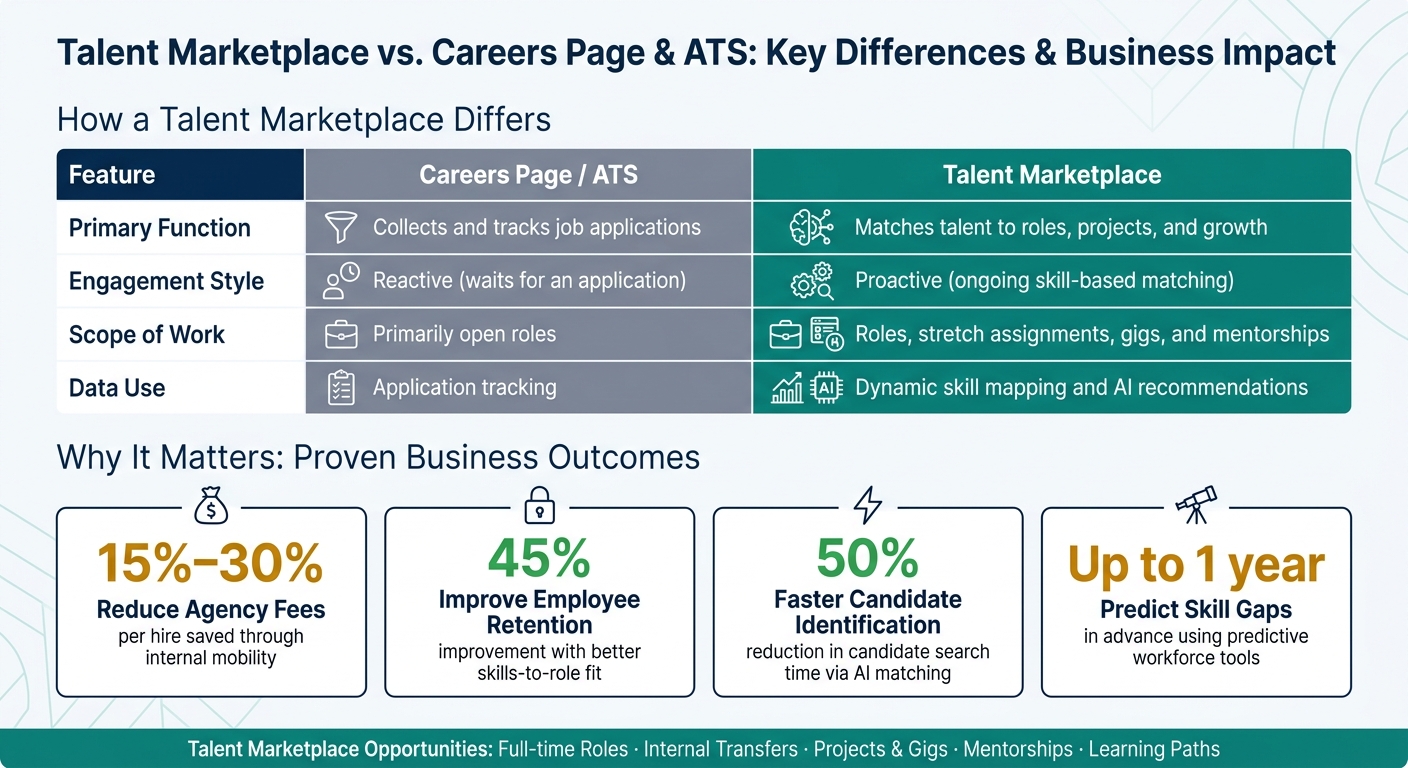
Talent Marketplace vs. Careers Page & ATS: Key Differences & Business Impact
What a Talent Marketplace Is
A talent marketplace matches employees or candidates to roles, projects, and growth paths based on skills and preferences. Unlike a standard careers page or ATS, it keeps mapping skills over time and recommends opportunities before someone goes looking for them.
That means the scope goes well beyond open roles.
The Types of Opportunities It Covers
A lot of people hear talent marketplace and think: another place to post jobs. That’s too narrow.
A talent marketplace can connect people to:
- Full-time roles
- Internal transfers
- Projects and gigs
- Mentorships
- Learning paths tied to skill gaps
That range matters. Internal mobility isn’t just about promotions. A talent marketplace brings jobs, projects, mentors, and learning paths into one place, so employees can see what they can do next and the company can put people where they fit best.
How It Differs from a Careers Page or ATS
A careers page promotes your company and lists open roles. An ATS collects, stores, and tracks applications through the hiring process. Both have a clear job to do, but they’re reactive by design. They wait for someone to visit, search, and apply.
A talent marketplace works differently. Instead of only processing applications, it matches people to roles, projects, and other paths based on skills and interest.
| Feature | Careers Page / ATS | Talent Marketplace |
|---|---|---|
| Primary Function | Collects and tracks job applications | Matches talent to roles, projects, and growth |
| Engagement Style | Reactive (waits for an application) | Proactive (ongoing skill-based matching) |
| Scope of Work | Primarily open roles | Roles, stretch assignments, gigs, and mentorships |
| Data Use | Application tracking | Dynamic skill mapping and AI recommendations |
How Talent Matching Works
A talent marketplace turns employee and candidate data into matches for roles, projects, gigs, and mentors. Once profiles are set up, the platform can start connecting people to work.
Profiles, Skills Data, and Preferences
It starts with skills data. When someone joins a talent marketplace, they build a profile with their skills, experience, and preferences. The platform stores that information and reads it in context.
For example, if a profile says someone "built microservices", the system can read that as a sign of seniority, not just a technical task. NLP helps the platform understand what a profile is signaling, so it can spot adjacent experience and likely seniority.
Those signals then feed the matching engine.
How AI Recommends Roles, Projects, and Mentors
Once profiles are in place, the matching engine compares them with open roles, projects, gigs, and mentors. It looks at exact and adjacent skills, which helps surface matches that a title-only search might miss.
For example, a "Product Owner" with strong stakeholder management skills might be a fit for a "Program Manager" role [4].
Recruiters and managers still stay in the loop. They can review the recommendations, apply skills-based filters, and use business context to make the final call. That matters because a good match on paper doesn’t always line up with team needs, timing, or headcount.
The system also gets better over time. When recruiters and managers act on AI-suggested matches, that feedback helps refine future recommendations [1].
What Happens After a Match Is Made
Recruiter and manager feedback helps improve future recommendations. That feedback loop works best when the platform has strong skills data, matching logic, and integrations.
That matching process depends on the feature set covered next.
Core Features That Make a Talent Marketplace Work
A talent marketplace works when four pieces line up: structured skills data, standardized postings, a matching engine, and clean integrations.
Skills Profiles and Opportunity Posting
A talent marketplace runs on structured skills data. In plain English, profiles need to go past job titles and spell out specific skills in a format the system can read, sort, and compare.
The same idea applies to opportunity postings. When internal roles, projects, or gigs follow a standard format, the platform can compare what a person brings with what the role asks for. That makes the comparison more consistent across jobs, short-term work, and mentor matches. It also gives the platform a steady way to rank fit.
Skills-based filters predict fit better than title-based filters [4]. Structured profiles and standardized postings are what make that work.
Matching Engine, Analytics, and Integrations
The matching engine turns that structured data into recommendations for roles, projects, and mentors. That’s the part doing the heavy lifting. AI-powered matching can cut candidate identification time by 50% [2].
Analytics sit right next to the engine and show what’s working and what isn’t. Real-time dashboards track metrics like time-to-fill, source-of-hire, and quality of hire, so HR teams can spot bottlenecks early instead of finding them weeks later.
Integrations connect the whole setup. When a marketplace syncs two-way with an HRIS, ATS, and LMS, data stays current across systems [1].
What a Strong Feature Set Looks Like
| Feature Category | What It Does | Business Outcome |
|---|---|---|
| Skills Intelligence | NLP parsing of profiles to extract structured skills data | Surfaces hidden talent; reduces manual data entry |
| Matching Engine | AI-driven recommendations for roles, projects, and mentors | Faster candidate identification |
| Opportunity Management | Standardized posting for internal roles, gigs, and projects | Consistent comparison of talent against requirements |
| Analytics & Reporting | Real-time dashboards for time-to-fill, source-of-hire, and quality of hire | Faster workforce decisions |
| Integrations | Two-way sync with ATS, HRIS, and LMS | Centralized employee data; supports compliance |
Business Benefits and Platform Examples
How HR Teams and Employers Benefit
When skills data, matching, and system connections are set up, the payoff starts to show in places HR teams care about most: hiring speed, cost, and retention.
Talent marketplaces can help companies move faster and spend less. That faster pace shortens time-to-fill. And when companies put internal mobility first, they can reduce agency fees by 15% to 30% per hire [2] while also cutting onboarding time. That’s a big deal, especially for teams that hire often.
There’s also a people side to this. Better skills-to-role fit has been shown to improve employee retention by 45% [3]. In plain English, when people land in roles that match what they’re good at, they’re more likely to stay.
HR teams also get a clearer view of what’s coming next. Talent marketplaces can help them spot skill gaps sooner and plan for future workforce needs with less guesswork [3].
Examples of Talent Marketplace Platforms
Some well-known platforms in this space include Gloat, Fuel50, Eightfold AI, and Phenom. These tools use skills data and AI matching to surface roles, projects, mentors, and learning paths.
When a Talent Marketplace Makes Sense
These gains tend to matter most for organizations with repeat hiring, internal mobility, or workforce planning needs.
| Situation | Why a Marketplace Helps |
|---|---|
| High agency spend and slow fills | Internal mobility reduces agency fees and cuts onboarding time [2] |
| Low visibility into internal skills | Centralized skills data makes hidden talent easier to find |
| Slow time-to-fill on specialized roles | AI matching identifies qualified candidates 50% faster [2] |
| High voluntary turnover | Better role-fit alignment can improve retention by 45% [3] |
| Forecasting skill gaps | Predictive tools can identify skill shortages up to a year in advance [3] |
FAQs
Who should use a talent marketplace?
Organizations that want to improve retention, internal mobility, and how fast teams can shift work should use a talent marketplace. It works especially well for companies trying to break down silos by connecting employees with projects, gigs, mentors, and open roles based on their skills.
It also gives HR teams and employers a clearer view of the talent they already have. That makes internal hiring easier and supports employee career growth through a skills-based approach.
What data does a talent marketplace need?
A talent marketplace runs on two kinds of information: structured data and unstructured data.
That usually means pulling from employee profiles that list skills, career paths, and performance ratings, along with information from job descriptions, internal projects, mentorship opportunities, and gig assignments.
Then the system uses resume parsing and natural language processing to make sense of it all. It looks at that information next to behavioral signals and assessment results to spot transferable skills, find relevant experience, and match people to internal opportunities.
How long does talent marketplace setup take?
Setup time depends on two things: the platform and the size of the organization.
Simple hiring tools can be up and running in minutes or hours. More complex AI-driven talent systems usually take longer and follow a planned, multi-week rollout.
A phased setup is common. For example, four weeks is often used to configure AI settings, line the system up with human decision-making, and connect it to tools already in place, such as an ATS.