

Staffing and Recruiting Services: A Buyer’s Checklist
A low fee does not mean a low hiring cost. When I compare staffing and recruiting services, I need to look at time to fill, candidate quality, brand fit, reporting, AI controls, contract terms, and total spend – not just the quote. That matters because SHRM puts median nonexecutive time-to-fill at 39 days and average cost per hire at $5,475.
Here’s the short version: I should first define the roles, volume, deadlines, budget, and systems. Then I should match my hiring need to the right model – staffing agency, RPO, executive search, or recruitment marketing partner. After that, I should score each vendor on proof: recent placements, sourcing plan, screening process, recruiter workload, funnel metrics, data handling, and legal terms.
If I want a clean buying process, I should check these points before I sign:
- Fit the model to the hiring problem
- Set role counts, locations, and deadlines
- Check recruiter specialization and account coverage
- Review screening rules and candidate scorecards
- Ask for source-channel data and funnel reports
- Compare all-in cost, not just the fee
- Define KPIs before work starts
- Review AI use, human review, and audit logs
- Check security, compliance, and exit terms
- Use one scoring sheet for every vendor
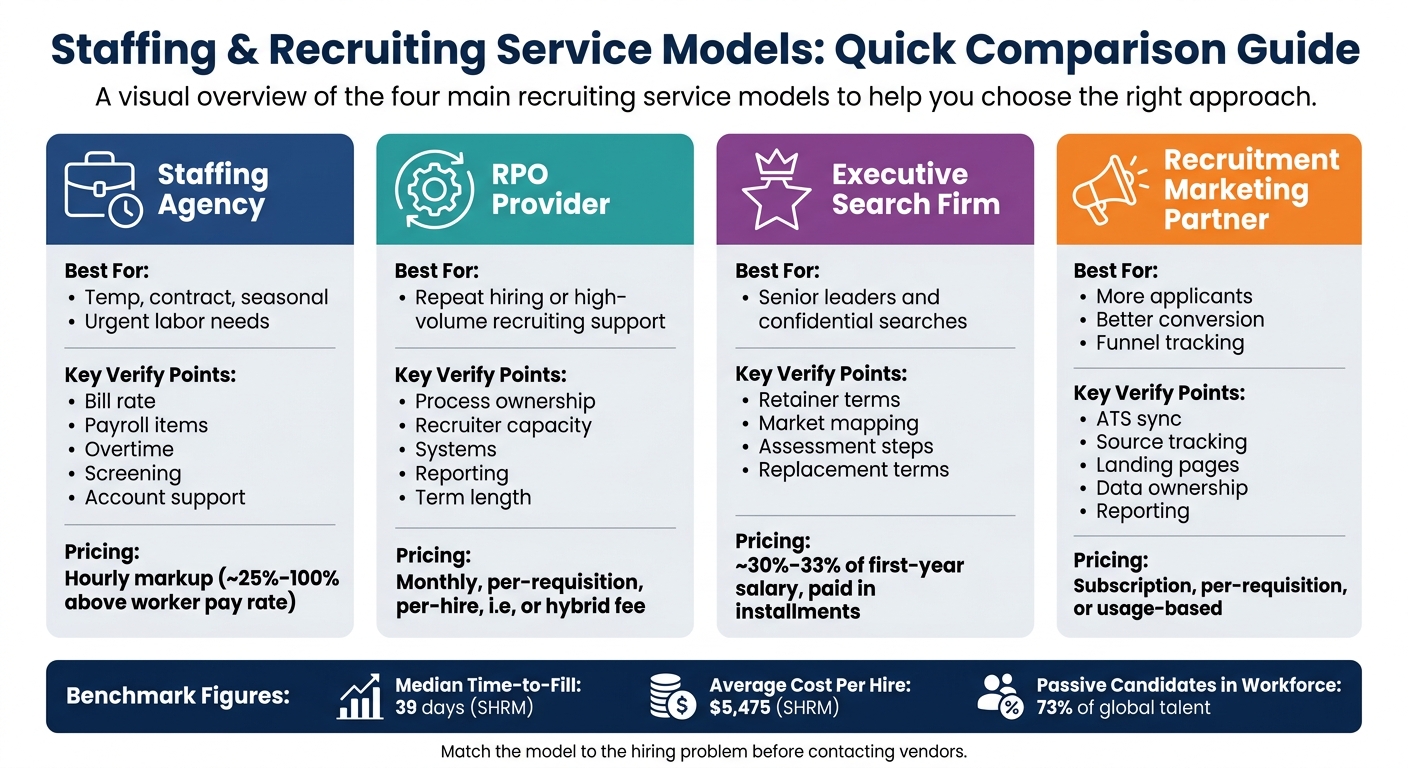
Staffing & Recruiting Service Models: Quick Comparison Guide
Before You Sign That 12-Month Staffing Agency Contract, Ask These 3 Questions!
Quick Comparison of Staffing and Recruiting Services
| Service model | Best for | What I need to verify |
|---|---|---|
| Staffing agency | Temp, contract, seasonal, urgent labor needs | Bill rate, payroll items, overtime, screening, account support |
| RPO provider | Repeat hiring or high-volume recruiting support | Process ownership, recruiter capacity, systems, reporting, term length |
| Executive search firm | Senior leaders and confidential searches | Retainer terms, market mapping, assessment steps, replacement terms |
| Recruitment marketing partner | More applicants, better conversion, funnel tracking | ATS sync, source tracking, landing pages, data ownership, reporting |
My goal is simple: pick the staffing and recruiting services provider most likely to fill the right roles on time, with clear reporting and lower risk. The article lays out the checklist I can use to do that in a consistent way.
1. Define Your Hiring Requirements Before Contacting Vendors
Vendors can only price and staff an engagement well if you give them clear numbers. A vague note like “we’re hiring in volume” leaves too much room for guesswork and makes proposals tough to compare. A structured brief fixes that.
Start with the facts vendors need to quote with confidence.
Document Roles, Hiring Volume, and Deadlines
Begin with a requisition inventory. List every open role, its job family, seniority level, employment type, number of openings, and whether it’s a backfill or a new position. Add the hiring manager, target start date, and business priority for each role. Also split recurring demand from one-time hiring needs so you don’t set up a vendor to underprice the work or promise more than they can deliver.
Geography matters more than many teams expect. Hiring in one local labor market is very different from hiring across several U.S. regions, running a nationwide remote search, or filling roles across time zones with location-based pay or licensing rules. Each setup changes how a vendor plans the work and what they charge. It also helps to track three milestones for every role:
- First qualified slate
- Offer
- Start date
That simple breakdown makes it easier to tell whether delays came from sourcing or from your own interview and approval process. In plain terms, it shows who owns the bottleneck.
Clarify Internal Capacity, Budget, and Systems
Before outsourcing any part of hiring to staffing and recruiting services, map out what your team can actually support. Assign ownership for intake, sourcing, screening, scheduling, interviews, offers, and onboarding. Mark each step as in-house, vendor-led, or shared. If your team can’t keep up with interviews or approvals, buying extra sourcing support won’t solve much.
Budget needs the same level of clarity. Set an approved range before reaching out to vendors. Then decide which pricing model fits your situation:
- Contingency fee
- Retained model
- Flat project fee
- Monthly RPO fee
You’ll also want to document your ATS, HRIS, background check process, scheduling tools, career site setup, and reporting needs at the start. Vendors should confirm whether they can work inside your ATS, keep source-of-applicant data intact, and send reports in the format you use. Those details shape whether a vendor can fit into your hiring process without creating extra friction.
Match Your Needs to the Right Service Model
Use this quick reference before contacting any provider:
| Hiring Problem | Best-Fit Model |
|---|---|
| Many hires quickly, often across locations or shifts | Staffing agency or scalable RPO with local sourcing |
| Recurring demand requiring full process ownership | RPO provider embedded in your systems and brand |
| Hard-to-fill technical, healthcare, or regulated roles | Specialized recruiting firm with domain sourcing depth |
| Confidential senior or executive replacement | Retained executive search with market mapping and assessment |
| Low application conversion, weak funnel visibility, or limited internal capacity | Technology-enabled recruiting partner evaluated on ATS integration, human support, and measurable improvement in qualified applicants or conversion |
Once the brief is clear, you can compare staffing and recruiting services on specialization, screening, and delivery capacity with a lot less guesswork.
2. Verify Specialization, Delivery Capacity, and Candidate Quality
After you’ve confirmed the right service model, the next step is simple: make sure the provider can fill your roles at the quality and volume you need.
Check Role Specialization and Delivery Ownership
A firm that says it recruits “across all industries” isn’t telling you much. That kind of broad claim sounds nice, but it doesn’t show whether the team can handle your hiring needs.
Ask for 3 to 5 recent placements that match your role type, seniority, employment model, geography, and hiring volume. Then go one step further: ask which recruiter handled each search and whether that same person would work on your account.
That part matters more than many teams expect. A provider may show strong past results, but if those results came from a different recruiter than the one assigned to you, the case studies don’t mean much.
Delivery ownership matters just as much as past experience. Ask for a written responsibility matrix that names who handles:
- sourcing
- outreach
- screening
- interview scheduling
- reference checks
- background checks
- offer coordination
- candidate communication
Then ask a practical question: If we open five similar requisitions next month, who sources, screens, and owns day-to-day communication?
You should also reconfirm the handoff points your team keeps, especially around requisition approval, interviews, and final hiring decisions.
Next, check recruiter capacity. Ask how many active requisitions each recruiter is carrying right now. Then ask what happens if hiring volume jumps or if a recruiter leaves. If the provider struggles to answer that clearly, that’s a warning sign.
Review Candidate Screening, Sourcing Breadth, and Brand Alignment
Once you know the team fits the role, look at how it finds and evaluates candidates.
Candidate quality comes from two things: screening rigor and sourcing reach.
Start by defining what “qualified” means before the search begins. Split your criteria into required items and preferred items. Required criteria may include licenses, certifications, work authorization, location, and schedule availability. Preferred qualifications can be weighed later.
Then ask the provider to share a sample scorecard that shows how candidates are judged against each criterion. This helps you avoid a common problem: a vendor sending over lots of candidates who fail basic requirements while still claiming strong delivery numbers.
Sourcing reach matters just as much. Roughly 73% of the global workforce consists of passive candidates [1][2]. So if a provider depends too heavily on job board applicants, it will miss a large part of the market, especially for niche or senior roles.
Ask for a role-specific sourcing plan that covers:
- professional networks
- direct outreach
- referrals
- talent communities
- diversity-focused organizations
- any recruitment marketing capability
Then ask for channel metrics, including outreach volume, response rate, qualified-candidate rate, and offer-acceptance rate by source channel.
Candidate experience also shapes your employer brand. Before any search starts, review sample outreach messages and job ads. Check that recruiter scripts match the actual compensation, schedule, location, and growth path for the role. If those details are overstated or wrong, strong candidates may drop out after interviews. That hurts conversion rates and can also damage your reputation in the market.
Use a Vendor Comparison Table and Red-Flag Checklist
Use the same scorecard for all staffing and recruiting services you review. Score providers on documented evidence, not sales talk.
| Criterion | Key Question | Evidence to Request |
|---|---|---|
| Specialization | Recent placements in comparable roles, locations, and employment types? | Case studies, references, placement data |
| Capacity | Can the assigned team handle your forecasted volume and complexity? | Recruiter workload, backup coverage plan |
| Process ownership | Are sourcing, screening, scheduling, references, and reporting clearly assigned? | Responsibility matrix, service-level commitments |
| Candidate quality | Does the provider use job-related criteria and a consistent scorecard? | Sample scorecards, screening guides, channel metrics |
| Sourcing breadth | Can it reach both active and passive candidates through relevant channels? | Channel plan, source-to-interview metrics |
| Brand alignment | Will outreach and job ads accurately reflect your employer brand? | Sample ads, outreach templates, approval workflow |
| Continuity | Is there a named backup and documented handoff process? | Backup coverage plan, shared documentation policy |
A few red flags should stop the process fast. Watch for vague claims like “broad reach” with no role-specific proof. Be careful with placement statistics that don’t define the time period, job type, or location. Push back if the provider can’t name the actual delivery team after the contract is signed. And if there’s no backup plan for recruiter turnover, that’s another problem.
If a provider can’t clearly explain its screening process, documentation standards, and candidate communication approach, reject it.
Next, compare each provider’s sourcing channels, pricing, and performance metrics.
3. Compare Sourcing Tools, Pricing Models, and Performance Metrics
Assess Sourcing Channels and Recruitment Marketing Capability
Where a vendor finds candidates matters just as much as how many names it sends over. Ask each provider for a written sourcing plan for your roles. It should spell out the target candidate profile, expected volume, outreach sequence, response-time standard, follow-up process, and who owns each step. That plan should also cover the full mix of channels: direct outreach, referrals, job boards, professional and social channels, events, talent communities, alumni networks, and any candidate database the vendor plans to use.
Big channel numbers can look nice on a slide deck, but they don’t tell the full story. Ask for channel-level data on qualified applicants, interviews, offers, hires, cost per qualified applicant, and source-to-application conversion. If a vendor can’t break results down by channel, you’re not looking at proof. You’re looking at claims.
Recruitment marketing needs its own review. Ask whether the provider can build mobile-friendly recruitment landing pages and short application forms, add knockout questions, and support multilingual or accessible applications. Then go one step further: can it track the funnel from impression to hire? A solid demo should show source tracking, automated follow-up, funnel reporting, and ATS integration. You should also ask whether recruiters can spot abandoned applications, re-engage those candidates, and pass source, consent, status, and disposition data into the ATS without duplicates.
Before you sign anything, get clear on data ownership. Who keeps candidate records, consent data, communication history, and campaign assets when the work ends? Require a usable export of candidate profiles, source data, screening results, and disposition reasons, and make sure those ownership and export terms are written into the contract.
Once you know how each channel performs, you can compare what it costs to get those results.
Compare Fee Structures and Total Cost
Look at the all-in cost, not just the headline fee. That means vendor fees, advertising, assessments, background checks, implementation, internal admin time, and replacement costs. Ask each provider to state exactly what its pricing is based on: base salary, total compensation, hours worked, billed hours, accepted offers, or start dates.
Use the same hypothetical scenario for every vendor. That’s the only fair way to compare total cost side by side.
| Service Model | Typical Pricing Structure | Key Items to Verify |
|---|---|---|
| Temporary staffing | Worker pay rate plus hourly markup, with published market examples commonly ranging from roughly 25%–100% depending on role and assignment scope | Pay rate, bill rate, overtime, holiday pay, payroll taxes, workers’ compensation, insurance, minimum hours, assignment length, markup changes |
| Temp-to-hire | Hourly markup during the assignment plus a possible conversion fee | Conversion schedule, credit for hours already billed, conversion deadline, minimum hours, whether the fee is based on salary or a fixed amount |
| Contingency direct hire | One-time fee commonly reported around 15%–30% of first-year salary | Salary base, invoice date, replacement guarantee, duplicate-candidate rules, exclusivity, refunds, payment terms |
| Retained executive search | Often around 30%–33% of first-year salary, paid in installments | Retainer schedule, research deliverables, exclusivity, milestones, replacement terms, travel, and expenses |
| RPO | Monthly, per-requisition, per-hire, hourly, or hybrid fee | Recruiter capacity, technology licenses, implementation, reporting, service levels, minimum term, termination rights, transition support |
| Recruitment-marketing technology | Subscription, implementation fee, usage-based fee, per-requisition fee, or hybrid pricing | Landing pages, forms, analytics, integrations, AI features, advertising spend, data export, support, user limits, renewal increases |
Also ask when payment is due. Is it at offer acceptance, start date, first invoice, or only after a guarantee period? And what happens if a hire leaves, gets laid off, or is terminated for cause? Those details can swing cost more than people expect.
Once pricing is on the table, lock down how success will be measured before any work begins.
Agree on Performance Metrics Before Signing
Staffing and recruiting services need written metric definitions. Before the contract is signed, document every KPI in writing: the formula, start point, end point, data owner, reporting cadence, target, and what happens if the target is missed.
Use 39 calendar days as a benchmark, but define exactly where the clock starts and where it stops. If you skip that step, two teams can report the same metric and mean two very different things.
The main metrics to lock in before day one are time to present, time to fill, time to hire, submission-to-interview ratio, offer acceptance rate, early attrition at 30/60/90 days, retention at 6 and 12 months, source-to-apply conversion rate, and, when possible, quality of hire. For each one, spell out whether the vendor or your team owns the data, which system is the source of truth, whether calendar or business days apply, and how duplicates and reopened requisitions are treated.
Require a shared dashboard or a standard report on a cadence that fits your hiring volume:
- Weekly for active high-volume recruiting
- Biweekly for smaller searches
- Monthly for review at the program level
Set escalation thresholds and corrective actions in the agreement so weak results trigger a clear response instead of a fuzzy conversation. Ask for a sample report that follows one hire from source impression through application, screening, interview, offer, start, and retention outcome.
Use that same report template before you review AI use, data handling, and contract terms. Next, check how AI, data protection, and contract language shape the tools and reporting you just reviewed.
4. Review AI Use, Compliance, Contracts, and the Final Decision Worksheet
After pricing and performance, look at the provider’s automation, compliance controls, and contract terms. This is where you find out whether the service can support hiring without piling on extra risk.
Confirm AI Use, Human Oversight, and Data Protection
Ask the provider to document every automated function in writing. That includes sourcing, parsing, ranking, scheduling, messaging, screening, content generation, personalization, chatbot workflows, and campaign optimization. The goal is simple: protect candidate experience, hiring speed, and brand consistency.
For each function, ask for:
- its purpose
- inputs and outputs
- decision owner
- model source
- deployment date
- affected candidate groups
Also ask for sample profiles, rankings, messages, and screening results. Your team needs to see how the system behaves in practice, not just how it’s described in a sales call.
Any AI-generated recommendation should stay under human control before it changes a candidate’s status. That means your contract should give you review, override, pause, and correction rights. You should also require audit logs for every AI action, including the input, output, reviewer, override, timestamp, and result.
Then pressure-test the system with edge cases. Use examples like career gaps, nontraditional credentials, accommodation requests, veterans, and varied names or schools. You want proof that a human reviewer can catch and fix bad outcomes before they affect a candidate.
Ask for the vendor’s written bias-testing method, validation evidence, remediation process, testing schedule, and adverse-impact monitoring approach. Treat claims like “bias-free” or “compliant by design” as unsupported unless the vendor can back them up with testing, validation, and continued monitoring. The U.S. Department of Justice, EEOC, CFPB, and FTC have jointly emphasized that automated systems are not an excuse for unlawful discrimination or other legal violations.[5] The EEOC has also noted that AI can create disability-related risks even when a tool was never designed to evaluate disability – for example, a system that scores an applicant poorly because of speech patterns associated with a disability.[6] Outsourcing the process does not transfer the employer’s legal responsibility.
You should also confirm whether candidates are told when AI is being used, whether consent is needed for recordings, assessments, biometric information, or text analysis, and how candidates can request accommodation or human review.
On data protection, the contract should bar the provider from using applicant data to train general-purpose models without your written approval. Data use should be limited to the contracted service. At termination, you should receive a complete, usable export of candidate records, consent logs, screening results, and audit history. Ask for a current list of all subprocessors too, including their locations, access levels, and the process for notifying you when that list changes.
Check Compliance, Security, and Contract Terms
Before signing with any staffing and recruiting services provider, assign each U.S. compliance duty in a written matrix. This is not paperwork for the back office. It’s part of the buying decision. If a duty is fuzzy, risk goes up.
The matrix should cover EEO and nondiscrimination duties, Title VII disparate-impact monitoring, ADA accommodation intake, and alternative assessment procedures. It should also cover accessibility for career pages, application forms, chatbots, assessments, interview scheduling, and candidate communications. Add FCRA background-check requirements too, including authorization, disclosure, pre-adverse-action notices, and post-adverse-action notices.[3][4] Then add pay transparency, record retention, and any state or local automated-decision rules.
For security, ask for current assurance evidence, penetration-test results, encryption standards, role-based access controls, MFA, and incident-response terms. The contract should spell out the breach-notice deadline, what the notice must include, cooperation duties, forensic access, remediation duties, and who pays investigation and notification costs.
Also confirm termination rights, the auto-renewal notice window, transition help, deletion certification, and a usable data export at termination. And watch vague candidate-ownership language closely. That kind of wording can turn into a mess later.
Conclusion: Score Every Provider Against the Same Worksheet
Use one worksheet for every staffing and recruiting services finalist before making a choice. Every score should point to evidence from the proposal, demo, references, pilot, or contract review. That keeps the process grounded in proof instead of gut feel.
A practical 100-point model can split weight across twelve categories:
| Category | Points |
|---|---|
| Service-model fit | 10 |
| Role specialization and delivery ownership | 10 |
| Candidate quality and screening | 12 |
| Sourcing breadth and recruitment marketing | 10 |
| Speed and capacity | 8 |
| Employer-brand alignment | 8 |
| Reporting and metric transparency | 8 |
| AI controls and human oversight | 10 |
| Compliance, accessibility, and security | 12 |
| Total cost | 6 |
| Contract flexibility and risk allocation | 4 |
| Internal effort required | 2 |
Score each category from 1 to 5, apply the weight, and record the evidence, assumptions, owner, and confidence level behind each score. Treat security, compliance, accessibility, and data protection as separate pass/fail checks. A strong commercial pitch should not cancel out a failure in those areas.
If there’s an open issue tied to discrimination risk, inaccessible candidate experiences, unauthorized data use, missing background-check controls, or weak incident response, treat it as a procurement problem that needs documented legal, security, or executive approval before signature.
FAQs
How do I choose the right recruiting model?
Start by looking at five things: your business size, hiring volume, role urgency, internal bandwidth, and budget.
The goal is simple: pick the leanest hiring model that fixes the problem you have right now. Then add more support as hiring demand grows.
Here’s the quick breakdown:
- Staffing agencies: best for urgent, temporary, or hard-to-fill roles
- Freelance recruiters: a good fit for flexible, project-based, or niche searches
- RPO: works well for steady, high-volume hiring
- In-house recruiters: best when you want more control, repeat hiring, and stronger employer branding
- AI tools: help automate early-stage sourcing and screening
Think of it like building a team in stages. You don’t need the biggest setup on day one. You need the one that matches your current hiring pressure without adding extra cost or complexity.
What hidden costs should I compare?
Look past the base subscription or service fee. The sticker price is often just the starting point.
Hidden costs can show up in a few places:
- One-time setup and implementation
- Data migration
- Team training
- Premium support
- Add-ons, customization, and integrations
It also helps to think about total cost of ownership, not just the monthly or annual bill. That includes retraining over time and the cost of a fragmented tool stack. When teams juggle too many disconnected tools, small inefficiencies can add up and eat into margins.
What AI and data risks should I check?
Prioritize transparency and fairness. Ask how the vendor’s AI is trained and tested for bias across demographic groups. Also ask whether it supports human review of automated decisions and gives admins the option to turn AI features on or off.
You should also confirm compliance with laws such as NYC’s AEDT law and the EU AI Act. And don’t just take match scores at face value. Test them against your actual roles to see how they hold up in practice.