




What Does a Talent Acquisition Manager Do?
A Talent Acquisition Manager runs the hiring process from planning to accepted offer. I’d sum it up like this: this person helps decide who to hire first, how to find them, how to move them through interviews, and how to keep hiring teams on track.
If you want the short answer, here it is:
- I see this role as the link between business hiring plans and actual hires
- The job covers workforce planning, sourcing, interview process control, offers, and handoff before onboarding
- Success is often measured by time-to-fill, cost per hire, offer acceptance rate, and quality of hire
- In smaller companies, the role may do both planning and hands-on recruiting
- In larger companies, the role often leads recruiters, tracks funnel data, and helps teams hit hiring goals
A few numbers show why this role matters:
- Average time to hire moved from 33 days in 2021 to 41 days in 2024
- Average cost per hire is about $4,700
- 56% of recruiters say social media brings their best candidates, compared with 37% from job boards
- Poor mobile applications can lead to a 20% drop-off rate
Here’s the plain-English version: a Talent Acquisition Manager does not just fill jobs. I’d say they build the hiring system, keep people aligned, track what is slowing things down, and help the company make better hires with less chaos.
One more thing: this role is not the same as a recruiter or an HR manager. A recruiter works on open roles and candidates day to day. An HR manager handles the employee side after hire, like policy, payroll support, and employee issues. The Talent Acquisition Manager owns the hiring process itself.
Talent Acquisition Explained [2025]
Quick comparison
| Role | Main focus | Typical work | Main goal |
|---|---|---|---|
| Talent Acquisition Manager | Hiring process and team direction | Hiring plans, sourcing approach, recruitment funnel tracking, offers, recruiter support | Better hiring results |
| Recruiter | Filling open roles | Sourcing, screening, interviews, candidate communication | Move candidates through the pipeline |
| HR Manager | Employee support after hire | Policy, compliance, employee relations, payroll support | Support employees and HR processes |
If you’re trying to understand the role in one sentence, I’d put it this way: a Talent Acquisition Manager makes sure hiring is planned, measured, and moved forward from start to finish.
Core Responsibilities Across the Hiring Lifecycle
Here’s how that work plays out across the hiring lifecycle. The plan doesn’t stay on paper for long. It turns into day-to-day work across planning, sourcing, interviews, and handoff.
Workforce Planning, Requisition Intake, and Hiring Priorities
The manager starts by reviewing approved headcount, growth goals, budget, location, and required skills with department leaders and HR or finance partners. From there, they build a recruiting plan that ranks roles by business impact, urgency, and how hard those roles are to fill. A revenue-producing sales role or a tough cybersecurity opening will usually move ahead of a lower-priority backfill.
Once a role gets approved, the manager runs a structured intake meeting with the hiring manager. The goal is simple: lock down salary, reporting structure, location, core qualifications, interviewers, and start date. They also trim requirements that shrink the candidate pool for no good reason, separating must-haves from nice-to-haves. That step cuts rework and helps the team bring in stronger candidates. The result is a hiring brief with the job profile, evaluation criteria, sourcing plan, and communication cadence.
Timelines come from stage-by-stage planning and past time-to-hire data by job family. One cited benchmark shows average time to hire climbed from 33 days in 2021 to 41 days in 2024, a 24% increase [7]. That kind of slippage is exactly why the manager sets service-level expectations early and keeps close watch on feedback deadlines.
Sourcing, Screening, Interviews, and Offer Coordination
Once the role is clear, the work shifts to sourcing and moving candidates through the funnel. Channel choice should fit the role, not run on autopilot. For a specialized engineering role, the manager may pair direct outreach through LinkedIn Recruiter with professional community engagement and employee referrals. For a high-volume customer service role, the focus may move to local advertising and referral campaigns. Good applicants matter more than a big pile of applications.
The manager watches conversion from identified to offer and steps in when candidates start dropping out. Those numbers show where hiring gets stuck and where candidate quality starts to slip. A weak pipeline may mean the job message needs work, a new sourcing channel is needed, or the team should revisit nonessential requirements. During interviews, the manager makes sure each candidate is judged against the same job-related criteria with structured scorecards. When the team picks a finalist, the manager pulls together the recruiter, hiring manager, compensation partner, and HR business partner so the process keeps moving. Same-day verbal offers, followed by digital offer letters, can help cut candidate drop-off.
Pre-Onboarding Handoff and Candidate Experience
The work doesn’t stop once the offer is accepted. This is the stretch where the manager keeps momentum going before day one. Candidates can cool off between signing and starting, so the manager keeps communication steady and checks in early if anything changes with availability.
The handoff to HR or the onboarding team needs to be clean and complete. That includes:
- Signed offer
- Confirmed start date
- Requisition details
- Required background checks
- Accommodations
- Any commitments made during recruiting
It also needs to be clear who owns candidate communication after acceptance, so no one gets left in limbo. Candidate experience comes down to timely scheduling, clear expectations, and respectful communication.
Employer Branding, Recruitment Marketing, and Pipeline Management
Talent acquisition also covers employer branding, recruitment marketing, and pipeline management. This work starts before sourcing. It begins with the messages and campaigns that influence who decides to apply. A talent acquisition manager uses an employer value proposition (EVP), career site copy, and social posts and ads to shape how candidates see the company. That ties brand work directly to candidate quality, pipeline volume, and time-to-fill [1].
Employer Brand and Job Messaging
A clear EVP gives candidates a specific reason to pick one employer over another. Then that EVP shows up in career-site copy, job descriptions, and social posts and ads, so each candidate touchpoint says the same thing.
To reach passive candidates – who make up 73% of the global workforce – managers lean on referrals, LinkedIn outreach, talent community events, and targeted social campaigns [1].
Recruitment Campaigns and Application Journey Conversion
Once the message is in place, the next step is distribution and conversion. Social recruiting is a major channel: 56% of recruiters say they find their best candidates there, versus 37% on job boards [1]. So job promotion can’t be treated like a simple post. It has to run like a campaign.
The application journey also needs to be easy to finish. If it feels clunky, people leave. Poor mobile forms can cause a 20% drop-off rate, which is why branded, mobile-first landing pages and smart forms matter if you want candidates to stay engaged [6]. Tools like HireLab.io help recruiters build high-converting job pages and smart forms. In 2025, Zalando used a 3-click mobile-first funnel for warehouse roles that asked only for a phone number and availability. That led to a 3.5x higher application conversion rate and cut time to hire by 9 days [2].
Once campaigns bring candidates in, the manager uses CRM data to keep qualified talent warm.
Talent Pools, CRM Segmentation, and Pipeline Quality
A CRM builds the pipeline, while an ATS moves active candidates through it. A recruitment CRM tracks passive leads, past applicants, referrals, and alumni. The ATS handles active applicants [5][6]. Talent acquisition managers segment these pools by skill set, seniority, location, and hiring readiness, so recruiters don’t have to start from scratch every time a role opens [5].
One of the best segments is made up of strong finalists who weren’t selected. These are people from past searches who matched the role well but didn’t get the offer. Managers can re-engage them with automated email and SMS sequences. That approach helped Siemens cut average time to hire by 10–14 days and fill 20% of roles from existing talent pools [2].
Good pipeline management also means using stage-level data to catch bottlenecks early and tracking which channels bring in qualified candidates, not just clicks [5][6]. In fact, 46% of sourced hires in 2026 came from candidates already stored in a company’s database. And each extra week in the hiring process can add 10%–15% to cost-per-hire while reducing offer acceptance likelihood by 16% [5][6][1].
These tools and segments feed the metrics used to judge hiring performance.
Tools, Metrics, and How Success Is Measured
Common Tools Used in Daily Work
Once the pipeline is in place, the manager needs systems that show where candidates move forward, where they get stuck, and where they leave the process.
A talent acquisition manager usually works from a small set of tools to run hiring from pipeline to offer. The ATS tracks active applicants and handles compliance. The CRM helps nurture passive talent over time. LinkedIn Recruiter supports direct outreach to passive candidates and sourcing for hard-to-fill roles. Scheduling tools like Calendly or GoodTime cut down on interview back-and-forth, trimming an average of 3 to 5 days from the hiring cycle [4]. Conversion tools show where candidates drop out of the application flow [1][6]. Analytics dashboards, often built into the ATS or CRM, show funnel health, source quality, and hiring speed in real time [6].
Managers use that data to adjust sourcing, interview pace, and offer timing.
These systems also produce the numbers used to judge hiring speed, cost, and candidate quality. An ATS can cut administrative time by 30% to 40% [1][3]. AI-powered screening tools can reduce manual resume review time by 70% to 80% and cut time-to-hire by up to 35% [1].
Key Hiring Metrics and What They Reveal
Talent acquisition metrics are diagnostic signals, not just reports. They help managers spot what’s working and what’s slowing the team down.
Time-to-fill shows how long a role stays open and what that gap may cost the business. Time-to-hire looks more closely at internal process speed. Cost per hire shows how much the company spends to bring in one employee. The average cost per hire is about $4,700, while executive-level hires in the U.S. can go beyond $14,000 [1][3].
The table below maps each core metric to the management question it answers:
| Metric | What It Reveals |
|---|---|
| Time-to-Fill | Role open time |
| Time-to-Hire | Internal process speed |
| Cost per Hire | Recruitment spend efficiency |
| Source of Hire | Which channels produce the best candidates |
| Application Conversion Rate | Where candidates drop out of the application flow |
| Interview-to-Offer Rate | Whether sourcing is delivering the right candidate quality |
| Offer Acceptance Rate | Whether compensation and experience are competitive |
| Quality of Hire | Whether new hires perform well and stay long-term |
| Hiring-Plan Completion | Whether headcount goals are being met |
Taken together, these metrics show whether hiring is moving fast enough, using budget well, and bringing in people who are likely to do well over time.
Quality of hire is often seen as the most important metric in talent acquisition, but it’s also the hardest to pin down. It usually combines performance, retention, and hiring-manager feedback. 89% of talent acquisition professionals agree that tracking it is becoming more critical [8].
Talent Acquisition Manager vs. Recruiter vs. HR Manager
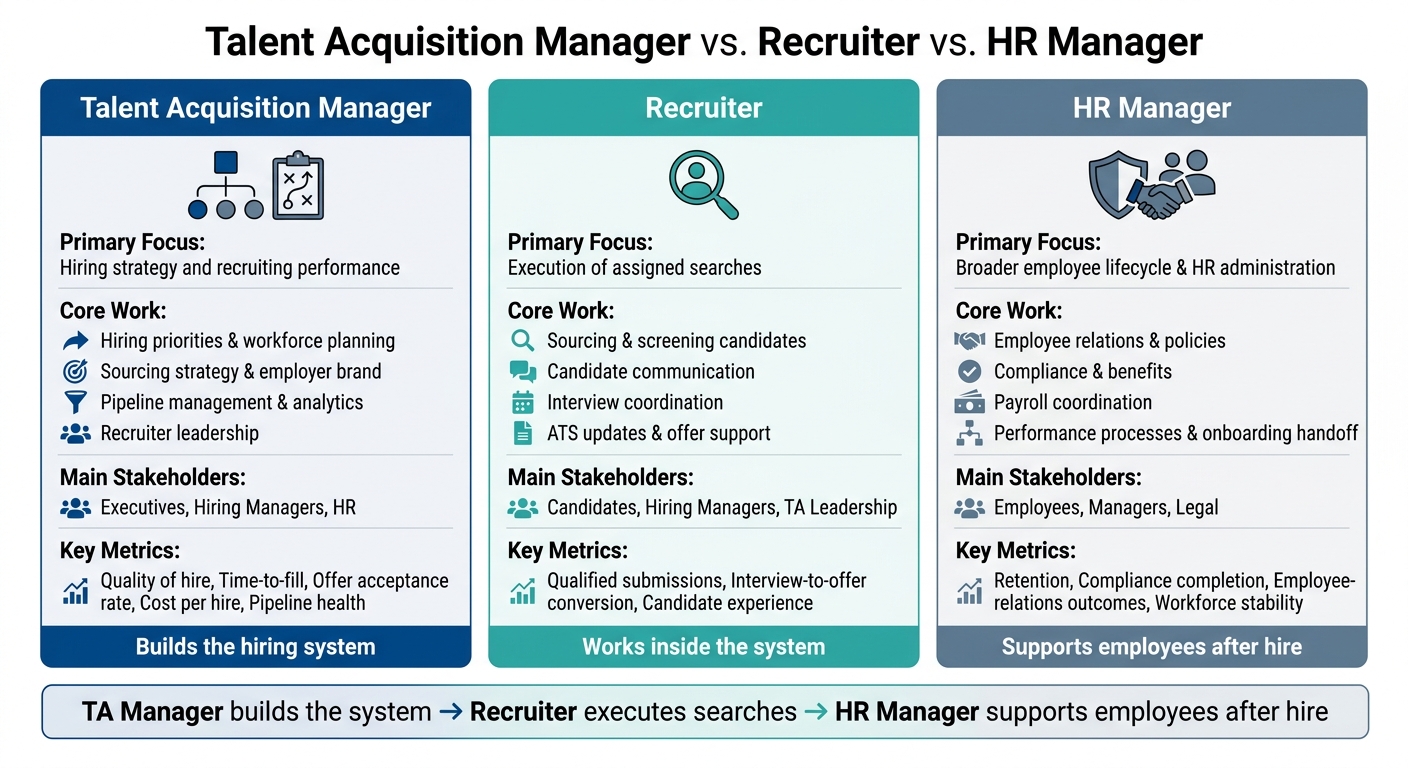
Talent Acquisition Manager vs. Recruiter vs. HR Manager: Role Comparison
How These Roles Differ in Focus and Accountability
This distinction matters because hiring speed and hiring quality both depend on clear ownership. At smaller companies, these roles can blur together. But in many teams, each one owns a different part of hiring and employment.
A Talent Acquisition Manager owns the hiring strategy and the process behind it. Recruiters and talent acquisition specialists handle individual searches. HR Managers oversee the broader employee lifecycle, including policy, employee relations, compliance, payroll, and performance.
Put simply: the TA Manager builds the system, the recruiter works inside that system, and the HR Manager handles what comes after the hire. The TA Manager is responsible for how well the hiring system works. The recruiter is responsible for moving candidates through it. The HR Manager is responsible for the employee experience after someone joins the company. When ownership is clear, teams deal with fewer delays, less confusion, and a better candidate experience.
The U.S. Bureau of Labor Statistics makes a similar distinction: recruiting managers oversee hiring strategy, while HR managers handle broader HR operations, including employee relations, compliance, payroll, training, and benefits. [9]
That line usually gets clearer as a company grows.
When One Person Covers Multiple Functions
At smaller companies and startups, one person often handles all three functions. This happens most often when speed matters more than specialization. Someone might source candidates in the morning, prepare offers in the afternoon, and answer benefits questions before the day ends. In that kind of setup, the title matters less than the actual scope of the work.
As organizations grow, these functions often split into separate roles. Larger U.S. employers may have dedicated TA leaders, recruiters, recruiting coordinators, HR business partners, and employee relations teams. The split usually depends on hiring volume, geographic spread, technical complexity, compliance needs, and budget, not on any fixed rule. That overlap is why the same title can mean very different day-to-day work from one company to the next.
Conclusion: How This Role Shapes Hiring Outcomes
Talent Acquisition Managers set hiring strategy, manage sourcing channels, align stakeholders, track pipeline health, and use data to improve decisions over time. Recruiters do the candidate-facing work. HR Managers support policy, compliance, and the employee experience after hire.
In practice, the boundaries often look like this:
| Role | Primary Focus | Core Work | Main Stakeholders | Common Measures |
|---|---|---|---|---|
| Talent Acquisition Manager | Hiring strategy and recruiting performance | Hiring priorities, sourcing strategy, employer brand, pipeline management, recruiter leadership, analytics | Executives, hiring managers, HR | Quality of hire, time to fill, offer acceptance rate, cost per hire, pipeline health |
| Recruiter | Execution of assigned searches | Sourcing, screening, candidate communication, interview coordination, offer support, ATS updates | Candidates, hiring managers, TA leadership | Qualified submissions, requisition progress, interview-to-offer conversion, candidate experience |
| HR Manager | Broader employee lifecycle and HR administration | Employee relations, policies, compliance, benefits, payroll coordination, performance processes, onboarding handoff | Employees, managers, legal | Retention, compliance completion, employee-relations outcomes, workforce stability |
These categories can shift based on company structure. Still, the core difference stays the same: the TA Manager leads the company’s approach to finding and hiring talent, the recruiter handles candidate-facing execution, and the HR Manager oversees the broader employment experience. That kind of clarity helps hiring move faster, brings in stronger candidates, and supports more consistent results over time.
FAQs
When should a company hire a Talent Acquisition Manager?
A company should hire a Talent Acquisition Manager when it’s time to move beyond reactive recruiting and start building a longer-term hiring plan.
This role matters when the business needs stronger headcount planning, a clearer employer brand, better relationships with passive candidates, and a more consistent, efficient hiring process from start to finish.
What skills make a strong Talent Acquisition Manager?
A strong Talent Acquisition Manager needs to balance big-picture planning with day-to-day discipline. That means thinking in systems, using data to guide decisions, and keeping hiring managers and recruiters on the same page.
They also need to be comfortable with tools like ATS, CRM, and analytics dashboards. Those tools help them track pipelines, spot issues, and measure performance. Just as important, they need change management skills so everyone knows who owns what at each stage of the hiring lifecycle.
How does a Talent Acquisition Manager improve candidate quality?
A Talent Acquisition Manager improves candidate quality by building a hiring process that’s structured and driven by data. That starts with clear job requirements and standard interview scorecards, so each candidate is judged the same way and bias has less room to creep in.
They also use AI-powered resume screening and predictive analytics to spot stronger matches earlier in the process. At the same time, they manage employer branding and nurture passive talent pools in a CRM, which helps keep the pipeline full of qualified candidates who fit the company’s culture.


