
Remote Talent Acquisition: What Changes and What Doesn’t
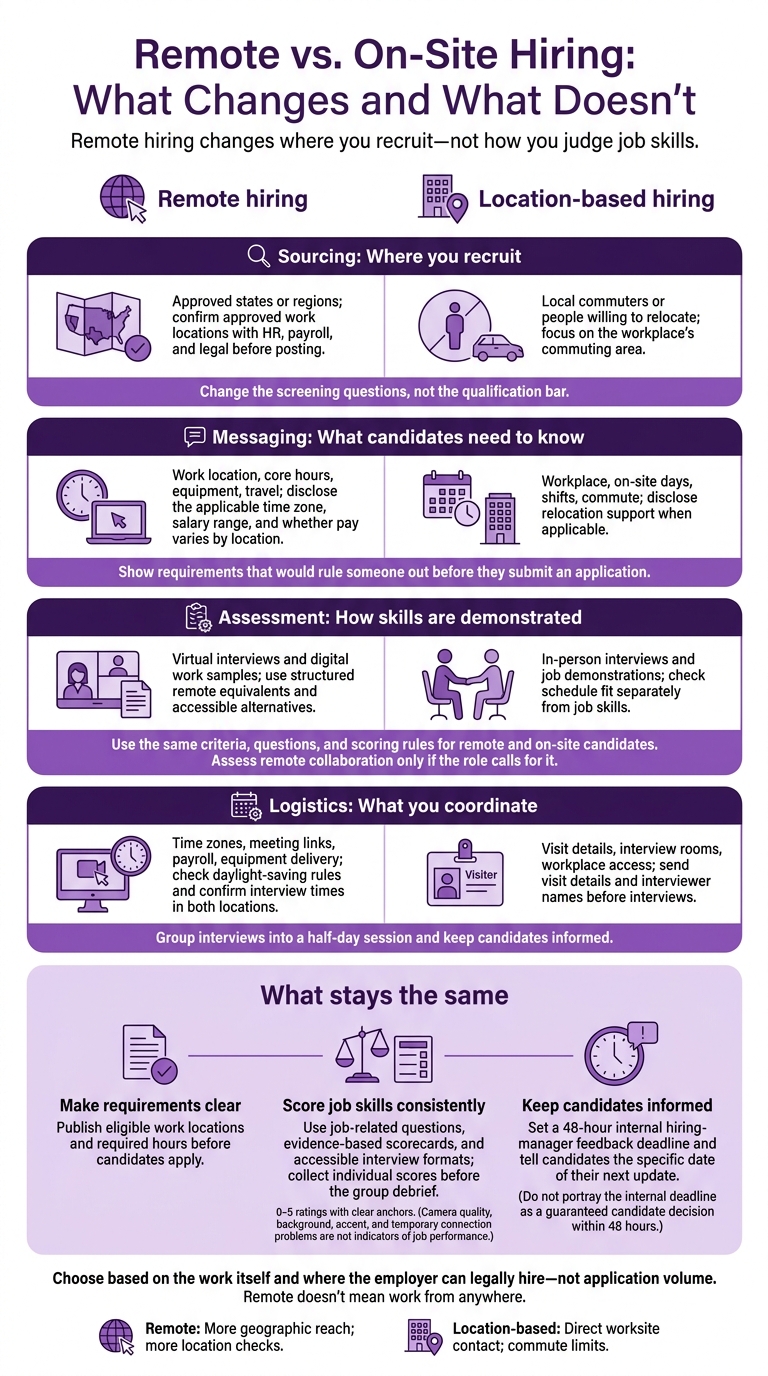
Remote talent acquisition changes where you recruit – not how you judge job skills. My starting point: publish eligible work locations and required hours before candidates apply, use the same scoring rules, and set a 48-hour feedback deadline.
Below, I compare remote talent acquisition and location-based hiring across four areas:
- Sourcing: Search approved regions for remote roles; focus on commuting distance for on-site roles.
- Messaging: Explain location, hours, pay, and travel upfront.
- Assessment: Use job-related questions and scorecards, with accessible interview formats.
- Logistics: Plan remote interviews around time zones and equipment needs; plan on-site interviews around travel and workplace access.
Remote doesn’t mean work from anywhere. I’d choose the model based on the work itself and where the employer can legally hire – not application volume.
Quick Comparison
| Area | Remote hiring | Location-based hiring |
|---|---|---|
| Candidate reach | Approved states or regions | Local commuters or people willing to relocate |
| Requirements to disclose | Work location, core hours, equipment, travel | Workplace, on-site days, shifts, commute |
| Assessment | Virtual interviews and digital work samples | In-person interviews and job demonstrations |
| Coordination | Time zones, meeting links, payroll, equipment delivery | Visit details, interview rooms, workplace access |
| Main tradeoff | More geographic reach; more location checks | Direct worksite contact; commute limits |
For either model, my rule is simple: make requirements clear, score job skills consistently, and keep candidates informed.
Remote vs. On-Site Hiring: What Changes and What Doesn’t
1. Remote Talent Acquisition
Sourcing Reach
For remote talent acquisition, source candidates across eligible regions and use social outreach alongside job postings. 56% of recruiters report finding their best candidates through social media, compared with 37% through job boards [2]. However, reaching more people works best when you define the role clearly and target your outreach – not just collect more applications.
Employer Messaging
Clear messaging is central to remote talent acquisition: spell out remote policies, eligible locations, time-zone expectations, and travel requirements in the job post and early candidate communications [3]. Use those requirements to guide screening.
Candidate Assessment
As the candidate pool grows, keep screening tied to the same job criteria. Assess written communication, digital fluency, and self-management when the role calls for them. Use structured, skills-based tasks and document evidence against the role’s criteria. When relevant, how candidates schedule appointments and meet deadlines can also signal self-management and digital fluency [3].
Interview and Hiring Logistics
Give candidates self-scheduling links and keep their records and interview feedback in one system [1][3]. Set a 48-hour hiring-manager feedback deadline to keep decisions moving [2][3]. Group virtual interviews into a half-day block rather than spreading rounds across weeks [3].
2. Location-Based Hiring
Location-based hiring focuses on candidates who can commute to the workplace and work on site.
Sourcing Reach
Build a local talent pool through past applicants and employee referrals. For high-volume retail or warehouse roles, offer one- or two-click mobile applications that collect location and availability without requiring a resume [3].
Employer Messaging
For on-site roles, location and schedule determine eligibility – they aren’t preferences. Before candidates apply, spell out the workplace location, required on-site days, shift hours, relocation support, and commute expectations. Collect location and availability within the first one or two clicks [3].
Candidate Assessment
Use in-person demonstrations and the same scorecard for every candidate, then check schedule fit separately [1][3]. In short, keep job-related standards unchanged, and score job skills separately from schedule fit.
Interview and Hiring Logistics
Send candidates visit details and interviewer names before their on-site interview [3]. Group all on-site interviews into one half-day session to keep the process moving and reduce candidate drop-off [3]. Once you make a decision, give a verbal offer that day and begin onboarding immediately after acceptance [3].
Sourcing and Messaging: Define Reach and Requirements
Sourcing changes how far your search reaches – not which qualifications matter. In remote talent acquisition, openings can attract candidates beyond commuting distance, but “remote” does not mean “work from anywhere.” Before posting, confirm approved work locations with HR, payroll, and legal teams. Settle employment limits first. Otherwise, advertising in a state where you cannot employ someone leads to avoidable rejection later. Keep job-related requirements the same across channels, even when the audience or ad format changes.
| Sourcing factor | Location-based hiring | Remote hiring |
|---|---|---|
| Geographic reach | Focuses on the workplace’s commuting area. | Reaches explicitly approved states or regions. |
| Eligibility | Requires access to the worksite and appropriate work authorization. | Requires an approved work location and appropriate work authorization. |
| Travel | Usually involves a regular commute. | Must disclose required in-person meetings or retreats. |
| Application questions | Confirm workplace and schedule fit. | Confirm approved-state eligibility and core-hour availability. |
| Employment constraints | Generally depend on the worksite’s jurisdiction. | Require review of obligations where employees actually work. |
Change the screening questions, not the qualification bar. At this stage, collect only what you need to confirm eligibility. For remote applicants, that usually means checking their work location and availability during required hours. Show requirements that would rule someone out before they submit an application.
Track qualified-applicant share, application completion, and eligibility-related drop-off to see whether requirements or their wording need adjustment. Compare these rates by channel. Application volume alone won’t tell you whether sourcing is working.
In remote talent acquisition, employer messaging should spell out how the job works. Keep the employer value proposition consistent, but give remote candidates a clear picture of daily work. Replace office-centered language with specific working arrangements. Wherever location limits apply, publish the approved-state list.
For example, a remote posting might specify work within approved U.S. states, core hours of 10:00 AM–2:00 PM Eastern Time, and a transparent salary range of $90,000–$110,000 annually.
| Messaging area | Office assumption to avoid | Explicit remote disclosure |
|---|---|---|
| Hours | Everyone follows the office’s local schedule. | Required overlap hours and the applicable time zone. |
| Communication | Colleagues can ask questions in person. | Communication tools, asynchronous practices, and response expectations. |
| Equipment | A workstation is ready at the office. | What equipment is supplied and how delivery works. |
| Accommodations | Accessibility means physical office access. | How to request accommodations and access digital support. |
| Compensation | Candidates understand the local pay policy. | Salary range and whether pay varies by location. |
Use HireLab.io’s AI-powered recruitment landing pages, customizable branding, and mobile-first design to make these details easy to find. Smart forms and the recruitment funnel builder can bring required screening questions into the application process. The campaign builder and social recruitment capabilities can share the same requirements across channels.
These tools support communication; they don’t replace accurate criteria or human review. Check generated copy to make sure it preserves every location, hours, travel, and compensation condition.
Review application completion, eligibility-related drop-off, clarification questions, and qualified-applicant share weekly. For example, repeated questions about approved states usually suggest unclear copy. Exits at eligibility questions may mean applicants didn’t see the restrictions soon enough. Fix the presentation first, then decide whether a requirement needs review – without quietly lowering standards for one channel.
Assessment and Hiring Logistics: Keep Standards Consistent
Use the same criteria, questions, and scoring rules for remote and on-site candidates. Assess remote collaboration only if the role calls for it. Camera quality, background, accent, and temporary connection problems don’t tell you how well someone can do the job. Give candidates a clear way to request reasonable accommodations.
| In-person method | Structured remote equivalent | Scoring and accessibility safeguards |
|---|---|---|
| Face-to-face interview | Ask the same behavioral questions about relevant tasks and decisions. | Keep prompts consistent and offer an accessible format when needed. |
| Portfolio or work-sample review | Review a digital sample using a defined task and rubric. | Supply clear instructions and accessible files. |
| Whiteboard or technical exercise | Use a shared document, coding environment, or submitted exercise. | Test job skills, not familiarity with the tool; offer an accessible alternative. |
| Interviewer notes and group debrief | Complete individual scorecards before discussing candidates. | Use 0–5 ratings with clear anchors, record supporting evidence, and distinguish missing evidence from poor performance. |
Calibrate the rubric before interviews begin. Define each rating so “strong communication” doesn’t turn into a preference for presentation style. Keep task scope and preparation requirements the same, while adjusting delivery for accommodations.
Have interviewers submit their scores before seeing colleagues’ judgments, then discuss disagreements. Track scorecard completion before debriefs, agreement on each criterion, and candidate feedback on instructions and accessibility. Repeated scoring gaps may point to unclear criteria, inconsistent questions, or interviewer training needs – not weaker candidates. [3][4]
Consistent scoring is one part of remote talent acquisition. The other is coordinating interviews, access, and handoffs across locations.
In remote talent acquisition, hiring logistics move from one worksite to many locations. You still need clear ownership, accurate documents, and prompt communication. Collect each participant’s time zone early, check daylight-saving rules for the interview date, and confirm the interview time in both locations. Offer interview windows within candidates’ local hours instead of expecting everyone to work around the headquarters schedule. [3]
| Logistics area | Location-based baseline | Remote change and owner |
|---|---|---|
| Scheduling | Confirm arrival time and worksite. | Recruiting confirms time zones, daylight-saving checks, local times, and interview windows. |
| Preparation and technical backups | Send directions and interviewer details; resolve room or equipment problems. | Recruiting sends agendas, instructions, interviewer names, tested meeting links, and dial-in alternatives. Connection failures don’t affect scores. |
| Accessibility | Arrange accessible rooms and interview formats. | Recruiting works with HR to provide accessible materials and alternative formats. |
| Records and payroll setup | Store documents and confirm worksite employment arrangements. | HR sets rules for secure storage, access, and retention, and gets recording consent where required. Before an offer, HR and payroll confirm employment arrangements and payroll support for the actual work location. |
| Compensation and benefits | Confirm the offer package. | HR documents compensation in USD, benefits eligibility, and required travel terms. |
| Access, equipment, and start date | Prepare a workstation, building access, and first-day arrangements. | IT confirms equipment delivery and secure access. HR and the hiring manager confirm the start date, first-week schedule, and contacts. |
| Team ownership | Coordinate local handoffs. | Recruiting passes accepted-offer details to HR, which assigns payroll, IT, and hiring-manager tasks with deadlines. |
Measure execution separately from assessment quality. Set a 48-hour internal feedback deadline and tell candidates the specific date of their next update. Track delays at each stage, follow-up speed, candidate feedback, and day-one readiness. Before the start date, confirm that equipment has arrived, access has been tested, payroll setup is complete, and first-week contacts are assigned. [2][3]
Use your ATS and recruiter workspace to track ownership, deadlines, and documents across recruiting, HR, payroll, and IT. These tools support coordination only; HR, payroll, and legal own compliance decisions. [3][4]
Pros, Cons, and Choosing the Right Hiring Model
Once sourcing, messaging, assessment, and logistics are covered, choose the remote talent acquisition or location-based model that fits the role. Weigh candidate reach, travel needs, and employment-location rules. However, reaching more candidates helps only if the employer can legally hire where they’ll work. [2][3]
Review these tradeoffs before writing the job posting.
| Decision factor | Remote hiring: pros and cons | Location-based hiring: pros and cons |
|---|---|---|
| Eligible reach | Reaches more eligible candidates, but legal hiring limits still determine where they can work. | Offers a defined local pool, but commuting distance and relocation barriers limit it. |
| Travel and coordination | Reduces interview travel and commuting, but needs time-zone coordination and clear updates. | Allows in-person coordination, but adds travel costs and commuting demands. |
| Location and compliance | Requires clear working conditions and location-specific compliance checks. | Lets candidates see the actual worksite, but requires participation at a physical location. |
Before posting, separate job-critical requirements from optional ones. Document location restrictions and confirm that the employer can meet applicable legal obligations before listing a location as eligible. [2][3]
Choose based on the role’s needs, while applying the same job-related evaluation standards and candidate communication rules to remote talent acquisition and location-based hiring. [2][3]
FAQs
What if a remote hire moves to an unapproved state?
When a remote hire moves to an unapproved state, your company can face employment law, tax, and data privacy risks. Reduce those risks with clear, documented remote work policies. Explain location requirements to candidates early in the hiring process so they know where they’re allowed to work.
Use an applicant tracking system to record hiring actions and apply location requirements consistently. Discussing location eligibility before hiring helps prevent problems after an employee starts and supports compliance as state regulations change.
How can I test remote collaboration skills fairly?
Define the collaboration skills the role needs, such as written communication, and screen for them early [1]. Use standardized scorecards, set questions, and consistent rating scales so interviewers assess every candidate against the same criteria [2][3].
Use virtual interview integrations and digital assessments to see how candidates interact remotely. Keep all feedback in your applicant tracking system to support impartial, data-driven comparisons [4][3].
What should I do if interview feedback misses the 48-hour deadline?
If interview feedback passes the 48-hour service-level agreement, follow up right away to prevent bottlenecks and keep hiring moving [1][2]. Keep candidates updated so they have a positive experience – and you’re less likely to lose top talent [2][3].
Use automated reminders in your applicant tracking system to prompt reviewers to submit evaluations immediately after interviews, while details are still clear in their minds [2].