
Talent Acquisition Explained: Process, Roles, and Tools
Hiring breaks down when teams wait until a role opens. I’d sum this up in one line: talent acquisition is a full hiring system that starts before a job post goes live and carries through onboarding.
Here’s the short version:
- I treat talent acquisition as long-range hiring, not just filling one open job
- It covers planning, sourcing, screening, interviews, offers, and onboarding
- It depends on clear owners across steps, from HR and finance to recruiters, sourcers, coordinators, and hiring managers
- It runs better with the right stack: ATS, CRM, recruitment marketing tools, AI screening, and scheduling tools
- It matters because hiring is expensive: average cost per hire is about $4,700, and U.S. executive hires can go past $14,000
- It also matters because 73% of workers are passive candidates, so job boards alone miss most of the market
- And slow hiring hurts: each extra week can add 10%–15% to cost per hire and cut offer acceptance by 16%
If I had to boil the article down even more, it says this: plan early, assign each step to one owner, keep interview feedback within 48 hours, and use software to cut manual work.
A few key takeaways stand out:
- Recruiting often starts after a vacancy appears
- Talent acquisition starts earlier with headcount planning and pipeline building
- Employer brand and candidate nurture help turn interest into applications
- Structured interviews and scorecards help teams compare people the same way
- Onboarding should start right after offer acceptance, including background checks and U.S. forms like I-9 and W-4
| Area | What I’d focus on |
|---|---|
| Planning | Budget, timing, headcount, role scope |
| Pipeline | Referrals, LinkedIn, social media, past finalists |
| Selection | Screening, scorecards, short interview loops |
| Team roles | TA lead, recruiter, sourcer, coordinator, manager |
| Tools | ATS, CRM, landing pages, AI screening, self-scheduling |
So if you want hiring that doesn’t stall every time a new role opens, this article is about building a system you can use again and again.
The Complete Talent Acquisition Process Explained | From Hiring Request to Employee Joining
The talent acquisition process from planning to onboarding
Talent Acquisition Process: Stages, Owners & Key Handoffs
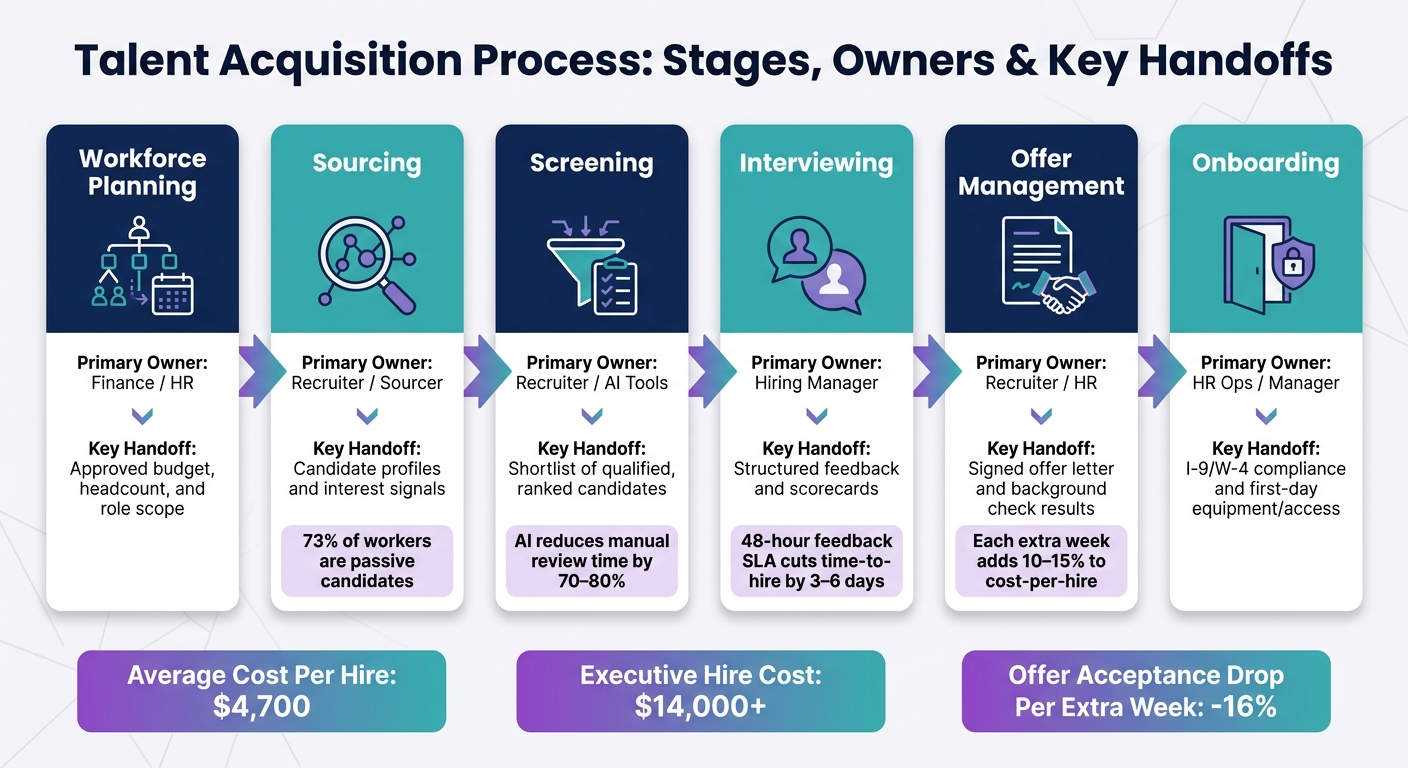
When ownership is fuzzy, good candidates slip away. Each step in the process has a natural handoff, and that’s often where things slow down if no one is clearly in charge.
| Stage | Primary Owner | Key Handoff |
|---|---|---|
| Workforce Planning | Finance / HR | Approved budget, headcount, and role scope |
| Sourcing | Recruiter / Sourcer | Candidate profiles and interest signals |
| Screening | Recruiter / AI Tools | Shortlist of qualified, ranked candidates |
| Interviewing | Hiring Manager | Structured feedback and scorecards |
| Offer Management | Recruiter / HR | Signed offer letter and background check results |
| Onboarding | HR Ops / Manager | I-9/W-4 compliance and first-day equipment/access |
Once ownership is set, the process can move cleanly from planning into building a hiring pipeline.
Workforce planning and role scoping
HR, finance, and hiring managers need to line up on three things before anything else starts:
- How many roles need to be filled
- When those roles need to be filled
- What budget is approved
That agreement on budget, timing, and success criteria should happen before sourcing begins.
Role scoping is just as important. In plain terms, that means doing a proper job analysis: the skills the role calls for, the day-to-day work, and how the person will fit with the team. Once that scope is clear, sourcing can start with less guesswork.
Sourcing, employer branding, and candidate nurturing
Most candidates aren’t actively applying, so job boards alone won’t cut it. Teams need a mix of referrals, LinkedIn outreach, talent community events, and targeted social campaigns. 56% of recruiters report finding their best candidates through social media, compared to 37% on traditional job boards [1].
Outreach also works better when employer branding is clear. If a landing page is built for mobile and easy to use, more people will follow through instead of dropping off halfway. After that, screening takes early interest and turns it into a shortlist the team can act on.
Screening, selection, hiring, and US onboarding
Once candidates enter the pipeline, speed and consistency both matter. Structured interviews with scorecards help teams compare candidates using the same standards. Shorter interview loops also help cut drop-off.
Each extra week in the hiring process increases cost-per-hire by 10–15% and decreases offer acceptance likelihood by 16% [2]. That’s why it makes sense to send verbal offers the same day, then follow up with digital offer letters right away.
The last handoff is onboarding, where HR turns an accepted offer into a first day at work. Reference checks, background checks, and I-9 checks should be automated as soon as the offer is accepted so there isn’t a dead stretch before day one.
Who does what in talent acquisition
Every stage in the hiring funnel needs a clear owner. If nobody owns a step, the process slows down fast. Clear role ownership is what keeps hiring moving instead of stalling.
High-performing teams often use a RACI framework – Responsible, Accountable, Consulted, and Informed – to spell out who owns what at each stage of the funnel. [2]
TA leaders and hiring managers
The Head of TA or TA Manager sets hiring priorities, approves process standards, and clears blockers. They also watch for bottlenecks and shift attention to roles that have stalled.
Hiring managers own role scoping, take part in interviews, and make the final hiring decision. Many teams also use SLAs, like sending interview feedback within 48 hours, to keep things from dragging. Hiring SLAs can cut time-to-hire by 3–6 days. [2]
Recruiters, TA specialists, and sourcers
Recruiters and TA specialists run the full-cycle hiring process. They line up with hiring managers at the start of a search, manage stakeholder communication, screen candidates, and move fast on offers to limit drop-off. A short intake review can flag risks before the search even begins. [2]
Sourcers map the market and find passive candidates. That work matters because 73% of the global workforce consists of passive candidates who aren’t active on job boards. [1]
Coordinators, employer brand, and recruitment marketing leads
Coordinators manage interview logistics, scheduling, ATS data hygiene, and candidate experience touchpoints. As automation tools handle more manual booking, their work shifts more toward dealing with no-shows and rescheduling. [2]
Employer brand and recruitment marketing leads own candidate attraction. They manage careers content, the employer value proposition (EVP), landing pages, social media strategy, and employee advocacy programs to improve conversion rates. In plain English, they help fill the top of the funnel that recruiters and sourcers depend on. These roles also rely on the right tools to do this at scale. Employer branding is critical to recruitment success, as it shapes how potential candidates perceive your company.
The core technology stack for each stage of hiring
Hiring only scales when each step has the right tool behind it. The simplest way to think about it is this: use an ATS for intake, a CRM for nurture, recruitment marketing tools for conversion, and AI for screening and scheduling.
ATS, CRM, and sourcing tools
The Applicant Tracking System (ATS) is the main hub of the hiring operation. It should connect with the tools around it through open APIs and webhooks, so candidate data moves on its own instead of getting typed in again and again by hand. That kind of setup matters. Investing in an ATS can cut administrative time by 30% to 40%.[3]
The ATS handles active applicants. The CRM keeps passive talent engaged, allowing you to nurture relationships before candidates are ready to apply.
A CRM works alongside the ATS and helps teams stay in touch with people who aren’t ready to apply yet. That includes passive candidates and silver medalists – past finalists who didn’t get the job but may still be a strong fit later. Email and SMS sequences can help keep that pipeline alive without turning every follow-up into manual work.
For sourcing, LinkedIn Recruiter helps recruiters find passive candidates and sync that activity back to the ATS.
Recruitment marketing and conversion tools
This is where recruiting starts to look a lot like marketing. If people are finding jobs through social channels, your hiring setup needs to meet them there.
79% of job seekers use social media in their search, rising to 86% for people in the first 10 years of their career.[1] Social recruiting can also cost 70% less than traditional methods.[3]
HireLab.io gives teams a way to build AI-powered landing pages, mobile-first application forms, and unique links that send source-tracking data back into the ATS. That makes it easier to see which channels are bringing in candidates and which ones are just noise.
Once candidates convert, AI tools can speed up screening and scheduling.
AI screening and automation tools
AI recruiting tools can help with resume screening and interview scheduling. Used well, they can reduce manual review time by 70% to 80% and cut time-to-hire by up to 35%.[1]
In practice, that can mean a few things:
- Auto-advancing top-scoring candidates
- Sending borderline candidates to a human reviewer
- Auto-declining the lowest tier
- Letting candidates self-schedule interviews with tools like Calendly or GoodTime
Self-scheduling is one of those small changes that removes a lot of back-and-forth. Instead of emailing five time options and hoping one works, candidates can just pick from open interview slots.
The goal is to use AI for speed, not final judgment.
Conclusion: How to build a scalable talent acquisition function
When you put process, ownership, and technology together, hiring starts to run like a system instead of a fire drill. Talent acquisition scales when planning, sourcing, nurture, selection, and onboarding work together in a repeatable way.
Clear ownership and 48-hour feedback SLAs keep things moving. And once everyone knows who owns what, technology can support the process instead of covering for holes in it.
An ATS, CRM, recruitment advertising tools, and AI automation cut manual work and help keep pipelines moving.
For U.S. teams, speed and consistency need to stay in balance. Standardized scorecards, candidate prep materials, and self-scheduling tools help teams move fast without losing fairness.
The goal is a hiring system you can rely on – one that scales, fills roles well, and gets better over time.
FAQs
When should talent acquisition start?
Talent acquisition should start before a role opens. It’s a planned, forward-looking process that begins with workforce planning and employer branding so companies can connect with both active and passive candidates early.
When teams build relationships ahead of time and keep a talent pipeline warm, they’re in a much better spot to see hiring needs coming. And when a role does open, they already have qualified candidates in view instead of starting from scratch.
How is talent acquisition different from recruiting?
Talent acquisition takes the long view. It’s about building the workforce a company will need over time. Recruiting is more tactical and focuses on filling a specific open role.
Recruiting deals with immediate hiring needs. Talent acquisition covers the broader end-to-end process, including workforce planning, employer branding, and building relationships with both active and passive candidates before a role even opens.
What tools matter most in talent acquisition?
The most important tool is an Applicant Tracking System (ATS). It keeps candidate data in one place, manages hiring pipelines, tracks metrics like time-to-hire, and helps with compliance.
A few supporting tools round out the stack:
- AI screening tools to cut down on manual review
- Recruitment marketing and landing page tools to attract applicants
- CRM and communication systems for candidate nurturing and scheduling
- Analytics tools or ATS reporting dashboards to track performance
Used together, these tools reduce manual work and make hiring more efficient, scalable, and measurable.