How to Choose a Staffing Solution for Your Business Size
Most hiring problems come down to one thing: using staffing solutions that don’t fit your company size.
If I had to boil this down into a few plain rules, it would be this:
- Under 50 employees: keep costs tight and use simple tools; a freelance recruiter often makes more sense than an agency.
- 50–250 employees: build more structure; an in-house recruiter usually starts to pay off, with agencies used for hard roles only.
- 250+ employees: focus on scale, process, and reporting; in-house TA plus RPO is often the better mix.
- If your application flow is weak, fix conversion before you buy more traffic or pay more agency fees.
- If roles depend on passive talent, job boards alone will not be enough – about 73% of the global workforce is passive.
- One hire can take about 48 hours of recruiter time, so team capacity matters just as much as budget.
The main staffing solutions are simple:
- Staffing agencies for urgent or hard-to-fill roles
- Freelance recruiters for one-off or niche hiring
- RPO for steady, high-volume hiring
- In-house recruiters for control, brand, and repeat hiring
- AI recruiting tools for sourcing, screening, and scheduling support
What I’d look at first is not features. It’s:
- Business size
- Hiring volume
- Role urgency
- Internal recruiting time
- Budget
- Tech gaps
Quick Comparison
| Option | Best fit | Main upside | Main tradeoff |
|---|---|---|---|
| Staffing agency | Urgent, temporary, or hard roles | Fast help | High placement fees, often 15%–25% of first-year salary |
| Freelance recruiter | Small teams, one-off searches | More flexible cost | Limited capacity |
| RPO | Large teams, high-volume hiring | Scale and process | Slower setup |
| In-house recruiter | Mid-sized and large employers | More control and repeatable hiring | Fixed payroll cost |
| AI tools | Any company size | Lower-cost help with early-stage recruiting | Still needs people and process behind it |
So the short answer is this: pick the leanest model that solves your current hiring problem, then add more support only when hiring volume forces it. That is the simplest way to control cost, cut delays, and avoid a bloated recruiting stack.
Compare the Main Staffing Solutions and Where Each One Fits
Every one of these staffing solutions gives you a different mix of cost, speed, and control. The smart move is to match the model to how often you hire, not just what you can afford right now.
Staffing agencies, freelance recruiters, and RPO
Staffing agencies work well when you need to move fast. They’re often used for urgent, temporary, or hard-to-fill roles, so it helps to know how to choose a recruiting agency before you sign. In most cases, they charge 15%–25% of the candidate’s first-year salary per placement [2]. That can get expensive, but if speed is the top goal, it often makes sense.
Freelance recruiters give you more flexible support. They’re a good option for one-off searches or niche roles, and they usually charge a project fee or monthly retainer. This setup can help you fill specialized roles without adding a full-time hire. The tradeoff is simple: they can do good work, but they only have so much time and capacity.
Recruitment Process Outsourcing (RPO) means handing off part or all of recruiting to an outside partner, similar to how HR outsourcing covers wider people operations. It fits best when hiring is steady and high in volume, or when a company is growing across many locations. In that case, having a process that can scale matters more than treating each search as its own project. This model is usually a better match for larger teams with a steady flow of openings.
In-house recruiters and AI-powered recruiting tools
Building an internal recruiting team gives you the most control. In-house recruiters get to know your company, learn how teams hire, build talent pipelines over time, and support employer branding. That makes this model a strong fit for steady, repeat hiring.
AI tools help with the early, time-heavy parts of recruiting, like sourcing, screening, and scheduling. They can cut initial resume review time by up to 50% [1], which helps smaller teams deal with more applicants without getting buried.
| Staffing Model | Ideal Business Size | Hiring Volume Fit | Budget Impact | Speed to Implement |
|---|---|---|---|---|
| Staffing Agency | Small to mid-sized | Low to Medium | High | Very Fast |
| Freelance Recruiter | Small to Mid | Low | Moderate (Project/Retainer) | Fast |
| RPO | Large | High (Sustained) | Moderate (Scalable) | Slow |
| In-house Recruiter | Mid to Large | Consistent | Fixed (Salaries + Tools) | Slow |
| AI / SaaS Tools | Any | Any | Low (Subscription) | Fast |
Where HireLab.io fits in the hiring stack
HireLab.io sits earlier in the hiring flow. It adds AI-powered landing pages and recruitment marketing funnels and ad tools that help improve candidate conversion before applicants even reach your ATS.
That matters because getting more people to apply is only part of the job. You also want the handoff into your recruiting system to be smooth, so the rest of the process has a better pool to work with.
Match the Right Staffing Solution to Your Business Size
Use the staffing solutions above as your options, and use company size as the filter. The right setup depends on four things: budget, hiring volume, internal capacity, and growth stage.
Small businesses: under 50 employees
At this stage, a full recruiting team usually doesn’t make sense. If you only need the occasional key hire, freelance recruiters often work better than agencies. They tend to cost less and give you more flexibility.
Your hiring stack should stay simple. A basic recruitment landing page, forms, and applicant tracking are usually enough. Enterprise contracts can eat through a small hiring budget fast.
HireLab.io adds a light conversion layer that helps small teams turn social traffic into applicants without adding headcount.
As hiring picks up, it makes sense to move from one-off help to a more structured internal process.
Mid-sized companies: 50–250 employees
Once you get into the 50 to 250 employee range, hiring usually gets more structured. You’re often filling roles on a steady basis, working with multiple hiring managers, and paying closer attention to employer branding, reporting, and process consistency.
At this point, recruiting starts to need a repeatable process, not just extra hands. That’s where a dedicated in-house recruiter or a small internal team often starts to pay off.
Agencies can still help, but use them with care. They’re a better fit for hard-to-fill or senior roles, not as the default for every opening. One of the biggest problems here is a messy tool stack. If too many tools overlap, costs climb and the process gets harder to manage.
HireLab.io fits this stage by helping branded campaigns turn social traffic into applicants while working alongside your ATS.
Once hiring becomes steady and high-volume, the focus shifts from flexibility to scale.
Large organizations: 250+ employees or high-volume hiring
At this size, the staffing problem changes. It becomes less about finding candidates and more about handling volume well. Large organizations usually combine staffing solutions: dedicated TA teams for strategic hires and RPO partners for repeatable, high-volume roles.
At that point, enterprise ATS platforms, AI-powered screening, and advanced analytics become must-haves.
The main risk isn’t traffic. It’s paying too much for funnels that don’t convert well. Large teams need strong conversion performance across every channel.
HireLab.io supports large teams with multi-funnel campaigns, ATS integration, testing, and analytics – instead of buying more traffic.
| Business Size | Recommended Primary Model | HireLab.io Role |
|---|---|---|
| Small (<50) | Freelance Recruiter / DIY | Lightweight conversion layer for social traffic |
| Mid-sized (50–250) | In-house Recruiter + Selective Agency | Branded job campaigns alongside your ATS |
| Large (250+) | In-house TA Team + RPO | Multi-funnel campaigns, ATS integration, and analytics |
A Step-by-Step Process to Choose the Right Staffing Option
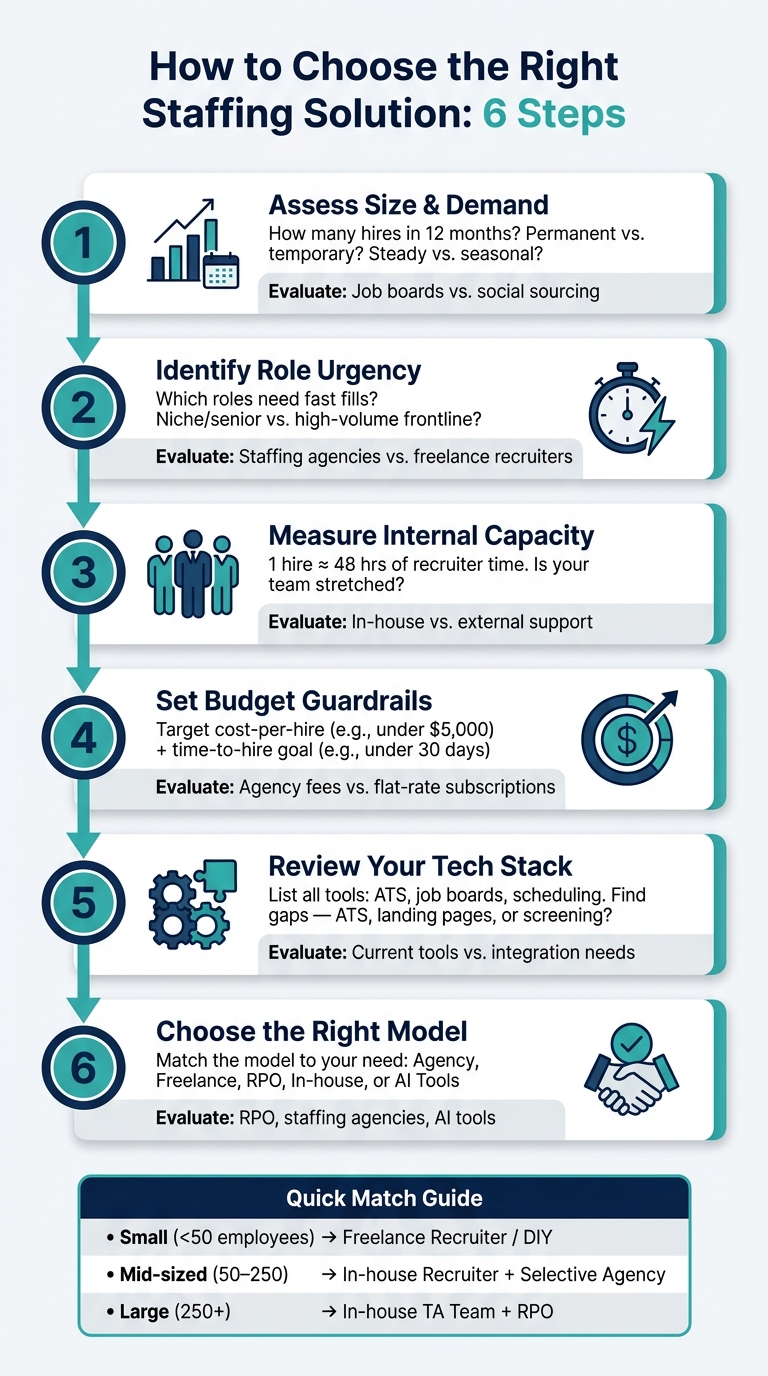
How to Choose the Right Staffing Solution: A 6-Step Decision Process
Once you know the main staffing solutions, the next job is simple: pick the one that fits your business right now. This six-step process helps narrow your options without overthinking it.
Steps 1 to 3: assess size, hiring demand, and internal capacity
Before you look at outside help, start with three basic questions about your own team.
Step 1 – Define your hiring volume. Write down how many roles you expect to fill over the next 12 months. Split them into permanent vs. temporary and steady vs. seasonal. A company hiring 10 people does not need the same setup as one hiring 200.
Step 2 – Identify role urgency and type. Some roles need to be filled fast. Others can wait a bit. Niche or senior positions often call for a different route than high-volume frontline hiring. This helps you avoid paying for speed when speed is not the main issue.
Step 3 – Measure your internal capacity. One hire can take about 48 hours of recruiter time [2]. If your team is already stretched, open roles can eat up that time fast. And if you do not have a dedicated recruiter, hiring manager hours count too. Add in no-shows, ghosting, and scheduling delays, and the true cost per hire starts climbing [2].
Steps 4 to 6: set budget, review technology, and evaluate partners
If your team does not have much room left, budget becomes the next filter.
Step 4 – Set a realistic budget with dual targets. Use your current cost-per-hire and agency-fee benchmarks to set a ceiling. It helps to set two targets:
- A cost-per-hire limit, like under $5,000
- A time-to-hire goal, like under 30 days [2]
Smaller teams usually need tighter cost controls. Bigger teams often need spend that can scale without getting out of hand.
Step 5 – Audit your current tech stack. List every hiring tool you already pay for: job boards, ATS, scheduling software, and career site builders. Tool overlap drains budget, so check what your ATS already covers before adding anything new. Then ask the practical question: where are the real gaps? ATS, landing pages, or screening? If your application flow is clunky on mobile, or your landing pages are weak, that is a gap worth fixing.
Once you know the gaps, compare staffing solutions against those needs only. Not the shiny pitch. Not the long feature list. Just the needs you already mapped out.
Step 6 – Evaluate partners against your actual needs. The main question is not which of the staffing solutions sounds best. It is whether that option solves the problem you found in Steps 1 to 3. Match the model to the job:
- Agency, freelance recruiter, RPO, in-house team, or AI tool should line up with a clear hiring need
- For landing pages and social sourcing, HireLab.io can fit into that layer of the stack
- For sudden surges or high-volume hiring, RPO or staffing agencies may be the better fit
- For steady growth and employer branding, in-house teams and AI-powered tools can make more sense
| Step | Objective | Key Questions | Models/Tools Evaluated |
|---|---|---|---|
| 1. Assess Size & Demand | Define hiring volume and role types | How many hires this year? Permanent or temporary? Steady or seasonal? | Job boards vs. social sourcing |
| 2. Identify Role Urgency | Separate urgent from flexible roles | Which roles need to be filled quickly? | Staffing agencies vs. freelance recruiters |
| 3. Internal Capacity | Measure available recruiter hours | Does the team have 48 hours per role available? | In-house vs. external support |
| 4. Set Budget | Establish cost guardrails | What is our cost-per-hire target? Can we absorb agency fees? | Agency fees vs. flat-rate subscriptions |
| 5. Review Tech Stack | Identify gaps and overlaps | Which gaps matter: ATS, landing pages, or screening? | Current tool list, integration requirements |
| 6. Evaluate Partners | Choose the right model | Do we need ongoing support or a single project? | RPO, staffing agencies, AI tools |
These steps turn size, demand, capacity, and budget into a clear choice between staffing solutions.
Conclusion: Build a Staffing Setup That Grows With Your Business
After looking at each model and checking your hiring demand, the choice should come down to fit, not feature lists. The right staffing solutions should match your current size, hiring volume, budget, and internal bandwidth. In many cases, the strongest setup mixes outside support with recruiting software. That way, you use each where it helps most and avoid doing the same work twice.
One metric worth watching from day one is source of hire – the channel that led to the hire. Put that next to time-to-fill and cost per hire, and you get a much clearer view of whether your current setup is doing its job.
Start with the leanest setup that solves today’s hiring problem. Then add more capacity as hiring volume grows. If your application flow is weak or your job pages aren’t turning visitors into applicants, fix that first before spending more on sourcing. HireLab.io fits into that part of the stack by helping teams improve applicant conversion without replacing their ATS or career site. The right staffing solutions should grow with the business.
FAQs
When should I switch from a freelance recruiter to an in-house recruiter?
Make the switch when hiring stops being occasional and starts becoming a steady, time-sensitive need.
If you’re hiring for complex or high-volume roles – like filling several openings at once or trying to land hard-to-fill talent – an in-house recruiter often makes more sense. You get tighter tracking, steady ownership of the pipeline, and closer coordination with the rest of the team.
How do I know if my hiring problem is traffic or conversion?
It’s a conversion problem when you’re getting plenty of interest, but very few people finish the application. You’ll usually see this show up as high click-through rates with low application starts, or lots of starts followed by heavy drop-off before completion.
Check your funnel metrics. If candidates quit partway through, the application may be too long, hard to use on mobile, or slowed down by technical friction. If they land on the page but don’t start, your ad message may not line up with what they see on the landing page.
What staffing setup works best for seasonal or surge hiring?
For seasonal or surge hiring, a mix of job boards and targeted paid social media usually works best when you need speed and volume. Job boards help you fill multiple roles fast, and geolocated ads on platforms like Facebook or Instagram put your openings in front of local talent.
It also helps to connect both channels to an applicant tracking system. That way, you can handle applications, screening, and candidate communication in one place.