




What Does a Talent Acquisition Coordinator Do?
A Talent Acquisition Coordinator keeps hiring from slowing down. I’d sum the role up like this: they handle interview scheduling, candidate updates, ATS cleanup, job posting support, and pre-hire tasks so recruiters can spend more time choosing the right people.
Here’s the short version:
- They keep interviews moving by managing calendars, invites, time zones, and reschedules
- They keep candidates informed with confirmations, reminders, prep notes, and next steps
- They keep hiring data clean by updating the ATS with stages, feedback, and source details
- They support job posting across career sites, job boards, and social channels
- They help after offer acceptance with background checks, references, and forms like the I-9 and W-4
This role matters because hiring teams are under pressure. Recruiters are dealing with 93% more applications while teams are 14% smaller than in 2021. And when hiring drags, cost per hire can climb by 10%–15% per extra week, while offer acceptance can drop by 16%.
If I had to put it in one line: recruiters own hiring decisions, while coordinators own the process flow.
A few facts stand out:
- 78% of job seekers use smartphones to look for jobs
- Poor mobile forms can lead to 20% abandonment
- Self-scheduling tools can trim 3–5 days from the hiring cycle
- A strong ATS setup can cut admin work by 30%–40%
- In one mobile-first hiring case, a simpler funnel led to a 3.5x higher application conversion rate and a 9-day drop in time-to-hire
| Role | Main focus | Daily work | Main goal |
|---|---|---|---|
| Talent Acquisition Coordinator | Process flow | Scheduling, candidate communication, ATS updates, pre-hire support | Keep hiring organized and moving |
| Recruiter | Candidate selection | Sourcing, screening, advising hiring managers, offers | Find and close the right hire |
In short: if you want a smooth hiring process, this is the person who keeps all the moving parts from slipping.
Core responsibilities across the hiring process
Posting jobs and supporting sourcing workflows
The work usually starts with an approved requisition. From there, the coordinator checks that the job details are correct and publishes the role in the right places: the company career site, job boards, and social channels.
Each posting should have its own trackable link. That way, the team can see which channels are driving applicants instead of guessing.
The application flow also needs to work well on phones. That’s a big deal. Seventy-eight percent of job seekers use smartphones to look for jobs, so a clunky mobile form can cost you people fast. In some cases, poor mobile forms lead to a 20% abandonment rate.
Once the role is live, the job shifts from posting to keeping candidates engaged and interviews on track.
Managing candidate communication and interview scheduling
As applications come in, the coordinator keeps candidates in the loop with confirmation emails, interview prep instructions, and reminders. Those touchpoints help cut drop-off and keep people moving through the process.
Scheduling is often the most coordination-heavy part of the role. One interview can mean juggling multiple interviewers, time zones, calendar invites, video links, and room bookings. Then there are the curveballs: last-minute reschedules and no-shows.
A lot of teams now lean on self-scheduling tools, and for good reason. These tools can cut 3–5 days from the hiring cycle on average [4].
After the interviews are set, the coordinator updates the ATS and begins the pre-hire handoff work.
Keeping ATS records accurate and supporting pre-hire steps
Clean ATS records keep reporting and handoffs from getting messy. Each time a candidate moves ahead or is declined, the coordinator updates that person’s stage in the system and logs interviewer feedback and other relevant notes.
That gives recruiters and hiring managers one current view of the process. It also helps the team track metrics like time-to-fill and source of hire without working from old or mixed-up data.
Once an offer is accepted, the coordinator moves into pre-hire support. That often includes:
- Triggering background checks
- Coordinating reference collection
- Helping candidates complete U.S. compliance paperwork like the I-9 and W-4
The point is simple: keep the handoff from offer acceptance to day one moving [4].
Tools Talent Acquisition Coordinators use every day
ATS, calendars, and communication tools
A Talent Acquisition Coordinator’s day runs on a small set of core tools.
The ATS is the main hub. It keeps requisitions, resumes, feedback, and status updates in one place. That matters because the work can get messy fast without one system holding it all together. Investing in an ATS can cut admin time by 30% to 40% [1].
Coordinators also tie Google Calendar or Microsoft Outlook to self-scheduling tools like Calendly or GoodTime. That lets candidates grab open interview slots on their own instead of waiting on a long email chain. For updates, coordinators lean on email and SMS. For internal handoffs and scheduling chatter, they usually use Slack or Teams.
Recruitment funnels, smart forms, and campaign tools
When teams run social campaigns, coordinators use recruitment marketing tools to turn clicks into tracked applicants. HireLab.io helps coordinators create branded, mobile-friendly landing pages and smart forms for these campaigns, with source data flowing straight into the ATS [1].
Zalando made this idea even simpler for warehouse hiring. The company moved to 3-click mobile-first funnels that asked only for a phone number and availability, not a full resume. The payoff was hard to miss: a 3.5x higher application conversion rate and a 9-day drop in time-to-hire [4].
For high-volume hiring, lower friction usually means more finished applications. Short forms help cut drop-off and push cleaner data into the ATS. That keeps the hiring funnel moving instead of getting stuck at the first step.
Put all of this together, and the tools do three big jobs:
- Cut back-and-forth
- Keep data clean
- Move candidates through the funnel faster
How coordinators improve hiring speed and candidate experience
Keeping candidates informed and engaged
With the right tools in place, coordinators do more than handle logistics. They help hiring move faster and make the process feel smoother for candidates.
A lot of that comes down to communication. Coordinators keep people moving by sending timely updates, interview details, prep materials, reschedule notes, and clear next steps. That matters more than it may seem. When candidates know what’s happening, they’re less likely to lose interest or drop out. At the same time, recruiters and hiring managers can keep their momentum instead of chasing details.
Reducing bottlenecks for recruiters and hiring managers
Coordinators also protect recruiter time by taking follow-up, scheduling, and status tracking off their plate. That gives recruiters more room to focus on assessment and selection.
They often use self-scheduling links to cut an average of 3–5 days from the hiring cycle [4]. They also push for feedback within 48 hours so decisions don’t stall. When hiring managers respond fast, the team can shave days off the process. And when ATS records are kept up to date, coordinators can spot delays early instead of finding them after the process has already slowed down.
That coordination work is a big part of what sets the role apart from recruiter work.
Job description of Talent Acquisition – Role, Responsibilities & Skills
How this role differs from a recruiter and where it fits on the team
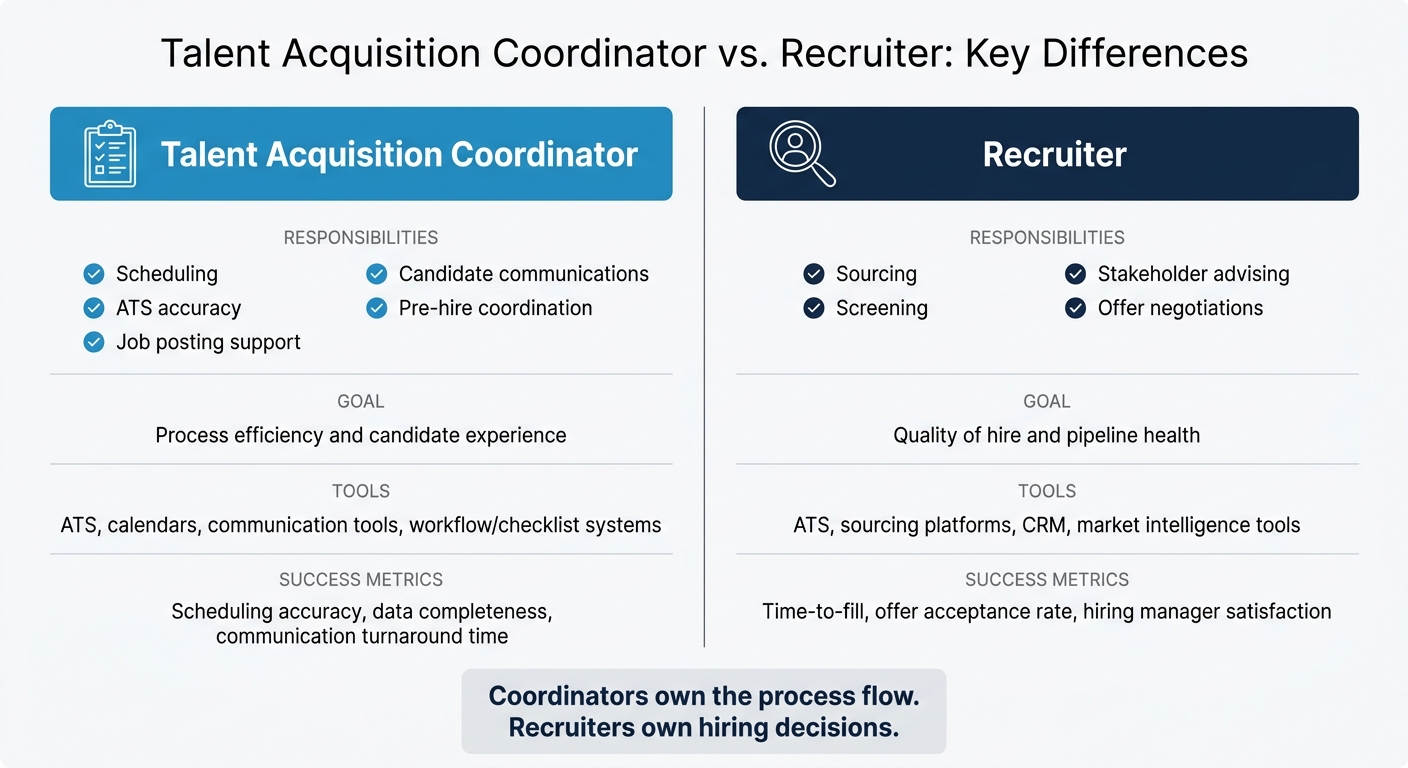
Talent Acquisition Coordinator vs. Recruiter: Key Differences
Talent Acquisition Coordinator vs. Recruiter: key differences
Once you get past scheduling and ATS tasks, the big difference comes down to ownership.
Recruiters own hiring decisions. Coordinators own the workflow.
That difference shows up in the day-to-day work:
| Talent Acquisition Coordinator | Recruiter | |
|---|---|---|
| Responsibilities | Scheduling, ATS accuracy, job posting support, candidate communications, pre-hire coordination | Sourcing, screening, stakeholder advising, offer negotiations |
| Goal | Process efficiency and candidate experience | Quality of hire and pipeline health |
| Tools | ATS, calendars, communication tools, workflow/checklist systems | ATS, sourcing platforms, CRM, market intelligence tools |
| Success metrics | Scheduling accuracy, data completeness, communication turnaround time | Time-to-fill, offer acceptance rate, hiring manager satisfaction |
In plain English, the coordinator keeps the process moving. The recruiter, much like a talent acquisition specialist, focuses on evaluating people and helping the team make hiring choices.
Coordinators usually report to a Talent Acquisition Manager or Lead Recruiter. They often sit at the center of the process, connecting recruiters, hiring managers, and HR.
Conclusion: The role behind a smooth hiring process
A Talent Acquisition Coordinator is the operational force that keeps hiring on track. They manage clean handoffs, keep candidates informed, and give recruiters the space to focus on candidate decisions.
When this role is done well, hiring gets faster, more organized, and more candidate-friendly at each step.
FAQs
What skills does a Talent Acquisition Coordinator need?
A Talent Acquisition Coordinator needs strong organization, technical know-how, and clear communication to keep the hiring process running smoothly. They should feel at ease using ATS platforms, calendar tools, and automated outreach systems.
They also need close attention to detail to keep candidate records accurate, handle interview logistics, and make sure recruiters, hiring managers, and candidates stay informed from start to finish.
Is a Talent Acquisition Coordinator the same as an HR Coordinator?
No. A Talent Acquisition Coordinator supports hiring. That usually means interview scheduling, ATS data hygiene, and candidate communication.
An HR Coordinator tends to cover a broader set of HR tasks, like payroll, benefits, compliance, and onboarding or offboarding. Both roles handle admin work, but the Talent Acquisition Coordinator is focused on recruitment.
What metrics show a Talent Acquisition Coordinator is effective?
A Talent Acquisition Coordinator does their job well when hiring runs smoothly and candidates stay informed at every step. A few metrics matter most:
- ATS data hygiene: accurate, complete, up-to-date candidate records
- Scheduling efficiency: fast, error-free interview coordination
- Funnel velocity: time-to-hire and stage-to-stage conversion rates
- Candidate experience: timely communication and status updates that support offer acceptance


