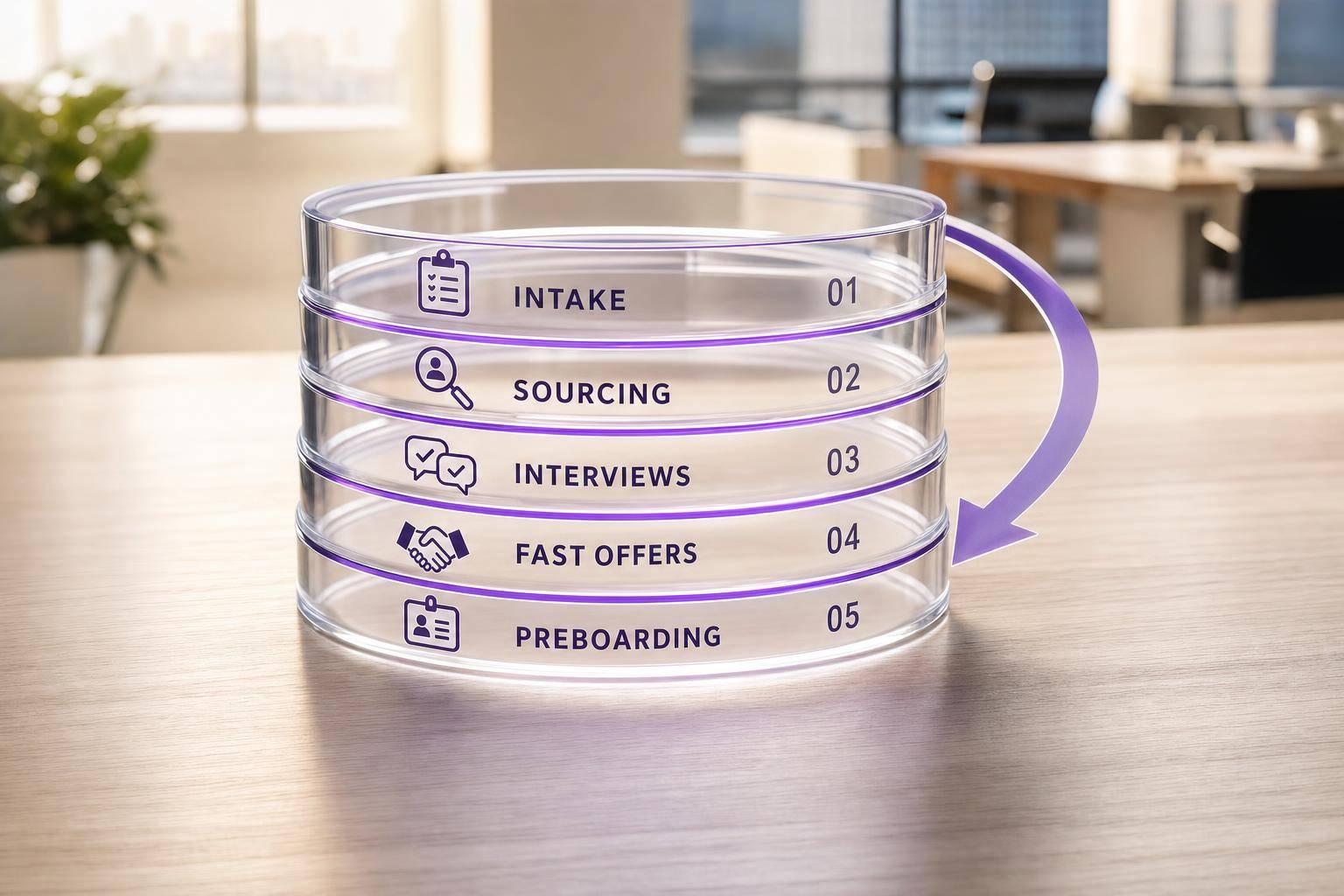

Full Cycle Recruiting Explained Step by Step
Full cycle recruiting means running hiring from kickoff to day one – and if one step slips, the whole process slows down. In this guide, I’d sum it up like this: define the role up front, source from more than one channel, screen with fixed criteria, use structured interviews, move on offers the same day, and make sure preboarding is ready before the start date.
Here’s the short version of what matters most:
- I start with an intake meeting to lock down the role, pay range, interview plan, and success outcomes.
- I separate must-haves, preferred qualifications, and deal-breakers before sourcing starts.
- I track time to fill, stage conversion, source of hire, and offer acceptance rate to find where the funnel leaks.
- I don’t judge sources by application volume alone. One stat in the article stands out: job boards and social sites drove 49% of applications but only 24.6% of hires.
- I use structured interviews and scorecards because they predict job performance better than unplanned interviews.
- I move fast after the final decision. The article notes that each extra week in the process can cut offer acceptance by 16%.
- I treat preboarding as part of hiring, not an afterthought, because day-one confusion can hurt accepted-to-start conversion.
If you want the article in one sentence: full cycle recruiting works best when each stage has a clear owner, fixed rules, and numbers you can track.
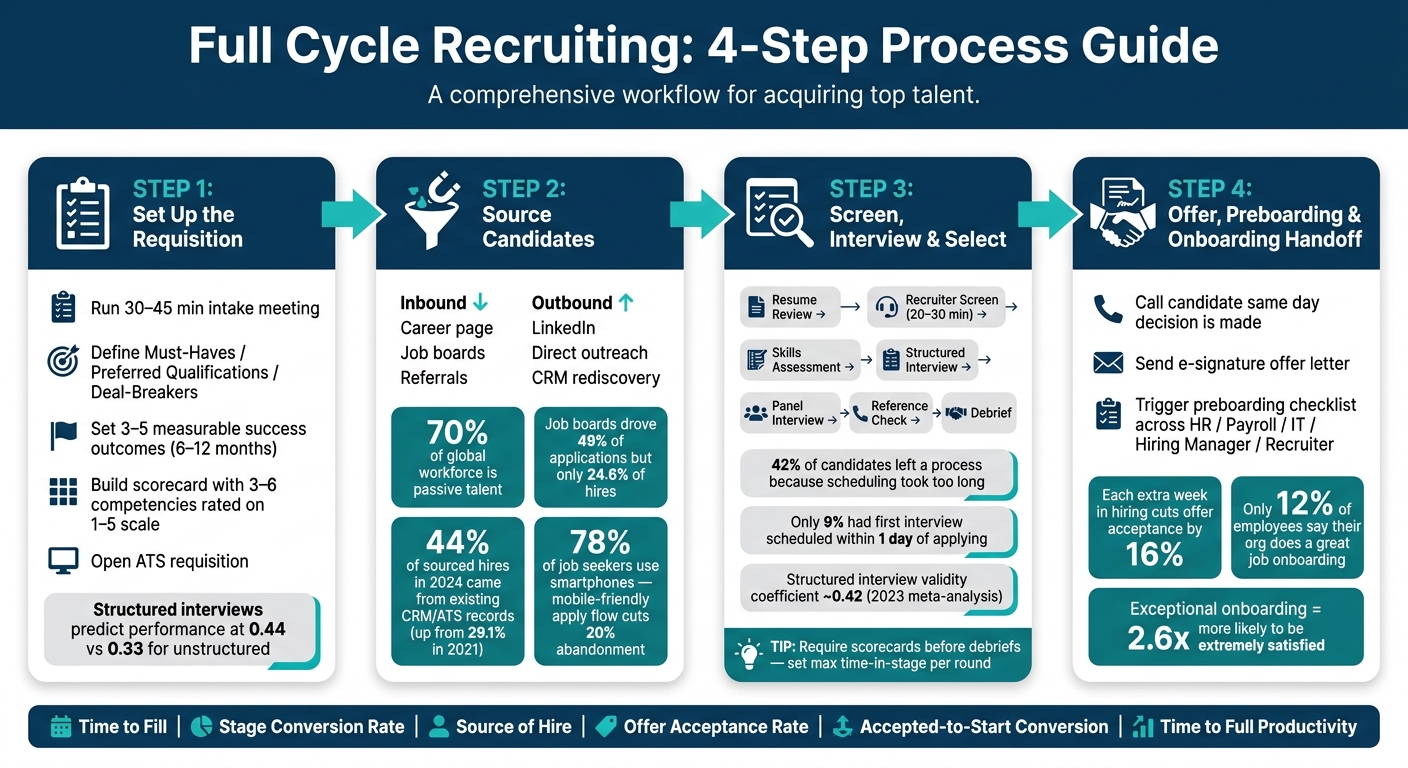
Full Cycle Recruiting: 4-Step Process Guide
What Is the Full Cycle Recruiting Process?
Step 1: Set up the requisition and open the role
Full cycle recruiting starts before any outreach begins: the recruiter and hiring manager need to agree on what success looks like. If that part is fuzzy, the search slows down and the shortlist starts to wander. That’s why this step begins with a structured intake meeting.
Run the intake meeting and define the candidate profile
A structured intake meeting – usually 30 to 45 minutes[6] – should lock in the basics: why the role exists, whether headcount is approved, who the role reports to, employment type, work location, target start date, and the approved pay range, including any bonus or equity eligibility. It should also name the decision-maker, interview panel, and approval path in a single search brief. Put these decisions in one place so the recruiter isn’t stuck answering the same basic questions during sourcing.
The most useful output from the intake meeting is a clean split between three qualification types:
- Must-haves: needed on day one
- Preferred qualifications: helpful, but can be learned on the job
- Deal-breakers: disqualifying conditions, such as a missing required license
For each must-have, ask the hiring manager a simple follow-up: what business need makes this non-negotiable? That question often clears out vague or inflated requirements.
Success also needs to be measurable. Instead of writing “strong communicator,” write something like: “deliver a monthly executive reporting package with fewer than 2% data errors by month six.” Aim for three to five observable outcomes across the first 6 to 12 months. These outcomes give the scorecard something solid to point to, and they help interviewers judge evidence instead of gut feel. A good intake output is a short search brief that covers role outcomes, candidate profile, pay range, interview plan, decision ownership, and feedback timing.
Ask: "If this role fails in six months, what caused it?"
Write the job description, build the scorecard, and open the requisition
Once the intake is documented, the recruiter can draft the job description and build the scorecard at the same time. A clear job description should include the role title and level, the core mission of the job, responsibilities written as outcomes, must-have and preferred qualifications, reporting line, location or remote expectations, pay details where state or local pay-transparency laws require them, and a short view of the hiring process. Use plain U.S. English and write for the candidate, not just the internal team.
The scorecard should cover three to six competencies tied to the success outcomes from intake. For each competency, note the interviewer, the question or exercise, and a 1-to-5 rating scale with behavioral anchors:
- 1 = insufficient evidence
- 3 = acceptable evidence for the role
- 5 = exceptional evidence backed by specific results
Interviewers should write down what the candidate actually said or showed, not just a vague impression. Research on structured interviews keeps pointing in the same direction: they predict job performance better than unstructured interviews, with validity coefficients of about 0.44 versus 0.33.[7]
After the job description and scorecard are finalized, open the requisition in the ATS. Set up the pipeline stages – sourced, applied, recruiter screen, hiring-manager review, interview, finalist, offer, hired, rejected – before the role goes live. The ATS should be the system of record for approvals, documents, candidate movement, and feedback.
Before publishing, confirm that all of this is in place:
- Headcount and requisition approvals are complete
- Compensation, employment type, location, and target start date are approved
- Job description is accurate, inclusive, and approved for publication
- Must-have, preferred, and deal-breaker criteria are clearly separated
- Six- and 12-month success outcomes are documented
- Interview stages, interviewers, questions, and decision rules are finalized
- Scorecard includes job-related competencies, rating anchors, and evidence fields
- Pipeline stages are configured in the ATS
- Recruiter-screen, outreach, scheduling, rejection, and next-step templates are ready
- Hiring-manager response-time expectations and escalation procedures are agreed upon
With the requisition open, Step 2 turns to sourcing candidates and keeping the funnel moving.
Step 2: Source candidates and keep the top of the funnel moving
Once the requisition and scorecard are set, move into the sourcing stage of full cycle recruiting. Use more than one channel. High application volume might look good on paper, but it doesn’t mean you’re bringing in the right people. The goal isn’t more applicants. It’s more candidates who make it to the recruiter screen. Industry benchmark data makes that pretty clear: job boards and social sites drove nearly 49% of applications but only 24.6% of hires[8].
Use multiple channels to reach active and passive candidates
Active candidates are already looking and applying. Passive candidates aren’t actively applying, but they may be open if the right role lands in front of them. That’s a big group. About 70% of the global workforce is passive talent[5]. If you only wait for inbound applicants, you’re leaving a lot of the market untouched.
That means using both inbound and outbound channels. On the inbound side, lean on your career page, job boards, referrals, talent communities, and social campaigns. On the outbound side, use LinkedIn, direct outreach, associations, and rediscovery. Rediscovery is easy to overlook, but it matters: 44% of sourced hires in 2024 came from existing CRM or ATS records, up from 29.1% in 2021[5].
Don’t judge a source by raw application count. Judge it by how many qualified candidates it moves to screen. Track metrics like:
- qualified-applicant rate
- screen rate
- time to recruiter screen by source
A source that sends fewer people, but more of the right people, can beat a high-volume source that stalls out after the apply stage. Tag every candidate with a primary source at the first touchpoint – values like linkedin_outbound, employee_referral, career_page, talent_community, and ats_rediscovery – and keep those tags consistent so your reporting stays clean over time.
Use an ATS, recruitment CRM, and HireLab.io funnels to improve conversion
To keep the pipeline moving, connect three layers. Use the ATS to track applicants and stage movement. Use the CRM to manage outreach before someone applies. Use HireLab.io to turn traffic into applications. That split matters. If you dump every prospect into the ATS too early, it gets messy fast.
For conversion, send sourced traffic to HireLab.io landing pages that are built for the role. A good role page gives candidates the basics they want upfront: job title, work location or remote policy, employment type, main responsibilities, required qualifications, compensation range when approved, benefits, interview process, and expected timeline. Keep it mobile-friendly and give people one clear call to action.
The pre-screen form should stay short. Ask only for details that help with early qualification, such as work authorization, location or willingness to relocate, required certification, years of related experience, availability, compensation expectations where appropriate, and consent to be contacted. When someone submits the form, route that record straight into the ATS with source, consent, and campaign fields intact.
"A CRM helps me build the pipeline, and an ATS helps me close it." – Ralph van Katwijk[4]
This setup matters because 78% of job seekers use smartphones to search for jobs, and a clunky application flow can drive a 20% abandonment rate[3]. A clean landing page and short pre-screen form cut that friction while still giving recruiters the data they need to qualify early.
Set outreach rules and next-step messages
Every candidate needs three things: an owner, a status, and a next action. Without that, even strong prospects can go cold.
For passive candidates, use a short outreach sequence built around permission. The first contact should say why you picked them, name the role, give a short value proposition, and ask if they’re open to a brief conversation. The first follow-up should go out after three to five business days and add one useful detail, like team scope, work arrangement, or compensation range if approved. The second follow-up should come several business days later and make the response easy: decline, ask about another role, or join a talent community. The final message should close the loop politely and say no more messages will be sent for that role.
Track statuses like:
- sent
- replied
- interested
- declined
- opted out
- bounced
That makes it easier to spot where the process is breaking down.
On the inbound side, set a clear service-level target. Review applications within one business day. Respond to qualified replies within one business day. Schedule screens within three business days. Use outreach stages like New, Needs Review, Outreach Sent, Replied, Interested, and Screen Scheduled so aging candidates are easy to spot. Any record with no activity after 48 business hours should land in an exception queue.
Before reaching out, check the CRM for earlier contact history so two recruiters don’t message the same person. Honor opt-outs right away and suppress those records from all future sequences. Fast follow-up helps keep interested candidates engaged before they drift away.
Candidates who confirm interest and meet the screen target move into structured screening.
Step 3: Screen, interview, and select the best candidate
After sourcing, the goal of full cycle recruiting changes. It’s no longer about volume. It’s about evidence.
Once candidates move into evaluation, gather job-related proof at each step so the final choice is based on documented facts, not gut feel.
Run structured screening before interviews begin
Start with the resume review. Take the must-haves from the intake meeting and turn them into a checklist. Then use that same checklist for every application. In the ATS, add a short note tied to evidence, like "Managed an $800,000 quota from 2023–2025" instead of vague comments like "strong candidate."
Mark each person as advance, hold, or decline, and record the reason in a standard disposition field. That makes the funnel easier to track and leaves a clear audit trail by source and stage.
Next comes the recruiter screen. A focused 20- to 30-minute call should confirm:
- relevant experience
- motivation
- compensation expectations
- earliest start date
- work arrangement
- location
- candidate questions
Leave space for the candidate’s questions too. That part matters. Keep work authorization and other pre-employment questions within what U.S. law and company policy allow. End every screen with a specific follow-up date so the candidate knows when to expect the next update.
Schedule interviews and use scorecards to guide feedback
After the screen, use scheduling software to send interview details. Include the date, start time, time zone, video or onsite instructions, interviewer names and titles, the competencies being assessed, and when the candidate can expect next steps. Check interviewer availability before the invite goes out.
If a panelist cancels, offer replacement times fast instead of leaving the candidate stuck in the middle of the mess.
According to Cronofy‘s 2024 Candidate Expectations Report, which surveyed 12,000 candidates across seven countries, 42% said they had left a recruitment process because scheduling an interview took too long. Only 9% had their first interview scheduled within one day of applying.[9] Slow scheduling can cost you qualified candidates.
Each interviewer should use the role scorecard from Step 1, with the same questions and the same rating scale for every candidate. Ask for independent feedback in the ATS before the debrief. That way, group discussion doesn’t shape ratings before people record their own views.
A 2023 meta-analysis reported a corrected validity coefficient of approximately 0.42 for structured interviews, placing them among the strongest commonly used predictors of job performance.[11] But that only works if interviewers ask the same core questions and score against the same criteria every time.
Compare finalists and clear common bottlenecks
The debrief should follow a set agenda. Review the scorecard. Look at each interviewer’s evidence and ratings. Surface disagreements. Document the reason for the decision.
If the group can’t agree, the hiring manager should ask a simple question: What evidence supports each view? That keeps the team from slipping into yet another interview round just because no one wants to decide.
Use the matrix below to track what each stage is for, who owns it, what it should produce, and where things usually get stuck:
| Stage | Purpose | Owner | Output | Common bottleneck |
|---|---|---|---|---|
| Resume review | Confirm baseline qualifications | Recruiter | Advance, hold, or disposition with reason | Inconsistent criteria or ATS backlog |
| Recruiter screen | Confirm role fit, logistics, and expectations | Recruiter | Screen notes and recommendation | Unclear pay, location, or next-step expectations |
| Skills assessment (if used) | Test a job-relevant capability | Recruiter + evaluator | Scored work sample | Overly long or inconsistently scored assignments |
| Structured interview | Assess defined competencies | Hiring manager + interviewers | Individual scorecards | Improvised questions or incomplete feedback |
| Panel interview | Gather complementary evidence | Assigned panelists | Completed panel scorecards | Duplicated questions or excessive panel size |
| Reference check | Validate relevant performance information | Recruiter or hiring manager | Documented reference summary | Late initiation or missing candidate consent |
The delays that keep showing up in full cycle recruiting are familiar: slow interviewer feedback, too many rounds, fuzzy decision rights, and rescheduling.
The fix is pretty plain:
- set a maximum time in stage
- reserve recurring interview blocks
- assign backup interviewers
- require scorecards before debriefs
Also, publish final decision authority before the process starts, not when the team is already stuck.
Even when the internal decision takes longer than planned, send the candidate a factual status update and a revised date. Lack of responsiveness was the most frustrating recruiting issue for 28% of respondents in the Cronofy findings.[10] Silence leaves people guessing. A short update is better.
Once the finalist is chosen, Step 4 covers the offer, preboarding, and onboarding handoff.
Step 4: Extend the offer, complete the hire, and hand off to onboarding
Prepare and present the offer
Once you’ve picked the finalist, don’t drag your feet. This is the point in full cycle recruiting where speed can make or break the hire.
Before you call the candidate, lock down the details: approved pay range, final salary, bonus or commission plan, benefits eligibility, title, manager, location or remote expectations, start date and schedule, employment status, and any contingencies. A simple offer-readiness checklist can save you from messy back-and-forth after the candidate says yes.
When approvals are done, call the candidate that same day the hiring decision is made. Research shows that each extra week in the hiring process cuts the chance of offer acceptance by 16%.[1][2] That’s a steep drop, and it adds up fast.
Use the call to connect the offer to what matters most to the candidate. If they care most about growth, flexibility, compensation, or team fit, speak to that directly. It gives you a chance to answer questions before the written offer lands in their inbox. After that, send the formal offer letter through an e-signature workflow that tracks delivery, acceptance, and expiration.
If the candidate wants to negotiate, stay inside approved limits. Go into that conversation knowing the salary range, sign-on authority, and any start-date flexibility. If they ask for something outside your authority, don’t wing it. Say it needs internal review instead of making an off-the-cuff promise. Document each requested change and get approval before you reply.
Complete preboarding and hand off to the right teams
After acceptance, move straight into preboarding, the final handoff in full cycle recruiting. A clean handoff isn’t fancy. It just means every task has a clear owner and a due date.
As soon as the candidate signs, update the ATS to hired or preboarding, record the accepted pay and start date, upload the signed offer, and move other finalists to the right disposition stage. That way, HR, payroll, IT, and the hiring manager all work from the same record instead of chasing updates across email threads and chat messages.
| Function | Preboarding tasks |
|---|---|
| HR / People Operations | Employment paperwork, policy acknowledgments, benefits enrollment, orientation, required records |
| Payroll | Pay rate, pay frequency, tax forms, direct deposit instructions, payroll cutoff timing |
| IT / Workplace | Laptop, monitor, software licenses, email, security access, badge, workspace |
| Hiring manager | First-week schedule, role priorities, stakeholder introductions, training plan, success expectations |
| Recruiter | Candidate communication, unresolved commitments, acceptance-risk monitoring |
A short check-in a few business days before the start date helps, too. Confirm first-day instructions, manager contact details, and any open questions. It’s a small step, but it can head off confusion before day one.
Gallup reports that only 12% of employees strongly agree their organization does a great job onboarding new employees, and employees who rate their onboarding as exceptional are 2.6 times more likely to be extremely satisfied with their workplace.[12] That means HR, IT, and the hiring manager all need the right information before the new hire logs in or walks through the door.
Conclusion: Treat full cycle recruiting as a measurable workflow
The offer stage closes the loop on the interview process. Intake sets the target. Sourcing fills the funnel. Screening narrows the field. Offer and preboarding bring the process home.
The basics of full cycle recruiting are simple:
- Align on the candidate profile during intake
- Source through more than one channel
- Screen against must-have criteria
- Run structured interviews with scorecards
- Move fast on offers
- Complete a clean onboarding handoff
However, what separates a full cycle recruiting process that works from one that stalls usually comes down to measurement. Track offer approval-to-send time, offer acceptance rate, accepted-to-start conversion, preboarding completion by day one, system-access time, and time to full productivity.
Those numbers show you where the slowdown is. Maybe approvals take too long. Maybe offer terms aren’t clear. Maybe background checks lag, equipment isn’t ready, or the manager wasn’t briefed. Find the bottleneck, fix it, then measure again.
FAQs
Who owns full cycle recruiting?
Full cycle recruiting spans the entire hiring funnel, but it isn’t owned by just one person.
TA leaders or the Head of TA set priorities and clear blockers. Hiring managers own role scoping and make the final call. Recruiters or TA specialists run the process from start to finish and keep things moving.
Sourcers focus on market mapping and passive talent sourcing. Coordinators handle interview scheduling, ATS updates, and the small candidate experience details that can make or break how the process feels.
Many teams split this work with RACI-style ownership, so everyone knows who’s leading, who’s helping, and where decisions sit.
How long should each hiring stage take?
Timelines vary by role, but high-performing companies often aim for 21–28 days from first contact to accepted offer.
That said, the right pace depends on the role:
- Entry-level or high-volume roles: 7–14 days
- Mid-level professional roles: 18–25 days
- Senior or specialized roles: 30–45 days
One more rule matters here: try to make a final decision within 48 hours of the last interview. That helps you keep momentum and cuts the odds of losing a strong candidate to another offer.
What metrics matter most in full cycle recruiting?
Focus on the metrics that show how well your funnel is working and how fast your team can hire. The two that matter most are time-to-hire and offer acceptance rate. Together, they show process efficiency, pay competitiveness, and the kind of experience candidates have as they move through your hiring process.
It also helps to track stage-by-stage conversion rates, cost-per-hire, and qualified candidates per opening. Those numbers make it easier to spot where candidates drop off and which sourcing channels are doing the heavy lifting.