Tech Staffing Agencies: A Practical Buyer’s Guide
Choosing the wrong one of the many tech staffing agencies can cost you time and about $6,000 to $10,000 per hire. My short take: I’d pick an agency only after I define the role, match the search to the right agency type, compare screening and time-to-fill data, and read the contract line by line.
Here’s the article in plain English:
- I start with the role: skills, seniority, pay range, work setup, and target start date.
- I match the need to the agency model: contract staffing, direct hire, executive search, specialist firms, or nearshore/offshore help.
- I compare agencies on four things: candidate quality, delivery speed, market reach, and process.
- I check the full cost, not just the fee: direct-hire fees often run 15%–25% of first-year salary, while executive searches can hit $12,000 to $15,000+.
- I look for contract terms that can add cost, like overtime rules, background check charges, conversion fees, and weak replacement clauses.
A few numbers stand out. Senior and hard-to-fill roles often take 30–45 days to fill. 73% of the global workforce is passive talent, so sourcing reach matters. And companies using skills-based hiring reported a 92.5% drop in mis-hires.
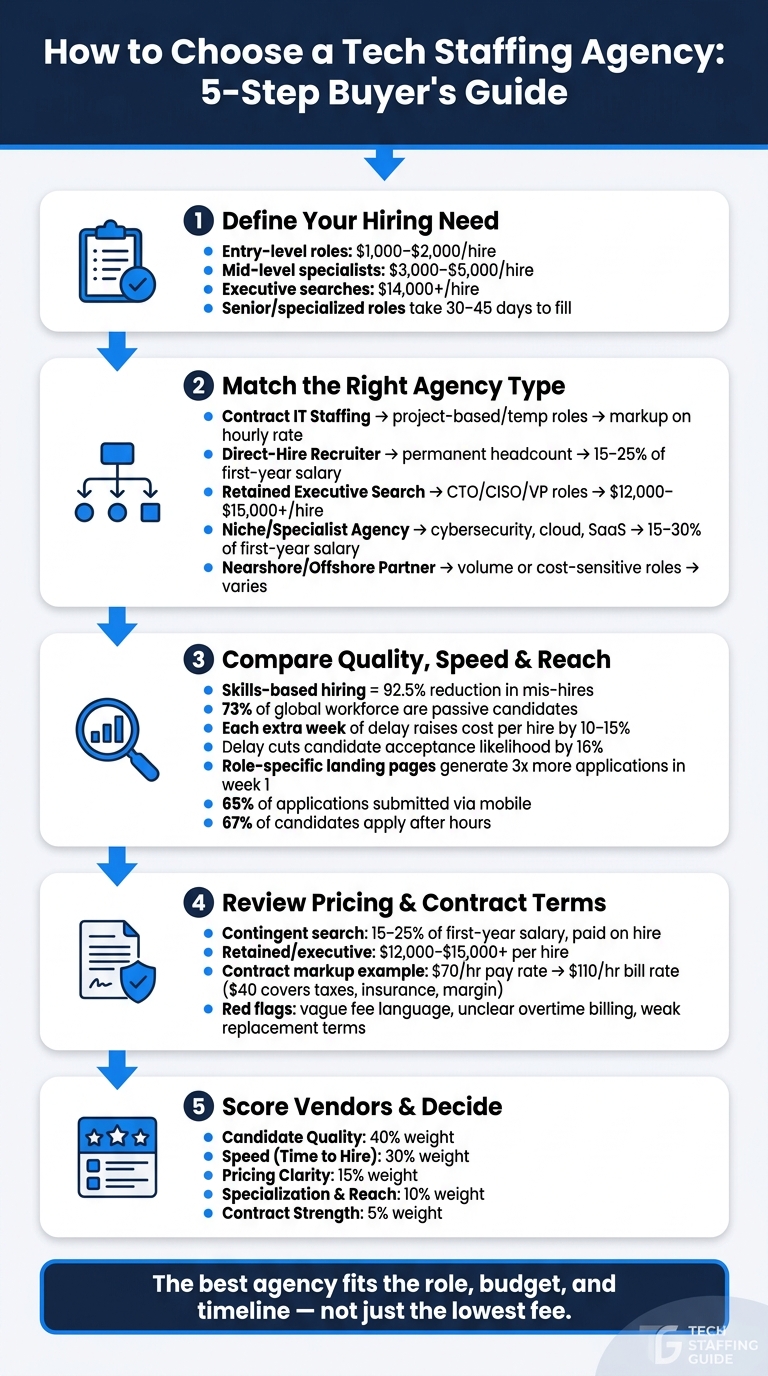
How to Choose a Tech Staffing Agency: 5-Step Buyer’s Guide
How to Compare Tech Staffing Agencies: Complete Guide
Quick Comparison
| What I’m checking | What matters most |
|---|---|
| Hiring need | Role, must-have skills, seniority, budget, location, timeline |
| Agency type | Contract, direct hire, executive, specialist, nearshore/offshore |
| Quality | Skills screening, retention, hiring manager feedback |
| Speed | Time-to-first-candidate, interview turnaround, reporting |
| Cost | Fee model, markup, vacancy cost, internal hiring time |
| Contract risk | Replacement terms, billing rules, compliance, conversion fees |
If I had to boil the full guide down to one point, it would be this: the best agency is the one that fits the role, budget, and hiring timeline – not the one with the lowest headline fee.
Step 1: Define Your Hiring Need Before Contacting Agencies
Before you reach out to any agency, get your brief in order. It doesn’t need to be fancy. It just needs to be clear.
A strong brief helps you spell out the role, required skills, budget, and timeline. It also makes Step 2 much easier, because you can line up your hiring need with the right agency model instead of guessing.
Clarify the Role, Skills, and Seniority Level
Start with the exact tech function you need. That could be software engineering, data, DevOps, cybersecurity, product, or IT support.
Then split the skill set into two buckets:
- Must-have skills
- Nice-to-have skills
That simple distinction saves a lot of back-and-forth later.
Seniority matters just as much as the tech stack. Entry-level roles usually cost $1,000–$2,000 per hire, mid-level specialists often land in the $3,000–$5,000 range, and executive searches can go past $14,000 [1]. Senior roles usually need more targeted search support than entry-level hires.
It also helps to get the hiring panel on the same page early. If one person thinks "qualified" means three years of hands-on work and another thinks it means ten, things can go sideways fast. Align on must-have skills and seniority before the search starts.
Set Budget, Timeline, and Work Location
Write down the target compensation, expected fee range, and target start date. For example, that might mean a $120,000 salary with a 15%–25% fee, or an $85/hour contractor rate [1].
Use a range instead of one fixed number. That gives you room to work with and helps avoid budget friction later.
Be direct about the work setup too. Say whether the role is fully remote, hybrid, or onsite. If it’s remote, note which U.S. time zones work for your team. Clear location and time-zone limits can cut down on scheduling delays [2].
You should also estimate vacancy cost, which is the daily cost of leaving the role open [1]. If that cost is high, paying for an agency that can move faster may make sense. Senior and specialized roles often take 30–45 days to fill [2], so if you need someone in place sooner, say that upfront.
Once those guardrails are in place, you can compare agencies based on fit, speed, and pricing.
With the brief ready, move to Step 2 and match the need to the right agency type.
Step 2: Find the Right Agency Type for Your Hiring Need
Tech staffing agencies don’t all do the same job. Once your brief is set, the next move is simple: match your hiring need to the right agency model. If you are also weighing general recruiters, our guide on how to choose a recruiting agency for your business covers the basics.
The best choice depends on three things:
- the role
- how fast you need to hire
- whether the hire is contract, permanent, or executive-level
Match the Agency Model to the Hiring Scenario
Each agency model fits a different kind of search.
Contract IT staffing firms (see our guide to IT staffing agencies) are a good fit for project-based work, like a six-month cloud migration. These agencies often work through vendor management systems, which makes them a strong option for contingent workforce programs.
Direct-hire recruiters make more sense when you’re adding permanent headcount. Fees usually land between 15%–25% of first-year salary [1].
Retained executive search is built for C-suite and senior leadership hires, such as a CTO or CISO. This process tends to move more slowly, but it goes deeper. Pricing follows that pattern too, with benchmarks from $12,000 to $15,000+ per hire [1].
Niche agencies that focus on cybersecurity, cloud infrastructure, SaaS, or similar areas can cost more, but that extra spend can pay off when the role is tough to fill. They often have deeper talent pools in their lane and stronger skills screening.
For volume hiring or lower labor costs, use nearshore or offshore partners.
Once you’ve picked the model, the next step is to check whether the agency has real depth in the role and the market you care about.
Filter by Specialization and Market Coverage
Specialization only matters if the agency can reach the right people in the right market. Ask for proof of placements in your exact role, seniority level, and geography.
Be direct:
How many placements have you made in this role in the last 12 months? In which U.S. markets?
Agencies with real depth should be able to answer with recent placement counts and target markets. That matters even more for hard-to-fill roles. Passive candidates make up 73% of the global workforce [3], so specialist agencies with strong vertical communities can be a big help.
Use this quick match-up to trim your shortlist.
| Agency Type | Use When | Typical Fee Range |
|---|---|---|
| Contract IT Staffing | Project-based or temp roles | Markup on hourly rate |
| Direct-Hire Recruiter | Adding permanent headcount | 15%–25% of first-year salary [1] |
| Retained Executive Search | CTO, CISO, VP-level roles | $12,000–$15,000+ per hire [1] |
| Niche/Specialist Agency | Cybersecurity, cloud, SaaS roles | 15%–30% of first-year salary [1] |
| Nearshore/Offshore Partner | Volume or cost-sensitive roles | Varies by market |
Step 3: Compare Agencies on Quality, Speed, Reach, and Process
Now that you have a shortlist of tech staffing agencies, it’s time to look under the hood. Don’t compare tech staffing agencies on promises alone. Compare how they screen, where they source, how fast they move, and what they report back to you.
Review Candidate Quality and Screening Methods
Don’t stop at, "How fast can you send candidates?" A better question is: what happens before a resume lands in your inbox?
A good agency should be able to walk you through its technical screening process in plain English. It should also show how it uses objective, skills-based assessments instead of gut feel alone. And it should be ready to share a Quality of Hire scorecard tied to 90-day retention, first-year performance, and hiring manager satisfaction [4].
If an agency says it uses skills-based screening, ask it to prove the results. Companies using skills-based hiring reported a 92.5% reduction in mis-hires [4]. That’s a huge gap. If the agency struggles to explain its process, treat that as a red flag.
You should also ask how the agency reaches passive talent. For example:
- Specialized communities
- Referrals
- Paid sourcing
- Social outreach
Look for agencies that use paid job ads and social sourcing, not just job boards. At this stage, process matters more than big volume claims.
Measure Delivery Speed, Reporting, and Geographic Fit
Speed matters. But speed without context doesn’t tell you much.
Ask each agency for its average time-to-first-qualified-candidate, interview-to-offer ratio, and retention data for roles close to yours [2]. Then ask whether weekly funnel metrics and role-level performance data are part of standard reporting. They should be.
Why does this matter? Because every extra week of delay can increase total cost per hire by 10–15% and cut candidate acceptance likelihood by 16% [2].
It’s also smart to ask for service-level agreements in writing, including a 48-hour feedback window for interview responses.
Geographic fit matters too. Ask where the agency has placed candidates in the last 12 months and whether it can support the markets where you hire. This gets even more important if you’re hiring across several states or running a remote-first team. An agency may look great on paper but still fall short if its network doesn’t match your footprint.
Check Whether the Agency Supports Modern Recruitment Marketing
For hard-to-fill technical roles, top-of-funnel performance matters just as much as screening. If the top of the funnel is weak, everything downstream gets harder. Agencies can use multi-client recruitment software to run those pages and campaigns for each client in one place.
Ask whether the agency uses role-specific landing pages instead of generic job board listings. Landing pages built for a specific role and audience can generate 3x more applications in the first week than standard postings [2].
You should also ask how the agency handles smart forms and campaign tracking. That tells you whether it can turn passive candidates from social ads into qualified applicants instead of losing them halfway through the process.
Mobile matters here too. With 65% of applications now submitted via mobile [4], a mobile-optimized funnel is no longer a nice extra. It’s part of the job.
And here’s one more thing many teams miss: what happens after hours? If an agency can’t explain how it handles candidates who apply at night or on weekends, flag it. About 67% of candidates apply after hours [2], so automated screening tools and 24/7 engagement can make a real difference, especially for technical roles where the candidate pool is thin.
Once quality and speed are clear, compare pricing and contract risk.
Step 4: Review Pricing, Contract Terms, and Risk
Once you’ve narrowed your list based on quality and speed, it’s time to look at actual cost and contract risk.
A lower fee can look good at first glance. But if the contract adds extra charges, weak replacement terms, or unclear billing rules, that “cheap” option can end up costing more.
Compare Pricing Models and Total Cost of Hire
Start by looking at the total cost of hire, not just the agency fee. That means adding up screening costs, vacancy time, and the internal time your team spends getting someone hired. Internal costs can include recruiter salaries, hiring manager time, HR admin time, and onboarding labor. External costs can include agency fees, background checks, and recruitment marketing spend [1].
Use the hiring model you built in Step 2 to decide which pricing setup makes the most sense.
| Pricing Model | How Fees Are Charged | Typical Use Case |
|---|---|---|
| Contingent Search | 15–25% of first-year salary, paid on hire [1] | Standard permanent placements |
| Retained / Executive Search | $12,000–$15,000+ per hire [1] | Leadership hiring |
| Contract Staffing Markup | Hourly bill rate above the contractor’s pay rate | Temporary or project-based work |
| Contract-to-Hire | Markup during the contract period plus a conversion premium if you hire the contractor permanently | Evaluate before committing to a full-time hire |
For contract staffing, ask for three numbers up front: the bill rate, the pay rate, and a clear breakdown of what the markup covers. If a contractor earns $70/hour and you’re billed $110/hour, that $40 difference can cover payroll taxes, workers’ compensation insurance, benefits, and the agency’s margin [1]. That setup is normal. What matters is knowing where the money goes.
With contract-to-hire deals, get specific about the conversion fee. Ask how it changes after 3, 6, and 9 months. A sliding fee can make a big difference if you plan to bring someone on later instead of right away.
You should also ask what replacement terms apply in the first 3–6 months. If the hire leaves early, you don’t want to find out too late that the guarantee was thin or full of carve-outs.
Review Contract Clauses That Affect Risk
Price matters a lot less when the contract quietly pushes extra risk onto your team. Before you sign, go line by line on the terms below:
- Payroll and compliance responsibilities – For contract workers, confirm who handles payroll taxes, workers’ compensation, and benefits compliance.
- Background check and screening costs – Ask if background checks, drug screenings, and credential checks are built into the fee or billed separately.
- Overtime billing – Confirm whether the markup stays the same for overtime hours or jumps to a higher rate.
- Replacement terms for no-shows – Ask whether the agency credits back fees or sends an immediate replacement if a candidate ghosts during onboarding [1].
The clearest red flag is vague fee language. If the contract doesn’t clearly spell out fee triggers, overtime rates, refund terms, or replacement terms, walk away.
Step 5: Score Vendors and Make the Final Decision
Once you’ve reviewed pricing and contract terms, put every agency into one scorecard and compare them side by side.
Use a Scorecard and Vendor Question List
A weighted scorecard helps keep the decision grounded in facts, not gut feel. Score each agency the same way, then pick the one that fits the role best.
| Scorecard Category | What to Evaluate | Recommended Weight |
|---|---|---|
| Candidate Quality | Skills-based assessment scores, 90-day retention rates, performance ratings [4] | 40% |
| Speed (Time to Hire) | Average days from first outreach to offer; interview and screening turnaround [2] | 30% |
| Pricing Clarity | Transparency of markups, commissions, and total cost-per-hire [1] | 15% |
| Specialization and Reach | Role-specific experience and market coverage [4] | 10% |
| Contract Strength | SLA commitments and risk terms | 5% |
Put the most weight on candidate quality. That’s usually the clearest sign of how well an agency screens people and how those hires perform after they start.
To keep responses easy to compare, ask every vendor the same set of questions:
- How do you reach passive candidates?
- What screening methods do you use?
- Can you commit to a 48-hour feedback SLA for similar roles?
Conclusion: Choose the Agency That Fits the Role, Budget, and Timeline
Pick the one of your shortlisted tech staffing agencies that lines up with the role, budget, timeline, and contract risk. The process is pretty simple when you strip it down: define the role clearly, choose the agency model that matches the hiring need, compare firms with measurable criteria, and review every contract clause before signing.
FAQs
How many tech staffing agencies should I compare?
There’s no fixed number. The goal is to compare enough agencies to get a clear baseline for service quality, pricing, and know-how.
For most teams, three to five agencies is plenty. That usually gives you enough range to compare role focus, candidate quality, and contract terms without turning the process into a mess. Stick with tech staffing agencies that fit your hiring timeline, budget, and technical needs.
What metrics matter most before signing?
Before signing, focus on metrics that balance speed, cost, and long-term value:
- Cost-per-hire and time-to-hire
- Quality-of-hire, including performance, retention, and hiring manager satisfaction
- Source effectiveness, offer acceptance rates, and reporting on submissions and pipeline conversion
When should I use a specialist agency?
Use a specialist agency when you need to fill hard-to-fill, niche, or senior-level roles and your internal team doesn’t have the know-how, network, or time to bring in top talent.
They’re most useful for technical or executive searches, where candidate quality matters more than volume. In those cases, a specialist agency can save a lot of back-and-forth. They already know the market, understand the role, and often have access to candidate pools your team may not reach on its own.
That can help cut hiring time and lower the risk of a bad hire.