Blue Collar Staffing: Strategies That Actually Work
For better blue collar staffing results, do four things first: get local reach, cut the application to under a minute, reply by text the same day, and use referrals. That’s the core idea.
I’d sum up the article like this: office-style hiring slows down hourly recruiting. Blue-collar workers apply on their phones, often between shifts, and they move on fast when forms are long or follow-up is slow. The fix is simple: show the job to nearby workers, spell out pay, shift, and start date up front, keep the form short, and use SMS reminders to cut no-shows.
A few numbers make the point fast:
- 73% of candidates drop off when the form is too long.
- Recruiters in 2026 are handling 93% more applications with teams 14% smaller than in 2021.
- Automated reminders can cut no-shows by 42%.
- Candidates who watch a recruiting video are 64% more likely to apply.
If I were putting this into practice today, I’d focus on:
- Geo-targeted ads by ZIP code or city
- Shift-first job titles with pay and location
- Mobile forms with only basic screening questions
- Text-to-apply, QR codes, and SMS follow-up
- Referral bonuses with simple payout rules
- Clear proof of weekly pay, safe sites, steady hours, and what the job looks like
The big takeaway is straightforward: blue collar staffing works better when the process matches how hourly workers search, apply, and decide.
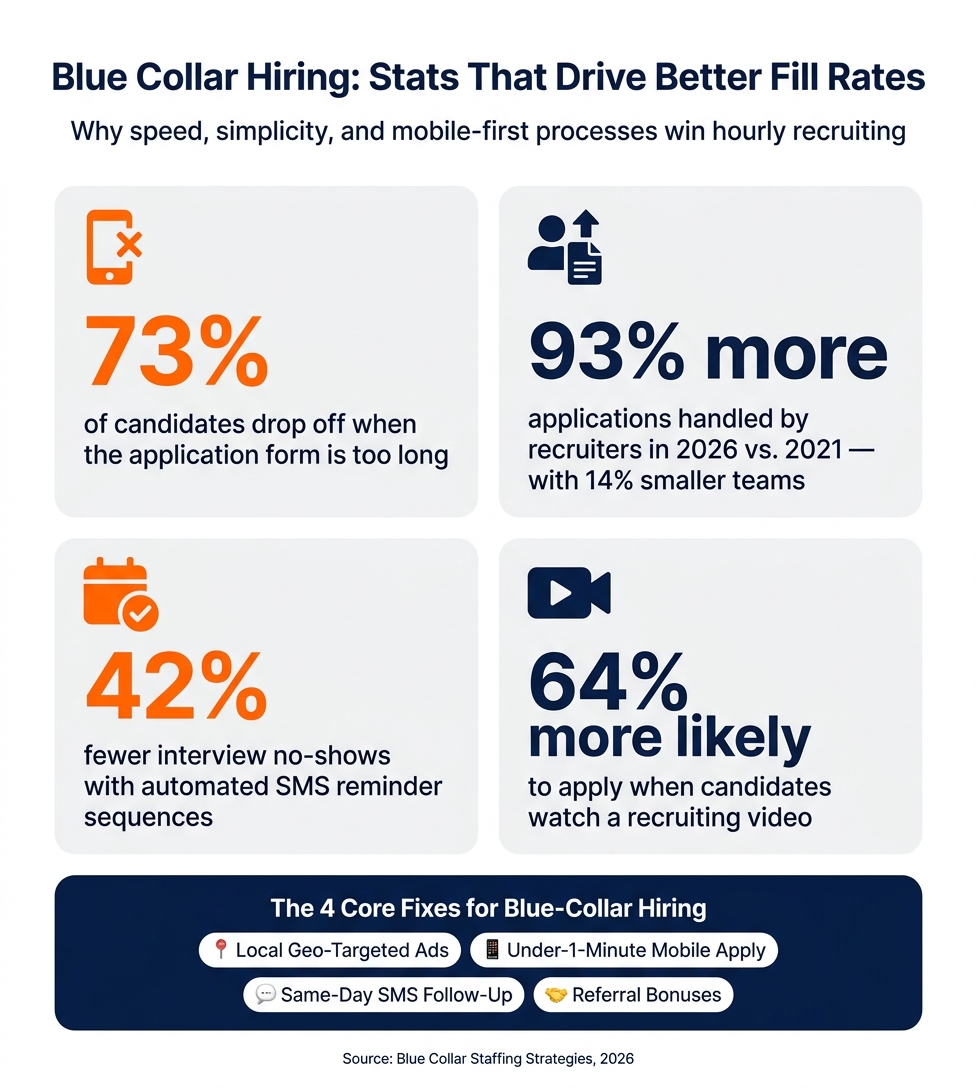
Blue Collar Hiring Stats: Why Speed & Simplicity Win
Industrial Trades Recruiting Process
Reach workers where they are: blue collar staffing starts with local reach
Many blue-collar candidates aren’t out there searching job boards every day. A lot of them are passive candidates, which means you need to reach them where they already spend time online.[1] Once you know where hourly workers are, the next move is simple: target by location and shift.
Use local job ads and geo-targeted campaigns
City-wide posts often burn money on people who live too far away to make the commute work. Radius targeting by ZIP code or city helps keep applicants inside a realistic commute zone, which can cut wasted clicks and help improve fill rate.[1]
A simple channel mix often works best:
For skilled trades and field roles, add QR codes and Text to Apply at job sites and branches. That makes it easier to pull in nearby workers fast.[2]
In September 2025, one U.S. construction company used QR-code applications and AI ranking to cut time-to-hire from 15 days to under 4 and double hiring capacity without adding recruiters. [2]
That same need for speed shows up in the application process too.
After the right workers see the ad, the headline needs to answer their first questions right away.
Write shift-specific ads that bring in the right applicants
Start with a job title that spells out the shift, pay, location, and start date. For example, 2nd Shift Forklift Operator – $24/hour – Dallas, TX – Start This Week tells workers what they want to know up front.[1][2]
If there’s a sign-on bonus, put it in the headline. So if the role offers $1,500, say that right away instead of hiding it in the description. A clear start date or bonus can improve response rates for volume roles.[1][2]
Make it easy to apply on mobile
Once your ad grabs attention, the application needs to carry that momentum forward. If the form feels long or annoying, people bail. In fact, 73% of candidates drop off when the form is too long.[1]
Reduce friction with short forms and text-to-apply
Keep the form tight. You only need enough details to qualify the person and get back in touch.
Ask for the basics:
- Contact info
- Eligibility to work
- Certifications
- Shift preference
However, anything extra can wait until later.
In addition, text-to-apply cuts friction even more. Instead of sending someone through a standard form, you let them start by text and answer a short SMS conversation one question at a time. It feels lighter, faster, and easier to finish on a phone. SMS-based applications also tend to move faster and get completed more often than standard mobile forms, cutting time-to-hire from weeks to days.[2]
Use landing pages built for hourly hiring
A short form works best when the page behind it is made for hourly applicants, not office hires. When someone taps a local ad or scans a QR code, the landing page should take them straight into the application flow.
A simple setup usually works best:
- Short mobile hiring application forms for most hourly roles
- Text-to-apply for high-volume trades
- QR codes for on-site hiring
HireLab.io lets you build mobile landing pages and smart forms without code.
Once the apply flow is this fast, the next step is keeping candidates engaged before they hit one of the common bottlenecks in a hiring funnel.
Use text and automation to keep candidates moving
Once someone applies, the clock starts in blue collar staffing. In blue-collar hiring, the first clear reply often gets the candidate. Slow follow-up gives them time to move on.
Set up same-day response with SMS follow-up
SMS meets candidates where they already are: on their phones. Send a text within minutes, answer basic questions right away, and include a self-scheduling link. That cuts out the back-and-forth and helps people move ahead fast [2].
There’s a practical reason this matters. In 2026, recruiters are handling 93% more applications with teams that are 14% smaller than in 2021 [1]. Without automation, it’s hard to keep response times short without wearing down your team.
Cut no-shows with reminders and easy rescheduling
Getting an interview on the calendar is only part of the job. People still miss interviews for simple reasons: they forget, get the time wrong, or aren’t sure what to bring. A three-touch reminder sequence helps:
- confirmation text right after booking
- day-before reminder
- same-day message with directions, parking details, and any needed PPE or documents
That small system can make a big difference. Automated reminders have been shown to reduce interview no-shows by 42% [2].
Rescheduling matters too. If a candidate can’t make it, a tap-to-reschedule link keeps the conversation alive instead of letting it die in silence [2].
SMS and automated scheduling beat manual and email-only follow-up for a simple reason: they move faster and help cut no-shows.
Fast follow-up keeps candidates moving; trust keeps them from dropping out.
Build trust with referrals and employer branding for hourly workers
Fast follow-up helps get candidates in the door. Trust is what gets them to stay.
And trust usually comes from simple proof: weekly pay, steady hours, safe sites, respectful supervisors, and a commute that makes sense. That’s what people want to know before they say yes.
So lead with proof, not vague culture talk. Use short videos from the actual worksite. Show real employees, real equipment, and what the job looks like day to day. That kind of direct proof matters. Candidates who watch a recruiting video are 64% more likely to apply [1].
Run referral programs workers will use
Referrals work for a simple reason: workers trust people on the job more than they trust ads. Employees are more trusted than company marketing, and their posts can reach more workers.
Keep the program easy to use. A split bonus often works well: part paid at 30 days, part at 90 days. For hard-to-fill shifts, use milestone payouts. And make referrals text-first so workers can send a name and number in seconds. A QR code at the worksite will often beat an HR portal.
A simple setup can look like this:
- One-time bonuses for high-volume roles
- Split bonuses for retention-sensitive roles
- Milestone payouts for hard-to-fill shifts
Conclusion: Blue collar staffing tactics that improve fill rates
These blue collar staffing tactics improve fill rates because they line up with how hourly workers make decisions. Geo-targeted local ads put openings in front of people who can actually get to the job. Mobile-first apply flows cut the friction that hurts conversions. SMS and automation keep candidates moving before they take another offer. Referrals, paired with clear job details, build the kind of trust that lifts both show rates and early retention.
You also don’t need a big team or a huge budget to do blue collar staffing well. A shorter application form, a same-day text, a referral bonus with a clear payout schedule, and a short worksite video can improve fill rates in a meaningful way. Small process changes, used consistently, add up fast. For broader labor-market context, the U.S. Bureau of Labor Statistics publishes occupational outlook data for trades and hourly roles.
FAQs
What should I fix first in blue-collar hiring?
First, fix your application process by removing friction. If it feels slow, repetitive, or clunky on mobile, you’re losing candidates before they even start.
Audit your recruiting pages and make sure they load in under 3 seconds and run smoothly on smartphones. Swap long forms for simpler multi-step versions with auto-fill and progress indicators. Then connect those forms straight to your ATS so applicants don’t lose their data and your team doesn’t waste time on manual entry.
How fast should we follow up with applicants?
Follow up fast. In a competitive blue-collar hiring market, speed matters because high-intent candidates can disappear fast.
Try to review applications within 48 hours and share feedback within 24 hours. Set clear internal deadlines too, including a final decision within two business days of the last interview.
A few simple steps can help keep things moving:
- Use automated reminders for your team
- Send text follow-ups to keep candidates engaged
What makes hourly workers trust a job offer?
Hourly workers trust a job offer when it feels real and dependable. They’re much more likely to believe what actual employees say than polished brand copy.
That trust grows when a job page spells out the details people care about right away: pay, schedules, what the work looks like day to day, how to get in touch, and clear signs the employer is legitimate. Fast, steady communication matters too. It gives people a direct sense of how the company treats its workers.