IT Staffing Agencies: What They Do and How to Choose One
If you need to fill a tech role fast, IT staffing agencies can cut search time, screen candidates, and help you choose the right hiring model. In this guide, I break down when to use one, how contract, contract-to-hire, and direct hire work, and what to check before you sign. That matters because many tech roles take 30 to 45 days to fill, and agency fees often run 15% to 25% of first-year salary.
Here’s the short version:
- I explain what IT staffing agencies do for both employers and job seekers
- I compare the three main hiring models: contract, contract-to-hire, and direct hire
- I show what to review before choosing an agency:
- specialization
- technical screening
- time-to-fill
- fees
- reporting
- communication
- I cover warning signs like:
- weak tech knowledge
- fuzzy screening steps
- hidden fees
- poor pipeline follow-up
- missing source data
- I point out key numbers that affect cost and speed:
- 30 to 45 days to fill many tech roles
- 10% to 15% more cost per hire for each extra week of delay
- 65% of applications now come through mobile
If I were picking an agency, I’d keep it simple: match the agency to the role, the hiring model, and the timeline. Then I’d ask for clear fee terms, proof of past placements, and a defined update schedule before moving forward.
Top 16 IT Staffing Agencies in 2026: Complete Guide
Quick Comparison
| Hiring Model | Best For | Cost Setup | Flexibility | Main Tradeoff |
|---|---|---|---|---|
| Contract | Short projects, urgent skill gaps | Hourly rate | High | Short-term fit only |
| Contract-to-hire | Roles where I want a tryout period | Hourly + possible conversion fee | Medium | May cost more if I convert |
| Direct hire | Permanent leadership or core team roles | 15% to 25% of first-year salary | Low | Higher upfront fee |
So if you’re hiring software engineers, cloud staff, DevOps talent, or security people, this article gives you a plain way to judge whether an agency is worth the cost.
What IT Staffing Agencies Do for Employers and Candidates
An IT staffing agency does more than fill open roles. It helps match each technical job to the right hiring model and the right group of people. These firms focus on tech roles like software developers, cloud engineers, cybersecurity analysts, and DevOps specialists. That focus matters because those jobs need different sourcing, screening, and qualification standards than non-technical roles. In practice, their work usually falls into two areas: support for employers and support for candidates.
Employer Services: Sourcing, Screening, and Pipeline Management
The work starts long before a resume shows up in your inbox. Agencies use Boolean search methods across GitHub, Stack Overflow, and LinkedIn to find technical talent that isn’t actively job hunting. That’s a big deal because many strong technical candidates never apply on their own.
After sourcing, agencies handle technical screening and give pay-rate guidance so employers can price roles with more accuracy. That can save a lot of back-and-forth later, especially when the market for a skill set is tight.
They also manage the candidate pipeline over time. If someone is strong but not the right fit today, a good agency doesn’t just drop the file and move on. It keeps that person warm for future openings instead of forcing the employer to start from zero every time.
Candidate Services: Matching, Preparation, and Placement Support
For job seekers, agencies do more than pass along a resume. They match candidates to contract or permanent roles based on specific skills, work preferences, and compensation targets.
They also help candidates get ready for interviews by sharing context on the hiring team, the tech stack, and what the role looks like day to day. That kind of prep can make a big difference. A job title might sound clear on paper, but the actual work can be a whole different story.
Agencies also keep strong but unselected candidates in their talent communities for future openings. That means a "no" today doesn’t always stay a no. Candidates may be revisited for similar roles later, so staying in touch with an agency after a rejection can still pay off. Those services change based on the staffing model, which matters next.
When an IT Staffing Agency Makes Sense
IT staffing agencies aren’t the right fit for every hire (see how staffing and recruiting companies differ), but they tend to make sense in a few cases:
- Urgent hiring needs – when a project needs technical help fast for a fixed timeline
- Hard-to-fill roles – cybersecurity jobs like SOC analysts or red team specialists where qualified candidates are scarce
- Recurring engineering team growth – where keeping a warm pipeline matters more than running one-off searches
IT staffing agencies matter most when speed, niche know-how, or a ready-to-move talent pool is critical. Next, compare contract, contract-to-hire, and direct-hire models.
IT Staffing Models and the Outcomes They Improve
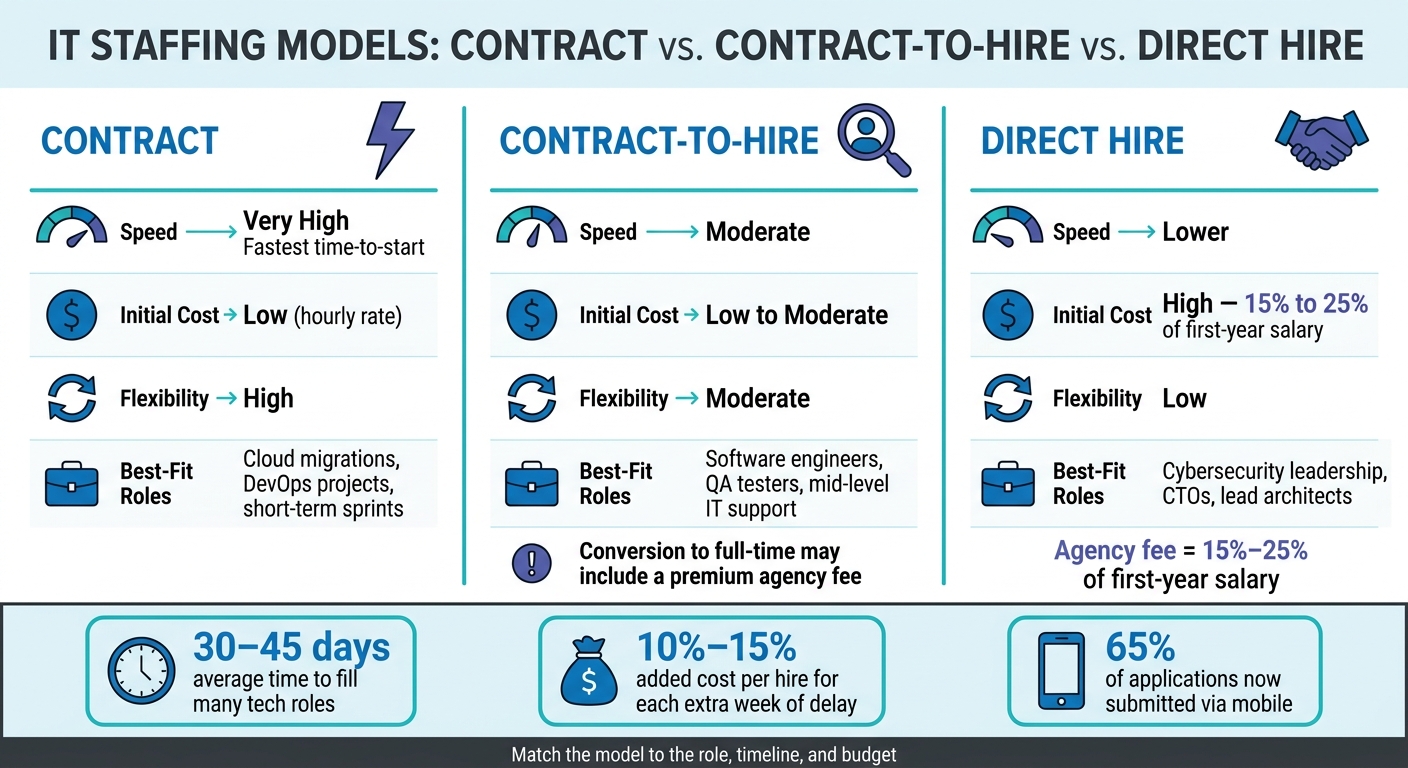
IT Staffing Models Compared: Contract vs. Contract-to-Hire vs. Direct Hire
Contract, Contract-to-Hire, and Direct Hire: How Each Model Works
Each staffing model makes a different tradeoff between speed, cost, and commitment. Picking the right model for the role matters just as much as picking the right agency.
Contract is the fastest option. You bring in a specialist for a set period, like a cloud migration, a DevOps project, or a development sprint, and pay an hourly rate. It works well when you need a specific skill set right away.
Contract-to-hire is basically an evaluation window. The person starts as a contractor, which gives your team time to judge technical performance and team fit before making a full-time offer. That can lower the odds of a bad hire. The catch is that converting the person to full-time often comes with a premium fee from the agency [1].
Direct hire makes the most sense for permanent, mission-critical roles like cybersecurity leaders, CTOs, or lead architects. It usually comes with the highest upfront fee, with agency commissions often landing between 15% and 25% of the candidate’s first-year salary [1].
| Model | Speed | Initial Cost | Flexibility | Best-Fit Roles |
|---|---|---|---|---|
| Contract | Very high | Low (hourly) | High | Cloud migrations, DevOps projects, short-term sprints |
| Contract-to-Hire | Moderate | Low to moderate | Moderate | Software engineers, QA testers, mid-level IT support |
| Direct Hire | Lower | High | Low | Cybersecurity leadership, CTOs, lead architects |
What Strong Agencies Improve in the Hiring Process
After you match the model to the role, the next step is simple: look at outcomes. A good agency should shorten the path from intake to interview. Why does that matter so much? Because every extra week added to time-to-hire can push total cost-per-hire up by 10% to 15% [2]. Delays don’t just slow things down. They get expensive fast.
Good agencies also cut down the interview load by pre-screening candidates before they ever reach your team. That means your hiring managers spend less time sorting through weak matches and more time talking to people who can do the job.
They can also reach passive candidates. That’s a big deal in specialized hiring, where the pool of qualified people is often small and the best candidates may not be applying at all.
How Agencies Fit Into Modern Recruitment Operations
Speed and fit matter, but measurement matters too. Agencies should plug into your recruiting workflow, including your applicant tracking system, in a way you can track.
One smart move is to use role-specific, mobile-friendly smarter recruitment landing pages for each agency campaign. That gives you a cleaner way to see which agency is bringing in qualified applicants and helps you track source of hire with more accuracy [3].
The mobile piece isn’t small. It’s a big part of the picture. 65% of applications are now submitted via mobile [5], so if those landing pages don’t work well on a phone, you’re making it harder for people to apply in the first place.
How to Evaluate and Choose an IT Staffing Agency
Define Your Hiring Requirements Before Talking to Agencies
Once you’ve picked the staffing model, the next step is choosing the agency. But before you reach out, get specific about what you need.
Define the role, required tech stack, seniority level, whether the job is remote or on-site, and your target start date. Also map out your total cost per hire. That includes hiring manager time, recruiter salaries, agency fees, and any job board spend. On top of that, budget for the cost of vacancy for each day the role stays open [1].
For hard-to-fill roles, ask for proactive outreach instead of job-board posting alone. And before the first call, split your list into must-haves and nice-to-haves. That one step can save a lot of back-and-forth later.
Once the role is clear, compare agencies based on fit, screening, speed, and cost.
Compare Specialization, Screening, Speed, and Fees
Not all IT staffing agencies do the same kind of work. Some focus on software development. Others lean into cloud, cybersecurity, DevOps, or contract-to-hire. The key is simple: match the agency’s main focus to the role you’re trying to fill, and our guide on how to choose a recruiting agency covers the broader basics.
A quick way to pressure-test an agency is to look at four things:
- Specialization: Do they place people in your exact technical area?
- Screening: Do they test candidates before submission, or just forward resumes?
- Speed: How long do they usually take to fill similar roles?
- Fees: What will the hire actually cost?
Technical screening is often the clearest signal of agency quality. Ask direct questions. Do they run technical interviews before they submit candidates? Do they use skills assessments, coding challenges, or structured evaluations? If an agency only reviews resumes, there’s a good chance your hiring managers will end up sorting through weak candidates.
| Criteria | What to Ask |
|---|---|
| Specialization | Do they regularly place candidates in your specific technical domain? |
| Technical Screening | Do they use live technical interviews, coding assessments, or structured evaluations before submission? |
| Speed | What’s their average time to fill similar technical roles? |
| Fee Model | Is it a flat fee or a percentage of salary (typically 15%–25%)? |
| Update Frequency | Will you get weekly updates and clear SLAs? |
For direct hire, the usual agency commission is 15%–25% of first-year salary [1]. For contract roles, you’re paying a markup on the hourly rate. Ask for total cost, conversion fees, and fee transparency upfront [1]. No one likes fee surprises halfway through a search.
Check Track Record, Reporting, and Partnership Fit
After pricing, move to proof. Ask the agency to show that it can deliver strong hires, not just fast resumes.
Request quality of hire data, post-hire retention rates, performance outcomes, and client references from companies like yours in industry or size. If they track post-placement results, ask to see them. Agencies that can point to measurable hiring outcomes are usually worth a closer look.
Partnership fit matters too. This comes down to response speed, feedback discipline, and day-to-day communication. A good agency should fit into your feedback process without friction. That said, it goes both ways. If your team takes a week to respond, even a good search can stall.
Set a 48-hour internal feedback rule to keep things moving. Then use that standard to judge whether the agency can match your pace.
Agency Selection Checklist, Red Flags, and Key Takeaways
Checklist for Shortlisting the Right Agency
Use the comparison criteria as a final go/no-go screen before you sign anything.
| Criteria | What to Confirm |
|---|---|
| Technical Specialization | Ask for recent fills in your exact stack. |
| Screening Process | Ask for the screening method and a sample assessment. |
| Hiring Model | Ask for written terms and contract-to-hire conversion fees. |
| Delivery Timeline | They can state average time-to-shortlist and time-to-fill for your role type. |
| Fee Transparency | Ask for all-in pricing, not just a base fee. |
| Communication Standards | Ask for update cadence and response SLA. |
| Proof of Results | They provide sample reports, source-of-hire data, and references from similar hires. |
Red Flags That Signal a Poor Fit
Even if an agency looks good on paper, a few warning signs can tell a different story.
One of the biggest issues is weak role knowledge. If an agency mixes up core technologies or can’t walk you through how it screens candidates, that’s a strong sign it doesn’t fully understand the jobs it’s trying to fill [4]. And if the screening steps stay fuzzy after you ask follow-up questions, that’s not a small issue. It’s a warning.
Pricing can trip teams up too. Hidden fees, vague terms, or contract-to-hire conversion fees that show up late in the process point to poor transparency [1][4]. On the candidate side, interview no-show rates above 10% or repeated drop-off late in the process usually mean the pipeline isn’t being managed well [1].
Weak partners don’t lighten the load. They add to it.
Another issue to watch is lack of reporting. If an agency can’t share source-of-hire data or sample reports, you have no clear way to see which channels are producing hires and which ones are wasting time [3].
Conclusion: Match the Agency to the Role, Model, and Hiring Goals
The right IT staffing agency isn’t the one with the biggest network. It’s the one that fits your role, hiring model, and technical standards. That means matching the agency to the work in front of you, whether you need contract, contract-to-hire, or direct hire help.
Teams that pair agency support with clear internal processes – like tight feedback loops and defined SLAs – often see better hiring outcomes [2]. The split is simple: the agency handles sourcing and screening, and your team handles decisions.
FAQs
How do I know if an IT staffing agency is worth the cost?
Calculate your total cost per hire by combining your internal hiring costs, like recruiter salaries and job ad spend, with the agency’s fees. Then compare that number with industry benchmarks. If your total is 20% above the median, there’s a good chance you’re spending too much or dealing with pipeline issues.
That said, a lower cost per hire isn’t always a win. If candidate quality slips or churn goes up, the cheaper hire can end up costing more. It also helps to look at the bigger picture: does the agency cut time-to-fill, bring in better candidates, and reduce the business cost of leaving roles open?
Which hiring model should I choose for my tech role?
Choose based on your role needs, timeline, and budget. Agency-driven hiring works well for specialized or high-stakes technical roles because it usually includes deeper screening and more hands-on candidate management. The tradeoff is simple: it often costs more.
In-house hiring can cost less for ongoing hiring, but it takes internal time and staffing to run well. And for high-volume, entry-level roles, automated screening can help cut cost-per-hire and time-to-fill.
What should I ask an IT staffing agency before signing?
Before you sign, ask a few direct questions.
Focus on:
- their specialization and track record for your technical roles
- their screening process, including performance-based assessments and human review
- their fee structure and expected timeline
- how they handle communication, data privacy, and candidate pipeline updates
It also helps to ask for examples of past placements in areas like cybersecurity or cloud roles. That gives you a clearer picture of whether they can handle the kind of hiring you need.
And be sure costs, timelines, and milestones are spelled out upfront. It saves headaches later.