IT Recruiting Agencies: What Sets the Best Apart
If you need to fill a hard tech role in the U.S., the best IT recruiting agencies usually stand out on one thing: can the hiring model bring you qualified people fast? With about 1.4 million open U.S. tech jobs and average tech hiring taking 66 days, delays cost money and can hurt offer acceptance.
I’d boil the article down to this:
- Specialist IT agencies tend to do best on passive candidate reach, technical screening, time-to-fill, and funnel reporting
- Generalist staffing firms can work for broader or lower-complexity hiring, but often lack depth for niche tech roles
- In-house teams know the company best, but may struggle with reach and hiring spikes
- RPO providers fit companies that need repeat hiring across many tech roles
- AI recruitment marketing platforms help at the top of the funnel, but they do not replace recruiter judgment
The main point is simple: if you’re hiring for senior, niche, or hard-to-fill IT roles, you should judge partners on candidate access, screen quality, hiring speed, and reporting clarity – not on resume volume.
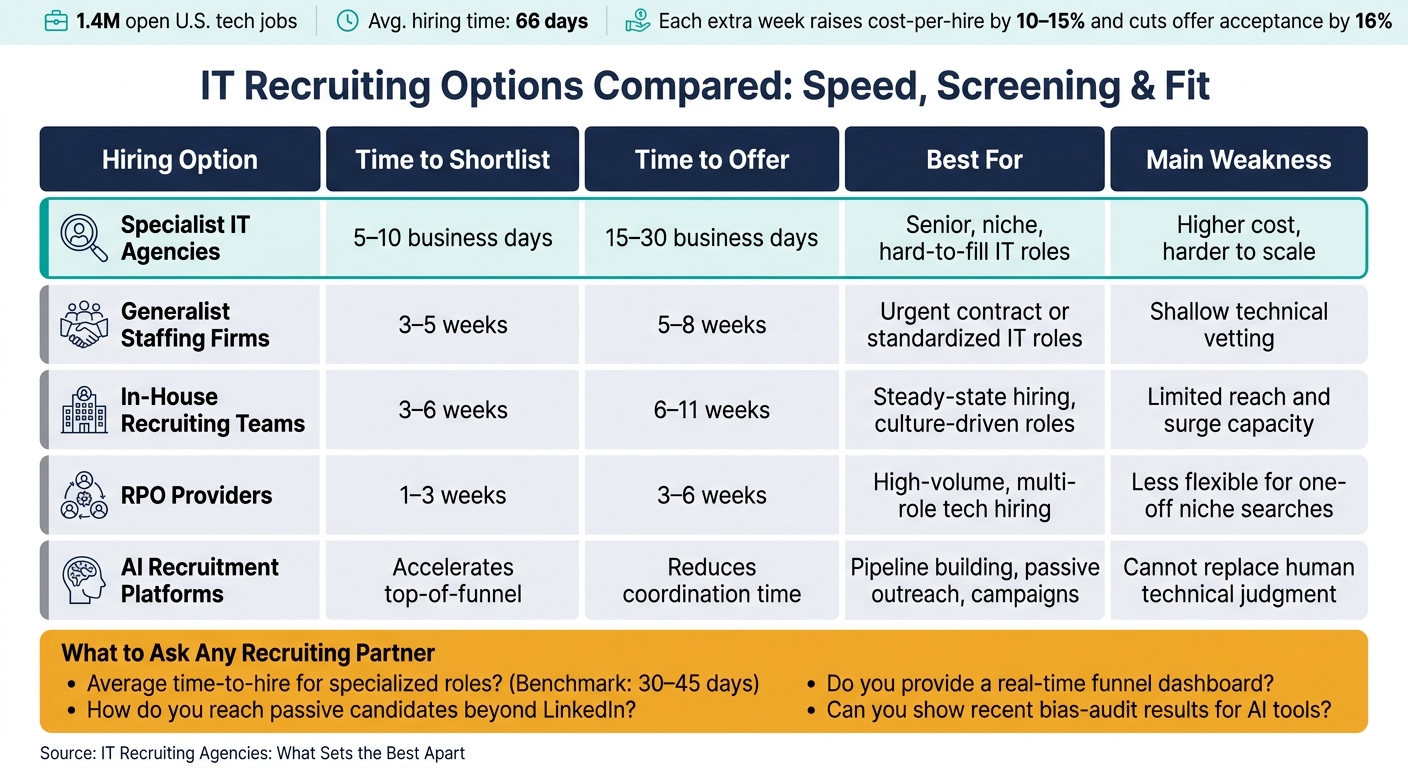
IT Recruiting Options Compared: Speed, Screening & Fit
Top Tech Recruiting Firms in the US (2026 Guide)
Quick Comparison
| Option | Best At | Main Limitation | Best Use |
|---|---|---|---|
| Specialist IT agencies | Niche sourcing, tech screening, faster searches | Higher cost, less fit for scale hiring | Senior and hard-to-fill roles |
| Generalist staffing firms | Broad coverage, fast volume hiring | Lower depth for niche IT work | Standardized or urgent hiring |
| In-house recruiting teams | Company knowledge, process control | Limited reach and bandwidth | Steady hiring needs |
| RPO providers | End-to-end recruiting at scale | Less fit for one-off niche searches | Multi-role growth hiring |
| AI platforms | Top-of-funnel traffic, apply flow, analytics | No deep human assessment | Pipeline building and campaign support |
If I were picking a partner, I’d ask for proof on 30–45 day hiring benchmarks, passive sourcing methods, live funnel data, and how they check technical fit before candidates reach the hiring manager.
1. Specialist IT recruiting agencies
Specialist IT recruiting agencies focus on hard-to-fill tech roles. That matters because they can reach passive candidates, screen skills with more care, and fill specialized roles in less time. You see the gap in how they build the recruitment funnel and how they filter it.
Passive talent access
These agencies keep warm pipelines of engineers, architects, and security candidates. So the search doesn’t begin from scratch every time. Instead of posting a role and waiting, or relying on basic recruitment advertising, they already know people who may be open to the right move.
Technical screening rigor
This is where specialist agencies often stand apart. They use role-specific technical assessments and structured recruiter screens to check skills before a candidate reaches the interview stage. That means hiring teams spend less time on basic skill checks and more time on fit, team match, and role scope.
Speed-to-hire
For senior roles, 30 to 45 days is a realistic target, and self-scheduling helps prevent candidate drop-off.[1] In plain terms, fewer back-and-forth emails can keep a strong candidate from going cold. Once speed improves, reporting can show where people still exit the process.
Brand and funnel analytics
Top specialist agencies track funnel velocity at each stage – application to screen, screen to interview, interview to decision, and decision to offer – so they can spot where candidates are dropping off.[1] They also track which channels and touchpoints lead to hires, not just applications.[2] That gives hiring teams a cleaner shortlist and a much clearer view of where the process is slowing down.
2. Generalist staffing firms
Generalist staffing firms cover a lot of ground, and that includes IT staffing. That broad reach can help when you need coverage across many job types. But there’s a catch: they often give up depth to get that range.
Compared with specialist IT agencies, generalist firms usually fall short in passive sourcing, technical screening, and reporting. That gap gets more obvious when the role is hard to fill or needs deep technical skill.
Passive talent access
Generalist firms tend to lean on active job seekers. In plain English, they spend more time on people who are already applying and less time in niche tech spaces where senior talent actually hangs out, like GitHub and Discord.
That makes passive outreach tougher, especially for specialized technical roles. If you’re trying to hire someone who isn’t looking for a job right now, that lack of access can slow things down.
Technical screening rigor
When a firm doesn’t focus on tech, the screening process often stays pretty basic. It may stop at resume review and simple skills checks.
As a result, more of the vetting lands back on your hiring team. So even if the agency sends candidates over, your internal team still has to do much of the heavy lifting to figure out who can actually do the job.
Speed-to-hire
Generalist firms can move fast for high-volume, entry-level hiring. In those cases, a 7–14 day time-to-hire is realistic.
That speed edge fades fast for specialized IT roles. Once the job calls for niche skills or more senior experience, general coverage doesn’t help as much, and hiring can slow down.
Brand and funnel analytics
This is usually the biggest weak spot. Most generalist firms track volume-based numbers like reach, clicks, and applications.
What they often don’t track as closely are hiring quality signals, such as:
- skills match
- source-of-hire
- on-the-job performance
Without source-of-hire tracking, employers can’t tell which channels bring in strong technical hires. That means less visibility into what’s working, what’s wasting time, and where qualified tech candidates are actually coming from.
That tradeoff matters most when employers want tighter control over technical hiring.
3. In-house technical recruiting teams
Unlike outside firms, in-house teams give up some market reach in exchange for tighter control and deeper company knowledge. That’s the big trade-off.
Their edge is simple: they know the company from the inside. They understand the culture, the tech stack, how the team works day to day, and what the role actually needs. The weak spot is reach. They usually don’t have the same broad network as an outside recruiting firm.
Passive talent access
In-house recruiters go after passive candidates through employer branding, social channels, and Boolean search on GitHub and Stack Overflow. They can also use role and stack filters to narrow the field fast.
But that only works when outreach is steady and the employer brand has pull. If the message is weak or the company isn’t getting attention, access dries up fast.
Technical screening rigor
Strong internal teams work with hiring managers to build role-specific assessments instead of relying on generic screens. Activision Blizzard, for example, developed a branded game-based test to evaluate developer skills, which cut screen-to-interview time by 7 days and improved candidate quality by 25%.[1]
That sets a high bar. Any top IT agency has to match or beat that level of screening.
Still, even a strong screen falls flat if hiring managers drag their feet.
Speed-to-hire
The biggest in-house bottleneck is usually manager feedback. Teams that enforce 48-hour SLAs cut delays and keep candidates moving.
HubSpot introduced 48-hour feedback SLAs tracked through internal dashboards, with missed deadlines escalated to HR leadership. That cut interview-to-offer time by 6 days and improved offer acceptance rates.[1]
It’s a good reminder that speed isn’t just about sourcing. It also comes down to how fast the people inside the company make decisions.
Employer brand and talent-pool analytics
In-house teams also have a strong advantage when it comes to re-engaging silver medalists and past applicants. With email and SMS, they can bring past candidates back into the process and fill roles from talent they already know.
Siemens used automated email and SMS sequences to re-engage silver medalist candidates, reducing time-to-hire by 10–14 days and filling 20% of open roles from existing talent pools.[1]
For employers, the real question is whether an outside partner can keep up with this level of context, control, and candidate re-engagement. A strong recruiting agency should be able to deliver the same mix of role knowledge, speed, and pipeline control.
4. RPO providers for tech hiring
RPO sits closer to an internal recruiting team than most outside partners. The difference is that you still get outside scale and process ownership. In practice, RPO providers plug into your hiring function and run tech recruiting end to end, from sourcing through offer.
That setup works best when a company needs repeatable hiring across several technical roles, not just one tough search.
Passive talent access
This is where RPO pulls away from specialist agencies. Instead of jumping in only after a requisition opens, RPO providers stay embedded and build ahead.
They often maintain segmented talent communities for priority skill sets months in advance. That includes employer-branded outreach, localized outreach, and role-specific talent communities built to connect with passive engineers, architects, and developers in a more targeted way.
Technical screening rigor
Strong tech RPOs don’t rely on generic screening templates. They build screening frameworks with input from engineering leaders, so the process lines up with the actual job.
That usually means structured competency models, role-specific assessments, and live coding environments tuned to the client’s stack. What sets mature RPOs apart is their quality control. They run quarterly scorecard tuning sessions with hiring managers, keep documented assessment blueprints for each job family, and audit interviewer feedback so evaluations stay consistent across remote and distributed teams.
Speed-to-hire
Because RPOs manage the full cycle inside your ATS and HR systems, they remove many of the handoff delays that slow external agencies down.
When scheduling, status updates, and candidate communication are automated, the hiring cycle gets shorter. It’s less stop-and-start, and more like one team moving through one process.
Brand and funnel analytics
Another area where RPOs stand out is analytics depth. Leading providers build custom dashboards that track source-of-hire, screen pass rates, offer acceptance, and cost-per-hire in USD. They break that data out by role, seniority, and U.S. region.
Then they use those numbers to tighten application forms, adjust compensation, cut interview steps, or refine role messaging. That kind of reporting shifts hiring from a reactive process to one that’s measured and controlled.
5. AI-enabled recruitment marketing platforms such as HireLab.io
AI-enabled recruitment marketing platforms don’t replace recruiters. They handle the top of the funnel: branded landing pages, social ads, application flows, and analytics that turn job posts into full campaigns.
That matters because it gives agencies and hiring teams better pipeline quality, faster response times, and cleaner reporting. For top IT hiring teams, recruiting starts to look less like a pile of separate requisitions and more like a measurable campaign.
Passive talent access
These platforms help teams reach engineers who aren’t actively applying. Instead of waiting for the right person to stumble across a job post, recruiters can use targeted social campaigns, retargeting, and nurture flows to stay in front of the right audience.
Teams can segment candidates by:
- skill stack
- seniority
- location
- prior engagement
Then they can promote the right roles to the right people. HireLab.io supports mobile-friendly branded landing pages, smart forms, and integrations with Meta and LinkedIn to turn interest into applications.
Technical screening rigor
Top-of-funnel automation only works when early qualification stays tight. This is where these platforms help most, but there’s a limit.
Smart forms, knockout questions, skill tags, resume parsing, and automated scoring can screen out clear mismatches before a recruiter steps in. That’s useful for speed and focus. But for role-specific technical depth, human validation still matters. These tools are strong at early qualification, not deep technical judgment.
Speed-to-hire
Automation and nurture sequences can cut the time it takes to get the first qualified response and reduce manual sourcing work. Recruiters spend about 13 hours per week sourcing manually for a single role[4], so this layer can save a lot of time at the start of the funnel.
That said, slow interview cycles still put a hard cap on total time-to-fill. If the back half of the hiring process drags, the gains up front only go so far.
Brand and funnel analytics
Once the funnel is live, measurement becomes the control point. The best platforms track impressions, click-through rate, apply-start rate, apply-completion rate, cost per applicant, source quality, and engagement by audience segment.
That makes it easier to see which messages bring in qualified applications and where drop-off begins. In plain English: you can tell what’s working, what’s leaking, and what needs fixing.
That reporting shapes channel selection, message testing, and application flow updates, so this layer stays tied to what sets the best IT hiring teams apart.
What the Best IT Recruiting Agencies Actually Do Differently
The best IT recruiting agencies pull ahead in four places: passive talent access, screening quality, hiring speed, and analytics. That’s where the gap shows up in day-to-day hiring, especially when the role is hard to fill.
Passive Talent Access
Top IT agencies don’t wait for a job to go live before they start building candidate relationships. They spend time in niche communities, keep tabs on GitHub, lean on referral networks, and stay close to conference circles. That gives them a much better shot at reaching passive candidates, not just the people already applying.
Generalist staffing firms cast a much wider net, but the reach is often shallow. They tend to do better with active candidates than with narrow technical searches.
| Option | Passive Sourcing Approach | Effectiveness for Niche IT Roles |
|---|---|---|
| Specialist IT Agencies | Niche communities, GitHub, referral networks, conference pipelines | High |
| Generalist Staffing Firms | Job boards, broad LinkedIn searches | Low to Medium |
| In-House Teams | Employer brand-driven outreach, internal network | Medium (company-specific) |
| RPO Providers | Programmatic advertising, scaled outreach | High volume, variable depth |
| AI Platforms (e.g., HireLab.io) | Branded landing pages, Meta/LinkedIn campaigns, retargeting, smart forms | Strong enabler |
HireLab.io helps agencies and employers turn passive interest into applications with targeted LinkedIn recruitment funnels and branded recruitment landing pages.
Technical Screening Rigor
This is another spot where specialist firms tend to separate themselves. They usually screen candidates with role-specific assessments run by engineers or technical recruiters. That matters because a résumé can say all the right things and still miss the mark once you dig into stack fit, depth, or hands-on skill.
Generalist firms, by contrast, often lean on keyword matching or basic skills tests. That can work for early filtering, but deeper vetting usually lands back on the hiring team.
| Option | Screening Depth | Consistency |
|---|---|---|
| Specialist IT Agencies | Advanced (stack-specific, led by engineers or technical recruiters) | High when structured scorecards are used |
| Generalist Staffing Firms | Basic (keyword matching, basic skills tests) | Variable |
| In-House Teams | High when engineering managers are involved | Inconsistent due to bandwidth |
| RPO Providers | Standardized skills assessments | High (process-driven) |
| AI Platforms (e.g., HireLab.io) | Smart forms and role-specific screening questions | High for early-stage filtering |
Speed-to-Hire Performance
Speed is where process quality becomes easy to spot. Specialist agencies with pre-qualified pipelines often deliver shortlists in 5–10 business days and help move roles to offer in 15–30 business days for hard-to-fill positions.[5][6]
| Option | Typical Time to Shortlist | Typical Time to Offer |
|---|---|---|
| Specialist IT Agencies | 5–10 business days | 15–30 business days |
| Generalist Staffing Firms | 3–5 weeks | 5–8 weeks |
| In-House Teams | 3–6 weeks | 6–11 weeks |
| RPO Providers | 1–3 weeks | 3–6 weeks |
| AI Platforms (e.g., HireLab.io) | Accelerates top-of-funnel response | Reduces manual coordination time |
Of course, that kind of speed doesn’t come from sourcing alone. It also depends on how cleanly the interview process runs once candidates enter the funnel.
Brand and Funnel Analytics
Analytics is what turns hiring activity into something you can measure and improve. Without it, teams may know they’re getting applicants but not why one role converts well and another stalls out.
| Option | Analytics Depth | Brand Alignment |
|---|---|---|
| Specialist IT Agencies | Funnel conversion, time-in-stage, offer acceptance | Strong employer brand strategy |
| Generalist Staffing Firms | Basic volume reporting | Limited client-specific branding |
| In-House Teams | Varies by tooling; often siloed | Strongest brand authenticity |
| RPO Providers | Enterprise-level SLA and ROI reporting | Shared brand |
| AI Platforms (e.g., HireLab.io) | Branded pages, A/B testing, recruitment funnel analytics | Strong enabler |
HireLab.io’s A/B testing and advanced analytics give agencies and employers a clearer view of which messages, channels, and application flows convert candidates.
Those tradeoffs shape which hiring model makes sense for a given role, budget, and hiring volume.
Pros and Cons of Each Option
Each hiring model works in a different situation. Push it outside that lane, and it starts to crack. So the real question isn’t which option sounds best on paper. It’s which one clears your biggest hiring roadblock.
| Option | Strengths | Weaknesses | Best-Fit Scenario |
|---|---|---|---|
| Specialist IT Agency | Deep technical network, rigorous screening | Expensive and harder to scale | Niche full-time engineering searches, senior or principal roles, executive search |
| Generalist Staffing Firm | Broad reach, weaker technical depth | Lighter technical vetting | Urgent contract hiring, hybrid roles, more standardized IT roles |
| In-House Recruiting Team | Strong brand control, limited capacity | Limited surge capacity | Steady-state hiring, core engineering team building, culture-driven roles |
| RPO Provider | Scales well, but less flexible for specialized roles | Weaker candidate experience for niche hires | High-volume tech hiring, sustained growth programs, rapid expansion |
| AI-Enabled Platform (e.g., HireLab.io) | Improves reach and measurement, but still needs human review | Still needs human recruiters for assessment and stakeholder management | Employer brand building, passive candidate outreach, high-volume digital recruiting |
You can see those tradeoffs most clearly in cost, speed, and control. Specialist agencies usually cost more because they’re brought in for roles that are tough to fill. In-house teams move spending into fixed overhead, which can make sense when hiring stays steady. AI-enabled platforms can cut cost-per-application at the top of the funnel, but they don’t replace human judgment when it’s time to judge technical fit.
In practice, the best setup is often a mix. Use in-house recruiting for core roles, bring in specialist agencies for hard searches, and run AI campaigns to keep the pipeline active. Put simply: match the model to the role, not the vendor list.
The right setup depends on role type, hiring volume, and how much control the employer wants to keep.
Conclusion
For hard-to-fill IT roles, the best partners stand out in four areas: passive candidate access, technical screening, speed, and reporting. The real test is simple: can they prove those strengths before the hire and after the placement?
The firms worth taking seriously tend to share a few must-have traits. They go past job boards to reach passive candidates, use strict technical screening, and track quality of hire, source of hire, and offer acceptance, not just time-to-fill.[3][1] That matters because slow hiring gets expensive fast. Each extra week in the process can push cost-per-hire up by 10% to 15% and cut offer acceptance by 16%.[1]
Use these questions to cut through polished sales talk and see what a partner can actually deliver:
- What is your average time-to-hire for specialized technical roles? (Strong benchmark: 30–45 days)[1]
- How do you reach passive candidates who aren’t active on LinkedIn or job boards?
- Do you provide a real-time dashboard showing live funnel status and timestamped submissions?
- Can you show recent bias-audit results for your AI tools?
A partner that answers with specific data, clear examples, and direct proof is worth a closer look.
FAQs
How do I choose the right IT recruiting model?
Choose the right IT recruiting model by balancing speed, cost, and candidate quality.
Start by finding the bottlenecks in your process. In many teams, that means manual resume screening, slow interview scheduling, or both. Those slowdowns add up fast, especially when hiring demand picks up.
For high-volume roles, automation can help move things along and cut busywork. But for senior or specialized technical roles, a mixed approach tends to work better. Let AI handle repeat tasks, then bring in human review where judgment matters most.
Pay close attention to clear hiring metrics, such as time-to-hire and offer acceptance rates. Those numbers give you a plain view of what’s working, what’s dragging, and where your recruiting model needs a tune-up.
What metrics should I ask an IT agency to prove?
Ask your IT agency to show proof, not just activity.
You want funnel metrics and quality metrics that tell you whether hiring is working from end to end. That includes:
- Qualified candidates per opening
- Time-to-hire and stage conversion rates
- Application-to-interview and interview-to-offer ratios
- Offer acceptance rate (around 90%+)
- Cost per hire (with a baseline of about $4,700) and ROI
That gives you a clearer picture of what’s happening. Are they sending enough people? Are those people a good fit? And are offers actually getting accepted? Without those numbers, it’s hard to tell if the agency is helping or just filling the top of the funnel.
You should also ask which sources perform best. In plain terms: where are the strongest candidates coming from, and which channels lead to interviews, offers, and hires instead of just clicks or applications?
If the agency uses AI screening, ask for a tighter set of checks:
- Precision
- Recall
- Time-to-screen
- Adverse impact ratios
- Pass rates by protected group
Those metrics matter because speed alone doesn’t mean much if the screening process filters out strong people or creates bias. If they use AI, they should be able to explain how well it works, how fast it works, and whether it treats groups fairly.
When does AI help most in tech hiring?
AI is most useful when hiring teams have to work through a large stack of applications in a short time. It can handle resume parsing, pre-screening, early rankings, scheduling, and candidate questions, which speeds up the top of the funnel.
It also helps improve precision with semantic analysis and natural language processing. That gives recruiters more time to focus on candidate relationships and final decisions, especially for hard-to-fill roles.