How to Evaluate Staffing and Recruiting Firms
When I evaluate staffing and recruiting firms, I judge them on five things: fit for my roles, candidate quality, hiring speed, total cost, and legal risk. That’s the short answer.
If I skip a set review process for staffing and recruiting firms, I’m more likely to pick based on a sales pitch instead of results. And that gets expensive fast: each extra week a role stays open can push cost per hire up by 10% to 15%, average time-to-fill is about 44 days, and agency-supported hiring often lands around $6,000 to $10,000 per hire.
So before I choose among staffing and recruiting firms, I’d make sure I can answer these questions:
- Do they fill roles like mine on a regular basis?
- How do they source people beyond job boards?
- How do they screen, score, and move candidates through the process?
- What do their numbers look like for time-to-fill, retention, and manager satisfaction?
- What will I pay in total, not just in agency fees?
- Can they work with my ATS, scheduling, and reporting setup?
- How do they handle compliance, worker classification, and background checks?
The main idea: I’d compare all staffing and recruiting firms with the same checklist and the same metrics. That gives me a clean side-by-side view of who can deliver qualified candidates, on time, at a cost I can justify.
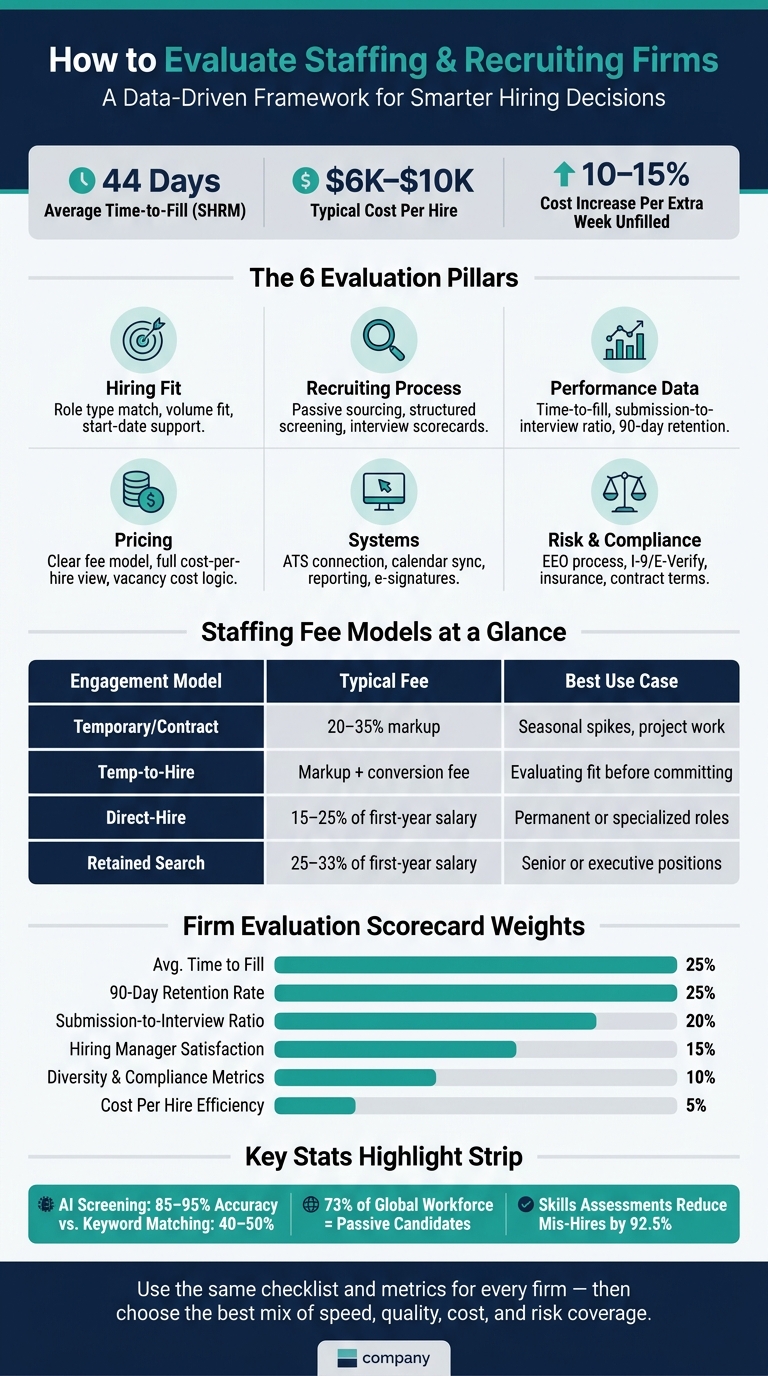
How to Evaluate Staffing & Recruiting Firms: Complete Scorecard Framework
10 Questions to Ask Before Choosing a Staffing Agency | Avoid Costly Hiring Mistakes in 2026
Quick Comparison of Staffing and Recruiting Firms
| What I review | What I want to see |
|---|---|
| Hiring fit | Role type match, hiring volume fit, start-date support |
| Recruiting process | Passive sourcing, structured screening, interview scorecards |
| Performance data | Time-to-fill, submission-to-interview ratio, 90-day retention |
| Pricing | Clear fee model, full cost-per-hire view, vacancy cost logic |
| Systems | ATS connection, calendar sync, reporting, e-signatures |
| Risk checks | EEO process, I-9/E-Verify handling, insurance, contract terms |
I’d use this framework to narrow my list of staffing and recruiting firms, score them the same way, and choose the one that gives me the best mix of speed, quality, cost control, and risk coverage.
1. Define Your Hiring Needs Before You Compare Firms
Start by getting clear on what you need to hire, and on how staffing and recruiting companies differ. That gives you a steady baseline when you compare staffing and recruiting firms. Without it, it’s easy to get pulled in by polished sales language instead of actual delivery.
List Your Role Types, Volume, and Timelines
Write down the details for every open role: seniority, location, work model, target start date, and expected hiring volume. Then match each role to the right engagement model.
- Temporary/contract works well for coverage gaps, project work, or headcount that still feels uncertain.
- Temp-to-hire gives you a measured path before making a long-term call.
- Direct-hire fits permanent roles with a clear long-term mandate.
If you’re hiring across multiple states or for remote roles, address compliance early. The firm should understand those requirements up front, not halfway through the search.
Set Your Target Metrics and Budget Ranges
Once your role list is in place, define the KPIs you’ll use to measure each firm’s performance. At a minimum, set targets for time-to-fill, retention rate, and manager satisfaction. SHRM reports an average time-to-fill of about 44 days [4], which gives you a solid benchmark. That number helps you judge whether a firm’s claims sound grounded or just polished.
Budget planning should be just as concrete. Fee structures usually vary by engagement model [5][6].
| Engagement Model | Typical Fee Structure | Best Use Case |
|---|---|---|
| Temporary/Contract | 20%–35% markup | Seasonal spikes, project work, leave coverage |
| Temp-to-Hire | Markup plus a conversion fee that declines over time | Evaluating fit before a permanent commitment |
| Direct-Hire | 15%–25% of first-year base salary | Permanent, specialized, or leadership roles |
| Retained Search | 25%–33% of first-year base salary | Senior or executive-level positions |
Use this baseline to compare staffing and recruiting firms on fit and value, not the pitch.
Next, compare staffing and recruiting firms on specialization, sourcing methods, and candidate quality.
2. Assess Core Recruiting Capabilities and Candidate Delivery
Once you’ve set hiring targets and budget, the next step is simple: find out whether the firm can send qualified candidates on time.
Check Specialization, Recruiter Expertise, and Sourcing Methods
However, big promises don’t mean much on their own. You need a firm that already works on the same kinds of roles, seniority levels, and markets you hire for.
For example, ask a direct question: How many roles like ours have you filled in the past 12 months, and what were the results? If they can’t point to clear examples, that’s a signal in itself.
Sourcing depth matters just as much. A good firm doesn’t rely only on job boards. It should also use:
- outreach to passive candidates
- social recruiting
- maintained talent pools
And there’s a practical detail you shouldn’t skip. Since 78% of job seekers use smartphones, ask whether the firm’s landing pages are mobile-friendly and connected to its ATS [7].
In addition, ask for role-specific scorecards and structured interviewing frameworks.
Once the specialization lines up, look at how steadily the firm screens candidates and keeps communication moving.
Review Screening Rigor, Candidate Quality, and Communication Standards
Specialization helps, but it only pays off if the firm screens well and keeps candidates from slipping out of the process.
A strong process should include structured interviews, skills-based assessments, and behavioral signal tracking. Skills-based assessments alone can reduce mis-hires by 92.5% [7]. Ask the firm to walk you through its process from intake to offer. Then push a bit further: how do they deal with declined offers, candidate drop-off in the middle of the process, or a weak first shortlist? Firms with mature systems should have documented answers for all three.
It also helps to confirm they have SLAs for candidate updates and interview feedback within 48 hours.
You’ll also want to ask whether they use AI screening or basic keyword matching. That difference is a big one. Keyword matching is only 40%–50% accurate and often misses good candidates who use different terms. AI-powered screening that uses NLP reaches 85%–95% accuracy and shows stronger predictive accuracy than keyword matching [7]. That gap has a direct effect on the shortlists that land in your inbox.
3. Compare Metrics, Fees, Contracts, and Technology
Once you’ve checked a firm’s niche focus and screening process, it’s time to get more objective. Move past gut feel and look at numbers, pricing, and written terms.
Request Performance Data and Build a Comparison Scorecard
Ask every firm on your shortlist for the same metrics. That’s the only way to make a fair side-by-side comparison. Start with one small but important point: ask whether the firm reports time to hire or time to fill, because they don’t mean the same thing. Then ask for funnel metrics like application-to-screen, screen-to-interview, interview-to-decision, and offer-to-acceptance [1].
The most useful data points to request include:
- Average time to hire or time to fill by role type
- Submission-to-interview ratio
- 90-day retention for temp and contract placements
- Hiring manager satisfaction scores
- Diversity and compliance metrics
- Cost per hire efficiency
Use benchmarks by role, not one blended average. A firm might look good on paper overall but fall short for the jobs you need most. And if it can’t explain how those benchmarks are tracked, that’s a warning sign.
You should also ask where candidates are coming from. Request source-of-hire and channel-attribution data so you can see which channels bring in qualified people. If a firm is leaning on the same job boards your team already uses, there may not be much extra value there. That matters even more when 73% of the global workforce consists of passive candidates who aren’t actively searching on standard job boards [3].
Once you have the numbers, build a weighted scorecard. Give more weight to the factors that matter most to your business.
| Evaluation Criteria | Weight | Firm A Score | Firm B Score |
|---|---|---|---|
| Avg. Time to Fill (vs. benchmark) | 25% | ||
| 90-Day Retention Rate | 25% | ||
| Submission-to-Interview Ratio | 20% | ||
| Hiring Manager Satisfaction | 15% | ||
| Diversity and Compliance Metrics | 10% | ||
| Cost per Hire Efficiency | 5% | ||
| Total | 100% |
If the data checks out, the next step is simple: look at what each firm charges and what’s included in that price.
Break Down Fee Models and Total Cost in Plain Terms
Fee models can look simple at first glance, but the headline number rarely tells the whole story. Whether a firm quotes a percentage fee, a markup, or something else, ask what you’re paying for and what costs extra.
| Cost Component | What It Can Include |
|---|---|
| Internal costs | Recruiter salaries, hiring manager time, ATS tools |
| External costs | Agency commissions, job board fees, background checks |
Ask for total cost per hire, including both internal and external costs. Agency fees usually range from 15% to 25% of first-year salary, and sometimes go as high as 30% [2].
You should also ask for a vacancy cost estimate. A slow hiring process doesn’t just drag on; it gets expensive. Each added week of time to hire can increase total cost per hire by 10% to 15% and cut the odds of candidate acceptance by 16% [1]. For example, a 20-day delay in filling a sales role with a $1 million annual quota can cost about $54,000 in lost potential revenue [1].
Put response-time expectations in the contract. If speed matters, it needs to be written down.
Then look at the tools behind the process.
Check Technology Stack and Workflow Integration
Tech only matters if it helps candidates move faster and keeps your team in the loop. Ask whether the firm can send candidates straight into your ATS and whether it supports calendar sync, APIs, and single sign-on (SSO) [1].
The main features worth checking include self-scheduling, automated reference checks, digital offer management with e-signatures, and AI-powered matching [1].
| Integration Category | Essential Features |
|---|---|
| Sourcing | Multi-board posting, social sharing |
| Engagement | SMS, WhatsApp, email integration |
| Evaluation | AI matching, skills testing |
| Administrative | Calendar sync, SSO, APIs |
| Post-Hire | E-signatures, background checks |
If the firm runs recruiting campaigns, ask how it tracks assisted conversions across social, email, and SMS instead of relying only on last-click attribution [2]. That detail can tell you a lot about how it measures performance behind the scenes.
4. Verify Compliance, Risk Controls, and U.S. Legal Alignment
Strong performance data and solid tech are good signs. But they don’t erase legal risk. Before you sign anything, do a basic compliance and risk review.
Confirm Employment Law, Worker Classification, and Screening Practices
Ask how the firm documents EEO compliance, candidate consent, data privacy, and adverse-action notices when a candidate is rejected.
If you’re hiring temporary or contract workers, get clear on two points: who handles worker classification, and who takes the hit if that classification is wrong.
You should also confirm that the firm can manage Form I-9 and E-Verify when required. On top of that, make sure it follows state-specific background-check rules. A firm may look polished on the surface, but this is where small gaps can turn into big problems.
Review Insurance, Incident Handling, and Contract Protections
Request proof of insurance. Then ask for a replacement guarantee, a cancellation clause, and written responsibility for misclassification or compliance incidents.
The contract should also spell out reporting duties and service-level expectations. That includes how fast the firm will notify you if something goes wrong. Don’t settle for vague language here. Require specific contract terms in writing.
Once the compliance details and contract terms are clear, you can narrow your list of staffing and recruiting firms and interview each one using the same checklist, as covered in our guide to choosing a recruiting agency.
5. Build a Shortlist, Interview Staffing and Recruiting Firms, and Make Your Final Decision
Use your shortlist to see which staffing and recruiting firms can back up what they say in a live interview. Then use those answers to check fit – not who gives the smoothest pitch.
Use a Standard Interview Checklist for Every Firm
If you want a clean side-by-side comparison, ask each firm the same questions. That keeps the process objective and makes scoring much easier. In every conversation, cover these areas:
- Recent placements: Ask for examples of roles like yours.
- Time-to-fill: Ask for benchmarks tied to the specific role.
- Sourcing methods: Ask whether they use targeted paid job ads. Firms that do can cut cost-per-application by up to 85% and improve applicant quality by 33% [7].
- Screening steps: Ask what happens between sourcing and submittal – skills tests, structured interviews, and reference checks.
- Reporting cadence and feedback speed: Confirm how often they report and what data they share. Also ask how they keep the process moving, including candidate feedback within 48 hours of an interview [1].
Score every firm on the same scale. Put more weight on the outcomes that matter most, like 90-day retention and hiring manager satisfaction.
Select a Firm and Set Post-Launch Review Points
Pick the firm with the strongest score and the best fit – not the lowest fee.
Once the work starts, review median and 90th-percentile time-to-hire every two weeks, assign owners with a RACI, and require interview feedback within 48 hours. Keep using the same scorecard so performance stays visible.
FAQs
How many staffing and recruiting firms should I compare?
Compare a small shortlist of staffing and recruiting firms so you can look at each firm closely. One smart way to do that is to run pilots or trial projects with a few shortlisted firms, then get feedback from recruiters and hiring managers.
That gives you a clear side-by-side view before you commit to a full partnership. Instead of stacking up too many options, keep your focus on a tight group of highly qualified firms and compare their track records, technology, and fit with your company culture.
What red flags should I watch for?
Watch for security and compliance gaps like no end-to-end encryption, weak access controls, thin audit logs, missing MFA, weak security audits or certifications, or fuzzy terms around data processing and incident response.
You should also keep an eye on AI screening that runs like a black box. That means no transparency, no human review, no bias testing, and no clear way for candidates to opt out or appeal.
Then there are plain old process problems. Ghosting, slow feedback, unclear ownership, too many approvals, or clunky tools can all create friction and lead to candidate drop-off.
How long should I test a firm before deciding?
Use a trial period of 14 to 30 days. In that window, run real candidate workflows so your team can spot slowdowns, check recruiter communication, and judge candidate quality.
That gives you enough data to compare the firm’s performance against your hiring goals before you commit for the long haul. It also helps you confirm that the firm’s process fits your current systems and produces results you can measure.